1 Oct 2013 | Events
FEATURING SARAH BROWN IN CONVERSATION WITH HELEN LEWIS (New Statesman)
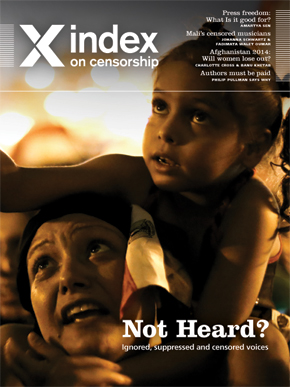
Join us in the heart of an inner London school community to launch the Autumn magazine with its special report on suppressed, ignored and censored voices – spotlighting silenced groups from around the world.
Join Sarah Brown in conversation with Helen Lewis, see an exclusive preview of They Will Have To Kill Us First the upcoming documentary from award-winning film-maker Johanna Schwartz, and catch Wail Gzoly’s startling Egyptian street photography.
Spirited debate, invigorating art and a free drinks reception at Lilian Baylis, a tiny but brilliant comprehensive school in the shadows of Westminster.
@IndexEvents – #notheard
When: Tuesday 15th October, 6:30 reception, 7:00-8:00pm event.
Where: Lilian Baylis School, SE11 5QY (Map/directions)
Tickets:Free, registration is required as space is limited.
19 Sep 2013 | Europe and Central Asia, Greece, News
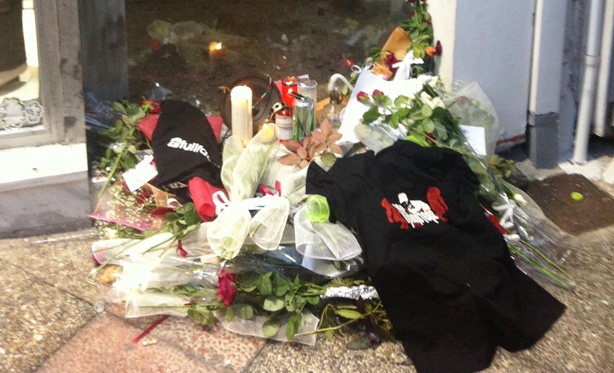
Tributes to murdered activist Pavlos Fyssas (pic: Christos Syllas-Dellis)
Thousands of protesters gathered on Wednesday evening in Athens near the place where Pavlos Fyssas, a 34 year-old antifascist hip hop artist was murdered by a Golden Dawn supporter.
“The blood is running, it seeks revenge”, they shouted, a slogan echoing the December 2008 riots , when 15 year-old student Alexandros Grigoropoulos was killed by two policemen.
The 45 year-old man who carried out the stabbing has told police that he was a supporter of far-right party Golden Dawn. This was clearly a politically motivated killing, added to a sequence of intimidation events and attacks carried out by Golden Dawn against immigrants and asylum seekers.
On 17 January, Shehzad Luqman, an immigrant worker from Pakistan was lethally stabbed by two men. Police later found pre-election pamphlets of Golden Dawn in the house of one perpetrator.
In December 2012, Amnesty International reported on this issue. In addition, Human Rights Watch has found that there is evidence connecting the attackers on immigrants with members of or affiliated with far-right groups such as Golden Dawn.
No matter how useful these findings may be, they were clearly not at the “agenda” of the rally at Keratsini. Young and old antifascists, together with immigrants, have been increasingly struggling with Golden Dawn vigilantes in the past five years. The murder of Fyssas comes as no surprise. A lot of people somehow anticipated the tragic event.
“The regime, in co-operation with Golden Dawn is clearly escalating the confrontation with political dissidents. This is why we’re here today. And we have to step up the intensity of this political struggle. Everywhere,” said a demonstrator, local resident of Keratsini.
Some 3,000 – 4,000 members of an organised anarchist block was heading towards Golden Dawns’ offices in Nikaia, while at the same time, demonstrators attacked Keratsini’s police station. Almost instantly clashes began: Riot police squads tried to disperse groups of demonstrators with the typical use of excessive force.
In an alley, the head of a police squad was heard shouting “Come on, let’s go and fuck them up”. Middle-aged people from the neighborhood curesed them, while young antifascists threw Molotov cocktails and stones.
Keratsini district, a working class neighborhood, was established after Greek refugees fled Asia Minor on 1922. The greater area of Piraeus (Nikaia, Perama, Keratsin), known for its anti-Nazi struggle, was historically affiliated with the political left.
This picture though seems to be fading away. According to polling company “Public Issue”, Golden Dawn has doubled its electoral influence on these areas. Moreover, it has worked its way on socially penetrating existing political views.
On June 2012, Egyptian fishermen were attacked in Perama after an inflammatory and racist speech by Golden Dawn MP Yannis Lagos, who said that the party would hold them accountable for their actions. A few days ago, again in Perama, members of the Communist Party (KKE) were brutally attacked by Golden Dawn’s supporters while putting up posters for an upcoming festival.
Last nights’ clashes have led to a total of 130 detentions and 34 arrests while tweeters were reporting a demonstrator had been heavily injured by a direct teargas shot. Questions about the way police responded at the place of the assassination remain unanswered. Witnesses on TV broadcasts this morning said that police were reluctant to involve at the fight before the stabbing.
There were protests against the murder throughout the country. Latest reports suggest that there have been discussions on emergency legislation to ban Golden Dawn’s acts.
This article was originally published on 19 Sept 2013 at indexoncensorship.org
3 Sep 2013 | Middle East and North Africa, News, Sudan
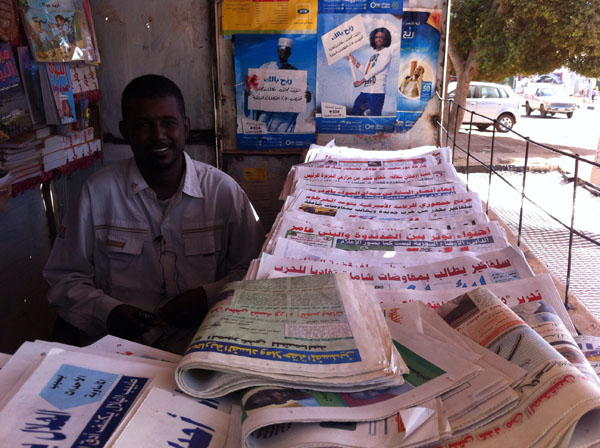
Photo: Usamah Mohammed
Three Sudanese columnists were prevented from writing by the National intelligence Security Services (NISS) after they condemned the Muslim Brotherhood in Egypt. Journalists Salah Awooda, Zuhair Elsrag and Rishan Oshi were banned from writing for between five to fifteen days during August after criticizing the Islamist group. This is part of a growing trend in Sudan for opinion columnists to be targeted by Government censorship, rather than newspapers.
Awooda, who works for the pro-government newspaper Alkir Lahza, was removed from his desk after he suggested that the Sudanese government’s criticism of the Egyptian military was hypocritical, as they also came to power via a military coup.
“They have suspended me because I condemned their contradictions about Egyptian events and claimed that they have acted as if they are democratic people,” Awooda says.
He also pointed out that the Sudanese government and its allied Islamists groups have organised demonstrations in front of the Egyptian embassy in Khartoum protesting against military action against the Brotherhood. Moreover, the official Sudanese media and others aligned with the Government have waged a campaign against the military intervening in politics in Egypt.
“I’m just surprised how they talk about legitimacy and democracy in Egypt,” he added, “while they undertook a military coup against the democratically elected government in Sudan in 1989 and they didn’t apologise to the Sudanese people for what they did. This is double standards”.
Awooda has been suspended on three occasions over the last two months, without any legal basis, following telephone calls by NISS agents to his editor-in-chief. The columnist was barred from writing for a month, and then for a further two days, after he criticized Government censorship. He was then detained for 15 more days without any apparent cause. In 2010, Awooda’s appointment as editor-in-chief of independent daily newspaper Aljareeda was blocked despite his considerable experience as editor-in-chief of three newspapers.
“They have stopped me three times since last July without giving any official reasons” he says. “They just suspend writers according to their mood without any legal basis in NISS regulations or the current constitution.”
Sudanese journalists have been engaged in a long running battle with the government over press freedom. 15 independent and anti-government newspapers have been closed in recent years. Since 2011, about 15 columnists have been prevented from working by NISS, though some have been allowed to return to their jobs after being suspended. Five have gone on to write for web publications but now the government is preparing a new law on electronic media which may lead to further harassment. In September 2009 the Sudanese Constitutional Court in Sudan rejected an appeal brought by a group of journalists, writers and columnists against newspaper censorship by NISS.
In a report on freedom of speech published in May by the organisation Journalists for Human Rights (JHR), the Sudanese government is accused of continuing to restrain press freedoms. It noted that the Sudanese government, via the NISS, has started to put pressure on individual columnists leading to their suspension, rather than targeting newspapers as they used to.
“There are many reasons for this,” says Faisal Mohamed Salih, a Khartoum columnist and winner of the Peter Mackler Award for ethical journalism. “For a long time the NISS restrained the news and other types of journalism as they controlled the newspapers but they moved their attention to the columnists because they have become stars. Readers prefer to get their information in opinion columns instead of the news stories.
“The NISS has succeeded in controlling newspapers but they couldn’t do it with the columnists because they are not employees of the newspapers, unlike the journalists, and can publish information that journalists couldn’t do” Faisal adds.
Yassin Hassan Bashir, another columnist who has been stopped from writing, thinks that the columns are an easier target for NISS censors compared to essays and investigative stories, simply as they are quicker to read.
“Because they are shorter than other type of journalism,” Bashir says, “they can read them more easily. You sometimes find the same opinions in longer, more difficult investigative stories, but they ignore it. They are not aware enough to evaluate the longer or more complex articles or they are too lazy to read them all”.
Aldooma argues that while government censors still target newspapers, they do so less than in the past. As the nature of journalism in Sudan changes to more opinion journalism than news and investigative journalism columnists will be increasingly targeted.
14 Aug 2013 | In the News
#DONTSPYONME
Tell Europe’s leaders to stop mass surveillance #dontspyonme
Index on Censorship launches a petition calling on European Union Heads of Government to stop the US, UK and other governments from carrying out mass surveillance. We want to use public pressure to ensure Europe’s leaders put on the record their opposition to mass surveillance. They must place this issue firmly on the agenda for the next European Council Summit in October so action can be taken to stop this attack on the basic human right of free speech and privacy.
(Index on Censorship)
ANGOLIA
Analysis: Angola illustrates the dangers of criminal defamation laws
South African media reacted nervously when a former Sowetan journalist was found guilty this week of criminal defamation. This was not an over-reaction, if the example of Angola is anything to go by. Do we really want to be taking media management lessons from José Eduardo dos Santos?
(Daily Maverick)
AUSTRALIA
Public servants and free speech
On Monday, August 13, Canberra public servant Michaela Banerji lost a case in the Federal Circuit Court before Judge Neville, which has paved the way for her possible dismissal from the Department of Immigration.
(The Conversation)
BAHRAIN
Bahrain activists to test demo ban at U.S. embassy
Bahraini opposition activists, inspired by the success of street protests in Egypt, plan to demonstrate near the U.S. embassy on Wednesday in defiance of a government ban.
(The Daily Star)
BRAZIL
U.S.-Brazil relations face ‘challenge’ under dark cloud of NSA leaks
The United States pledged on Tuesday that Brazil and other allies will get answers about American communications surveillance aimed at thwarting terrorism, but gave no indication it would change the way it gathers such information.
(The Globe and Mail)
EGYPT
Press Freedom at Risk in Egypt
Hopes for press freedom were high after the 2011 revolution ousted Hosni Mubarak, led to an explosion of private media outlets, and set the country on a path to a landmark presidential election. But more than two years later, a deeply polarized Egyptian press has been battered by an array of repressive tactics, from the legal and physical intimidation of Mohamed Morsi’s tenure to the wide censorship of the new military-backed government. A CPJ special report by Sherif Mansour with reporting by Shaimaa Abu Elkhir from Cairo
(CPJ)
FRANCE
Twitter in hot water again in France – this time, for Homophobic Hashtags
The problem with giving into the requests of the government is that, well, you have to follow through. After an altercation with a few advocacy groups and the French government over some anti-Semitic trending hashtags earlier this year, Twitter promised to provide a streamlined access for users ( & the government) to signal inappropriate content. They also suggested that they would be turning over account information of users who use hate speech on the social network so that the French government can pursue those users for violating France’s free speech laws.
(Rude Baguette)
RUSSIA
In Russia only tyrants’ names change
The news out of Russia never seems to be new. The names change, not the essence. Nor does the reaction of Russia-watchers: a deep, hopeless, wordless sigh. As if to say: What’s to be said? Ah, Russia!
(Boston Herald)
Olympic athletes who promote ‘non-traditional sexuality’ will be arrested
Athletes at the Winter Olympics will be arrested if they breach Russia’s controversial ‘gay propaganda’ laws, the country’s interior ministry has confirmed.
(Metro)
Previous Free Expression in the News posts
Aug 13 |Aug 12 |Aug 9 |Aug 7 | Aug 6 | Aug 5 | Aug 2 | Aug 1 | July 31 | July 30 | July 29 | July 26 | July 25 | July 24 | July 23 | July 22 | July 19
