11 Nov 2022 | Egypt, Ruth's blog, United Kingdom, United States
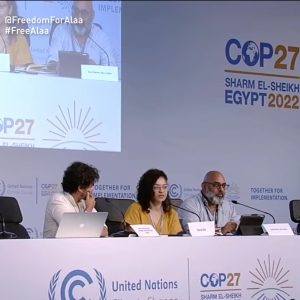
Sanaa Seif, the sister of Egyptian writer and activist Alaa abd el-Fattah, speaking at COP27
It shouldn’t surprise anyone reading this that I care passionately about freedom of expression. I have dedicated my life to political engagement and campaigning and have used every right afforded to me under article 10 of the Human Rights Act as I have sought to fix problems in our society.
At Index I spend every day seeking to ensure that those people who are silenced by despotic regimes have a platform for their words and their art. I speak to journalists and stakeholders daily about threats to freedom of speech at home and abroad. After all, Index was founded to protect this most fundamental of human rights everywhere it is threatened.
But there are some weeks when even I am surprised by the scale of news coverage of freedom of speech. Especially in the UK. It increasingly feels like the phrase freedom of speech is dominating political debate as well as the comment pages in our mainstream media. Of course I welcome every mention and the truth, in an age of disinformation, trolling and political populism, is that we need a national conversation about how language, speech and debate need to be protected and cherished as our communication tools evolve and develop.
But in the last week I’m not sure that’s what we’ve seen. I want a debate about freedom of speech and expression. About how to protect and promote media, artistic and academic freedoms. Instead what we have seen is journalists arrested, in the UK, for doing their job and covering the news. We’ve seen an elected politician denounce media outlets for having the audacity to cover protests.
On the international stage we’ve seen a social media platform used by millions of people change dramatically on the whim of a billionaire within a matter of days of his taking ownership. World leaders attending COP27 in Egypt failing in all efforts to intervene in the case of Alaa Abd el-Fattah, a democracy campaigner, imprisoned because he dared to support a political protest. And in the US we’ve once again seen too many politicians undermining the very basis of their democracy as a political tool.
We deserve so much better than this.
We deserve more than political rhetoric about free speech while populists seek to hijack their own definition of free speech for political gain.
We deserve more than token diplomatic gestures when people are rotting in prison for having the audacity to demand their basic human rights.
We deserve more than our police forces arresting journalists and undermining media freedom because they seek to cover the news.
We deserve better. And Index will keep demanding better – at home and abroad.
4 Nov 2022 | Egypt, Middle East and North Africa, News
The 2022 United Nations Climate Change Conference, or COP27 as it is better known, opens this Sunday, 6 November, in the Egyptian Red Sea resort of Sharm El Sheikh.
As has become customary, COP27 will become the focus of protest. Yet not all protests at COP27 will be about the environment.
One protester at the event, Sanaa Seif, says that the world leaders attending will have “blood on their hands” if they do not secure the release of her brother, the British-Egyptian writer and activist Alaa Abd El-Fattah. Abd El-Fattah is a pro-democracy activist and founder, with his wife Manal Hassan, of the Arabic blog aggregator Manalaa. He has been held in the country’s prisons on and off for nine years for his part in the 25 January protests that rocked the country in 2011.
In 2013, the writer was jailed by the government of Egypt’s military ruler Abdel Fattah el-Sisi and has been in prison most of the time since where he has been both tortured and offered only limited communication with his family.
In order to bring attention to his plight, Abd El-Fattah went on a partial hunger strike on 2 April this year, limiting his intake to just 100 calories a day, sipping tea with a spoonful of honey. After six months on hunger strike, his body is seriously weakened and his health is in a precarious state. Four days ago, he stopped even that meagre daily allowance and is now taking only water.
On the opening day of COP27, he will stop even that.
Since 18 October, Sanaa and her sister Mona, have been holding a sit-in as part of their Free Alaa campaign outside the UK’s Foreign Commonwealth and Development Office to draw the attention of incoming Foreign Secretary James Cleverly to their brother’s plight.
On Wednesday this week, Cleverly finally spoke to the pair and vowed that the Government would “continue to work tirelessly for his release”.
In a Facebook post, the sisters said: “We were so relieved to finally get to speak to James Cleverly and hear his assurance that Alaa’s safe release is top priority. I hope this translates to tangible action that actually saves Alaa before it is too late.”
At a press conference on the street outside the FCDO the following day, Sanaa said: “Alaa will escalate his hunger strike as he stops taking water as world leaders head to Egypt to attend COP27. I want to tell these officials that if you don’t save him you will have blood on your hands. I want to call on Rishi Sunak – you are going to be in the same land as a British person dying and if you don’t show that you care then it will be interpreted as a green light to kill him.”
Sanaa’s sister Mona added: “Alaa is in a very critical state but he is not desperate to die. These are the actions of a man who is desperate to end this ordeal he has been sucked into for nine years and desperate to be reunited with his family.”
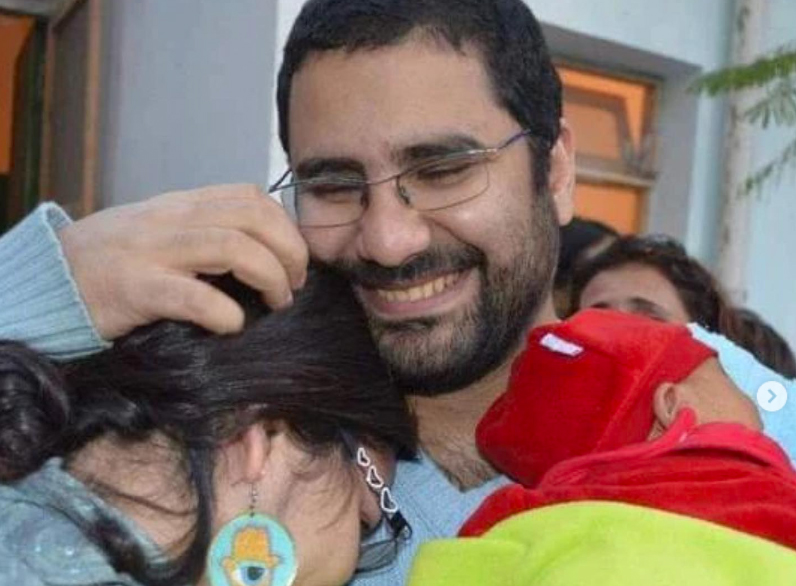
The British-Egyptian writer and activist Alaa Abd El-Fattah in happier times with his wife and baby son Khalid
Speaking to Index, Mona said: “In the eyes of the Egyptian regime Alaa is one of the symbols of 25 January [2011 revolution] and therefore one of those calling for an end to the leadership of the military regime. In some people’s minds he is a British national. For others he is a writer, or an activist. Most importantly, he is an amazing brother and a son. And most importantly of all what seems to be forgotten is that he is a father to a 10-year-old, Khalid.”
She added: “Khalid and his father have a unique and extraordinary relationship. Khalid is on the autistic spectrum and is non-verbal. We found out his diagnosis back in 2014 when Alaa was serving his first five sentences. Alaa was briefly released in 2019, although he had to spend every night in a police cell, and Alaa and Khalid formed an amazingly strong bond. We were worried about how Khalid would receive his father because he was not used to him in his life. We were honestly surprised. He and Khalid bonded immediately. He flourished under Alaa’s presence and Khalid’s doctors and teachers all noted a massive difference.”
“When Alaa was taken again in September 2019, the one hit the hardest was Khalid. When Alaa appeared before the state security prosecution, Khalid was angry with his father for disappearing. Since then, it has been particularly difficult to sustain Alaa’s presence in Khalid’s life. A very big part of why Alaa has taken such extreme measures is that he feels Khalid has been orphaned.”
Mona and family will hold a candlelit vigil for Alaa outside Number 10 Downing Street at 4pm on 6 November. Meanwhile, Sanaa will fly out to Egypt to take part in an event with the German climate envoy, Human Rights Watch and Amnesty International at COP27 next Tuesday.
“This will serve as an embarrassing reminder to everyone,” Sanaa said.
Mona has another message to the leaders attending COP27. In another Facebook post this week, she wrote the following.
“Regardless of how it ends Alaa has already won this battle. If he makes it out alive and joins us, his family, in safety. Then he would have done it using only his body and words. If he doesn’t make it and dies in prison, his body will tell the whole world what a bunch of liars you all are, ruthless inhumane creatures that should not be trusted with one plant let alone people and the future of this planet.
15 Oct 2022 | Middle East and North Africa, News, Saudi Arabia, United Kingdom
Rt. Hon. James Cleverly MP
Foreign Secretary
Foreign, Commonwealth and Development Office
King Charles Street
London
SW1A 2AH
United Kingdom
15 October 2022
Dear Foreign Secretary,
On behalf of the below signed organisations, we would like to congratulate your appointment as Secretary of State for Foreign, Commonwealth and Development Affairs. At a time of significant global uncertainty and unrest, the UK can and must play a leading role in promoting human rights globally. While we appreciate the wide and diverse range of issues facing you and your department, we are contacting you today to draw your attention to the treatment of political prisoners in Saudi Arabia who have been imprisoned for expressing themselves.
The Specialized Criminal Court (SCC), established in 2008 to try those suspected of acts of terrorism, has instead administered disproportionate sentences, including the death sentence, to people solely for expressing themselves online. Cloaked in the language of cybercrime, this has effectively criminalised free expression and has also been brought to bear against individuals outside of Saudi Arabia.
You will have heard about the shameful case of Saudi national Salma al-Shehab, who was a student at the University of Leeds at the time of her alleged ‘crimes’ – sharing content in support of prisoners of conscience and women human right defenders, such as Loujain Alhathloul. For this, upon Salma al-Shehab’s return to Saudi Arabia, she was arrested and held arbitrarily for nearly a year, before being sentenced to 34 years in prison with a subsequent 34-year travel ban. The fact that the sentence is four years longer than the maximum sentence suggested by the country’s anti-terror laws for activities such as supplying explosives or hijacking an aircraft demonstrates the egregious and dangerous standard established both by the SCC and the Saudi regime to restrict free expression. It also further illustrates the Saudi government’s abusive system of surveillance and infiltration of social media platforms to silence public dissent.
But the actions aimed at Salma al-Shehab did not happen in isolation. In fact, her sentencing is the latest in a longstanding trend that has seen the Saudi judiciary and the state at-large being co-opted to target civil society and fundamental human rights. The same day that al-Shehab was sentenced, the SCC sentenced another woman, Nourah bint Saeed Al-Qahtani, to 45 years in prison after using social media to peacefully express her views. Ten Egyptian Nubians were sentenced to up to 18 years in prison after they were arrested and detained – for two months they were held incommunicado and without access to their lawyers or family – after organising a symposium commemorating the 1973 Arab-Israeli war. Dr Lina al-Sharif was arbitrarily detained for over a year following her social media activism after a group of agents of the Presidency of State Security raided her family home and arrested her without a warrant. A worrying dimension is the use of violence and torture to coerce confessions, as well as ongoing persecution or surveillance following a prisoner’s release, further eroding the legitimacy of the SCC and its verdicts.
The UK’s close relationship with Saudi Arabia should not bind your hands to upholding human rights commitments and calling out violations when they are brought to your attention, particularly, in the case of al-Shehab, where they relate to the application of Saudi legislation for actions that took place within the territory of the United Kingdom. In fact, this relationship places you in a strong position to call for the release of all prisoners unlawfully held in Saudi Arabia without delay.
Acting definitively so early in your tenure would be a powerful symbol both to our allies and others that the UK can be a trusted protector of human rights and the rule of law.
We await your action on this important issue and further support the calls to action outlined by over 400 academics, staff and research students from UK universities and colleges in a letter authored to you and the Prime Minister.
If you require any more information we would be happy to organise a briefing at a time that works best for you.
Kind regards,
Index on Censorship
ALQST For Human Rights
SANAD Organisation for Human Rights
CIVICUS
Electronic Frontier Foundation
Gulf Centre for Human Rights (GCHR)
SMEX
Vigilance for Democracy and the Civic State
Access Now
Human Rights Watch
PEN International
English PEN
Front Line Defenders
IFEX
