Love Matters is an international multimedia platform that encourages young people to discuss love, sex and relationships. Launched first in India, Love Matters focuses on regions where discussions about sexual and reproductive health is censored or taboo, and their content is available in English, Hindi, Arabic, Spanish and Mandarin Chinese. Their aim is to offer young people a space to learn and ask questions they can’t ask elsewhere.
“There are a lot of myths and misconceptions based on religious or cultural perceptions that make it very difficult to speak openly about love, sex and relationships,” Stephanie Hasse, coordinator of Love Matters Africa, told Index.
The idea was first piloted in India in 2011. Love Matters India has now had more than 12 million visits and they have over 700,000 followers on their Facebook page.
“Talking about sex and anything related to sex continues to be a taboo in India,” said Vitikha Yadav, coordinator at Love Matters India. “People continue to live in shame and silence with respect to sexual health issues.”
Last year Love Matters India launched a campaign called BearNoMore targeting intimate partner violence among young unmarried couples. The campaign was run online, through their website and social media channels, and offline through film screenings in three villages of Rajasthan, each attended by over 1000 people.
“The response was amazing,” said Yadav. “We reached about two million people in two months.”
“That really encouraged discussions about intimate partner violence. It was a different kind of campaign, had huge engagement and was something that was not looked at by any organisation before, so it was hugely empowering for us as well.”
Love Matters Arabic covers the Middle East and north African region, with a specific focus on Egypt. To mark their first anniversary, the group held a stand-up comedy event in Cairo on love, sex and relationships. “We created a new space to talk about this sensitive subject in public,” Michele Ernsting, head of the Love Matters Global Project, explained to Index.
“Love Matters Arabic is actually the only dedicated platform in the Arabic language that discusses sexual health and sexual health of young people, in their own language. That’s why it’s unique,” Abir Serras, coordinator of Love Matters Arabic told Index.
Love Matters Africa launched the Love Matters Music Awards: the first music awards in Kenya dedicated to providing young people the chance to produce songs on themes related to pleasure and sexuality.
“In the region that Love Matters Africa works in, topics around love, sex and relationships aren’t easily discussable,” said Hasse.
“Young people often don’t have the information they need when it comes to making choices about their sex lives. That has to do with the fact that sexual health education is missing at schools, or it’s focused on abstinence only,” she said.
“Last year in May we ran a special campaign for International Day Against Homophobia and Transphobia, trying to make the topic more discussable.”
Across all their platforms, Love Matters now has over 100 million page views. “We now have persuasive data to show how to improve the effectiveness of sexual health education by directly addressing the uncensored needs of young people,” said Ernsting.
“It has been wonderful to see Love Matters to scale up to all these countries and in really challenging settings where the need of this work is immense,” Vitikha Yadav said of the impact that Love Matters has had on young people. “We are hoping to reach out to many more millions in the country and many more across the world.”
[vc_row][vc_column][vc_custom_heading text=”This year brings the 400th anniversary of William Shakespeare’s death and Index on Censorship is marking it with a special issue of our award-winning magazine, looking at how his plays have been used around the world to sneak past censors or take on the authorities – often without them realising.”][vc_row_inner][vc_column_inner width=”1/2″][vc_column_text]
Our special report explores how different countries use different plays to tackle difficult themes. Hungarian author György Spiró writes about how Richard III was used to taunt eastern European dictators during the 1980s. Dame Janet Suzman remembers how staging Othello with a black lead during apartheid in South Africa caused people to walk out of the theatre.
Kaya Genç tells of a 1981 production of A Midsummer’s Night Dream in Turkey that landed most of the cast in jail. And Brazilian director Roberto Alvim recountshis recent staging of Julius Caesar, which was inspired by the country’s current political tumult. The issue also includes contributions from Simon Callow, Tom Holland, Preti Taneja and Kathleen E McLuskie. Plus we explore Shakespeare’s ability to provoke and protest in India, Zimbabwe and the USA. Currently Shakespeare is very much in favour in China and our contributing editor Jemimah Steinfeld explores why.
Shakespeare aside, we have Hollywood screenwriter John McNamara on why his film on blacklisted screenwriter Dalton Trumbo nearly didn’t make it to the big screen. There are interviews with US academic Steven Salaita and Syrian playwright Liwaa Yazji. We look at how one man from New Zealand has been hacking North Korea for years. And we explore Index’s archives on Argentina’s dictatorship, 40 years after the coup, with interviews from former prisoners and descendants of the disappeared.
The issue also includes new fiction from Akram Aylisli, one of Azerbaijan’s leading, and persecuted, writers. Plus lyrics from Egyptian musician Ramy Essam, famed for his performances in the Tahrir Square revolution, and Basque protest singer Fermin Muguruza. And there are illustrations and cartoons by Martin Rowson, Ben Jennings,Eva Bee and Brian John Spencer.
Order your copy here, or take out a digital subscription via Exact Editions (just £18 for the year, with a free trial). Copies are also available in excellent bookshops including at the BFI and Serpentine Gallery (London), News from Nowhere (Liverpool), Home (Manchester) and on Amazon. Each magazine sale helps Index on Censorship fight for free expression worldwide.
Rising star – Jemimah Steinfeld on how China has embraced Shakespeare, with performances spanning from brash pro-government productions to a Tibetan Hamlet
When the show doesn’t go on – Jan Fox reports on why school and community theatre productions in the US are under increasing pressure to curb “controversial” themes
The Bard meets Bollywood – Suhrith Pathasarathy looks at how India’s films use Shakespeare to tackle controversy
Lifting the curtain on Zimbabwe – While Shakespeare’s tales of power play and ageing rulers get the go-ahead, local playwrights struggle to be heard, says playwright Elizabeth Zaza Muchemwa
Lend me your ears – Claire Rigby interviews leading Brazilian director Roberto Alvim about tackling his country’s current political turmoil through Julius Caesar
Theatre of war – Charlotte Bailey interviews Syrian playwright Liwaa Yazji
Beyond belief – Ryan McChrystal looks at whether Ireland’s new government will finally phase out the country’s blasphemy law
Exposing history’s faultlines – Vicky Baker explores the Index archives for stories of Argentina’s dictatorship 40 years on, and talks to those who were affected
Rainbow warriors – Duncan Tucker reports on the attacks and killings of LGBT activists in Honduras
Hack job – Sybil Jones interviews Frank Feinstein, who monitors the North Korean propaganda machine
“They worried I’m dangerous. I’m absolutely harmless” – Nan Levinson speaks to US academic Steven Salaita who lost his job after posting controversial tweets
Tools and tricks for truthseekers – Alastair Reid and Peter Sands on why people need to learn verification techniques to combat hoaxes and misinformation on social media
Your television is watching you – Jason DaPonte explains how information stored by internet-connected home devices could be used against us
Tackling Trumbo – Hollywood screenwriter John McNamara on how his story about blacklisted writer Dalton Trumbo almost didn’t make it to screens
[/vc_column_text][/vc_column][/vc_row][vc_row][vc_column][vc_custom_heading text=”SUBSCRIBE” css=”.vc_custom_1481736449684{margin-right: 0px !important;margin-left: 0px !important;border-bottom-width: 1px !important;padding-bottom: 15px !important;border-bottom-color: #455560 !important;border-bottom-style: solid !important;}”][vc_column_text]Index on Censorship magazine was started in 1972 and remains the only global magazine dedicated to free expression. Past contributors include Samuel Beckett, Gabriel García Marquéz, Nadine Gordimer, Arthur Miller, Salman Rushdie, Margaret Atwood, and many more.[/vc_column_text][vc_row_inner][vc_column_inner width=”1/2″][vc_single_image image=”76572″ img_size=”full”][/vc_column_inner][vc_column_inner width=”1/2″][vc_column_text]In print or online. Order a print edition here or take out a digital subscription via Exact Editions.
Copies are also available at the BFI, the Serpentine Gallery, MagCulture, (London), News from Nowhere (Liverpool), Home (Manchester), Calton Books (Glasgow) and on Amazon. Each magazine sale helps Index on Censorship continue its fight for free expression worldwide.
It’s hard for many of us to imagine, but all around the world, people are being intimidated out of playing music. Here is a list of some musicians who have been prevented from expressing themselves freely so far in 2016.
Ahmet Muhsin Tüzer, Turkey
The Turkish musician was denied permission to perform in Portugal by Turkey’s Directorate of Religious Affairs, according to several news media, on 1 March 2016. His performance at the Serralves Museum in Porto had been approved by Turkey’s Cultural Ministry before the Diyanet, Turkey’s religious enforcement authority, overruled their decision.
Bangy (CedricBangirini), Burundi
Cedric Bangirinama, known as Bangy, was arrested on 27 January 2016 by Burundi’s national intelligence service for statements he made on his Facebook account that were insulting to the head of state. The musician was held for three weeks and eventually released on 16 February 2016.
Elawela Balady, Egypt
A concert scheduled for 24 January 2016, celebrating the fifth anniversary of the Egyptian Revolution, was to forced to cancel by the country’s Ministry of State of Antiquities. The event was to feature Elawela Balady and had received approval from the Ministry of Culture to hold the show in Cairo’s Prince Taz Palace. The band that was set to play have contributed to political and social awareness through their music.
Art Attack, Kenya
Art Attack, a Kenyan band who campaign for LGBT rights in the country and other African nations, faced censorship after the Kenyan Film and Classification Board banned their video in February for its remix of Macklemore and Ryan Lewis’s song Same Love. The decision was made because the video “does not adhere to the morals of the country”, Kenyan newspaper The Star reported. The video includes powerful images of LGBT protests and homophobic news headlines from the country.
Salar Aghili, Iran
Salar Aghili was banned from performing at Iran’s Fajr International Music Festival and from appearing on Iranian television because of his appearance on a Persian-language satellite channel based in London. Ali Jannati, minister of Culture and Islamic Guidance, said earlier this month that “artists shouldn’t give any interviews to foreign satellite channels”.
Index on Censorship has teamed up with the producers of an award-winning documentary about Mali’s musicians, They Will Have To Kill Us First, to create the Music in Exile Fund to support musicians facing censorship globally. You can donate here, or give £10 by texting “BAND61 £10” to 70070.
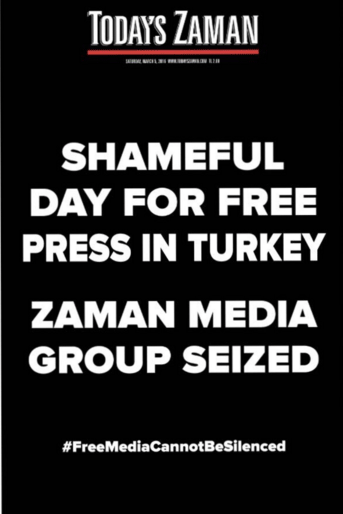
This column was originally submitted to Today’s Zaman but was rejected by the new management. Yaşar Yakış is a Turkish politician. He is a former foreign minister, and a former ambassador to the UN Office in Vienna, Egypt and Saudi Arabia, and was a columnist for Today’s Zaman.
An important step has been taken in Turkey’s painful negotiations with the EU. Turkey submitted to the Turkey-EU summit, held in Brussels on 7 March, several proposals, including the following:
-Move to 1 June 2016 the implementation of the readmission agreement, which will make Turkey contractually obligated to readmit any person who travelled to an EU country from Turkey if he or she was not admitted by that EU country;
-For every citizen of a third country readmitted by Turkey, the EU should promise that it will admit one refugee from Turkey, and the readmission expenses will be covered by the EU. This will protect Greece from the uncontrollable flow of refugees arriving in the Greek islands from Turkey’s coastal towns. However, difficulties may arise in finding an EU country that will fulfill this commitment, and Turkey’s refugee problem may continue to increase since the arrival of refugees from Syria may not stop before Syria is stabilised.
-If the readmission agreement enters into force by 1 June 2016, visa-free travel will be possible for Turkish citizens wishing to visit the Schengen countries.
-Turkey asked for an additional 3 billion euros, to be spent for refugee-related projects.
-Turkey’s EU accession process will be reactivated by opening new negotiation chapters that were blocked for political reasons, either by the EU Council or by individual countries, such as France and the Greek Cypriot administration. This positive commitment may not guarantee that Turkey will become a member of the EU but may lead to the resumption of the reforms that Turkey has to comply with under the Copenhagen criteria and the Maastricht economic criteria.
The deal will be discussed once again with Turkey before the EU Council meeting on 18 March.
Turkey’s refugee problem may thus be slightly alleviated if the genuine efforts by Chancellor Angela Merkel of Germany succeed. The bulk of the burden, however, will still remain on Turkey’s shoulders. Turkey will have to accommodate the refugees, mainly from Syria, until the EU countries select among them the eligible ones. The EU does not want to assume the moral responsibility for the solution of a problem that stems basically from Turkey’s open door policy for Syrian refugees.
The good side of the deal for Turkey is that the EU is giving Turkey a helping hand. If Chancellor Merkel hadn’t taken the lead to alleviate Turkey’s refugee burden, Turkey would have been left alone to solve it. If the deal is implemented properly, Turkey will receive not only an easing of its refugee burden but will make progress in other areas: One of them is the grinding to a halt of Turkey’s EU accession process. Both Turkey and the EU had lost their appetite for the continuation of the process. Not only the refugee problem but also the entire Syrian crisis, and beyond it the other crises in various Middle Eastern countries, may have demonstrated to certain EU countries that cooperation with Turkey could facilitate the solution of the problems that the EU may face in the Middle East. Therefore, certain EU countries may have decided to revisit the question of the reactivation of Turkey’s EU accession process.