6 Jun 2014 | Azerbaijan News, Digital Freedom, News
(Image: Bplanet/Shutterstock)
Croatia’s new criminal code has introduced “humiliation” as an offence — and it is already being put to use. Slavica Lukić, a journalist with newspaper Jutarnji list is likely to end up in court for writing that the Dean of the Faculty of Law in Osijek accepted a bribe. As Index reported earlier this week, via its censorship mapping tool mediafreedom.ushahidi.com: “For the court, it is of little importance that the information is correct – it is enough for the principal to state that he felt humbled by the publication of the news.”
These kinds of laws exist across the world, especially under the guise of protecting against insult. The problem, however, is that such laws often exist for the benefit of leaders and politicians. And even when they are more general, they can be very easily manipulated by those in positions of power to shut down and punish criticism. Below are some recent cases where just this has happened.
Tajikistan
On 4 June this year, security forces in Tajikistan detained a 30-year-old man on charges of “insulting” the country’s president. According to local press, he was arrested after posting “slanderous” images and texts on Facebook.
Iran
Eight people were jailed in Iran in May, on charges including blasphemy and insulting the country’s supreme leader Ayatollah Ali Khamenei on Facebook. They also were variously found guilty of propaganda against the ruling system and spreading lies.
India
Also in May this year, Goa man Devu Chodankar was investigated by police for posting criticism of new Indian Prime Minister Narendra Modi on Facebook. The incident was reported the police someone close to Modi’s Bharatiya Janata Party (BJP), under several different pieces of legislation. One makes it s “a punishable offence to send messages that are offensive, false or created for the purpose of causing annoyance or inconvenience”.
Swaziland
Human rights lawyer Thulani Maseko and journalist and editor Bheki Makhubu were arrested in March this year, and face charges of “scandalising the judiciary” and “contempt of court”. The charges are based on two articles, written by Maseko and Makhubu and published in the independent magazine the Nation, which strongly criticised Swaziland’s Chief Justice Michael Ramodibedi, levels of corruption and the lack of impartiality in the country’s judicial system.
Venezuela
In February this year, Venezuelan opposition leader Leopoldo Lopez was arrested on charges of inciting violence in the country’s ongoing anti-government protests. Human Rights Watch Americas Director Jose Miguel Vivanco said at the time that the government of President Nicholas Maduro had made no valid case against Lopez and merely justified his imprisonment through “insults and conspiracy theories.”
Zimbabwe
Student Honest Makasi was in November 2013 charged with insulting President Robert Mugabe. He allegedly called the president “a dog” and accused him of “failing to do what he promised during campaigns” and lying to the people. He appeared in court around the same time the country’s constitutional court criticised continued use of insult laws. And Makasi is not the only one to find himself in this position — since 2010, over 70 Zimbabweans have been charged for “undermining” the authority of the president.
Egypt
In March 2013, Egypt’s public prosecutor, appointed by former President Mohamed Morsi, issued an arrest warrant for famous TV host and comedian Bassem Youssef, among others. The charges included “insulting Islam” and “belittling” the later ousted Morsi. The country’s regime might have changed since this incident, but Egyptian authorities’ chilling effect on free expression remains — Youssef recently announced the end of his wildly popular satire show.
Azerbaijan
A recent defamation law imposes hefty fines and prison sentences for anyone convicted of online slander or insults in Azerbaijan. In August 2013, a court prosecuted a former bank employee who had criticised the bank on Facebook. He was found guilty of libel and sentenced to 1-year public work, with 20% of his monthly salary also withheld.
Malawi
In July 2013, a man was convicted and ordered to pay a fine or face nine month in prison, for calling Malawi’s President Joyce Banda “stupid” and a “failure”. Angry that his request for a new passport was denied by the department of immigration, Japhet Chirwa “blamed the government’s bureaucratic red tape on the ‘stupidity and failure’ of President Banda”. He was arrested shortly after.
Poland
While the penalties were softened somewhat in a 2009 amendment to the criminal code, libel remains a criminal offence in Poland. In September 2012, the creator of Antykomor.pl, a website satirising President Bronisław Komorowski, was “sentenced to 15 months of restricted liberty and 600 hours of community service for defaming the president”.
This article was published on June 6, 2014 at indexoncensorship.org
13 May 2014 | Asia and Pacific, News, North Korea
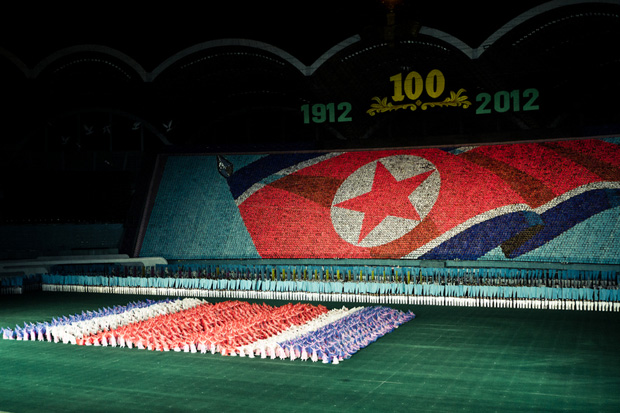
Gymnasts at Arirang festival in Pyongyang, North Korea (Image: Roman Kalyakin/Demotix)
Jang Jin-sung, formerly poet laureate for North Korea, is one of its highest-ranking defectors and most vocal critics. A meteoric career that saw him also become chief propagandist in the United Front Department, engaging in counter-intelligence and psychological warfare against South Korea, he was also one of Kim Jong Il’s inner circle — a dreamlike life of privilege shattered when he found the bodies of famine victims lying in the streets of his home town. Facing almost certain death for the crime of mislaying a prohibited text, he dramatically escaped to China in 2004 and defected to South Korea. Based on his insights from working in the elite, he argues that the official narrative of North Korea being run under the absolutist genius of the Kim dynasty and the Korean Workers Party, is a lie. Power was not harmoniously transferred upon Kim Il Sung’s death in 1994 to his son, Kim Jong Il — instead Kim Jong Il had long before usurped his father with the support of the clandestine Organisation and Guidance Department (OGD), while Kim Il Sung spent his last years under virtual house arrest, bamboozled by his own cult, created by his son. Kim Jong Il directed the OGD under his reign and he legitimised “every single policy and proposal, surveillance purge, execution, song and poem”, but upon his death in 2011, however, the bequest of leadership upon his son Kim Jong Un was solely symbolic; the OGD took charge. That year, Jang set up New Focus International to give insight and analysis to North Korea. This week he talked about the OGD as “the single most powerful entity in North Korea” to the All-Party Parliamentary Group on North Korea. His words were translated by NFI’s international editor, Shirley Lee, and the talk was chaired by Lord David Alton.
The OGD is “the entity that controls everything. This is where all roads end, all chains of command, and all power structures go,” Jang said. “The real power structure, nothing has changed since Kim Jong Il’s time. The OGD is still just as it is, the same men are in the same positions of power.” Yet the OGD is so secret and compartmentalised a structure, it’s only fully comprehended by the most senior leaders, and known to “less than a dozen” of the approximate 26,000 refugees out of North Korea. That lack of knowledge has meant that traditionally, outside observers omitted the OGD’s existence, basing their views on diplomatic notes, refugee testimonies and political theories which Pyongyang has successfully fed into with propaganda about the Kims’ omnipotence, to obscure its power structures. Hence, many observers interpreted the purge of Kim Jong Un’s uncle Jang Song Thaek as the new leader getting rid of his old guard to make his own power network, whereas it was really the OGD liquidating a rival. South Korea has also connived to keep a lid on knowledge of the OGD. When Hwang Jong Op, the international secretary of the Korean Workers’ Party and principal author of the state philosophy of Juche, defected and sought to tell of the OGD, the South’s then Sunshine Policy “was based on a policy of engagement that sought not to provoke the North Korean regime, [so] they actually silenced his testimony from appearing,” said Jang.
Whereupon while “every single person seen as the second, third, fourth most powerful man, has been purged or destroyed … every single powerful member of the OGD has remained”. They will stay in power as the OGD is in effect North Korea’s “human resources department, it appoints everyone”. The vetting of appointees is based on trust, and loyalty secured by cadres knowing any perception of disloyalty will imprison them, their parents and their children. “No-one is exempt from this… because no matter how big you are, if you do something wrong, you are sending your family to prison camp to rot away for the rest of their lives, never to be seen again.” As Lee put it, “you’re not going to kill your own family to change that”. Jang himself has tried many times to contact his parents in North Korea, but has never succeeded. “You can’t begin to think about what his parents may be suffering but that just makes him stronger,” said Lee.
The OGD appoints all generals and makes all military orders, with the military’s autonomy compromised like everything else by the OGD’s all-pervasive surveillance structure. Party committees of spies are installed across all sectors from diplomacy to tourism, down to each and every apartment block — “the OGD has eyes and ears everywhere”. It is backed by the OGD’s secret police and system of prison camps that the group developed into a weapon of mass terror while it usurped Kim Il Sung. He was prevented from seeing friends or family by his OGD-appointed bodyguards, a corps now numbering 100,000. He “died as a scarecrow, he was nothing,” said Lee.
As well as these physical means of control, the state seeks to monopolise all information flows and uses incredible psychological and emotional force to ensure its citizens’ loyalty. “In North Korea the only politically correct faith to have is in the cult of the Kims,” said Jang, while religious organisations like the Chosun Association or Buddhist association are run by the UFD, and Christians end up in prison camps. “The only narrative that matters is of the righteous sovereignty of the state.”
Yet for all the surface illusion of power, the nuclear weapons, the police and prison system, “it is a country that’s ruined inside, it’s a collapsed state. They do not control the price of an egg, and that is a huge deal”. Black markets have almost entirely supplanted the government monopoly of provision of goods, ranging from clothing to food, which collapsed in the mid-1990s as millions perished in the famine. This has created two classes, those loyal to the party because of their stake in the status quo; and the market class of people who were abandoned by the state and survive on the black market. Critically, this means that for promotions, status, power or material wealth, “the currency has converted from loyalty to money,” said Jang, “and that has broken the cult of North Korea for everyone”.
Economic “reforms” are really state efforts to try control the black markets, which have at times suffered violent crackdowns, for having become “a black hole that sucked in the control mechanisms of the state”. Equally, however, the regime cannot survive without them, as “the market feeds the people”. The country is also suffering from criminal activities actually sanctioned by the regime, namely counterfeit dollar bills, meth amphetamine production and computer hacking. “It’s not the world that’s suffering, the country is being destroyed by the regime’s own creations,” as government computers are hacked and fake bills and drugs run through society. Refugee statements say meth amphetamine abuse has become “just part of the ordinary life”.
Meanwhile the markets live off information. “The price of rice, the price of your life rises and falls in terms of knowing outside world information…ordinary people know it’s an advantage to listen to the outside world [information],” and Jang endorses the set up of a BBC Korea service to broadcast into North Korea. “The only way to break the dictatorship of force is by breaking that emotional monopoly over the people… There is no more effective tool that the world can do than to acknowledge that the North Korean people have the right to another narrative than that the party supplies.”
“More important is that no one in the North today believes it will last for ever,” but “the one thing that is stopping them from acting is there is no other way. Everyone is trying to do it the regime’s way”. This extends from efforts to deal with Pyongyang’s nuclear bomb program, which fail because international frameworks don’t apply to North Korea — “the only way the world can resolve the nuclear problem is seeing the regime transform. You can’t do it within their demands” — to the country’s appalling human rights record. “Those who think putting human rights on the agenda would jeopardise engagement and dialogue are wrong. North Korea is more desperate for dialogue at the state level than the West is. They [the North Korean state] need that to sustain what is happening right now.” Putting human rights atop all agendas would mean “there is nowhere left for the North Korean leadership to stand”.
“Stop looking at the regime as the agent of positive transformation,” said Jang, and engage with those with no stake in the status quo. Meanwhile, China, as the North’s sole supporter, is key to its survival and to brook any change. “China supports North Korea because it’s more convenient to support it than not,” said Jang, adding that Kim Jong Il hated China more than anybody “because he was at their mercy”, while Beijing’s anger at Jang Song Thaek’s execution was because it was “like the nightmare of Kim Jong Il would continue”. On Wednesday China warned North Korea against carrying out another nuclear test. And while China has yet to host Kim Jong Un, it has already welcomed South Korea’s President Park with open arms. Repeatedly reaffirming North Korea’s human rights record, damningly detailed by the United Nations’ Commission of Inquiry Into Human Rights in the DPRK in March, to the Chinese government may pressure them into giving up the forceful repatriation of North Korea refugees, which leads to prison or death, according to Lord Alton. “The scariest thing for China is to start to get moral blame for what’s going on in North Korea. So it will want to be seen to be doing the right thing.” On that, Jang said any retribution befalling the regime for human rights abuses, “the OGD will blame will Kim Jong Un alone”.
Again it’s an issue of perception. “In North Korea, I thought change could not come because the regime was so powerful. When I came to South Korea I learned that North Korea was not transformed because the South Koreans didn’t know it could.” Indeed, “the only thing holding North Korea back from transforming is that the world isn’t ready for it.”
The talk was organised with help from the European Alliance for Human Rights in North Korea. Jang’s book Dear Leader (UK Random House, US, Simon & Schuster) is out now.
This article was posted on May 13, 2014 at indexoncensorship.org
2 May 2014 | News
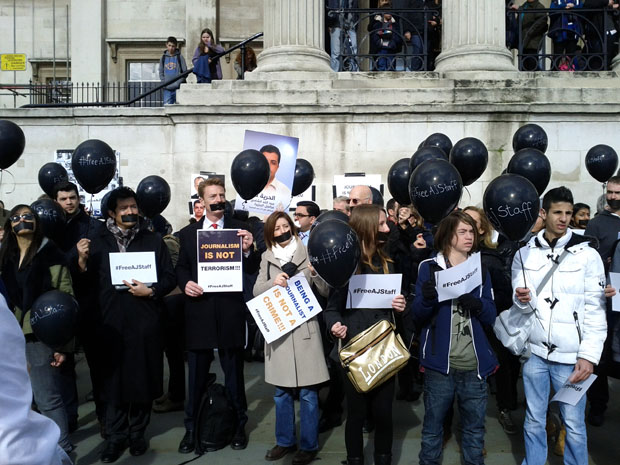
A London protest calling for the release of jailed Al Jazeera journalists in Egypt (Image: Index on Censorship)
Press freedom is at a decade low. Considering just a handful of the events of the past year — from Russian crackdowns on independent media and imprisoned journalists in Egypt, to press in Ukraine being attacked with impunity and government reactions to reporting on mass surveillance in the UK — it is not surprising that Freedom House have come to this conclusion in the latest edition of their annual press freedom report. This serves as a stark reminder that press freedom is a right we need to work continuously and tirelessly to promote, uphold and protect — both to ensure the safety of journalists and to safeguard our collective right to information and ability to hold those in power to account. On the eve of World Press Freedom day, we look back at some of the threats faced by the world’s press in the last 12 months.
1) Journalism is not terrorism…
National security has been used as an excuse to crack down on the press this year. “Freedom of information is too often sacrificed to an overly broad and abusive interpretation of national security needs, marking a disturbing retreat from democratic practices,” say Reporters Without Borders (RSF) in their recently released 2014 Press Freedom Index.
Journalists have faced terrorism and national security-related accusations in places known for their somewhat chequered relationship with press freedom, including Ethiopia and Egypt. However, the US and the UK, which have long prided themselves on respecting and protecting civil liberties, have also come under criticism for using such tactics — especially in connection to the ongoing revelations of government-sponsored mass surveillance.
American authorities have gone after former NSA contractor and whistleblower Edward Snowden, tapped the phones of Associated Press staff, and demanded that journalists, like James Risen, reveal their sources. British authorities, meanwhile, detained David Miranda under the country’s Terrorism Act. Miranda is the partner of Glenn Greenwald, the journalist who broke the mass surveillance story. Authorities also raided the offices of the Guardian — a paper heavily involved in reporting in the Snowden leaks.
2) …but governments still like putting journalists in prison
The Al Jazeera journalists detained in Egypt on terrorism-related charges was one of the biggest stories on attacks on press freedom this year. However, Mohamed Fahmy, Baher Mohamed, Peter Greste and their colleagues are far from the only journalists who will spend World Press Freedom Day behind bars. The latest prison census from the Committee to Protect Journalists (CPJ) put the number of journalists in jail for doing their job at 211 — their second highest figure on record.
In Bahrain, award-winning photographer Ahmed Humaidan was sentenced in March to ten years in prison. In Uzebekistan, Muhammad Bekjanov, editor of opposition paper Erk, is serving a 19-year sentence — which was increased from 15 in 2012, just as he was due to be released. In Turkey, after waiting seven years, Fusün Erdoğan, former general manager of radio station Özgür Radyo, was last November sentenced to life in jail. Just last Friday, Ethiopian authorities arrested prominent political journalist Tesfalem Waldyes and six bloggers and activists.
3) New media is under attack…
As more journalism is being conducted online, blogs, social and other new media are increasingly being targeted in the suppression of press freedom. Almost half of the world’s jailed journalists work for online outlets, according to the CPJ. China — with its massive censorship apparatus — has continued censoring microblogging site Sina Weibo, while also turning its attention to relative newcomer WeChat. In March, it closed down several popular accounts, including that of investigative journalist Luo Changping.
Meanwhile, Turkish Prime Minister Recep Tayyip Erdoğan has publicly all but declared war on social media, at one point calling it the “worst menace to society”. Twitter played a big role in last summer’s Gezi Park protests, used by journalists and other protesters alike. Only days ago, Turkish journalist Önder Aytaç was jailed, essentially, because of the letter “k” in a Tweet.
Meanwhile Russia has seen a big crackdown on online news outlets, while legislation recently passed in the Duma is targeting blogs and social media.
4) …and independent media continues to struggle
Only one in seven people in the world live in countries with free press. In many parts of the world, mainstream media is either under tight control by the government itself or headed up media moguls with links to those in power, with dissenting voices within news organisation often being pushed out. Brazil, for instance, has been labelled “the country of 30 Berlusconis” because regional media is “weakened by their subordination to the centres of power in the country’s individual states”. At the start of the year, RIA Novosti — known for on occasion challenging Russian authorities — was liquidated and replaced by the more Kremlin-friendly Rossiya Segodnya (Russia Today), while in Montenegro, has seen efforts by the government to cut funding to critical media. This is not even mentioning countries like North Korea and Uzbekistan, languishing near the bottom of press freedom ratings, where independent journalism is all but non-existent.
5) Attacks on journalists often go unpunished
A staggering fact about the attacks on journalists around the world, is how many happen with impunity. Since 1992, 600 journalists have been killed. Most of the perpetrators of those crimes have not been brought to justice. Attacks can be orchestrated by authorities or by non-state actors, but the lack of adequate responses by those in power “fuels the cycle of violence against news providers,” says RSF. In Mexico, a country notorious for violence against the press, three journalists were murdered in 2013. By last October, the state public prosecutor’s office had yet to announce any progress in the cases of Daniel Martínez Bazaldúa, Mario Ricardo Chávez Jorge and Alberto López Bello, or disclose whether they are linked to their work. Pakistan is also an increasingly dangerous place to work as a journalist. Twenty seven of the 28 journalists killed in the past 11 years in connection with their work have been killed with impunity. Syria, with its ongoing, devastating war, is the deadliest place in the world to be a journalist, while some of the attacks on press during the conflict in Ukraine, have also taken place without perpetrators being held accountable. That attacks in the country appear to be accelerating, CPJ say is “a direct result of the impunity with which previous attacks have taken place”.
This article was published on May 2, 2014 at indexoncensorship.org
30 Apr 2014 | Egypt, Iraq, News, Nigeria, Pakistan, Religion and Culture, Syria, Tajikistan, Turkmenistan, Vietnam
In January, Index summarised the U.S. State Department’s “Countries of Particular Concern” — those that severely violate religious freedom rights within their borders. This list has remained static since 2006 and includes Burma, China, Eritrea, Iran, North Korea, Saudi Arabia, Sudan, and Uzbekistan. These countries not only suppress religious expression, they systematically torture and detain people who cross political and social red lines around faith.
Today the U.S. Commission on International Religious Freedom (USCIRF), an independent watchdog panel created by Congress to review international religious freedom conditions, released its 15th annual report recommending that the State Department double its list of worst offenders to include Egypt, Iraq, Nigeria, Pakistan, Tajikistan, Turkmenistan, Vietnam and Syria.
Here’s a roundup of the systematic, ongoing and egregious religious freedom violations unfolding in each.
1. Egypt
The promise of religious freedom that came with a revised constitution and ousted Islamist president last year has yet to transpire. An increasing number of dissident Sunnis, Coptic Christians, Shiite Muslims, atheists and other religious minorities are being arrested for “ridiculing or insulting heavenly religions or inciting sectarian strife” under the country’s blasphemy law. Attacks against these groups are seldom investigated. Freedom of belief is theoretically “absolute” in the new constitution approved in January, but only for Muslims, Christians and Jews. Baha’is are considered apostates, denied state identity cards and banned from engaging in public religious activities, as are Jehovah’s Witnesses. Egyptian courts sentenced 529 Islamist supporters to death in March and another 683 in April, though most of the March sentences have been commuted to life in prison. Courts also recently upheld the five-year prison sentence of writer Karam Saber, who allegedly committed blasphemy in his work.
2. Iraq
Iraq’s constitution guarantees religious freedom, but the government has largely failed to prevent religiously-motivated sectarian attacks. About two-thirds of Iraqi residents identify as Shiite and one-third as Sunni. Christians, Yezidis, Sabean-Mandaeans and other faith groups are dwindling as these minorities and atheists flee the country amid discrimination, persecution and fear. Baha’is, long considered apostates, are banned, as are followers of Wahhabism. Sunni-Shia tensions have been exacerbated recently by the crisis in neighboring Syria and extremist attacks against religious pilgrims on religious holidays. A proposed personal status law favoring Shiism is expected to deepen divisions if passed and has been heavily criticized for allowing girls to marry as young as nine.
3. Nigeria
Nigeria is roughly divided north-south between Islam and Christianity with a sprinkling of indigenous faiths throughout. Sectarian tensions along these geographic lines are further complicated by ethnic, political and economic divisions. Laws in Nigeria protect religious freedom, but rule of law is severely lacking. As a result, the government has failed to stop Islamist group Boko Haram from terrorizing and methodically slaughtering Christians and Muslim critics. An estimated 16,000 people have been killed and many houses of worship destroyed in the past 15 years as a result of violence between Christians and Muslims. The vast majority of these crimes have gone unpunished. Christians in Muslim-majority northern states regularly complain of discrimination in the spheres of education, employment, land ownership and media.
4. Pakistan
Pakistan’s record on religious freedom is dismal. Harsh anti-blasphemy laws are regularly evoked to settle personal and communal scores. Although no one has been executed for blasphemy in the past 25 years, dozens charged with the crime have fallen victim to vigilantism with impunity. Violent extremists from among Pakistan’s Taliban and Sunni Muslim majority regularly target the country’s many religious minorities, which include Shiites, Sufis, Christians, Hindus, Zoroastrians, Sikhs, Buddhists and Baha’is. Ahmadis are considered heretics and are prevented from identifying as Muslim, as the case of British Ahmadi Masud Ahmad made all too clear in recent months. Ahmadis are politically disenfranchised and Hindu marriages are not state-recognized. Laws must be consistent with Islam, the state religion, and freedom of expression is constitutionally “subject to any reasonable restrictions imposed by law in the interest of the glory of Islam,” fostering a culture of self-censorship.
5. Tajikistan
Religious freedom has rapidly deteriorated since Tajikistan’s 2009 religion law severely curtailed free exercise. Muslims, who represent 90 percent of the population, are heavily monitored and restricted in terms of education, dress, pilgrimage participation, imam selection and sermon content. All religious groups must register with the government. Proselytizing and private religious education are forbidden, minors are banned from participating in most religious activities and Muslim women face many restrictions on communal worship. Jehovah’s Witnesses have been banned from the country since 2007 for their conscientious objection to military service, as have several other religious groups. Hundreds of unregistered mosques have been closed in recent years, and “inappropriate” religious texts are regularly confiscated.
6. Turkmenistan
The religious freedom situation in Turkmenistan is similar to that of Tajikistan but worse due to the country’s extraordinary political isolation and government repression. Turkmenistan’s constitution guarantees religious freedom, but many laws, most notably the 2003 religion law, contradict these provisions. All religious organizations must register with the government and remain subject to raids and harassment even if approved. Shiite Muslim groups, Protestant groups and Jehovah’s Witnesses have all had their registration applications denied in recent years. Private worship is forbidden and foreign travel for pilgrimages and religious education are greatly restricted. The government hires and fires clergy, censors religious texts, and fines and imprisons believers for their convictions.
7. Vietnam
Vietnam’s government uses vague national security laws to suppress religious freedom and freedom of expression as a means of maintaining its authority and control. A 2005 decree warns that “abuse” of religious freedom “to undermine the country’s peace, independence, and unity” is illegal and that religious activities must not “negatively affect the cultural traditions of the nation.” Religious diversity is high in Vietnam, with half the population claiming some form of Buddhism and the rest identifying as Catholic, Hoa Hao, Cao Dai, Protestant, Muslim or with other small faith and non-religious communities. Religious groups that register with the government are allowed to grow but are closely monitored by specialized police forces, who employ violence and intimidation to repress unregistered groups.
8. Syria
The ongoing Syrian crisis is now being fought along sectarian lines, greatly diminishing religious freedom in the country. President Bashar al-Assad’s forces, aligned with Hezbollah and Shabiha, have targeted Syria’s majority-Sunni Muslim population with religiously-divisive rhetoric and attacks. Extremist groups on the other side, including al-Qaeda and the Islamic State of Iraq and the Levant (ISIL), have targeted Christians and Alawites in their fight for an Islamic state devoid of religious tolerance or diversity. Many Syrians choose their allegiances based on their families’ faith in order to survive. It’s important to note that all human rights, not just religious freedom, are suffering in Syria and in neighboring refugee camps. In quieter times, proselytizing, conversion from Islam and some interfaith marriages are restricted, and all religious groups must officially register with the government.
This article was originally posted on April 30, 2014 at Religion News Service
