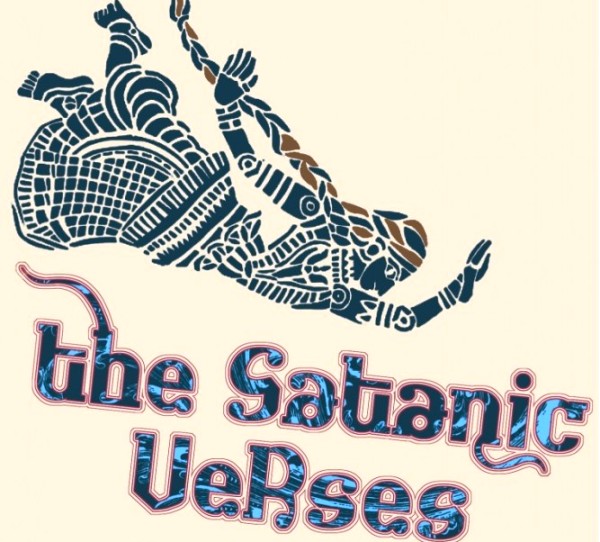
Inna Lillahi wa inna ilaihi raji’un. I am informing all brave Muslims of the world that the author of The Satanic Verses, a text written, edited, and published against Islam, the Prophet of Islam, and the Qur’an, along with all the editors and publishers aware of its contents, are condemned to death. I call on all valiant Muslims wherever they may be in the world to kill them without delay, so that no one will dare insult the sacred beliefs of Muslims henceforth. And whoever is killed in this cause will be a martyr, Allah Willing. Meanwhile if someone has access to the author of the book but is incapable of carrying out the execution, he should inform the people so that [Rushdie] is punished for his actions. Rouhollah al-Mousavi al-Khomeini.”
On 14 February 1989, 25 years ago today, the supreme leader of the Islamic Republic of Iran handed down a death sentence not just on British author Salman Rushdie, but on anyone associated with the publication of his novel the Satanic Verses.
It’s always worth writing down exactly what happened. A medievalist tyrant decided a novelist and his editors and publishers should die, because he was offended by a book he could not claim to have read.
Rushdie went into hiding. Hitoshi Igarashi, the novel’s Japanese translator, was murdered. Because he had translated a novel.
The controversy did not begin with Khomeini – he merely attempted to capitalise on it. No, the first countries where the book stoked the ire of Islamists were South Africa and India, both countries whose divide-and-rule laws (the Indians’ law inherited from British colonial law, the South Africans’ in a diabolical league of its own) meant it paid to promote communal grievance.
Khomeini’s fatwa seems, in hindsight, a desperate bid to distract the people of Iran, and the rest of the Muslim world, from the fact that his reign, about to end, had been a disaster. Iranians had hoped their 1979 revolution would deliver them from the oppression of the Peacock Throne. Instead they just found their oppressors had simply grown beards.
The disaster was not entirely of Khomeini’s own making, perhaps. He could not be blamed for having the equally psychopathic Saddam Hussein as a neighbour, but nonetheless, he had sent hundreds of thousands of Iranians to their death, promised martyrdom as they marched into Saddam’s poisoned gas during the Iran-Iraq war that raged for almost the whole of the 1980s.
The Iran Iraq War ended in 1988. Neither side could legitimately claim victory. The Islamic Republic had not swept all before it. And Khomeini needed something new to establish his Shia theocracy as the leader of the Islamic world. He found it in harnessing the mounting anger over Rushdie’s book.
In Britain, this was the moment for political Islam. Young second generation South Asian Islamists exploited their parents’ folk memories of anti-Muslim violence during the torturous period before and after partition in 1947 (the subject of Rushdie’s great work, Midnight’s Children) to mobilise Muslims against Rushdie.
Inayat Bunglawala of the Muslim Council of Britain wrote in 2007:
So on February 14 1989, when the Iranian Islamic leader, Imam Khomeini delivered his fatwa calling for Salman Rushdie’s death, I was truly elated. It was a very welcome reminder that British Muslims did not have to regard themselves just as a small, vulnerable minority; they were part of a truly global and powerful movement. If we were not treated with respect then we were capable of forcing others to respect us.
Yusuf Islam, formerly known as cuddly hippy musician Cat Stevens, told a television audience at the time that he felt Rushdie deserved to die. Some on the British right were pleased, seeing the death sentence as comeuppance for a man who was a vicious critic of the racist establishment.
Khomeini is dead and Rushdie is a knight of the realm (though some, such as Shirley Williams, considered that elevation in 2007 unwise). But it is perhaps on those grounds only that victory can be claimed for free speech. As Kenan Malik has suggested, writing for Index on Censorship, we live still in the “shadow of the fatwa”.
Religious sensitivity has become an excuse for threats. “Offence” is something to be taken greedily, and then pumped back out with a mixture of aggression and self pity.
And the shadow of that fatwa does not only fall on Islam. Every zealot of every creed will now offer up special pleading for their right to be protected from mockery, debate and challenge with the line “You wouldn’t say that about Islam.” What they mean, always, is “We want you to be scared. We want you to be as scared as Salman Rushdie was when he received that threat. We want you to be so scared that you will never question our literalism, our version of events. Truth is ours and ours alone.”
Rushdie’s friend, the late Christopher Hitchens, wrote that the fatwa represented “an all out confrontation between the ironic and the literal mind: between every kind of commissar and inquisitor and bureaucrat and those who know that, whatever the role of social and political forces, ideas and books have to be formulated by individuals”.
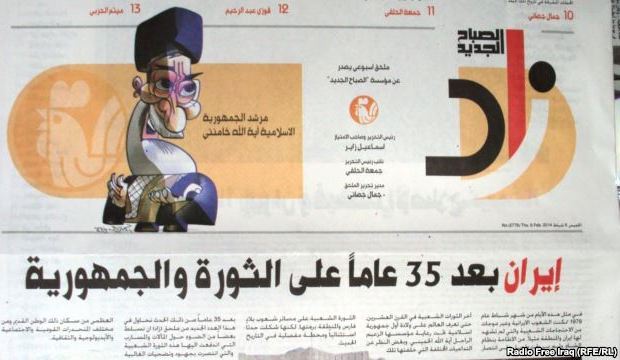
Al-sabah al jadeed’s caricature of Ayatollah Khamenei (Image RFE/RL)
Independent Iraqi daily newspaper Al-Sabah Al-Jadeed has survived numerous attempts to destroy it over its 10 year existence. But on 10 February, the newspaper’s Baghdad office was bombed and now its future is in doubt. The daily may need to find a new office, employees are fleeing, and its website is facing one DoS attack after another.
Windows, furniture and equipment were damaged when a bomb went in front of the building at 4.30 am. Later that morning another bomb exploded not far from the newspaper, while an unexploded heavy C4 plastic explosive device was found inside the premises and dismantled by police. No one was injured or killed, as the office was empty – but some neighbours are suggesting that the newspaper should move.
A few hours later that same day a militia-like group entered the building. “They came threatening us in broad daylight, so to speak,” says Ismael Zayer, editor in chief. The group escaped after employees managed to warn the police.
The bomb attacks followed a social media campaign to demand the closure of the newspaper after it published its weekly supplement Zad on 6 February. The supplement was devoted to the 35th anniversary of the Islamic Revolution in Iran and on the cover featured a caricature of Iran’s supreme leader, Ayatollah Ali Khamenei. The cover caricature is a tradition for Zad, a supplement that came into existence in the first months of the Arab Spring. Ahmed al-Rubaie, the newspaper’s cartoonist, has drawn hundreds of caricatures of political and religious figures, from Iraqi president Jalal Talabani, Najaf’s grand ayatollah Al-Sistani and prime minister Nouri al-Maliki to Nelson Mandela and other internationally known figures. These cartoons are never intended to be offensive or convey a negative message, they are just an alternative to uninteresting photos of VIPs.
Zayer believes the caricature of Khamenei is just a pretext to attack the newspaper and have it closed before the parliamentary elections planned for this spring. But there may be yet more reasons for the attacks and threats against the newspaper. Al-Sabah Al-Jadeed recently covered a damning report by Human Rights Watch on the abuse of female detainees in Iraqi prisons. HRW accused the government of illegally detaining wives and daughters of (Sunni) suspects who are on the run, claiming detainees were sexually abused. Zayer wrote an open letter to the government, demanding that the Minister of Justice, Hassan al-Shimmari, be sacked. “I am ashamed of my country,” he commented, “What are we? A whorehouse?”
After some efforts to convince the Ministry of Interior to protect the newspaper and its staff, the office of the newspaper is now under permanent surveillance by the police, but it is unclear for how long. Zayer has left the country temporarily after receiving death threats. This is not the first time the editor has been forced to flee Baghdad.
In the beginning of 2006 when Iraq’s sectarian conflict led to thousands of assassinations a month, Zayer managed the newspaper from a small office in Amman, Jordan. He planned to create an international edition for the millions of Iraqi refugees outside their home country – a project that was almost ready to be launched when on 30 December, Saddam Hussein was hanged in a way that scandalised his Jordanian supporters and made the company that was going to produce the international edition wary of printing a newspaper critical of Ba’athists.
Zayer decided to open a second bureau in Erbil, the relatively safe capital of the autonomous Kurdish Region, and to bring back around a dozen journalists that had escaped to neighbouring Jordan, Lebanon and Syria. The bureau was maintained until the very end of 2009, when Zayer and most of his staff went back to Baghdad.
The newspaper has faced many other challenges. In May 2004, Zayer’s driver and bodyguard were killed during an attempt by fake police to kidnap the editor in chief. Later, one of Zayer’s brothers was kidnapped for a hefty ransom. More than once ministers ordered an advertising boycott – a large part of the advertising in the newspaper concerns government tenders, next to a steady stream of ads by mobile phone companies and real estate firms. Nowadays, a strange rule is in force that says tender ads can only be paid once the tender has been decided – as a result, the newspaper is sitting on hundreds of unpaid bills.
From 2006 until 2008, when Nouri al-Maliki, after having been under siege in Basra himself, finally decided to defeat the Shi’ite militias in the south and the capital, distribution of the newspaper was often prohibited in many cities and Baghdadi neighbourhoods. Distribution north of the capital was completely disrupted during the American siege of Fallujah at the end of 2004 – and for a long time thereafter. The Borsa in Baghdad, a building from where for years, several independent and party newspapers were sold to traders every morning, was occupied for months by Ba’athists. Sometimes printing houses ran out of paper after trucks were stolen on the road from Amman to Baghdad and their drivers killed.
By attempting to create a modern, democratic trade union for journalists, Zayer, who was elected its first president, ran into serious trouble with the old union, one of the many Ba’athist institutions the US occupation’s administration had left intact.
The newspaper has survived several libel cases brought on by various politicians demanding potentially ruinous compensation sums, owing its victories to courageous independent judges. It has survived vicious campaigns on the internet claiming it is in “American-Zionist” hands. Recently it survived the flooding of large parts of Baghdad, as a result of bad maintenance of the sewage system and torrential rain.
Iraqi readers have shown their support for the newspaper after the bomb attack. This February is not the first time there is no Al-Sabah Al-Jadeed in the streets – but this time, as those responsible for the bomb attack didn’t leave a business card, with whom should the newspaper negotiate? Removing the supplement from the website hasn’t helped to assuage the anger about the innocent caricature of Khamenei. In the past the newspaper could hang on thanks to financial help from donors, as well as political support from Iraqi ministers and top officials who think independent media are at least a necessary evil. It certainly needs solidarity now.
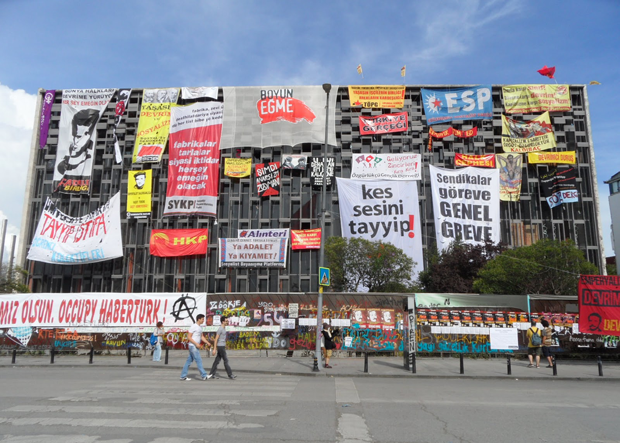
Limitations and challenges to freedom of expression and of assembly in Turkey have – once again – come to international attention over the past year. But despite this, censorship of the arts is often under-reported.
Siyah Bant was founded in 2011 as a research platform that documents censorship in the arts across Turkey by a group of arts managers, arts writers and academics working on freedom of expression. The group is concerned that many instances of censorship in the art world, especially in the visual and performing arts, were under-reported and only circulated as anecdotes. Siyah Bant also found the blanket understanding that “it is the state that censors” to be insufficient.
The Gezi Park protests that began in late May 2013 not only highlighted the continued existence of police violence and the institutionalized use of excessive force that has long been a familiar sight in the Kurdish region, and, more recently, in the protests against hydroelectric plants in the Black Sea parts of Turkey. The demonstrations also made apparent the tight grip that the alliance of political establishment and business conglomerates have over Turkish print and broadcasting media, as numerous journalists were fired for reporting on the anti-government protests.
Together with China and Iran, Turkey has been taken the lead in terms of numbers of imprisoned journalists, many of which are charged under anti-terrorism laws. Currently, all eyes are on the amendments to internet law 5651 that passed parliament in early February 2014, now waiting to be signed into effect by President Abdullah Gül.
While the government claims these changes are to ensure privacy and clamp down on pornography, activists maintain that the law will procedurally ease the profiling of internet users and effectively heighten government control over online content. Turkey has already a questionable track record when it comes to internet freedom with access to more than 40,000 internet sites being restricted.
Rather than operating through bans and efforts at complete suppression that marked the 1980 coup d’état and its aftermath, the current censorship mechanisms in Turkey aim to delegitimize and discourage artistic expressions and their circulation.
Siyah Bant’s initial aim was two-fold: Firstly, the group conducted research in five cities to identify and examine different modalities of censorship and the actors involved in censoring motions. Secondly, Siyah Bant wanted to create awareness around censorship in the arts and facilitate solidarity networks in the advocacy for freedom of expression in the arts.
In the course of its research it set up a website that documents arts censorship in Turkey and assembled two publications. The first presents selected case studies of censorship in the arts in Turkey as well as international initiatives in the fight for freedom of expression. The second focuses more closely on artists’ rights and the legal framework of freedom of the arts in Turkey as well as the ways in which these laws are applied–or not applied, in most cases.
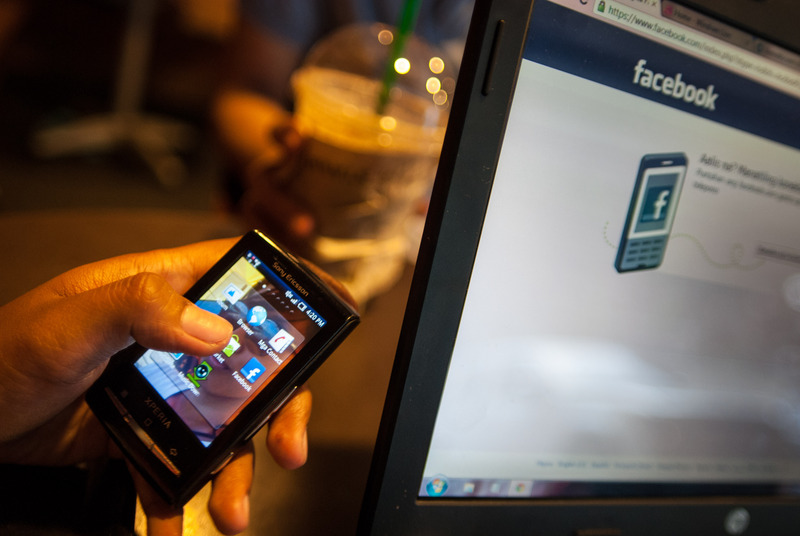
Today Facebook celebrates its 10th anniversary. The social networking giant now has over 1.23 billion users, but there are still political leaders around the world who don’t want their country to have access to the site, or those who have banned it in the past amid fears it could be used to organise political rallies.
North Korea
Perhaps the most secretive country in the world little is known about internet access in Kim Jong-un’s nation. Although a new 3G network is available to foreign visitors, for the majority of the population the internet is off limits. But this doesn’t seem to bother many who, not knowing any different, enjoy the limited freedoms offered to them by the country’s intranet, Kwangmyong, which appears to be mostly used to post birthday messages.
A limited number of graduate students and professors at Pyongyang University of Science and Technology do have access to the internet (from a specialist lab) but in fear of the outside world many chose not to use it. Don’t expect to see Kim Jong-un’s personal Facebook page any time soon.
Iran
In Iran, however, political leaders have taken to social media- despite both Facebook and Twitter officially being extraordinarily difficult to access in the country. Even President Hassan Rouhani has his own Twitter account, although apparently he doesn’t write his own tweets, but access to these accounts can only be gained via a proxy server.
Facebook was initially banned in the country after the 2009 election amid fears that opposition movements were being organised via the website.
But things may be beginning to looking up as Iran’s Culture Minister, Ali Jannati, recently remarked that social networks should be made accessible to ordinary Iranians.
China
The Great Firewall of China, a censorship and surveillance project run by the Chinese government, is a force to be reckoned with. And behind this wall sits the likes of Facebook.
The social media site was first blocked following the July 2009 Ürümqi riots after it was perceived that Xinjiang activists were using Facebook to communicate, plot and plan. Since then, China’s ruling Communist Party has aggressively controlled the internet, regularly deleting posts and blocking access to websites it simply does not like the look of.
Technically, the ban on Facebook was lifted in September 2013. But only within a 17-square-mile free-trade zone in Shanghai and only to make foreign investors feel more at home. For the rest of China it is a waiting game to see if the ban lifts elsewhere.
Facebook isn’t officially banned in Cuba but it sure is difficult to access it.
Only politicians, some journalists and medical students can legally access the web from their homes. For everyone else the only way to connect to the online world legally is via internet cafes. This may not seem much to ask but when rates for an hour of unlimited access to the web cost between $6 and $10 and the average salary is around $20 getting online becomes ridiculously expensive. High costs also don’t equal fast internet as web pages can take several minutes to load: definitely not value for money for the Caribbean country.
Bangladesh
The posting of a cartoon to Facebook saw the networking site shut down across Bangladesh in 2010. Satirical images of the prophet Muhammad, along with some of the country’s leaders, saw one man arrested and charged with “spreading malice and insulting the country’s leaders”. The ban lasted for an entire week while the images were removed.
Since then the Awami-League led government has directed a surveillance campaign at Facebook, and other social networking sites, looking for blasphemous posts.
Article continues below[/vc_column_text][/vc_column][/vc_row][vc_row][vc_column][vc_custom_heading text=”Stay up to date on freedom of expression” font_container=”tag:p|font_size:28|text_align:left” use_theme_fonts=”yes”][vc_separator color=”black”][/vc_column][/vc_row][vc_row][vc_column width=”1/2″][vc_column_text]
Index on Censorship is a nonprofit that defends people’s freedom to express themselves without fear of harm or persecution. We fight censorship around the world.
To find out more about Index on Censorship and our work protecting free expression, join our mailing list to receive our weekly newsletter, monthly events email and periodic updates about our projects and campaigns. See a sample of what you can expect here.
Index on Censorship will not share, sell or transfer your personal information with third parties. You may may unsubscribe at any time. To learn more about how we process your personal information, read our privacy policy.
You will receive an email asking you to confirm your subscription to the weekly newsletter, monthly events roundup and periodic updates about our projects and campaigns.
As Egyptians took to the streets in 2011 in an attempt to overthrow the regime of Egyptian President Hosni Mubarak the government cut off access to a range of social media sites. As well as preventing protestors from using the likes of Facebook to foment unrest, many websites registered in Egypt could no longer be accessed by the outside world. Twitter, YouTube, Hotmail, Google, and a “proxy service” – which would have allowed Egyptians to get around the enforced restrictions- seemed to be blocked from inside the country.
The ban lasted for several days.
Syria
Syria, however, dealt with the Arab Spring in a different manner. Facebook had been blocked in the country since 2007 as part of a crackdown on political activism, as the government feared Israeli infiltration of Syrian social networking sites. In an unprecedented move in 2011 President Bashar al-Assad lifted the five year ban in an apparent attempt to prevent unrest on his own soil following the discontent in Egypt and Tunisia.
During the ban Syrians were still able to easily access Facebook and other social networking sites using proxy servers.
Mauritius
Producing fake online profiles of celebrities is something of a hobby to some people. However, when a Facebook page proclaiming to be that of Mauritius Prime Minister Navin Ramgoolam was discovered by the government in 2007 the entire Mauritius Facebook community was plunged into darkness. But the ban didn’t last for long as full access to the site was restored the following day.
These days it would seem Dr Ramgoolam has his own (real) Facebook account.
Pakistan
Another case of posting cartoons online, another case of a government banning Facebook. This time Pakistan blocked access to the website in 2010 after a Facebook page, created to promote a global online competition to submit drawings of the prophet Muhammad, was brought to their attention. Any depiction of the prophet is proscribed under certain interpretations of Islam.
The ban was lifted two weeks later but Pakistan vowed to continue blocking individual pages that seemed to contain blasphemous content.
Vietnam
During a week in November 2009, Vietnamese Facebook users reported an inability to access the website following weeks of intermittent access. Reports suggested technicians had been ordered by the government to block the social networking site, with a supposedly official decree leaked on the internet (although is authenticity was never confirmed). The government denied deliberately blocking Facebook although access to the site today is still hit-and-miss in the country.
Alongside this, what can be said on social networking sites like Facebook has also become limited. Decree 72, which came into place in September 2013, prohibits users from posting links to news stories or other news related websites on the social media site.
This article was published on 4 February 2014 at indexoncensorship.org[/vc_column_text][/vc_column][/vc_row][vc_row][vc_column][vc_basic_grid post_type=”post” max_items=”12″ style=”load-more” items_per_page=”4″ element_width=”6″ grid_id=”vc_gid:1538131415482-d092e45b-9f66-5″ taxonomies=”136″][/vc_column][/vc_row]