20 Aug 2013 | Campaigns
In an article in today’s Guardian, editor Alan Rusbridger reports that the newspaper was coerced into destroying material that related to its revelations about state surveillance.
The Chief Executive of Index on Censorship, Kirsty Hughes said:
“Using the threat of legal action to force a newspaper into destroying material is a direct attack on press freedom in the UK. It is unclear which laws would have been used to force the Guardian to hand over its material but it is clear that the Snowden and NSA story is strongly in the public interest. Coming on the back of the detention of David Miranda, it seems that the UK government is using, and quite likely misusing, laws to intimidate journalists and silence its critics.”
19 Aug 2013 | Campaigns, Counter Terrorism
On Sunday, David Miranda, the partner of Guardian journalist Glenn Greenwald who has been instrumental in revealing mass surveillance programmes run by the US, was detained at London Heathrow. He was held for almost nine hours and questioned under Schedule 7 of the Terrorism Act 2000, the law which allows the police to stop, detain and question any individuals at airports and other border areas.
According to the New York Times, Brazilian citizen Miranda was travelling between Berlin and Rio De Janeiro, where he lives with Greenwald. Miranda had met journalist Laura Poitras in Germany, apparently in order to exchange documents. Greenwald said that the Guardian had paid for Miranda’s trip.
The broad powers that the Terrorism Act 2000 has given to the police were supposed to be used to clamp down on terrorism. However, as the example of David Miranda shows when such powers are not controlled they can be easily abused. The Terrorism Act creates a situation in which all of us, whenever we are at airports or other border areas can become potential terrorism suspects. As a result the most crucial human rights that all people have are put into question.
Under the Terrorism Act people detained or questioned are not automatically allowed to have access to a lawyer. If they exercise their right to remain silent to avoid self-incrimination they may be charged with a separate offence for refusing to cooperate with the police. The detention of David Miranda makes it difficult to escape the conclusion that the Terrorism Act allows the authorities to target journalists and others such as human rights defenders.
Index Chief Executive Kirsty Hughes commented: “The Terrorism Act should not be used to directly or indirectly intimidate journalists. If David Miranda was detained because of his association with Glenn Greenwald, it is not only a misuse of the Terrorism Act but a direct challenge to free speech in this country and internationally.”
7 Aug 2013 | Egypt, News, Politics and Society, Religion and Culture, Turkey, Turkey Statements
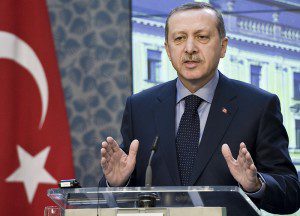
Turkish Prime Minister Recep Tayyip Erdogan (Photo: Philip Janek / Demotix)
While Turkey this week jailed its former Chief of Staff, General Ilker Basbug, in Egypt, General Sisi’s popularity is still riding high following the army’s ousting of President Morsi.
Yet the mass prosecutions and heavy sentencing under the so-called Ergenekon case in Turkey do not simply show a welcome assertion of civilian over military power. Nor does the military’s role in Egypt constitute what US secretary of state John Kerry rather remarkably referred to a week ago as “restoring democracy” – contradicted this week by John McCain for the first time calling the coup a coup.
Both Turkey and Egypt have failed so far to find a way to reconcile democracy, Islam, and the role of the military. And while a big segment of the Egyptian population is now rashly putting its faith in its army to lead it to a fully functioning pluralist democracy, Turkey’s recent past shows precisely why that might result in modernisation but not democracy.
Yet the recent protests in both countries also show that majoritarian democracy, without respect for the rule of law, human rights, and media freedom, will not lead to a fair, open and stable democratic system either. Where Turkey was once seen as the poster boy for democracy in a Muslim majority country, that picture is now truly tarnished. But the route via military power will never make a good alternative model.
The Military and Kemalism
Turkey for decades followed a path – led by its military and various Kemalist and secularist supporters – of modernisation and westernisation, a sort of quasi-democracy with the military there as a ‘guard rail’ against Islamists and other ‘enemies’ of the state. This army-protected approach did little to propel democracy though it led to some substantial economic and social modernisation especially in the west of Turkey (though its neglect of the smaller businesses of central Anatolia was one part of Erdogan’s remarkable success when he swept to power in 2002).
But, without proper political accountability or a genuinely independent judiciary and free media, corruption and the ‘deep state’ grew and prospered in Turkey tying together a range of unlikely bedfellows, while labelling as dangerous enemies a range of people from Islamists to Kurds, leftists and Alevis with civil society, academics and independent journalists seen as at best deeply suspicious too.
Turkey’s last military coup was in 1980 but the so-called ‘soft coup’ of 1997 pushed the Justice and Development Party (AKP)’s predecessor out of power. Frustrated and oppressed by military-backed politics, when Erdogan’s Islamist-leaning AKP came into power in 2002, many liberals welcomed it as heralding and introducing major steps forward in starting to create a genuinely pluralist democracy, one that would respect minorities, seriously tackle Turkey’s appalling record of torture, and open up the prospect of finally replacing the 1982 military-imposed constitution.
The nationalist-secularist deep state was less impressed fearing underlying Islamist intentions. But attempts at an ‘e-coup’ in 2007 (through military expressed disapproval of the Erdogan government) to the attempted banning of the AKP in the ‘judicial coup’ of the following year failed. And so over his eleven years in power, Erdogan has asserted increasing civilian control over the military.
But the over-reach in the Ergenekon trials, with a wide range of observers criticising the politicisation of the prosecution, lack of due process, and the severity of the sentencing, some labelling it a witch hunt, suggest a process more of political revenge or what commentator Cengiz Candar labels “civilian authoritarianism” rather than a democratic breakthrough. With only 21 acquitted from 275 defendants, in a very wide set of charges around terrorism and coup plots, the Ergenekon sentences mark a moment of deepening political division in Turkey. The draconian nature of the sentences against several journalists and writers have been severely criticised by Dunja Mijatovic, the OSCE’s freedom of the media representative and condemned by the Association of European Journalists.
As this more authoritarian Turkish democracy has developed over the last five years, Turkey’s media has become ever less independent, ever more crushed or complicit – with more journalists in jail than in China and Iran, and sacking of columnists and editors rife even before the surge in dismissals that followed the recent Gezi Park protests and the Ergenekon imprisonments.
Nor has Erdogan stopped at media pressure and control. Turkey has a weak record on internet freedom too. The European Court of Human Rights ruled in May this year that Turkey’s blanket blocking of sites violated freedom of expression – a ruling that will doubtless not have impressed Erdogan and his ministers who were so outraged by free speech on Twitter and other social media during the recent protests.
But it would be hard to argue that Turkey would be better off today if it reverted to its old, failed ways of military coups and a corrupt, elitist deep state. Turkey needs a truly independent, impartial and honest judiciary, a free, strong media to hold politicians to account, a free and open internet. And it also needs healthy dynamic opposition parties too. Yet the recent mass protests showed only too clearly that the stumbling Republican People’s Party (CHP) has still failed to find a convincing modern democratic voice, even as Erdogan has shifted from progressive to more authoritarian ways. The masses of protesters – looking for a more genuine, pluralist democracy – still lack serious political parties to work through.
It is a vicious circle – as the lack of dynamic opposition parties interacts with the ever crumbling, no longer independent media, government over-reach and the failure to introduce a modern constitution respecting human rights, free speech, and an independent judiciary.
Any Lessons for Egypt?
It is this sort of majoritarianism democracy, but worse, that Egypt has now supplanted with its own protest-backed military coup. Morsi’s government had lurched into an authoritarianism that went a long way beyond where Erdogan has taken Turkey. Where Erdogan failed to introduce a new constitution, Morsi rammed one through that undermined any hopes of establishing a genuine pluralist democracy with full respect for human rights for all.
But the omens for Egypt’s coup as a pro-democracy move are not good. The military have moved rapidly to restore in full public sight various secret police groups. Muslim Brotherhood politicians, including Morsi, are in jail, protesters have been shot and killed – often in the head or chest in what many have called a massacre. And media are being watched, with those sympathetic to the Muslim Brotherhood closed down or censored. This week 75 judges were questioned about their political sympathies for the Brotherhood – a step the Turkish deep state would have only applauded and concurred with. The so-called Third Square movement, attempting to create support for a new democratic path that supports neither military nor Morsi, is so far small compared to the other two camps.
The US, EU and Arab diplomats are now stepping in urgently – attempting to stop a lurch into indefinite and widespread violence, and to stop further killings as the Egyptian authorities threaten to close down the two Brotherhood protest camps in Cairo. But today disturbingly the interim presidency said these efforts have failed – more violence may well loom.
The same challenge
In the end both Turkey and Egypt face the same challenge: how to get to a fully functioning democracy, with rights for all not just the majority. It cannot be done through military coups, violence and military-backed modernisation. It cannot be done through street protests alone. And where Erdogan’s AKP in 2002 showed a possible way ahead, that model now lies in tatters as Erdogan has shed his progressive mantle.
Yet the tools and the vital steps are not a mystery; they include a free and independent media, full respect for human rights, an independent judiciary, and a vibrant set of political parties. The political challenge is how to create and defend those tools; that is the big task for progressive civil society and for genuinely democratic politicians in both countries – and for their supporters in other countries.
6 Aug 2013 | In the News
#DONTSPYONME
Tell Europe’s leaders to stop mass surveillance #dontspyonme
Index on Censorship launches a petition calling on European Union Heads of Government to stop the US, UK and other governments from carrying out mass surveillance. We want to use public pressure to ensure Europe’s leaders put on the record their opposition to mass surveillance. They must place this issue firmly on the agenda for the next European Council Summit in October so action can be taken to stop this attack on the basic human right of free speech and privacy.
(Index on Censorship)
BAHRAIN
After Arresting and Disappearing of Two Journalists, ANHRI Demands Revealing their Fate
The Arabic Network for Human Rights Information (ANHRI), denounces the continuing harassments against the photographers and the journalists by the Bahraini authorities in addition to arresting them without clear reasons in addition to the denial of the authorities for its relation with some of the direct detention process, which arouse concerns related to the life of the detainees.
(ANHRI)
BRAZIL
Citizen journalists take on Brazil’s media
The Ninja media group want independent journalism and a revolution of Brazil’s media coverage. During the country’s recent unrest, the citizen journalists were hailed as an alternative to major media outlets.
(DW)
CHINA
Fear and Loathing at the China Daily
When Mitch Moxley arrived in Beijing in 2007 to work for China’s largest English-language daily, he discovered life in the Chinese media could be very strange indeed.
(The Atlantic)
IRAN
Hassan Rouhani raises Iranian hopes for free expression
During his inauguration address, Iran’s new president Hassan Rouhani promised peace and a push towards a more open dialogue with the West. Although it is far too soon to gauge whether his promises will transform into policies as he pushes against Iran’s convoluted theocracy, one thing is certain–Rouhani’s election has instilled a great feeling of hope among the Iranian people. Small Media reports
(Index on Censorship)
ITALY
Hundreds expected to protest anti-free speech ‘homophobia’ law in Rome, Paris
Up to 500 people are expected to hold a demonstration later tonight outside the Italian parliament to protest a bill that would criminalize homophobia and “transphobia,” something constitutional experts believe would shut down citizens’ right to free speech, especially for Christians.
(LifeSiteNews.com)
KENYA
Parliament Should Not Kill the Freedom of Expression
As Parliament passes the forthcoming media bill, it should remember Kenya and her development require more, not less freedom of the media.
(The Star via AllAfrica.com)
RUSSIA
Banned, unbanned – film debacle continues
“We have the greatest constitution on the planet,” tweeted a relieved Jahmil Qubeka after the Film and Publishing Board’s Appeal Tribunal unbanned his film Of Good Report over the weekend.
(Index on Censorship)
SOUTH AFRICA
Banned, unbanned – film debacle continues
“We have the greatest constitution on the planet,” tweeted a relieved Jahmil Qubeka after the Film and Publishing Board’s Appeal Tribunal unbanned his film Of Good Report over the weekend.
(Grocott’s Mail)
The futility of online censorship
Local legislators should not follow the UK prime minister’s ill-advised plan, says Andrew Verrijdt.
(TechCentral)
TUNISIA
How Censorship Stifled Us In Tunisia
During the era of former Tunisian President Ben Ali, book-shoppers were banned from buying books that have anything to do with politics. Being exposed to such books would allow both intellectuals and common people to better understand the nature of political life in Tunisia and ultimately realize that Tunisians are indeed living under the shadows of dictatorship.
(The Tunis Times)
TURKEY
Turkey sentences nearly 300 for “plotting coup”
A Turkish court on Monday sentenced a former military commander to life in prison and dozens of others including opposition members of parliament to long terms for plotting against the government, in a case that has exposed deep divisions in the country.
(Al-Akhbar)
UNITED ARAB EMIRATES
Journalist Held Incommunicado, Netizens Arrested, Censorship
Reporters Without Borders condemns Egyptian journalist Anas Fouda’s detention by the authorities in the United Arab Emirates for the past month. Based for many years in the UAE, Fouda has been held incommunicado ever since his arrest on 3 July.
(RSF via AllAfrica.com)
UNITED STATES
Children given lifelong ban on talking about fracking
Two Pennsylvanian children will live their lives under a gag order imposed under a $750,000 settlement
(The Guardian)
Judge Says No Speech Protection Applied To Whistleblower Cop
A Federal Judge last week dismissed a lawsuit by an NYPD officer who said he was punished when he complained about quotas in his precinct, ruling that constitutional protections on free speech do not apply because the officer was speaking as a member of the Police Department and not as a private citizen.
(The Chief)
Previous Free Expression in the News posts
Aug 5 | Aug 2 | Aug 1 | July 31 | July 30 | July 29 | July 26 | July 25 | July 24 | July 23 | July 22 | July 19 | July 18 | July 17 | July 16
