8 Oct 2024 | Israel, Middle East and North Africa, News, Palestine
Yesterday marked a year since Hamas’s brutal incursion into Israel, where nearly 1,200 people were killed, including 815 civilians, making it the deadliest day for Jewish people since the Holocaust. The militant group also abducted 251 people, and at least 97 are still thought to be held hostage in the Gaza Strip. Following the attack, Israel launched a devastating assault on Gaza, and has since killed nearly 42,000 Palestinians, of whom nearly 14,000 are children. The conflict has now expanded to Lebanon – where more than 2,000 people have been killed – and Iran, with serious concerns it could escalate into a full-blown regional war in the Middle East.
Amongst the horrendous loss of life and destruction, there has been significant repression of free speech. Israel has banned international journalists from Gaza, whilst the Committee to Protect Journalists (CPJ)’s investigations have found that at least 128 Palestinian journalists and media workers have been killed over the past year, of which five were directly targeted and murdered by Israeli forces. Communication blackouts, such as internet shutdowns, have also prevented individuals from reporting on the situation to the world via social media. Such stifling of free expression makes it impossible to know the full extent of war crimes being committed by both sides.
Israeli journalists have also faced repression, censorship and intimidation by their own state, and they cannot enter the blockaded Palestinian territory unless under strict surveillance by the Israeli Army. According to Reporters Without Borders (RSF), in October 2023 alone, at least 15 journalists were attacked or threatened by the Israeli Security Forces or citizens, with reports of journalists being forced to evacuate their homes, threatened, arrested or assaulted for covering the war.
Additionally, grassroots organisations that join up Israelis and Palestinians in peace-making initiatives have been targeted – Standing Together, an organisation which works with Jewish and Palestinian citizens of Israel “in pursuit of peace, equality and social and climate justice” saw two of its members arrested last year in Jerusalem for putting up peace-promoting posters.
There are also reports of Hamas crushing dissent in Gaza, including of Palestinians who have publicly criticised the 7 October incursion and have said it has made a peaceful solution between Israel and Palestine even less attainable. According to reporting from Reuters, Palestinian activist Ameen Abed was beaten by masked men and hospitalised after speaking out about the atrocity.
Index looks back at its coverage of the conflict over the past year, which showcases how free speech and journalistic reporting continues to be suppressed in Israel and Palestine.
Israel and Palestine – the key free speech issues
Freedom of expression looked certain to be a casualty as the Gaza Strip exploded into conflict.
The stakes are high for free expression in Israel-Hamas conflict
In the first month Index CEO Jemimah Steinfeld wrote on the many threats to free expression from the conflict.
Silent Palestinians in Gaza and Israel
Index contributor Samir El Youssef wrote on how Palestinians were being silenced in Gaza and Israel by multiple forces.
The unstilled voice of Gazan theatre
In Gaza, cultural institutions such as the Ayyam al Masrah theatre have been destroyed. Yet, theatre remains a crucial voice for the displaced, wrote Laura Silvia Battaglia.
The suffering of Wael al-Dahdouh in “deadliest conflict for journalists”
The war in Israel/Gaza has been the “deadliest conflict for journalists.” Read our interview with Youmna El Sayed on the immense suffering of Al Jazeera English bureau chief in Gaza, Wael al-Dahdouh.
Telling fact from fiction: how war reporting is being suppressed
Journalistic “black holes”, such as in Gaza and Sudan, curtail people’s ability to understand geopolitics and conflict, wrote Index editor Sarah Dawood.
Art institutions accused of censoring pro-Palestine views
The past year has seen an eruption of censorship in cultural institutions across the world, particularly targeting pro-Palestinian voices, wrote Daisy Ruddock.
Are people in Israel getting the full story on Gaza?
The world is seeing a completely different war from the domestic audience, wrote Index CEO Jemimah Steinfeld.
X marks the spot where Israel-Hamas disinformation wars are being fought
The Elon Musk-owned social media platform used to be the go-to in times of crisis but its strengths for truth-telling are eroded and all but gone, wrote Sophie Fullerton.
Standing together for peace in the Middle East
Activists working for peace in Israel and Palestine came together at the end of last October to raise their voices.
The world needs to learn from Masha Gessen moments
The Russian-US writer was at the centre of a controversy yet things were not exactly as they first seemed.
From the Danube to the Baltic Sea, Germany takes an authoritarian turn
German authorities are increasingly silencing pro-Palestine activism in an effort to stamp out anything they fear could be seen as antisemitic, wrote Jakob Guhl.
Sport faces growing censorship problem over the Israel-Gaza war
Governing bodies are becoming increasingly heavy-handed in their attempts to remain neutral in the conflict, wrote Daisy Ruddock.
The unravelling of academic freedom on US campuses
When the lines between speech and action have been ambiguous, US colleges have moved too far towards clamping down on what people say. Now pro-Palestinian and pro-Israeli students feel victimised and unsafe but the answer is not more silencing, wrote Susie Linfield.
Israel’s closure of Al Jazeera’s West Bank office is a blow to press freedom
Another example of Israel’s suppression of Palestinian journalists, which stops them from documenting the brutal war in Gaza and beyond, wrote Youmna El Sayed.
Israel’s trajectory into a nascent police state
Israel’s push towards authoritarianism by Prime Minister Benjamin Netanyahu’s coalition is not slowing down during the country’s ever-expanding military operations. If anything, it is intensifying, wrote Ben Lynfield.
4 Oct 2024 | Israel, News, Newsletters, Palestine, Sudan
If a tree falls in a forest, and no one is around to hear it, does it make a sound? This well-known philosophical question most likely stems from the work of 18th century philosopher George Berkeley, who questioned the possibility of “unperceived existence”. In other words – did something really happen if no one is around to witness or perceive it?
This might seem a lofty and pretentious way to start this week’s Index newsletter. But the first-hand observance and subsequent documentation of events is the fundamental basis of rigorous journalism, and enables injustices to be accurately reported around the world. It provides us with the ability to understand truth from falsehood. And it is being increasingly undermined.
Journalistic “black holes” are appearing in conflicts globally, stopping the world from being able to witness what is happening on the ground, and therefore causing us to question reality.
Since the start of the Israel-Hamas war, triggered by Hamas’s incursion into Israel on 7 October 2023, Israel has banned foreign media access in Gaza. Only very limited international news crews are allowed in under strict conditions. This has left the world reliant on press statements, the words of government officials, and individual Palestinian journalists, who have risked their lives to showcase the brutality of the war on social media.
And many have lost their lives in the process. According to investigations by the Committee to Protect Journalists (CPJ), as of 4 October 2024, at least 127 journalists and media workers are among the more than 42,000 Palestinians and 1,200 Israelis killed since the war began, making it the deadliest period for journalists since the organisation started gathering data in 1992. The CPJ has determined that at least five of these journalists were directly targeted.
Major broadcasters have also been targeted. Last month, Al Jazeera’s office in the West Bank was raided and shut down for 45 days by Israeli soldiers, following the closure of the channel’s East Jerusalem office in May, on claims that they are a threat to Israel’s national security. But as Al Jazeera English’s Gaza correspondent Youmna El Sayed writes for Index this week, such shutdowns of legitimate news providers prevent global audiences from being able to see the pain and suffering that is being endured by both Palestinians and Israelis, encouraging misinformation to propagate.
As hostilities escalate across the Middle East, news channels continue to be curtailed. This week, an air strike destroyed the headquarters of the religious al-Sirat TV station in Beirut, Lebanon, on grounds that it was being used to store Hezbollah weapons, a claim which Hezbollah denies. Foreign correspondents are, however, still allowed in Lebanon – but in Iran all broadcasting is controlled by the state, with foreign journalists barred, meaning access to objective reporting is essentially impossible.
Outside of the region, other countries’ severe reporting restrictions and intimidation of journalists have made it difficult for global audiences to comprehend what is happening in conflicts. This includes Kashmir, the disputed mountainous region between India and Pakistan, and Sudan, where it is estimated that 90% of the country’s media infrastructure has been wiped out by the civil war.
What is the impact of this? The worrying rise in press suppression not only creates huge risks for journalists, but severely curtails people’s ability to understand geopolitics, conflict, and in future, historical events. It stops us from being able to weigh things up and form opinions based on what we have perceived.
Ultimately, it is impossible for any news producer, whether they be an individual correspondent or a major broadcaster, to be truly “objective”. People are driven by motives, both emotional and financial, and their own lived experiences. A news organisation, backed by a particular country or group, will appear truthful to some and severely biased to others.
But the only way to ensure some level of objectivity is to retain access to a broad range of sources, from the BBC to Al Jazeera, helping us form a more rounded world view. To go back to Berkeley’s philosophical analysis, the only way to verify the truth is to have the privilege of witnessing the evidence. Without this, it becomes virtually impossible to be able to tell fact from fiction.
24 Sep 2024 | News
This afternoon, the president of the Islamic Republic of Iran, Masoud Pezeshkian, will address world leaders at the United Nations General Assembly. He left Tehran for New York on Sunday, reportedly accompanied by a large delegation of 40 people, including close family members.
Pezeshkian’s trip to New York comes as renowned rapper and human rights activist Toomaj Salehi remains in prison in Iran despite widespread international condemnation. Salehi’s music and activism have supported the Woman, Life, Freedom movement in Iran, challenged corruption, and tackled human rights abuses by the Iranian authorities. In retaliation for his work, Salehi has been subjected to over three years of judicial harassment. He has been imprisoned, beaten, and tortured. In April 2024, he was sentenced to death by Branch 1 of the Isfahan Revolutionary Court for “corruption on earth,” punishable by death under the Islamic Penal Code. The death sentence was overturned by the Iranian Supreme Court in June 2024 and referred to the Revolutionary Court for sentencing. But months later, Salehi remains imprisoned — and now the authorities have charged him with fresh offences for his music and his work. The Iranian authorities continue to refuse to provide him with adequate healthcare, including treatment and pain relief for his torture-inflicted injuries.
Two Urgent Appeals have been filed with United Nations (UN) bodies. In May 2024, an Urgent Appeal was filed with two UN Special Rapporteurs by an international legal team at Doughty Street Chambers on behalf of the family of Toomaj Salehi and Index on Censorship. In July 2024, the Human Rights Foundation submitted an individual complaint to the UN Working Group on Arbitrary Detention in Salehi’s case, in conjunction with the counsel team at Doughty Street Chambers and Index on Censorship.
Today’s Call
In advance of Pezeshkian’s speech today, Salehi’s family, his international counsel team at Doughty Street Chambers, Index on Censorship, and the Human Rights Foundation call for Iran to immediately and unconditionally release Salehi.
Salehi’s friend and manager of his social media accounts, Negin Niknaam, said: “Toomaj remains unlawfully in Dastgerd prison despite the lack of an arrest order and being in need of urgent medical care to avoid permanent disability for injuries he endured in custody under torture, which in itself is forbidden as per Article 38 of the Iranian Constitution.
“I ask UN Member States to urgently raise these concerns, remind the Islamic Republic of Iran’s authorities of the legal obligations and demand a full commitment for the immediate release of Toomaj from President Masoud Pezeshkian before his address at the United Nations General Assembly in New York.”
Salehi’s cousin, Arezou Eghbali Babadi, added: “The international community’s solidarity and support have played a key role so far in ensuring the death penalty for my cousin Toomaj Salehi was overturned. Now the international community must speak out and press the Iranian president to release Toomaj, before it is too late.”
24 Sep 2024 | News
Banned Books Week is here once again. And so too are more stories of books being censored across the world. This week, Pen America reported that the number of book bans in public schools has nearly tripled in 2023-24 from the previous school year.
While the week-long Banned Books Week event, supported by a coalition including Index on Censorship, looks largely towards bans in the USA, we’re taking a moment to reflect on global censorship of literature. We asked the Index team to share what they think is the most ridiculous instance of book censorship, from the outright silly to the baffling but dangerous. Some of these examples verge on amusing — the Chinese Communist Party (CCP)’s aversion to talking animals, for example — but the bans that have ended in attempted murders just go to show that the practice of book banning itself is completely nonsensical, and can lead to real harm.
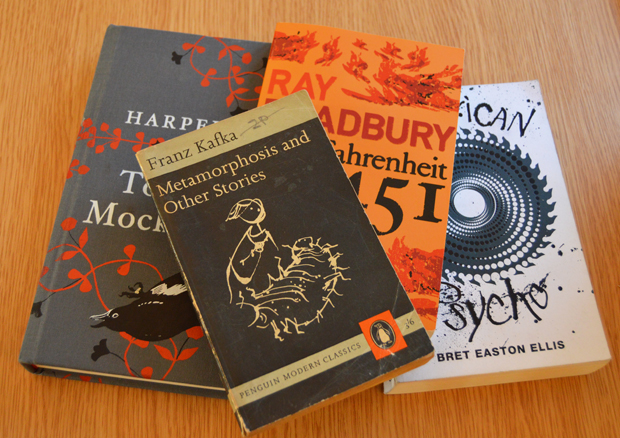
Banned Books (Photo by Aimée Hamilton)
Too many talking animals
You don’t have to have children to imagine what a clichéd kids book might look like. Yes, you’ve guessed right – animated animals. Tigers, mice, dogs – they’re all common in children’s literature. But the Chinese authorities have an uncomfortable relationship with our furry friends.
In 2022 a Hong Kong court sent five people to prison for publishing a series of books called Sheep Village (and of course they banned the books too). To be fair these illustrated books, aimed at kids aged four to seven, didn’t code their political messages well: a flock of sheep (stand-in for Hong Kongers) peacefully resist a savage wolf pack (the guys in Beijing). So this might not be the most absurd example, though it did feel like an absurdly low moment.
However, what was clearly absurd on all levels was the 1931 ban of Alice in Wonderland by the governor of Hunan Province. The book’s crime? Talking animals. Apparently they shouldn’t have used human language and putting humans and animals on the same level was “disastrous”. What unites the CCP with the Republic of China that came before it? Unease around anthropomorphised animals it would seem.
Too many banned books
Ban This Book by Alan Gatz, a book about book bans, has been banned by the state flying the banner for banning books. This is not a tongue twister, riddle or code. It is the crystallisation of the absurdity of banning books.
In January 2024, the book was banned in Indian River County in Florida after opposition from parents linked to Moms for Liberty. According to the Tallahassee Democrat, the school board disliked how the book “referenced other books that had been removed from schools” and accused it of “teaching rebellion of school board authority”. When you are trying to reshape the world in line with your own blinkered view it is probably best not to draw attention to it by calling out reading as an act of rebellion. Just a thought.
The book tells the story of Amy Anne Ollinger’s fight to overturn a book ban in her fictional school library. The book’s conclusion leads Amy Anne “to try to beat the book banners at their own game. Because after all, once you ban one book, you can ban them all”.
This tells us something – the self-harming absurdity of book bans is apparent to kids like Amy Anne but not to the prudish administrators and thuggish groups wielding their mob veto like a weapon. Groups like Moms for Liberty and their fellow censors obscure the darkness of our shared history by removing any reference to it and by pretending it did not happen — not by addressing the root causes or working to ensure it does not happen again.
- Nik Williams, policy and campaigns officer
Too Belarusian
In Belarus, numerous books in the Belarusian language by the country’s best classical and modern writers have been banned, especially following the 2020 presidential election and pro-democracy protests. Unbelievably, Lukashenka’s regime — often called the last dictatorship in Europe and backed by Russia — views Belarusian historical, cultural and national identity as a threat.
Many books in Belarusian have been labelled extremist and even destroyed from the National Library’s collection since the protests started in August 2020. This includes Dogs of Europe by Alhierd Baharevich, works by 19th century writer Vincent Dunin-Marcinkievich and 20th century poet Larysa Hienijush, among others.
- Jana Paliashchuk, researcher on Index’s Letters from Lukashenka’s Prisoners project
Too decadent and despairing
Franz Kafka’s The Metamorphosis, possibly the greatest short story ever written, was banned by both the Nazis and the Soviets. Being a Jewish author, the Nazis burned Kafka’s books on their “sauberen” (cleansing) pyres. But in the Soviet Union, his books were banned as “decadent and despairing”. This was clearly a judgement made by officials without much knowledge of the history of the novel, where so many titles are filled with human despair. Without these, we would not get the contrasting light of decadent writers like Oscar Wilde and JK Huysmans.
- David Sewell, finance director
Too mermaidy
One of my favourite books to read with my son is Julian is a Mermaid by Jessica Love. It’s a beautiful picture book where a young boy dreams of becoming a mermaid after seeing a school / pod (collective noun to be determined) of merfolk on the way to the Coney Island Mermaid Parade, then rummages around his nana’s home for a costume.
In various parts of the USA, Julian has been banned. In a school district in Iowa, it was flagged for removal under a law that “bans books that depict or describe sex acts”, which apparently also covers gender identity — there are definitely no sex acts in this book. In other districts, it’s been fully banned due to representing the LGBTQ+ community.
If book banners in the USA are really worried about kids becoming mermaids, then I’d like to know on what grounds. Because, quite frankly, I always wanted to be a mermaid, and if it turns out it was a viable option, I have some regrets. Personally, I’d be more concerned about Julian ripping down his nana’s curtains to make a tail, à la Julie Andrews making costumes for the Von Trapp children.
- Katie Dancey-Downs, assistant editor
Too accurate
In Egypt, Metro, the country’s first graphic novel by Magdy El Shafee, was quickly banned after publication in 2008 for “offending public morals”. This was likely due to the novel’s depiction of a half-naked woman, inclusion of swear words and general portrayal of poverty and corruption in Egypt during the former president Hosni Mubarak’s 30-year rule. The author was charged under article 178 of the Egyptian penal code for infringing “upon public decency” and fined 5,000 LE. It was eventually republished in Arabic in 2012.
- Georgia Beeston, communications and events manager
Too dystopian
Aldous Huxley’s 1932 dystopian classic Brave New World explores an imagined future centred on productivity and enforced “happiness” at the expense of individual freedom. Set in 2540, society has been stripped of families, with babies manufactured synthetically with specific characteristics, then forced into a predetermined “caste” system. People are encouraged to prioritise short-term gratification through casual sex and taking a “happiness” drug called soma, making them blissfully unaware of their imprisonment within the system.
Since its publication nearly 100 years ago, the novel has caused controversy globally. It was initially banned in Ireland and Australia in 1932 for eschewing traditional familial and religious values, then later banned in India in 1967 for its sexual content, with Huxley even being referred to as a “pornographer” for depicting a society that encourages recreational sex. It is still banned in many classrooms and libraries across America for a range of wild reasons, from use of offensive language and sexual explicitness to racism and “conflict with a religious viewpoint”.
But Huxley’s imagined future is one of horror. He uses themes of enforced, unfettered pleasure and a twisted genetic-based class system to express how humans’ complex problems and moral quandaries cannot be solved by scientific advancement alone. The main point of dystopian fiction is to tell a cautionary tale of the levels of exploitation that society could sink to, in order to save the world at large. While it was undoubtedly shocking and crass for its time, the fact that Huxley’s novel still ruffles feathers reveals a complete misunderstanding of allegory.
Too many lesbians
I first read Radclyffe Hall’s legendary lesbian novel, The Well of Loneliness, published in 1928, with bated breath as a young, closeted queer person. Her portrayal of young woman ‘Stephen’ Gordon and her romance with Mary Llewellyn was wildly liberating and satisfying to read. Of course, as a product of its time it is in many ways outdated and of course laced with problematic values, for example biphobia and misogyny. But it was hugely important in terms of normalising queer relationships over a century ago.
Shortly after publication, the book went to trial in Britain on the grounds of “obscenity” and was subsequently banned — but this is no Lady Chatterley’s Lover. There are no real ‘hot under the collar moments’. The only ‘obscenity’ was the portrayal of two women in a romantic relationship, even though (unlike male homosexuality), lesbianism wasn’t actually illegal in 1928.
- Anna Millward, development officer
Too friendly
The award-winning writer and painter Leo Lionni’s first children’s book Little Blue and Little Yellow (1959) is a short story for young children about two best friends who, one day, can’t find each other. When they meet again, they give each other such a big hug that they turn green.
Despite its important message about the power of love and friendship, the mayor of Venice decided to ban it from all preschools in the province for “undermining traditional family values”. It was one of more than 50 children’s books to have been banned just days after he took up the post after his election in 2015.
- Jessica Ní Mhainín, head of policy and campaigns
Too uncensored
As ironies go, the banning of Ray Bradbury’s Fahrenheit 451 may be the strangest. The novel describes a dystopian future in which books are banned and “firemen” burn any that are found – its title comes from the ignition temperature of paper.
In 1967, a new edition of the book aimed at high schools, known as the Bal-Hi edition, was substantially altered to remove swear words and references to drug use, nudity and drunkenness. Somehow, the censored text came to be used for the mass-market edition in 1973 and “for the next six years no uncensored paperback copies were in print, and no one seemed to notice”, wrote Jonathan R. Eller in the introduction to the 60th anniversary edition of the book.
Readers eventually realised and alerted Bradbury. He demanded that the publisher retract the censored version, writing that he would “not tolerate the practice of manuscript ‘mutilation’”.
- Mark Stimpson, associate editor
Too unflattering
It’s not altogether surprising that UK authorities attempted to prevent the autobiography of former MI5 officer Peter Wright, Spycatcher (co-written by Paul Greengrass), from hitting the shelves. The book did not present British intelligence agencies in a flattering light, and the government’s claims that they were suppressing its publication in the interests of security — rather than to save face — were eventually dismissed by the courts.
However, the ridiculous part about this book banning was that it only applied to England and Wales and the book was freely accessible elsewhere — including Scotland. This led to an absurd situation where newspapers around the world were reporting on the book’s contents while the press in England was subject to a gagging order, despite the information having already been revealed and books being easily shipped into the country. The ban was eventually lifted after it was acknowledged that the book wasn’t exposing any secrets due to its overseas publication.
- Daisy Ruddock, CASE coordinator
Too blasphemous
The most absurd book banning is also, arguably, the most serious in recent history. The Satanic Verses by Salman Rushdie was published in 1988 to deserved critical acclaim. It is a playful and complex novel that examines, among other things, the origins of Islam. The death sentence imposed on the author by Iran’s supreme leader Ayatollah Khomeini was fuelled by, and in turn itself fuelled an ideology that believes that a novel can be blasphemous and its author should be killed. It would be laughable if the consequences weren’t so deadly.
- Martin Bright, editor at large
