29 Oct 2014 | Bahrain, News, Statements
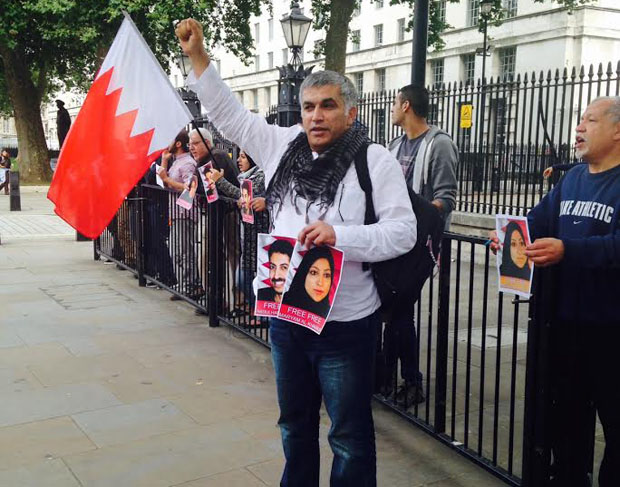
Nabeel Rajab during a protest in London in September (Photo: Milana Knezevic)
Nabeel Rajab has been freed without bail as a court postponed his trail until 20 January.
A Bahraini court had ruled last week that Nabeel Rajab would face criminal charges stemming from a single tweet in which both the Ministry of Interior and the Ministry of Defense allege that he “denigrated government institutions.” The court had postponed the trial until Sunday, 2 November. If convicted, Rajab could face up to six years in prison.
Americans for Democracy & Human Rights in Bahrain (ADHRB), the Bahrain Center for Human Rights (BCHR), the Bahrain Institute for Rights and Democracy (BIRD), and Index on Censorship condemn the criminal prosecution brought against Rajab, denounce his continued detention on charges related to his right to free speech and call for his immediate and unconditional release.
Rajab, President of BCHR and Co-Director of the Gulf Center for Human Rights (GCHR), was summoned to the Cyber Crimes Unit of the Central Investigations Directorate’s (CID) for interrogation and promptly arrested on 1 October after spending months advocating for human rights in Bahrain throughout Europe. After 19 days in pre-trial detention, Mr. Rajab appeared in front of a judge on 19 October, where the court postponed sentencing until 29 October and denied him release on bail.
The international community has been outspoken in condemning the arrest of Rajab and calling for his immediate and unconditional release. The United Nations called his detention “chilling” and argued that it sends a “disturbing message.” The governments of the United States, Norway, France, and Ireland, as well as the President of the European Parliament, United States Ambassador Samantha Power, United States Congressman James McGovern, 13 members of the UK Parliament and 40 members of the European Parliament also called for Mr. Rajab’s release. While the UK government claims to be following the situation closely, it has yet to call for Rajab’s release.
This is not the first time Rajab has faced arbitrary detention. From July 2012 to May 2014, he was detained after calling for and participating in peaceful protests in Bahrain’s capital of Manama. Rajab was also previously sentenced to 3 months imprisonment for allegedly defaming citizens of Muharraq via Twitter. Despite his eventual acquittal by the Court of Appeal, Rajab served most of his sentence.
We, the undersigned human rights organizations, call on the United States, the United Kingdom, the European Union, and other national and international bodies to actively engage the Government of Bahrain to:
- Immediately and unconditionally release Nabeel Rajab;
- drop all charges against him in relation to or retaliation for his work and his exercise of the right to freedom of expression; and
- ensure that all civil society organizations and human rights defenders in Bahrain are able to conduct their work without fear of retaliation or reprisal.
Americans for Democracy & Human Rights in Bahrain (ADHRB)
Bahrain Center for Human Rights (BCHR)
Bahrain Institute for Rights and Democracy (BIRD)
Index on Censorship
This article was originally posted on Wednesday Oct 29 2014 and updated on Sunday Nov 1 2014 at indexoncensorship.org
9 Jul 2012 | Middle East and North Africa, Uncategorized
Nabeel Rajab, president of the Bahrain Center for Human Rights (BCHR) was taken into custody by Bahraini authorities today after a court sentenced him to three months in prison for allegedly defaming the citizens of the village of Muharraq on Twitter. (more…)
16 Oct 2012 | Middle East and North Africa
Saudi Arabia has said it is “insulted” by the announcement of a UK Parliamentary Foreign Affairs Committee inquiry into the UK’s relationship with the Gulf states, in particular Saudi Arabia and Bahrain. In a veiled threat to key trade deals, the country warned that it may “re-evaluate their country’s historic relations” with the UK in response. The inquiry has asked for responses on “how the UK can encourage democratic and liberalising reforms in Saudi Arabia”.
This probe was first announced unofficially by Ann Clwyd MP at an Index on Censorship Bahrain briefing in early September. Attending the briefing on human rights abuses and stalled efforts of reform was Maryam al-Khawaja, Acting President of the Bahrain Center for Human Rights (BCHR). Highlighting censorship and human rights abuses in her country, al-Khawaja said “the UK is to Bahrain what Russia is to Syria”.
In the briefing she pointed out that:
The UK government has made countless pledges to push on Bahrain to implement supposed reforms, but has yet to push forcefully on its partner where it counts…the country continues to perpetuate flagrant human rights violations.
The UK Foreign Office (FCO) regularly refers to Saudi Arabia and Bahrain as “close friends”, “key allies” and “valuable trade partners”. Just yesterday as the inquiry furore was made public the FCO said: “Saudi Arabia is a key strategic partner in the region and one of the closest friends and allies”.
Clearly it is politically expedient to ignore the way Saudi Arabia ruthlessly constricts the freedom of its female population, censors much criticism of the ruling authorities and regularly breaks international human rights law in the way it treats its citizens. Bahrain, another ally, breaks up peaceful protests with teargas, birdshot and police brutality, locking up its citizens for such dreadful crimes as tweeting and “insulting the King”.
Throughout the recent uprisings in North Africa and the Middle East, the UK government openly supported protests and revolutions that toppled dictators in Egypt, Tunisia and Libya. However when the Bahraini people gathered at the Pearl Roundabout in Manama to voice their discontent they were met with a brutal crackdown by the Bahraini authorities aided by Saudi forces. Despite promises of reform this crackdown continues complete with numerous injured protesters, political prisoners, and claims of torture.
And the punishment by the UK government to Saudi Arabia and Bahrain? The UK signs a defence agreement with the Gulf Kingdom to “bolster Bahrain’s security with regards to its regional standing, as well as its internal stability” and remains silent on the issue of human rights abuses in the country.
Index calls upon the UK Foreign Office to live up to its international commitments on human rights and to put real and adequate pressure on Saudi Arabia and Bahrain to reform.
Index and the BCHR both welcome the announcement of this week’s inquiry and plan to submit evidence.
Annette Fisher is international programmes manager at Index
Read more:
Index’s spotlight on Bahrain on the anniversary of the 14 February unrest
19 Sep 2012 | Bahrain Statements, Middle East and North Africa, News
As the Human Rights Council (HRC) prepares to release its final recommendations on Bahrain, Index joins over 100 NGOs in calling for the country to implement the recommendations. Daisy Williams reports
(more…)
