13 Jul 2018 | Magazine, News, Volume 47.02 Summer 2018
[vc_row][vc_column][vc_column_text]
In the summer 2018 issue of Index on Censorship magazine Caroline Muscat takes a closer look at the truths this year’s European Capital of Culture, Valetta in Malta, is hiding
[/vc_column_text][vc_single_image image=”101057″ img_size=”large” add_caption=”yes” alignment=”center”][vc_column_text]
The sprawl of construction sites represents the reality of Malta. It’s a sign of progress, never mind the fact that planning laws are farcical. The country’s affluence is shown by the number of cars on the road, never mind the traffic congestion. Its freedom is evidenced in the number of media outlets and news portals, never mind the fact that they all offer similar content. It’s all about appearance, not substance. Scratch beneath the surface and the problems start to appear.
“National pride has reached historic levels,” Prime Minister Joseph Muscat told more than 100,000 people who flocked to the nation’s capital, Valletta, for its inauguration as Europe’s Capital of Culture 2018. The announcement was made as the country was grappling with the assassination of its most prominent journalist, Daphne Caruana Galizia, and as accusations of a collapse in the rule of law continued to haunt Malta.
Restaurants offering mouth-watering dishes are found across the length and breadth of Malta’s islands, but while digging into a bruschetta few stop to question the sudden influx of Sicilian restaurants that are suspected of being money-laundering fronts for the Sicilian mafia.
Operation Beta, led by the Italian authorities in 2017, culminated in the arrest of 30 people as part of a major clampdown on illegal gaming activities and money laundering linked to a Sicilian family, the Santapaola-Erculanos, linked to the mafia by the Italian media. Almost a year later, Italian police cracked an operation involving Sicilians, Maltese and Libyans smuggling Libyan fuel into the European market. Once again, a link to the Santapaola-Erculano family emerged. A look at the histories of the mafia clans reveals deep family connections to Malta as a hub from which to extend their reach and profits.
The links date back to 1974, when a Sicilian man and his bride went to the Maltese island of Gozo on their honeymoon. They loved the island so much they frequently returned. To the locals who interacted with him in Pjazza San Frangisk, in Victoria, he was known simply as Toto.
But Toto was Salvatore Riina, the mafia boss who terrorised Sicily and made the Italian State tremble while making friends in Malta.
Over the years, Malta has continued to attract shady characters, including politically exposed politicians, from countries including India, Ukraine and Azerbaijan. There are clear risks in probing too deeply into the shadows of modern Malta – not that this is obvious to anyone landing in the country for a fortnight of sun and sea. Popular events, such as the annual music festival the Isle of MTV, continue to offer a distraction on the islands that were once a safe haven for tourists and locals. But the recent release of the Panama Papers linked a Maltese minister, Konrad Mizzi, and the prime minister’s chief of staff, Keith Schembri, to $1.6m payments to Dubai companies. Both deny the claims of payments.
It is now clear that a political party elected in 2013 on the promise of change was not thinking of adding transparency or media freedom. Since the Panama Papers revelations, journalists have piled up stories of scandals, but nothing has changed. Deals selling off the country’s assets continue to be made, shrouded in secrecy. And in the midst of all this, calls for justice for an assassinated journalist continue to echo in the air.
[/vc_column_text][/vc_column][vc_column][/vc_column][vc_column][/vc_column][/vc_row][vc_row][vc_column width=”1/4″][vc_icon icon_fontawesome=”fa fa-quote-left” color=”custom” align=”right” custom_color=”#dd3333″][/vc_column][vc_column width=”3/4″][vc_custom_heading text=”Few stop to question the sudden influx of Sicilian restaurants that are suspected to be money laundering fronts” google_fonts=”font_family:Libre%20Baskerville%3Aregular%2Citalic%2C700|font_style:400%20italic%3A400%3Aitalic”][/vc_column][/vc_row][vc_row][vc_column][vc_column_text]
Daphne Caruana Galizia was killed because of what she exposed. Seven months later, the institutions that failed to protect her are the same institutions that are failing to bring those who ordered her killing to justice. Every month, on the date marking her death, citizens gather to call for justice in the country’s capital. They gather in front of a makeshift memorial before the law courts as a reminder that justice has not been served. Every time, they know they will see each other the following month because nothing will have changed. Yet their presence, and the flowers and candles placed at the foot of the monument, serve as a reminder to the authorities that they will never forget.
Those who mention her name, those who refuse to bow to a society bent by corruption, are insulted and threatened. Journalists and activists keep being reminded of the untold damage they are doing to the country’s reputation. Malta’s image is everything, but it is not what it seems.
When confronted by the news that the European Parliament was sending a delegation to investigate Malta’s anti-money laundering rules, Muscat said: “I invite them to come over to see what a fantastic country we are.” But the Paradise Papers had already shown just how “fantastic” Malta s by casting a dark cloud over its economic miracle.
While workers in other countries have borne the brunt of austerity, the Maltese have never had it so good, shielded by an economic system which relies partly on enticing shell companies to Malta by offering a favourable fiscal regime, in addition to a growing dependence on i-gaming and construction. In addition, Malta’s controversial “sale” of European passports continues, despite concerns about the erosion of democracy.
Living in Malta as a journalist one experiences the stark reality of it all. Those exposing corruption are ostracised and vilified. Their voices are drowned out by the millions spent on the marketing machine to promote Malta and clean its image. Journalism is undermined through an almost complete domination of the narrative by the government – millions of euros spent on PR ridicules weeks of investigative journalism. Government advertising drowns out calls for a democracy that ends corruption and protects freedom of speech.
On 16 May, Labour MP Rosianne Cutajar stood up in parliament and spent 30 minutes criticising the publication of a six-month investigation by The Shift News that exposed pro-government secret Facebook groups with thousands of members posting threats against activists. These posts included threats towards anti-corruption activist Tina Urso, whose home address was also published on the site. Urso filed two complaints with the police, but wasn’t offered any protection.
The MP also said I was sowing the seeds of hatred left behind by Caruana Galizia by attacking the government. Compare this with the exposé of anti-Semitism in the UK Labour Party and the media scandal that followed. In Malta, the scandal was the journalist who dared to speak truth to power.
Caruana Galizia had written: “Malta is in a dangerous place, and now we can no longer say that it is corrupt politicians who have brought it to this point, for it can no longer be denied that those corrupt politicians are a reflection of society.”
In this scenario, the protection of journalists is critical in a landscape that is intolerant of independent thought.
[/vc_column_text][/vc_column][/vc_row][vc_row][vc_column][vc_column_text]
Caroline Muscat is the co-founder of The Shift News, based in Malta
This article was originally published in the Summer 2018 issue of Index on Censorship magazine. Click here to read about the other articles in the issue.
The latest issue of Index on Censorship magazine, Trouble in Paradise, Escape from Reality: what holidaymakers don’t know about their destinations is out now. Buy a subscription. Buy a print copy from bookshops including BFI, Serpentine and MagCulture (London), News from Nowhere (Liverpool), Home (Manchester), and Red Lion Books (Colchester), or via Amazon. Digital versions available via exacteditions.com or iTunes.
Finally, don’t miss our regular quarterly magazine podcast, also on Soundcloud, including an interview with the founder of the Rough Guides, Mark Ellingham. Come by and visit us.
[/vc_column_text][/vc_column][/vc_row][vc_row][vc_column][vc_custom_heading text=”From the Archives”][vc_row_inner][vc_column_inner width=”1/3″][vc_single_image image=”89160″ img_size=”213×287″ alignment=”center” onclick=”custom_link” link=”http://journals.sagepub.com/doi/pdf/10.1080/03064229108535157″][vc_custom_heading text=”Do not disturb” font_container=”tag:p|font_size:24|text_align:left” link=”url:http%3A%2F%2Fjournals.sagepub.com%2Fdoi%2Fpdf%2F10.1177%2F0306422011399822|||”][vc_column_text]2011
In 2011, Charles Young reported that writers, journalists and even DJs are falling foul of Malta’s censorious laws[/vc_column_text][/vc_column_inner][vc_column_inner width=”1/3″][vc_single_image image=”64776″ img_size=”213×287″ alignment=”center” onclick=”custom_link” link=”http://journals.sagepub.com/doi/pdf/10.1080/03064220008536796″][vc_custom_heading text=”Social disturbance” font_container=”tag:p|font_size:24|text_align:left” link=”url:http%3A%2F%2Fjournals.sagepub.com%2Fdoi%2Fpdf%2F10.1177%2F0306422015571882|||”][vc_column_text]March 2015
News footage provided by readers and viewers has entered a new era, where we’re faced with more propaganda, hoaxes and graphic detail than ever before. Vicky Baker looks at the increasingly tough verification process at the BBC’s user-generated content department[/vc_column_text][/vc_column_inner][vc_column_inner width=”1/3″][vc_single_image image=”99282″ img_size=”full” alignment=”center” onclick=”custom_link” link=”http://journals.sagepub.com/doi/pdf/10.1080/03064229308535477″][vc_custom_heading text=”Index around the world” font_container=”tag:p|font_size:24|text_align:left” link=”url:http%3A%2F%2Fjournals.sagepub.com%2Fdoi%2Fpdf%2F10.1177%2F0306422018769585|||”][vc_column_text]Spring 2018
Attacks on journalists are escalating in areas formerly seen as safe,
including the USA and the European Union, says Danyaal Yasin[/vc_column_text][/vc_column_inner][/vc_row_inner][vc_separator][/vc_column][/vc_row][vc_row content_placement=”top”][vc_column width=”1/3″][vc_custom_heading text=”Trouble in Paradise” font_container=”tag:p|font_size:24|text_align:left” link=”url:https%3A%2F%2Fwww.indexoncensorship.org%2F2018%2F04%2Fthe-abuse-of-history%2F|||”][vc_column_text]The summer 2018 issue of Index on Censorship magazine takes you on holiday, just a different kind of holiday. From Malta to the Maldives, we explore how freedom of expression is under attack in dream destinations around the world.
With: Martin Rowson, Jon Savage, Jonathan Tel [/vc_column_text][/vc_column][vc_column width=”1/3″][vc_single_image image=”100843″ img_size=”medium” alignment=”center” onclick=”custom_link” link=”https://www.indexoncensorship.org/2018/06/trouble-in-paradise/”][/vc_column][vc_column width=”1/3″ css=”.vc_custom_1481888488328{padding-bottom: 50px !important;}”][vc_custom_heading text=”Subscribe” font_container=”tag:p|font_size:24|text_align:left” link=”url:https%3A%2F%2Fwww.indexoncensorship.org%2Fsubscribe%2F|||”][vc_column_text]In print, online. In your mailbox, on your iPad.
Subscription options from £18 or just £1.49 in the App Store for a digital issue.
Every subscriber helps support Index on Censorship’s projects around the world.
 SUBSCRIBE NOW[/vc_column_text][/vc_column][/vc_row][vc_row][vc_column][/vc_column][/vc_row]
20 Jun 2018 | News, Volume 47.02 Summer 2018
[vc_row][vc_column][vc_custom_heading text=”Crime writers have less to lose than travel writers in describing the underside of holiday spots, argues Rachael Jolley in the summer 2018 issue of Index on Censorship magazine.” google_fonts=”font_family:Libre%20Baskerville%3Aregular%2Citalic%2C700|font_style:400%20italic%3A400%3Aitalic”][vc_single_image image=”101057″ img_size=”full” add_caption=”yes”][vc_column_text]
When you read a novel, it takes you on a journey to a different time or place. Being an avid reader of crime fiction, my early journeys to Chicago were in the company of Sara Paretsky. I walked the streets with her VI Warshawski. We shot down North Michigan Avenue and headed out to Wrigley Field for the fifth inning. Chicago opened up to me in those books – not always gloriously.
Donna Leon showed me around the small islands of the Venetian Lagoon and Ian Rankin has taken me on numerous tours of the dark closes of Edinburgh, as well as its swankier New Town.
Crime writers have less to lose than many other authors in describing the underside of the cities. After all, their readers don’t expect a fairytale, and their escapism is a different kind from the happy-ever-afters of the perfect beach-read.
Perhaps we get more accurate portrayals of cities or countries by crime writers than in guidebooks or from travel apps.
Take Mexico and the Maldives, for instance. These are sexy holiday destinations, popular with everyone from honeymooners to scuba divers. But when thousands of holidaymakers are packing their sunscreen and swimsuits, do they know of the catastrophic numbers of journalists killed in Mexico in the past few years? Or how journalists in the Maldives are fleeing in fear of their lives?
Ad-hoc, non-scientific research, through the medium of asking friends and family, suggests not. And when that information is received, it is with some shock.
[/vc_column_text][/vc_column][/vc_row][vc_row][vc_column width=”1/4″][vc_icon icon_fontawesome=”fa fa-quote-left” color=”custom” align=”right” custom_color=”#dd3333″][/vc_column][vc_column width=”3/4″][vc_custom_heading text=”The results are stark. Many top tourism destinations do terribly on freedom of expression.” google_fonts=”font_family:Libre%20Baskerville%3Aregular%2Citalic%2C700|font_style:400%20italic%3A400%3Aitalic”][/vc_column][/vc_row][vc_row][vc_column][vc_column_text]
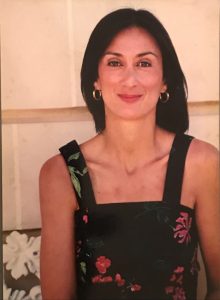
The other side: Maltese journalist Daphne Caruana Galizia was murdered on 16 October 2017
Mexico is ranked 147th out of 180 in the 2018 Reporters Without Borders World Press Freedom Index, down from 75th in 2002. During this period, tourist numbers have continued to go up. Meanwhile, 4.6% of the government’s annual spend continues to go on tourism, significantly more than is spent in Brazil and New Zealand, for instance.
Travel and tourism delivers 6.9% of Mexico’s GDP, compared with 3.3% of Brazil’s and 5.1% of New Zealand’s. No wonder, then, that Mexico’s government is prepared to invest in tourism, and to keep that tap firmly switched on.
Informed tourists could be a powerful pressure point on governments that have been practising repression of those voices raised in criticism, or that don’t bother to pursue the criminals who threaten or kill those voicing dissent.
At this year’s Hay Festival, I was on a panel with Paul Caruana Galizia, son of the murdered journalist Daphne, as well as Malta journalist Caroline Muscat of The Shift News, and BBC Europe editor Katya Adler. Paul talked about his mother’s work, the pressures she was under and how she pursued her investigations. We discussed the wider situation in Malta, where 34 libel cases against Daphne have, since her death, rolled over to the rest of the family. During the question and answer session, some members of the audience said they had no idea about what was going on in Malta, even though they went there on holiday, and asked what they could do to help.
Paul suggested that anyone holidaying on the Mediterranean island might mention being aware of the case to local people they met. The island was dependent on tourism, and if the Maltese felt this could be affected there would be more pressure on the government to alter its attitude, and legislation, on media freedom.
He also believed the Maltese government was much more worried about international attitudes than local ones.
In places where freedom of expression is under pressure – and Malta, the Maldives and Mexico are just a few of them – tourism is often a valuable asset. So visitors who are aware of the wider situation could be advocates for change.
According to analysis of travel, tourism, financial and freedom-of-expression data carried out for Index on Censorship magazine by Mark Frary, there are indications that some tourists want to know more than whether or not a destination has a good beach before they head off on holiday.
Data on travel patterns suggest that travellers also “reward” destinations that change legislation or the environment, his analysis suggests, with Argentina picking up significant tourist numbers after it became the first South American country to make gay marriage legal.
In this issue, we have asked reporters around the world to dig into the details of popular holiday destinations to look at their records on freedoms, such as the right to protest, the right to debate and freedom of the media. The results are stark. Many top tourism destinations do terribly on freedom of expression.
In post civil war Sri Lanka, there was a period of hope after the election of Prime Minister Maithripala Sirisena in 2015. Many hoped that this beautiful island could have a future that was less violent, more equal and more open. Those hopes are now looking tarnished. As Meera Selva reports for the magazine, the country’s tourist numbers grew spectacularly in 2017. But while tourists flocked in, the great improvement was not going as well as Sri Lankans had wished.
The prime minister has reactivated the Press Council – a body with the power to imprison journalists – and civil rights activists report threats against them. In this potential Eden, the garden is not as green and pleasant as predicted.
Pretty beach paradise Baja California Sur is a popular holiday destination, particularly for Americans. But not many will know that it also has the second-highest murder rate in Mexico, behind the western state of Colima, according to government data. The dangers of being an investigative journalist there are particularly high, with some living under 24-hour protection, as Stephen Woodman reports in the magazine. Again, this is a place where many (probably most) tourists are unaware of the fuller picture of the place where they are happily enjoying the sunshine.
As someone with a heritage collection of guidebooks from publishers including Lonely Planet, Rough Guides and Footprint, it is easy for me to flick through the pages and see that those guides have made a fair effort to inform readers on questions of human rights, politics and safety in the past.
But guidebooks are carried by far fewer travellers these days. According to the Financial Times, from 2005 to 2014, 9% fewer travellers left the UK but guidebook sales fell by 45%.
With most people looking to the web for all their holiday information, are they finding themselves as well-informed as they would have been with a well-thumbed book under their arm?
An April 2018 travel section article about Malta’s capital Valletta on The Guardian’s website doesn’t mention the politics or human rights record of the island. Nor, as far as I could find, did the Lonely Planet website section on Malta. While, of course, it would be possible to find news about those issues on different parts of The Guardian site, or elsewhere on the web, it’s certainly not connecting the dots for travellers.
With the printed travel sections of newspapers under pressure from advertisers – and far smaller than they were a decade ago – there is little space to create in-depth reports, and travel articles that include gritty details as well as the delights seem few and far between.
At the upcoming Index magazine launch and summer party on 4 July, our panel of experts will discuss what responsibility authors might have to tell their readers about the good, the bad and the ugly sides of any destination. It should be an interesting evening, chaired by BBC World reporter Vicky Baker, who also writes for Guardian Travel. If you would like to join us, email [email protected] to grab a free ticket.
And since we are just back from the Hay Festival, we can also recommend our special Hay Festival podcast, where deputy editor Jemimah Steinfeld chats to three authors about taboos. Catch it on Soundcloud.com/indexmagazine.
Finally, don’t miss our regular quarterly magazine podcast, also on Soundcloud, including an interview with the founder of the Rough Guides, Mark Ellingham. Come by and visit us.
The latest issue of Index on Censorship magazine, Trouble in Paradise, Escape from Reality: what holidaymakers don’t know about their destinations is out now. Buy a subscription. Buy a print copy from bookshops including BFI, Serpentine and MagCulture (London), News from Nowhere (Liverpool), Home (Manchester), and Red Lion Books (Colchester), or via Amazon. Digital versions available via exacteditions.com or iTunes.
[/vc_column_text][/vc_column][/vc_row][vc_row content_placement=”top”][vc_column width=”1/3″][vc_custom_heading text=”Trouble in paradise” font_container=”tag:p|font_size:24|text_align:left” link=”url:https%3A%2F%2Fwww.indexoncensorship.org%2F2018%2F06%2Ftrouble-in-paradise%2F|||”][vc_column_text]The summer 2018 issue of Index on Censorship magazine takes a special look at how holidaymakers’ images of palm-fringed beaches and crystal clear waters contrast with the reality of freedoms under threat
With: Ian Rankin, Victoria Hislop, Maria Ressa [/vc_column_text][/vc_column][vc_column width=”1/3″][vc_single_image image=”100776″ img_size=”medium” alignment=”center” onclick=”custom_link” link=”https://www.indexoncensorship.org/2018/06/trouble-in-paradise/”][/vc_column][vc_column width=”1/3″ css=”.vc_custom_1481888488328{padding-bottom: 50px !important;}”][vc_custom_heading text=”Subscribe” font_container=”tag:p|font_size:24|text_align:left” link=”url:https%3A%2F%2Fwww.indexoncensorship.org%2Fsubscribe%2F|||”][vc_column_text]In print, online. In your mailbox, on your iPad.
Subscription options from £18 or just £1.49 in the App Store for a digital issue.
Every subscriber helps support Index on Censorship’s projects around the world.
SUBSCRIBE NOW[/vc_column_text][/vc_column][/vc_row]
23 May 2018 | Journalism Toolbox Spanish
[vc_row][vc_column][vc_custom_heading text=”Canan Coşkun, periodista en el diario Cumhuriyet, se enfrenta a dos juicios por su trabajo periodístico. Nos habla de su actitud frente a los peligros de la vida como reportera en Turquía”][/vc_column][/vc_row][vc_row][vc_column][vc_column_text]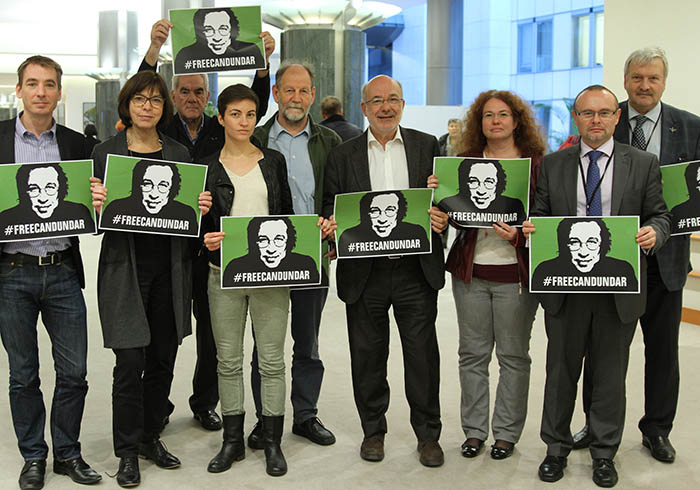
El Grupo Green / EFA campaña por la liberación del periodista Can Dundar que después de su reportaje sobre transportes de armas en Turquía fue encarcelado. Crédito: Rebecca Harms / Flickr[/vc_column_text][/vc_column][/vc_row][vc_row][vc_column][vc_column_text]
Hace un tiempo que, cada dos o tres semanas, veo a algún colega salir del juzgado camino de prisión, o consigo robar unos momentos con algún compañero de trabajo detenido, al que echo mucho de menos, bajo la atenta mirada de las autoridades. Pero no le tenemos miedo a esta oscuridad como de calabozo: los periodistas solo hacemos nuestro trabajo.
Soy reportera judicial para Cumhuriyet desde 2013, así que paso la mayor parte de mi vida laboral en los juzgados. Todos tenemos momentos imposibles de olvidar en nuestras vidas como profesionales. Para mí, uno de esos momentos fue el 5 de noviembre de 2016, el día que arrestaron a 10 de nuestros redactores y coordinadores. Estaba esperando a la decisión del tribunal justo al otro lado de la barrera en el juzgado y, en el instante en que escuché el veredicto, me recorrió una ráfaga de orgullo por nuestros 10 redactores y coordinadores, seguida de la ira y de una profunda depresión por el destino de mis amigos.
Sentí orgullo porque la decisión del tribunal mencionó el hecho de que habían sido arrestados por su trabajo periodístico. Al enumerar ejemplos de nuestros reportajes como una de las razones del arresto, el juez cogió la insistencia del gobierno en que «no habían sido arrestados por periodistas» y la arrojó por la borda. Sentí ira y tristeza porque estaban enviando a nuestros amigos a una cautividad indefinida. La policía ni siquiera nos permitió despedirnos de nuestros colegas, que estaban apenas a 30 o 40 metros de distancia, al otro lado de una barrera. Pero, pese a la multitud de emociones que sentí, el miedo no estaba entre ellas. Cuando los ataques al periodismo se dan a tal escala, el miedo se convierte en un lujo.
Tras el arresto de nuestros diez compañeros, empezaron a llegar muchos periodistas de toda Europa a la redacción de nuestro periódico. Nuestros colegas extranjeros querían saber lo que había pasado y cómo nos sentíamos, y todos tenían la misma pregunta: «¿Tenéis miedo?». Desde noviembre, los arrestos a periodistas han sido continuos y regulares. Pero, como aquel día, mi respuesta a sus preguntas es, simple y llanamente: «¡No!».
No tenemos miedo porque estamos haciendo nuestro trabajo, y nuestro trabajo es lo único que nos preocupa. No tenemos miedo porque nosotros también nos sentimos como si hubiéramos pasado estos largos meses en la prisión de Silivri con nuestros compañeros. No tenemos miedo porque ya apenas hay diferencia entre estar dentro o fuera de prisión. No tenemos miedo porque nuestros colegas presos mantienen la cabeza bien alta. No tenemos miedo porque Fethullah Gülen, el clérigo exiliado acusado por el gobierno de estar tras el fallido intento de golpe del año pasado, no fue nuestro «cómplice» jamás. No tenemos miedo porque el Cumhuriyet que los gobiernos de todas las épocas han intentado silenciar solo informaba, informa e informará.
Ahmet Şık, un reportero de mi periódico, lleva en prisión provisional desde diciembre de 2016. Anteriormente, en 2011, junto al ex Jefe de Estado General İlker Başbuğ y multitud de soldados, policías, periodistas y académicos, Şık pasó más de un año en prisión por el caso «Ergenekon». Los acusaron de estar tratando de derrocar al gobierno.
Şık está actualmente bajo custodia acusado de conspirar con el movimiento de Gülen. Pero debido a las características del sistema judicial turco, el caso por el que arrestaron a Şık en 2011 sigue pendiente, lo cual nos dio la oportunidad de verlo en el juzgado el 15 de febrero. Esperé fuera de la sala, junto a las puertas. Cuando las abrieron, lo único que vi fue una cara sonriendo de esperanza: era la primera vez en meses que podía ver a sus amigos. Aunque Şık es un periodista con mucha más experiencia que yo, su mesa estaba cerca de la mía en la redacción, y lo echaba de menos.
Durante aquella sesión, resumió la lucha que existe a día de hoy por continuar la labor periodística en un estado de excepción de este modo: «La historia de los que creen tener el poder y lo utilizan para perseguir a los periodistas es tan antigua como la del mismo periodismo».
El diciembre pasado, seis periodistas, incluidos algunos de mis amigos, fueron retenidos durante 24 días a causa de una investigación sobre el hackeo de los emails del ministro Berat Albayrak. (Albayrak es el yerno del Presidente Recep Tayyip Erdogan.) Más adelante, el juez ordenó prisión preventiva para tres de estos periodistas. Durante este tiempo uno de ellos, Mahir Kannat, fue padre, pero no pudo ver a su hijo. A su compañero apresado, Tunca Öğreten, no le permitieron enviar ni recibir cartas, ni ver a nadie salvo a su familia inmediata. Tuvo que pedirle matrimonio a su novia a través de sus abogados.
Hace poco escuché a uno de estos periodistas relatar un recuerdo de su tiempo en el juzgado. Al notar que su fe en la justicia se tambaleaba, en un intento por salir libres, recurrieron a supersticiones durante las vistas. Metin Yoksu, un periodista liberado, dijo que tres de ellos se habían sentado cerca de la salida y habían reemplazado los cordones de sus zapatos —los cuales les habían quitado— por cordones hechos de trozos de botellas de agua. ¿El resultado? Los que se habían sentado cerca de la puerta de salida fueron los que salieron libres.
La confianza en el sistema judicial turco se ha desmoronado hasta tal punto que ahora nos amparamos en la superstición. Qué deprimente.
[/vc_column_text][/vc_column][/vc_row][vc_row][vc_column][vc_column_text]
Para leer sobre el proyecto de Index «Turquía sin censura», visita indexoncensorship.org
Traducido del turco John Butler
Traducido al español por Arrate Hidalgo
La periodista Canan Coşkun es reportera judicial en Cumhuriyet. Actualmente se enfrenta a cargos de difamación a la identidad turca, la República de Turquía y los órganos e instituciones estatales por uno de sus artículos. El artículo cubría el caso de un camión lleno de armas escondidas bajo un cargamento de cebollas. También se la acusa de haber retratado como objetivos a los policías que luchan contra el periodismo para un reportaje sobre los arrestos a kurdos turcos.
[/vc_column_text][/vc_column][/vc_row][vc_row][vc_column width=”1/3″][vc_custom_heading text=”Subscribe”][vc_column_text]In print, online. In your mailbox, on your iPad.
Subscription options from £18 or just £1.49 in the App Store for a digital issue.
Every subscriber helps support Index on Censorship’s projects around the world.
SUBSCRIBE NOW[/vc_column_text][/vc_column][vc_column width=”1/3″][vc_custom_heading text=”Listen”][vc_column_text]Historian Rana Mitter talks about China’s current historical narrative, broadcaster Bettany Hughes discusses how memory affects history and Omar Mohammed talks on the dangers of recording history under Isis in this Index magazine podcast.[/vc_column_text][/vc_column][vc_column width=”1/3″][vc_custom_heading text=”Read”][vc_column_text]Through a range of in-depth reporting, interviews and illustrations, the spring 2018 Index on Censorship magazine explores how history is being abused by countries and groups around the world.
With: Neil Oliver, Louisa Lim, Simon Callow[/vc_column_text][/vc_column][/vc_row]
21 May 2018 | Digital Freedom, European Union, Germany, News, Russia, United States
[vc_row][vc_column][vc_single_image image=”85524″ img_size=”full” alignment=”center”][vc_column_text]For around six decades after WWII ideas, laws and institutions supporting free expression spread across borders globally. Ever more people were liberated from stifling censorship and repression. But in the past decade that development has reversed.
On April 12 Russian lawmakers in the State Duma completed the first reading of a new draft law on social media. Among other things the law requires social media platforms to remove illegal content within 24 hours or risk hefty fines. Sound familiar? If you think you’ve heard this story before it’s because the original draft was what Reporters Without Borders call a “copy-paste” version of the much criticized German Social Network law that went into effect earlier this year. But we can trace the origins back further.
In 2016 the EU-Commission and a number of big tech-firms including Facebook, Twitter and Google, agreed on a Code of Conduct under which these firms commit to removing illegal hate speech within 24 hours. In other words what happens in Brussels doesn’t stay in Brussels. It may spread to Berlin and end up in Moscow, transformed from a voluntary instrument aimed at defending Western democracies to a draconian law used to shore up a regime committed to disrupting Western democracies.
US President Donald Trump’s crusade against “fake news” may also have had serious consequences for press freedom. Because of the First Amendment’s robust protection of free expression Trump is largely powerless to weaponise his war against the “fake news media” and “enemies of the people” that most others refer to as “independent media”.
Yet many other citizens of the world cannot rely on the same degree of legal protection from thin-skinned political leaders eager to filter news and information. The Committee to Protect Journalists (CPJ) has documented the highest ever number of journalists imprisoned for false news worldwide. And while 21 such cases may not sound catastrophic the message these arrests and convictions send is alarming. And soon more may follow. In April Malaysia criminalised the spread of “news, information, data and reports which is or are wholly or partly false”, with up to six years in prison. Already a Danish citizen has been convicted to one month’s imprisonment for a harmless YouTube video, and presidential candidate Mahathir Mohammed is also being investigated. Kenya is going down the same path with a draconian bill criminalising “false” or “fictitious” information. And while Robert Mueller is investigating whether Trump has been unduly influenced by Russian President Putin, it seems that Putin may well have been influenced by Trump. The above mentioned Russian draft social media law also includes an obligation to delete any “unverified publicly significant information presented as reliable information.” Taken into account the amount of pro-Kremlin propaganda espoused by Russian media such as RT and Sputnik, one can be certain that the definition of “unverified” will align closely with the interests of Putin and his cronies.
But even democracies have fallen for the temptation to define truth. France’s celebrated president Macron has promised to present a bill targeting false information by “to allow rapid blocking of the dissemination of fake news”. While the French initiative may be targeted at election periods it still does not accord well with a joint declaration issued by independent experts from international and regional organisations covering the UN, Europe, the Americans and Africa which stressed that “ general prohibitions on the dissemination of information based on vague and ambiguous ideas, including ‘false news’ or ‘non-objective information’, are incompatible with international standards for restrictions on freedom of expression”.
However, illiberal measures also travel from East to West. In 2012 Russia adopted a law requiring NGOs receiving funds from abroad and involved in “political activities” – a nebulous and all-encompassing term – to register as “foreign agents”. The law is a thinly veiled attempt to delegitimise civil society organisations that may shed critical light on the policies of Putin’s regime. It has affected everything from human rights groups, LGBT-activists and environmental organisations, who must choose between being branded as something akin to enemies of the state or abandon their work in Russia. As such it has strong appeal to other politicians who don’t appreciate a vibrant civil society with its inherent ecosystem of dissent and potential for social and political mobilisation.
One such politician is Victor Orban, prime minister of Hungary’s increasingly illiberal government. In 2017 Orban’s government did its own copy paste job adopting a law requiring NGOs receiving funds from abroad to register as “foreign supported”. A move which should be seen in the light of Orban’s obsession with eliminating the influence of anything or anyone remotely associated with the Hungarian-American philanthropist George Soros whose Open Society Foundation funds organisations promoting liberal and progressive values.
The cross-fertilisation of censorship between regime types and continents is part of the explanation why press freedom has been in retreat for more than a decade. In its recent 2018 World Press Freedom Index Reporters Without Borders identified “growing animosity towards journalists. Hostility towards the media, openly encouraged by political leaders, and the efforts of authoritarian regimes to export their vision of journalism pose a threat to democracies”. This is something borne out by the litany of of media freedom violations reported to Index on Censorship’s Mapping Media Freedom, which monitors 43 countries. In just the last four years, MMF has logged over 4,200 incidents — a staggering array of curbs on the press that range from physical assault to online threats and murders that have engulfed journalists.
Alarmingly Europe – the heartland of global democracy – has seen the worst regional setbacks in RSF’s index. This development shows that sacrificing free speech to guard against creeping authoritarianism is more likely to embolden than to defeat the enemies of the open society.[/vc_column_text][/vc_column][/vc_row][vc_row][vc_column width=”1/2″][vc_single_image image=”100463″ img_size=”full” onclick=”custom_link” img_link_target=”_blank” link=”http://www.freespeechhistory.com”][/vc_column][vc_column width=”1/2″][vc_column_text]
A podcast on the history of free speech.
Why have kings, emperors, and governments killed and imprisoned people to shut them up? And why have countless people risked death and imprisonment to express their beliefs? Jacob Mchangama guides you through the history of free speech from the trial of Socrates to the Great Firewall.[/vc_column_text][/vc_column][/vc_row][vc_row][vc_column][vc_basic_grid post_type=”post” max_items=”12″ style=”load-more” items_per_page=”4″ element_width=”6″ grid_id=”vc_gid:1526895517975-5ae07ad7-7137-1″][/vc_column][/vc_row]
