1 Apr 2022 | News, Russia, Ukraine
Oleksandra Matviichuk is head of the Centre for Civil Liberties in Kyiv. She recorded this video for Index on Censorship to appeal to the international community to act over Russian abuses of free expression in the Ukrainian territories occupied by Russian troops since 24 February. She is particularly concerned with beatings and abductions of protesters and journalists in cities in the southeast of the country and names Khakova, Mariupol, Kherson and Berdyansk in her powerful testimony.
Index has been working closely with members of the Ukrainian media and civil society since the outbreak of the conflict. It is our intention to build a network of journalists, writers and artists in Ukraine itself and in the diaspora to help keep the outside world informed.
Index was inspired by dissidents in Russia and Czechoslovakia who protested against the Soviet invasion of 1968. We are proud to stand by those who continue to fight for freedom of expression in Ukraine today.
14 Mar 2022 | News, Russia, Ukraine
It was never easy for hromadske. The independent Ukraine broadcaster was set up in 2013 during the dark days of Viktor Yanukovich, the pro-Russian President of Ukraine. Founded originally as an independent TV station, hromadske (public, in Ukrainian), prided itself on its freedom from control by oligarchs or the state even after Yanukovych was forced to flee by the “Maidan” protests of 2014.
Over the years journalists at the station had adapted to shifts in the media landscape and by the time of the Russian invasion hromadske was streaming topical videos on You Tube and Facebook with special reports every Tuesday and Thursday.
“From January 2022 we changed our model and had no broadcasts, only irregular live streams on the spot from what we considered to be major events,” producer Kostan Nechyporenko tells Index on Censorship. These included the treason trial of former President Petro Poroshenko and major demonstrations.
“After 24 February things changed dramatically,” says Kostan. “It was tense in the first few days and people moved out of Kyiv. We had a backup plan in case of invasion.” The station moved its studio from the centre of Ukraine, close to the country’s parliament building, to a temporary base in Vynittsia, halfway between the capital and the Moldovan border.
“We left a lot of our gear,” says Kostan. We took our most important things. We had to take care of the website as a priority.” The producer moved with his family to the countryside outside Kyiv but plans to return to the office for more equipment this week. Meanwhile, he organises logistics for hromadske crews still reporting all over the country. The film making capacity of hromadske was initially reduced, but the team took the opportunity to revive broadcasts and there is now an hour-long programme every evening at 6.30pm.
The whole mission of hromadske has now changed. “Only the video production had some problems in the early days of the war. The website and social media were working overtime and much more intensely than before. After the first five or six days the situation changed with video production too. Now we produce two to three videos a day, though they might be made in a rush. And because of the war, we’re back to digital broadcasting, though it’s of poorer quality and from a makeshift studio.”
Kostan has no doubt hromadske journalists are at mortal risk from the Russian forces. At the beginning of the war, one of his colleagues, whose must remain anonymous for security reasons, was already in the Donbas region in the east of the country to report on the shelling of Shchastia in the Luhansk region. The reporter remained there when the war started and reported from the front, but had serious problems getting out.
“Our journalist found a car and went to the front line again in the Zaporizhzhia region,” Kostan continues. “The car got shot by a Russian tank so was abandoned. The Russians took a laptop, camera and personal belongings.” Thankfully, the reporter was able to hide in an abandoned house and contact her colleagues at hromadske the next morning.
A second correspondent narrowly escaped from Irpin, on the northwest edge of Irpin, where New York Times journalist Brent Renaud was killed.
The hromadske project was founded during a flowering of independent media in Ukraine and fiercely protected its freedom from the influence of oligarchs and government. The independent values remain more important than ever as it continues to report from Ukraine under siege.
11 Mar 2022 | Opinion, Russia, Ruth's blog, Ukraine
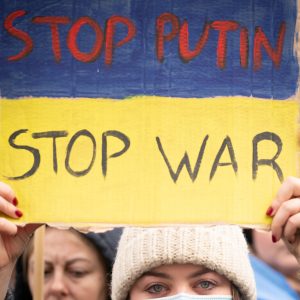
Protests against the Russian invasion of Ukraine. Photo: Stefan Rousseau/PA Wire/PA Images
I had planned to write this week on International Women’s Day. I wanted to feature the female war journalists who are on the frontline as the artillery falls in Ukraine. The brave protesters in Russia who have made their views on the war clear, in spite of the fear of detention. The Russian female scientists who added their names to a joint letter in the academic periodical Trinity Option – causing the publication to be blocked by the Russian state censor. I wanted to write of the amazing women in Myanmar and Hong Kong and Afghanistan and Belarus who keep the dream of democracy alive.
Thankfully these brave women are still fighting the good fight. Inspiring us every day.
And as important as their stories are – and we will keep covering them at Index both in the magazine and on our website, it’s the faces on our media which are dominating my thoughts.
I feel shell-shocked, unable to turn off the news, unable to look away from the devastation being wrought by the Russian military on innocent civilians. Of course, we only know what is happening in Ukraine because we are lucky enough to have independent journalism and media plurality. And as much as I keep holding onto that – it’s the images of the shelled hospital in Mariupol, the pregnant women stumbling from the wreckage, the children sobbing as they looked for help, that I cannot move on from.
War is ugly and the innocent are always caught up in the horror. This has been true since the beginning of time. But there are some images we never thought we would see again on the streets of Europe. Children dying of starvation, residential areas targeted, Holocaust survivors once again exposed to war and fleeing their homes. War crimes happening less than 1,750 miles from where I type.
For those of us who have followed closely the war in Syria, none of this should come as a surprise. And it doesn’t but that does not make the realities on our screens any easier. Russian misinformation, propaganda and lies is adding insult to injury – I won’t share their appalling statements on the events in Mariupol, as their lies need no audience but never have I been more grateful for a free press and to live in a democratic society.
So, as we mark International Women’s Day this week my heart is with the people of Ukraine. I am inspired by their collective bravery in the face of Putin’s tyranny and violence. I grieve with them as they face the reality of war and I stand with them against the lies and deceit of the Russian Federation.
4 Mar 2022 | Opinion, Russia, Ruth's blog, Ukraine
Today marks nine days since Putin unilaterally declared war on Ukraine, invading a sovereign state and attempting to redraw the world order as we know it. Thanks to our independent and free media we have all witnessed the coordinated Russian military attacks from land, sea and air against an innocent population who sought nothing more than to be free. Every one of us is now a witness, for better or worse, to the heart-breaking events happening in mainland Europe. There can be no excuses of ignorance, no turning the other way and no pretence that this isn’t happening on our watch.
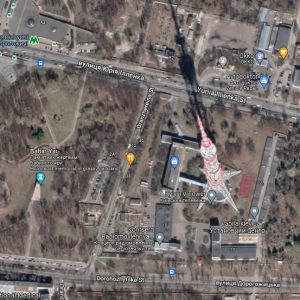
An aerial view of the TV tower and Babyn Yar Holocaust Memorial in Kyiv. Photo: Google
On Tuesday Putin’s forces committed what can only be considered a war crime in Kyiv – where they targeted the main TV tower and also hit the Babyn Yar Holocaust memorial, the site of the largest mass grave in Europe. Five civilians were burned alive, in a European capital, in the twenty-first century. This is only one of the devastating atrocities we have seen reported in the last week – the International Criminal Court has already determined that there is enough evidence to launch a probe into war crimes perpetuated by Russian forces and 38 world leaders have made the largest ever referral to ICC with evidence of potential war crimes perpetuated by Putin’s forces.
On Wednesday Ukrainian Emergency Services announced that over 2,000 Ukrainian civilians have been killed by Russian actions since the invasion began.
Overnight, for the first time in world history, Russian troops targeted a nuclear power facility in Zaporizhzhia, something which could have had terrible consequences for us all.
And this morning the Russian government blocked access to the BBC Russian service website after the Russian language website’s audience had grown from 3.1 million people to 10.7 million since the invasion.
The news is bleak; every day there is more despair, more death and more destruction. Every conversation I have had over the last week has not just touched on events in Ukraine but returned to them again and again. Tears have been shed throughout Europe and impartial and independent media coverage has never been more important.
But even in the midst of war there is hope. Humanity does indeed prevail. Small acts of kindness, of resistance, of rebellion have inspired us all. From the unarmed Ukrainians who refused to let the tanks pass to the exceptional bravery of the journalists who are at the frontline reporting hourly on events, and those in Russia who have been trying to report the facts of the war.
Whilst I could have dedicated this entire blog to the incredibly impressive Volodymyr Zelenskiy and other politicians in Ukraine who are leading from the front, there are others whose bravery I would like to highlight. Every day since the invasion began anti-war protestors have made their voices heard across Russia and Belarus.
Ovd-Info reports that as of this morning 8,163 Russians have been arrested for protesting the war in towns and cities across the country. The Duma has brought in emergency legislation which will now enable jail terms of up to 15 years for spreading ‘fake information’ about the armed forces – this would include saying that the war isn’t going to plan. In response one of the final independent TV stations – Dozhd has closed up shop – their final programme an act of defiance as it showed the staff walking off the set. In Putin’s Russia challenging him or the status quo is a very dangerous thing to do – these people are heroes, using all the tools at their disposal to demonstrate their dissent.
While there are people who are willing to say No, to highlight the impact of an authoritarian regime, to fight for our shared human rights – then there is hope.
Index stands with Ukraine and we stand with the people of Russia who oppose Putin’s aggression.
