23 Jan 2015 | News
Bahrain
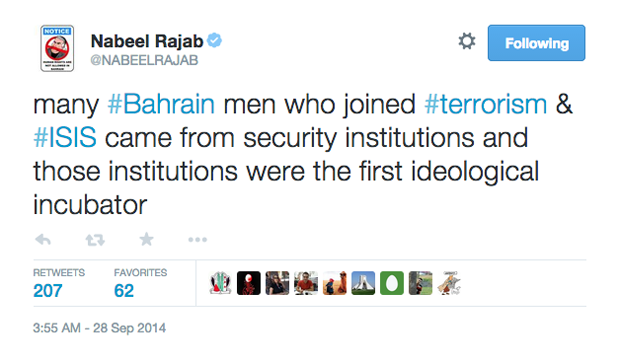
This week, prominent Bahraini human rights activist Nabeel Rajab was handed down a six month suspended sentence over a tweet in which both the country’s ministry of interior and ministry of defence allege that he “denigrated government institutions”. Rajab was only released last May after two years in prison, over charges that included sending offensive tweets. His experience is not unique in Bahrain. In May 2013, five men were arrested for “insulting the king” via Twitter.
Turkey
A former Miss Turkey was recently arrested for sharing a satirical poem criticising the country’s President Recep Tayyip Erdogan on her Instagram account. She is set to go on trial later this year. Turkey has a chequered relationship with social media, temporarily banning both Twitter and YouTube in the wake of the Gezi Park protests, in large part organised and reported through social media. In 2013, authorities arrested 25 individuals for spreading “untrue information” on social media.
Saudi Arabia

(Photo: Gulf Centre for Human Rights)
In late 2014, women’s rights activist Souad Al-Shammari was arrested during an interrogation over some of her tweets. The charges against her include “calling upon society to disobey by describing society as masculine” and “using sarcasm while mentioning religious texts and religious scholars”, according to the Gulf Centre for Human Rights.
France
![(Photo: « Source : Réseau Voltaire » [CC BY-SA 3.0 (http://creativecommons.org/licenses/by-sa/3.0)], via Wikimedia Commons](https://www.indexoncensorship.org/wp-content/uploads/2015/01/Dieudonné_Axis_for_Peace_2005-11-18.jpg)
(Photo: Réseau Voltaire [CC BY-SA 3.0], via Wikimedia Commons)
Following the series of terrorist attacks in Paris in early January, at least 54 people have been detained by police for “defending or glorifying terrorism”. A number of the cases, including against comedian Dieudonne M’bala M’bala, are believe to be connected to social media comments.
Britain
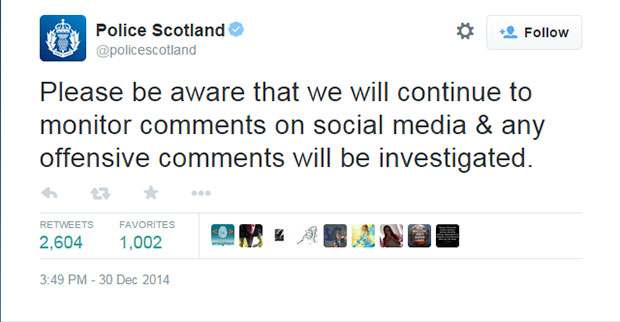
A 22 year old man was arrested in for “malicious communication” following Facebook messages made in response to the murder of soldier Lee Rigby, and another user was arrested after taunting Olympic diver Tom Daly about his dead father. More recently, police arrested a 19-year-old man over an “offensive” tweet about a bin lorry crash in Glasgow that killed six people. TV personality Katie Hopkins, known for her controversial tweets, was also reported to Scottish police following some tasteless tweets about about Scots. The incident prompted Scottish police the to post their now infamous tweet declaring they would continue to “monitor comments on social media“.
China
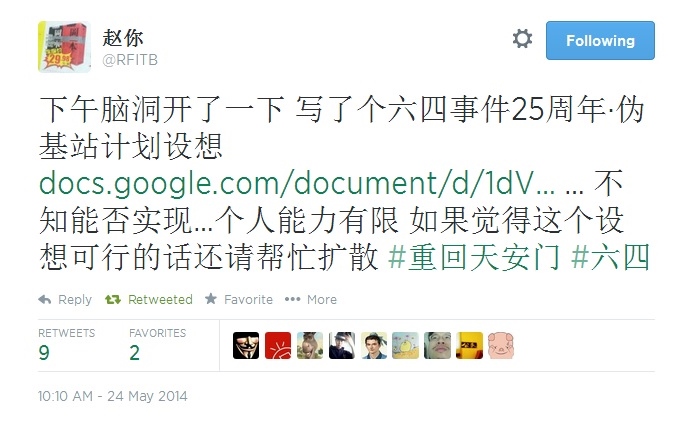
Online activist Cheng Jianping was arrested on her wedding day in 2010 for “disturbing social order” by retweeting a joke by her fiance. She was sentenced to one year of “re-education through labour”. Twitter is officially banned in China, and microblogging site Weibo is a popular alternative. In 2013, four Weibo users were arrested for spreading rumours about a deceased soldier labelled a hero and used in propaganda posters. The four were said to have “incited dissatisfaction with the government”, according to the BBC.
Australia

A teen was arrested prior to attending a Pink concert in Melbourne for tweeting: “I’m ready with my Bomb. Time to blow up #RodLaverArena. Bitch.” The tweet referenced lyrics from the American popstar’s song Timebomb.
India
An Indian medical student was arrested in 2012 over a Facebook post questioning why her city of Mumbai should come to a standstill to mark the death of a prominent politician. Her friend was arrested for liking the post. Both were charged with engaging in speech that was offensive and hateful.
United States
Back in 2009, a New York man was arrested, had his home searched and was placed under £19,000 bail for tweeting police movements to help G20 protesters in Pittsburgh avoid the officers. According to Global Voices, it is unclear whether his actions were actually illegal at the time.
Guatemala
A man was arrested in 2009 for causing “financial panic” by tweeting that Guatemalans should fight corruption by withdrawing all their money from banks.
This article was posted on 23 January, 2015 at indexoncensorship.org
10 Nov 2014 | China, News, Tibet
![Photo: Wolfgang H. Wögerer, Vienna, Austria [CC-BY-SA-3.0 (http://creativecommons.org/licenses/by-sa/3.0) or CC-BY-SA-3.0 (http://creativecommons.org/licenses/by-sa/3.0)], via Wikimedia Commons](https://www.indexoncensorship.org/wp-content/uploads/2014/11/Vienna_2012-05-26_-_Europe_for_Tibet_Solidarity_Rally_158_Lobsang_Sangay.jpg)
Lobsang Sangay at a solidarity rally for Tibet in 2012 (Photo: Wolfgang H. Wögerer, Vienna, Austria [CC-BY-SA-3.0 or CC-BY-SA-3.0], via Wikimedia Commons)
It was not, to say the least, what he had been expecting. Just a few weeks earlier, Sangay had become Tibet’s new political leader, taking over all political authority from the Dalai Lama after winning an election held among exiled Tibetans all across the world. It had been his first day in parliament in Dharamsala, where the Central Tibetan Administration (CTA) is based, and his entire cabinet had just been unanimously approved — a cause for celebration.
Yet that same day, a top-secret memo about an upcoming visit to the US had somehow been obtained from the government’s computers, and leaked into the public domain. “Everything was supposed to be very confidential, and the memo was only meant for three people in Washington DC,” Sangay tells Pao-Pao.
His assistants recommended cancelling the trip altogether. “It’s all out,” they told Sangay. “Nothing is a secret.” Their worries were not unwarranted. The Chinese government had started pressuring the American politicians listed in the memo to cancel their meeting with Sangay. Still, he pushed ahead. “I said: ‘We are going to Washington DC, on the same dates as described in the memo, and we are meeting with the same people as in the memo. That’s the only way we can respond to Beijing’s bullying.’”
Security upgrade
In the end, the visit went ahead as planned. But the attack was a shock to Sangay. “First of all, that Beijing is so capable of penetrating our computers that they can get at even our very confidential memos,” he says. “But also, that when I came back to the office, they were logging into every computer in the office and trying to shut it down, trying to track down which computer was affected with a virus and how they stole the secret memo. The whole place was shut down.”
It wasn’t the first time that the Tibetan administration had found itself under Chinese cyber attack. In 2008, the large-scale cyber spying operation Ghostnet managed to extract emails and other data from the CTA. Ghostnet also affected other Tibet-related organisations, as well as embassies and government organisations across the world. A year later, ShadowNet was employed, which researchers from the Infowar Monitor (IWM) at the University of Toronto called a form of “cyber espionage 2.0”.
The IWM researchers were able to establish that the hackers worked from within China, but they have been hesitant to link these hackers to the Chinese government due to a lack of direct evidence. However, an American cable released by Wikileaks describes a “sensitive report” that was able to establish a connection between the attackers’ location and the Chinese army.
The 2011 attack propelled Sangay to tighten the administration’s digital security. “At the time, there was a different mindset about it: ‘Oh, we can’t do much about it, Beijing can do whatever it wants,’” he recalls. Sangay, who was an outsider to Tibetan politics and had spent the sixteen years before he was elected at Harvard Law School, didn’t agree. “I thought that we could upgrade our security to a certain level. Now, even if we have a virus, it’s only on one computer, we can isolate it.”
But while the CTA’s office might no longer grind to a halt when a computer is infected, attacks have continued unabated. In 2012, a Chinese cyber attack infiltrated at least 30 computer systems of Tibetan advocacy groups for over ten months. In 2013, the CTA’s website Tibet.net was compromised in a so-called watering hole attack, which allows hackers to spy on and subsequently attack website visitors.
Greg Walton, an internet security researcher at Oxford University, is concerned at the growing number of these watering hole attacks. When they are combined with attacks that exploit software vulnerabilities, he argues that “there is essentially no defence for the end user, and no amount of awareness or training will mitigate the threat.”
Sangay does not believe that absolute security is possible. “Beijing is still, I am sure, trying to steal things. And I am sure they are successful, in some sense. But we also have to try to make it a little more difficult,” he says. “I assume my email is being read on a daily basis. The Pentagon, the CIA, multinational companies are all being hacked, and they are spending hundreds of millions to protect themselves.”
Sangay throws up his hands: “Poor me! My administration’s budget is around 50 plus million dollars. Even if I would spend my whole budget to protect my email account, that still wouldn’t be enough.”
No attachment, please
Sangay does believe that many problems can be avoided with a few basic precautions. He uses very long passwords for instance, and changes them often to prevent hacks of his own email account. And, he says: “You always have to follow Buddha’s message. What would Buddha say if you send him an email? ‘No attachment please!’” Sangay laughs. “One of the cardinal sins in Buddhism is attachment. Well, Buddha’s lessons, who said that 2,500 years ago, are still valid.”
Holding himself to “Buddha’s teachings” has prevented Sangay from getting his computer infected many times — although there have been some close calls. Take for example the time Time magazine’s editor Hanna Beech emailed him, a week prior to a scheduled interview in Dharamsala.
“She sent me the ten questions she would ask me. I found that very generous, journalists sending me questions ahead of time!” Sangay was about to download the attachment — but then he paused. “I grew a bit suspicious, so I decided to write back to her to ask if it was really her.” Beech said it wasn’t.
The attack was sophisticated, but not uncommon, Sangay says. “We get that on a daily basis, literally; some Tibetan support group or someone from our office sends an email that will contain a virus.”
Strengthening bonds
For the Tibetan government, digital communications have offered Chinese hackers a welcome point of attack. But Sangay also emphasises the positive sides of the internet: “Despite the [Great] Firewall, information breaks through, and is exchanged. That is happening, and that is not something that the Chinese government or any other government can prevent.”
He points to the 2008 protests in Tibet as one example. In the protests, which some dubbed “the cellphone revolution”, written reports, videos and photos from eyewitnesses were able to make their way to the rest of the world via mobile phones.
Additionally, the internet has allowed the Tibetan Central Administration in Dharamsala, home of about 100,000 Tibetans, to strengthen its bonds with the approximately 50,000 exiled Tibetans living elsewhere. Sangay says that the exile community — “scattered across some forty countries” — keeps in touch mainly through the internet.
“The internet has been very vital. The other day, I was speaking to Tibetans in Belgium. I asked them how many log in to Tibet.net, our website, and how many watch Tibetan online TV. About 40% raised their hands.” Tibetans from inside Tibet even manage to send Sangay “one-off messages” via Facebook from time to time. “Things like: ‘I wish you well’, from Facebook accounts that are immediately deleted.”
Dangerous, but helpful
Tibetans inside and outside of China now also communicate constantly via WeChat, but that is not without danger. A year ago, two monks in Tibet were arrested and jailed after posting pictures of self-immolations via the chat app. “Many say it’s very dangerous, because it’s an app by a Chinese company,” Sangay concedes. Still, he also considers it “very helpful and informative” as long as it is used to discuss safe topics.
The Tibetan administration consciously abstains from contacting Tibetans inside China “for fear that we might jeopardise them,” Sangay says. “We get a little less than 100,000 readers to our website every month, and we know many are from inside Tibet and China as well. We know it’s happening, but we really don’t make deliberate efforts [to contact them], and we also don’t keep track.”
Skyping with Woeser
Since Sangay was elected, it has been too risky for him to keep in touch with Tibetans in China via the internet. But before his election, like many others, he was in touch with those inside China almost every day. During his years at Harvard, he often Skyped with the famed Tibetan blogger and activist Tsering Woeser.
“It almost became an everyday ritual. I would go to the office, and then at a particular time I would log on and we would talk for half hour or more. Because her Tibetan wasn’t good, I became her unpaid, amateur Tibetan language teacher.” Sangay laughs as he recalls Woeser’s unsuccessful attempts to crack jokes in her — at the time — mediocre Tibetan.
Unfortunately, Sangay says he “had to stop talking to her for fear that I might endanger her”. But he still admires her work: “She is a good source of information. She compiles information from inside and shares with the rest of the world. She is very bold.” He considers bloggers like her an invaluable resource for those who want to know what life in Tibet is really like.
So will the internet ultimately be a force for good or evil? Sangay doesn’t know. “It all depends on who uses it. For good, if more good people use it.” On the one hand, he is in awe at how nowadays “in zero seconds, at almost zero cost, you can send vast volumes of information”. But he worries about the security side of the internet. “Ultimately, the [power] dynamic is so asymmetrical. One has wealth, and control over access to stronger and better technology, and one doesn’t.”
That, of course, is a power dynamic that the Tibetan leader has long ago gotten accustomed to. “I think the David and Goliath battle will go on, even on the internet,” Sangay says. “Ultimately, if David will prevail, we will have to see.”
This article is also available in Chinese at Pao-Pao.net
This article was posted on 10 November at indexoncensorship.org with permission from Pao-Pao.net
23 Oct 2014 | China, Digital Freedom, News

(Image: Screengrab from linecorp.com/en/)
The instant messaging app LINE has strengthened its censorship methods in mainland China, according to new findings from the Citizen Lab at the University of Toronto. The academic researchers not only found proof that the app now censors more topics than ever before, but also that LINE is censoring in a way that is harder to detect for the average user.
Want to discuss the China’s ruling Communist Party (CPC) with your friends on LINE? Go ahead. Compare foreign leaders to dictators? No problem, chat away. Unless you mention both the CPC and dictatorship in one chat message, you won’t notice LINE’s new censorship policy. That’s because LINE recently “improved” its censorship methods in China by adding almost fifty so-called regular expressions to its long list of taboo subjects; that is, groups of words that users are allowed to use independently, but not in combination.
The findings are interesting because LINE’s novel use of regular expressions allows a more subtle form of censorship, argues Jason Q. Ng, one of the researchers at the University of Toronto. “It allows for a more nuanced censorship for topics such as Xinjiang, instead of just a blanket block,” he told Pao-Pao over the phone, referring to the western province which has long been plagued by tensions between Chinese authorities and the indigenous Uighur people.
That’s positive for the authorities, he explains: “If you hide a smaller set of things, less people will encounter censorship than if you block everything related to a certain topic. Many people might want to speak in a so-called ‘legitimate’ way on a topic like Xinjiang, so if [the censors] block everything related to the topic, it will just make those people curious about the censorship, and the reasons behind its existence.”
Ng says that he thinks that the new method of censorship will only hinder the small minority of people already aware of the existence of censorship. One of the new, blocked combinations of words on LINE includes “Xinjiang”(新疆)and “independent” (獨立). Similar censorship techniques have already been implemented on Weibo, also known as Chinese Twitter.
There’s a whimsical name for the phenomenon that the Chinese authorities are trying to avoid with these new techniques: the Streisand effect, after American singer Barbara Streisand. In 2003, she attempted to suppress photographs of her residence in Malibu, California by suing a photographer. The lawsuit ended up inadvertently generating a storm of publicity: whereas only six people had viewed the photographs before the lawsuits — two of which were her attorneys — the case caused 420,000 people to look up the photos within the month.
But it is a serious principle, as demonstrated earlier this month, during the protests in Hong Kong which were in a sense also a prime example of the dreaded Streisand effect. After a few students were teargassed by the police in an effort to suppress their protest, local outrage and support only swelled, resulting in a much higher turnout at demonstrations on the following days.
The Citizen Lab researchers have been tracking and analyzing LINE’s censorship for close to a year. They have reverse engineered the application, finding that when the user’s country is set to China it will enable censorship by downloading a list of banned words from a website called Naver. Whenever the list is updated, they study the differences compared to previous lists.
In a post on their website, Citizen Lab also show users how they can change their regional settings, allowing them to circumvent censorship on LINE within China.
In Citizen Lab’s report on the new methods, the researchers conclude that the new list “demonstrates LINE Corporation’s continued commitment to filtering keywords for users based in China and a push to improve the underlying technology”.
Still, Jason Q. Ng says that it is hard to say whether LINE’s censorship is better or worse than other chat apps like WeChat. “For LINE it is easier to see the exact way they censor,” he says. “Normally we can’t do that: we have to test the app word by word. We are still working on WeChat. Also, it depends on the way you measure: some apps might censor less, but have the ability to surveil a lot. That might be worse for the users.”
This article was originally published at pao-pao.net