21 Jan 2014 | Asia and Pacific, Bangladesh, News
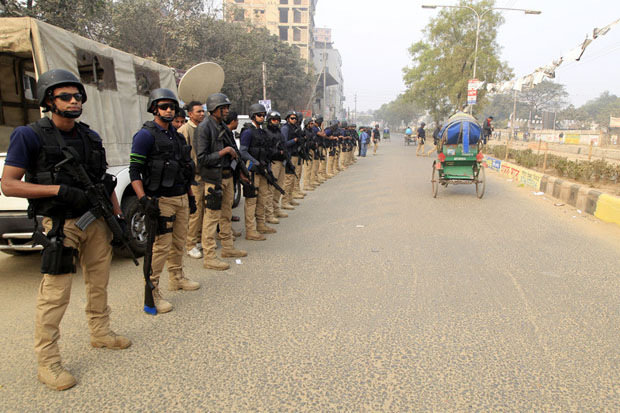
Election day in Bangladesh (Image: Md Manik/Demotix)
It is a story worthy of great theatre: the bitter rivalry between two women that is tearing apart a country.
Sheikh Hasina and Khaleda Zia head the two main political parties of Bangladesh, and have swapped power back and forth for the last 20 years.
The relationship between the two “battling begums” has come under international scrutiny recently, after Bangladesh suffered the most violent election in its short history. More than 100 people died during the campaign, with the country disrupted by strikes, blockades, and violent clashes between police and opposition supporters.
The controversy started well before the country went to the polls on 5 January. Since 1996, Bangladesh has held elections under a neutral caretaker government. In 2010, Hasina’s Awami League party, buoyed by a strong parliamentary majority, decided to abolish the provision. The opposition, Zia’s Bangladesh Nationalist Party (BNP) took issue with this, saying that a fair election could not be guaranteed without a neutral body overseeing it. The Awami League would not set up a caretaker government. The BNP boycotted the election.
Hasina decided to go ahead with the poll. Inevitably, her party – unopposed in 153 of the country’s 300 constituencies – won. But, equally inevitably, the validity of a contest in which there was only one real option has been questioned. The election result was also undermined by an unusually low turnout, with the government putting the figure at under 40 per cent and others reporting far less than that.
This was not just to do with voters choosing not to vote, but with a systematic campaign of intimidation and violence by supporters of the opposition BNP. Enforcing blockades, strikes, and boycotts, supporters of the BNP and their allies, the Jamaat-e-Islami, petrol bombed buses carrying workers, and set fire to shops that had opened in defiance of the strikes.
“The violence perpetrated against people who have not complied with the opposition call is a criminal act and it is the responsibility of the government to bring the attackers to justice,” says Abbas Faiz, Bangladesh researcher for Amnesty International. “But the majority of people who died during the two months of elections died from gunshot wounds. There is a strong possibility the police may have used excessive force.” Amnesty is calling for immediate investigations to identify the perpetrators of attacks, and to establish whether the force used by police was lawful. In a statement, UN Secretary General Ban Ki Moon called on “all sides to exercise restraint and ensure first and foremost a peaceful and conducive environment, where people can maintain their right to assembly and expression.”
Elections in Bangladesh tend to be big public events, with people getting up early to join famously long queues and proudly displaying their ink stained fingers. Yet people in the capital Dhaka during this year’s election described an eerie calm. Voting took place in just nine of 20 seats in the city. There were vicious attacks on the country’s Hindu minority, who make up around 10 per cent of the population and tend to support the Awami League.
The consensus seems to be that both of the main parties are equally culpable for the farce that the election has descended into. An editorial in the country’s Daily Star newspaper said that the Awami League had won “a predictable and hollow victory, which gives it neither a mandate nor an ethical standing to govern effectively”. Its verdict on Zia and her associates was no better: “Political parties have the right to boycott elections. But what is unacceptable is using violence and intimidation to thwart an election.”
The election chaos comes after a year of ugly political violence in Bangladesh: around 500 people were killed in political clashes during 2013, making it one of the most violent years since independence in 1971. This began with a mass popular movement against religious fundamentalism. Named the Shahbag movement, after the area of Dhaka where it began, the protests swiftly triggered a backlash from the religious right and their supporters. Much of this polarisation – between secularists and Islamists – had been precipitated by the government’s war crimes tribunal. Prosecuting people for crimes committed during the war of independence in 1971, the tribunal has reopened old tensions. Islamists claim it is being used to shut down the opposition, while secularists argue that the sentences (which include the death penalty) are not harsh enough.
Now, several weeks after the election, the political system remains in crisis. Zia is effectively under house arrest, while Hasina’s victory is seen across the board as empty. International and domestic observers alike say that the only way forward is for the two women to sit down together and hammer out a compromise. With early elections expected within the next 18 months, and with political uncertainty and violence continuing, this is ever more pressing.
This article was published on 21 January 2014 at indexoncensorship.org
8 Apr 2013 | Newswire
Four Bangladeshi bloggers are being held on suspicion of “harming religious sentiment” amid protests calling for blasphemy to be made a capital crime.
On 31 March, hardline Islamists submitted a list of 84 “atheist” bloggers to authorities, demanding their arrest. Rasel Parvez, Mashiur Rahman Biplob and Subrata Adhikari Shuvo, were arrested on 1 April, and had laptops and other devices confiscated. Asif Mohiuddin was arrested days later.
The arrests take part against the backdrop of the Shahbag protests. The protests, which began as demands for the death penalty for figures convicted of war crimes during the 1971 war that led to independence from Pakistan — when many Islamist groups sided with Pakistan — have broadened to general demonstrations against the radical Jamaat-e-Islami and other “extremist” groups.
The secular movement has drawn a strong response from hardliners, who have called for a blasphemy law, along the way smearing activists as defamers of the prophet Muhammad.
The Islamist group Hefajat-e-Islam has said the capital Dhaka will face a “siege” unless the government meets its demand to introduce the death penalty for blasphemy.
However, Bangladesh’s Prime Minister, Sheikh Hasina has rejected calls for a blasphemy law, telling the BBC that “existing laws are enough”.
She went on to say that while Bangladesh is a “secular democracy”, where everyone “has the right to practice their religion freely”, it was “not fair to hurt anybody’s religious feeling”, and that the government “try to protect every religious sentiment.”
8 Apr 2013 | Uncategorized
Four Bangladeshi bloggers are being held on suspicion of “harming religious sentiment” amid protests calling for blasphemy to be made a capital crime.
On 31 March, hardline Islamists submitted a list of 84 “atheist” bloggers to authorities, demanding their arrest. Rasel Parvez, Mashiur Rahman Biplob and Subrata Adhikari Shuvo, were arrested on 1 April, and had laptops and other devices confiscated. Asif Mohiuddin was arrested days later.
The arrests take part against the backdrop of the Shahbag protests. The protests, which began as demands for the death penalty for figures convicted of war crimes during the 1971 war that led to independence from Pakistan — when many Islamist groups sided with Pakistan — have broadened to general demonstrations against the radical Jamaat-e-Islami and other “extremist” groups.
The secular movement has drawn a strong response from hardliners, who have called for a blasphemy law, along the way smearing activists as defamers of the prophet Muhammad.
The Islamist group Hefajat-e-Islam has said the capital Dhaka will face a “siege” unless the government meets its demand to introduce the death penalty for blasphemy.
However, Bangladesh’s Prime Minister, Sheikh Hasina has rejected calls for a blasphemy law, telling the BBC that “existing laws are enough”.
She went on to say that while Bangladesh is a “secular democracy”, where everyone “has the right to practice their religion freely”, it was “not fair to hurt anybody’s religious feeling”, and that the government “try to protect every religious sentiment.”
16 Jan 2013 | Uncategorized
A Bangladeshi blogger is in critical condition after being stabbed by three unknown attackers on 14 January in Dhaka, the country’s capital. Asif Mohiuddin, 29, is the author of a blog about atheism widely read in Bangladesh. His posts often satirise religion, with one post referring to god as “almighty only in name but impotent in reality.” Press reports have referred to Mohiuddin as a “militant blogger”, although there is no suggestion that his work incited violence. Shortly after the attack, the South Asian Meeting on Internet and Freedom of Expression was held in Dhaka, and participants called on the government to protect journalist’s human rights under the constitution of Bangladesh, and bring the perpetrators to justice.

– Blogger Asif Mohiuddin was stabbed on 14 January
A Nigerian newspaper editor was shot dead on 12 January. Ikechukwu Udendu was killed in the southeastern city of Onithsa by an unknown assailant, who then phoned the victim’s brother to instruct him to collect the dead body. The editor was on his way to supervise the printing of the mothly newspaper Anambra News when he was attacked. Arrests and attacks on the Nigerian media are frequent but rarely resolved. On 26 April 2012, the offices of daily newspapers in the cities of Abuja and Kaduna were bombed.
Last week saw widespread attacks on the media in Greece, after bombs were placed outside of the homes of five journalists on 11 January. Homemade devices were used to carry out arson attacks on Chris Konstas, Antonis Liaros, George Oikonomeas, Petros Karsiotis and Antonis Skyllakos, members of the Journalists’ Union of Athens Daily Newspapers. Anarchist group Lovers of Lawlessness said they committed the attacks in protest against the journalists for allegedly covering the government favourably since the financial crisis began in 2009.
An editor of investigative weekly Alaan Magazine has been charged with defamation in Morocco, after alleging that a government official had ordered champagne to his hotel room during a business trip. Youssef Jajili printed a hotel receipt under Minister of Manufacture and Trade Abdelkader Amara’s name, which charged him for the alcohol while he was away at the expense of taxpayers. Amara denied the claim, saying that someone had ordered the champagne while he was out of the room. Jajili will appear in court on 28 January, and faces one year imprisonment and if found guilty under section 52 of Morocco’s defamation laws. Even though alcohol is widely available in Morocco, it is forbidden to followers of Islam, who make up the majority of the country.
On 15 January, Facebook announced a new format to its search facilities: “graph search”. The new tool will allow users to search for specific content, people, or images on the site. Critics suggest that the move could undermine Facebook’s privacy policy and allow users less control over their personal information, but Facebook founder and CEO Mark Zuckerberg said that the graph search is “privacy aware,” since the new tool will only search content already shared with the user.
