2 Dec 2019 | Artistic Freedom Commentary and Reports, Azerbaijan, Azerbaijan Incident Reports, Belarus, Belarus Incident Reports, News, Russia, Turkey, Ukraine
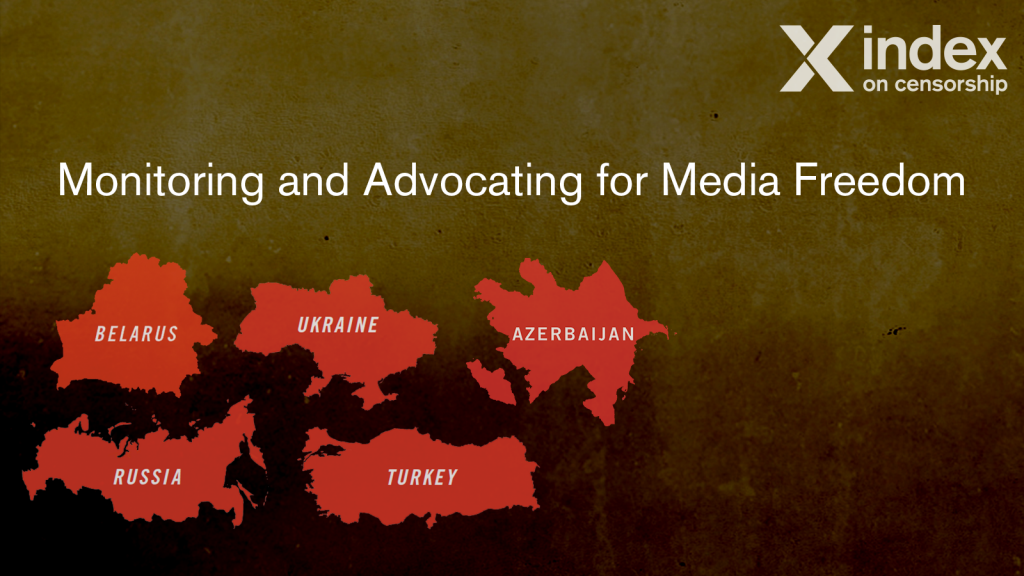
Index on Censorship’s Monitoring and Advocating for Media Freedom project monitors threats, limitations and violations related to media freedom in Azerbaijan, Belarus, Russia, Turkey and Ukraine. Previously these countries were also included in the Mapping Media Freedom project, which Index incubated and managed between 2014 – 2018.
This report summarises policy recommendations based on analysis since April, 2019. The recommendations are based on research by in-country correspondents and Index staff. Country reports published by the project since April are available on the project webpage.
After a brief background section, the report sets out key policy recommendations that apply to all the project countries, followed by key recommendations for each project country.
Background
It is essential that media freedom groups and international organisations continue to monitor, verify and document threats, limitations and violations related to media freedom in Azerbaijan, Belarus, Russia, Turkey and Ukraine, continue to raise awareness about the challenges and to advocate for change. Media freedom is severely restricted in all these countries and journalists are under great pressure.
Violence against journalists; misuse of counter-terror and security legislation to silence journalists; travel bans that isolate journalists and impact them professionally; failure to investigate violent crimes against journalists and silencing and punishing journalists through defamation and insult laws – all these are familiar tactics and increasingly common. In more recent years the introduction of restrictive internet-related legislation, such as in Russia, has opened a new frontline in the fight to safeguard media freedom.
RECOMMENDATIONS FOR ALL PROJECT COUNTRIES
- Governments and the EU must take a stronger stand for media freedom
Governments and multilateral groups, in particular the European Union (EU), must take a strong stand in defence of media freedom and journalists, both in their bilateral relations with the project countries and in multilateral processes. Governments and the EU should ensure that issues such as proposed or existing legislation that restricts media freedom, violence against journalists and failures to investigate crimes against journalists, form part of the agenda in strategic bilateral and multilateral discussions.
Countries that have a version of the Magnitsky Act (in the EU, this includes Estonia, Latvia, Lithuania and The Netherlands) should consider making use of this legislation in cases where media freedom and the safety of journalists are at stake. Countries that have not yet introduced such legislation should consider doing so. The UK should put its Magnitsky amendment into use.
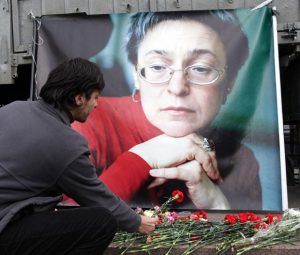
A man lays flowers near the picture of murdered journalist Anna Politkovskaya, during a rally in Moscow, Russia, 7 October 2009. CREDIT: EPA / Alamy Stock Photo
Impunity is a major challenge in all the project countries. In Azerbaijan, the death of freelance journalist Rafic Tagi, who died in hospital after a stabbing in 2011, has never been investigated properly. Belarussian cameraman Dzmitry Zavadski disappeared in 2000 on his way to meet journalist Pavel Sheremet, later killed in Ukraine in 2016. Zavadski’s body was never found.
The instigator of the 2006 contract killing of investigative journalist Anna Politkovskaya in Russia is still not known, nor is the motive. In 2018 the European Court of Human Rights found that the Russian authorities had failed to carry out an effective investigation into her killing. Turkey failed to investigate the death of editor Rohat Aktaş, killed when he was covering hostilities between Kurdish separatists and Turkish forces in 2016.
Ukrainan journalist Pavel Sheremet was killed by a car bomb in Kyiv in 2016 and, despite statements from the authorities that the case is a priority, there has been no progress. All the project countries should commit to investigating unsolved killings of journalists and should implement the guidelines in recommendation CM/Rec(2016)4 of the Committee of Ministers of the Council of Europe.
In relation to impunity, the guidelines envisage that when investigations and prosecutions have not resulted in justice member states can consider establishing special inquiries or independent specialised bodies, and that the latter could involve participation by respected media and/or civil society figures.
 Council of Europe member states must engage fully with the platform for journalism
Council of Europe member states must engage more actively with the Council of Europe’s Platform for the protection of journalism and safety of journalists. The partner organisations of the platform, which include Index on Censorship, should continue to use the platform to raise awareness of media freedom violations and threats to journalists. This should include advocating for states to respond to all alerts communicated to the platform.
The overall response rate from states in 2018 was only 39%. It is also important that states provide substantive replies to alerts and engage in follow-up dialogue with the partner organisations. The platform is an underused mechanism, with potential to achieve more. Partner organisations can also be of assistance to member states that are willing to engage fully.
Belarus is not a member of the Council of Europe, but other international organisations and processes, such as the special procedures of the United Nations human rights council, should be engaged to follow up cases and issues in Belarus.
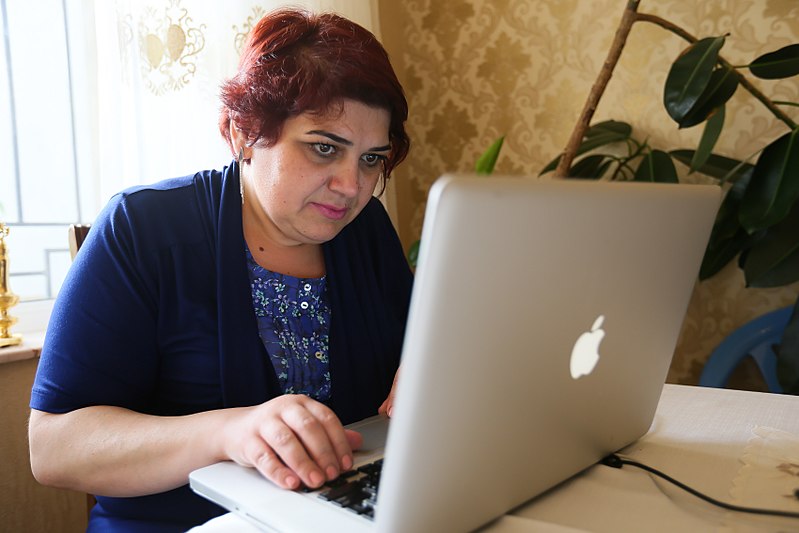
Azerbaijan must halt its use of travel bans for journalists including Khadija Ismayilova
AZERBAIJAN
- The EU must defend media freedom in negotiations with Azerbaijan
The EU must use its influence to defend media freedom and journalists in Azerbaijan. Negotiations on an agreement to replace the EU-Azerbaijan Partnership and Cooperation Agreement, in place since 1999, are at an advanced stage and will need to be brought to a conclusion by the new European Commission. It is extremely important that the EU raises media freedom and human rights in these negotiations.
In 2018, the European Parliament adopted a resolution which recommended that the EU should make deepening of relations with Azerbaijan conditional on respecting democratic values and human rights, and that it should ensure that Azerbaijan frees its political prisoners (including journalists such as Afgan Mukhtarli) before the negotiations on a new partnership agreement are concluded. Mukhtarli remains imprisoned.
Azerbaijan must refrain from targeting journalists’ online activities, including through call hacking, internet blocking and distributed denial-of-service (DDoS) attacks. In October, internet blockages and disruption to mobile phone services were reported in central Baku in connection with ongoing protests. Several journalists were also detained or subjected to physical violence during the protests. Social media platforms such as YouTube should respect Azerbaijani users’, including journalists’ right to seek, receive and impart information. Platforms should implement terms and conditions consistently and transparently, including when dealing with harassment of journalists by alleged state-sponsored trolls.
Azerbaijan must halt its use of travel bans for journalists. For example, the well known journalist Khadija Ismayilova is currently under a travel ban. OSCE Media Freedom Representative Harlem Désir has stated that it is a serious hindrance to her work as a professional journalist.
BELARUS
- Amend the law on mass media
Belarus must amend the law on mass media. The legislation currently requires journalists, including freelancers, who work for media outlets registered outside Belarus to obtain accreditation from the foreign affairs ministry. This has led to journalists being fined repeatedly. At a very minimum, Belarus must urgently establish procedures that enable journalists to appeal rejected accreditation requests.
- Other governments must signal that restrictions are not acceptable
Other governments must make it clear to Belarus that restrictive and repressive actions against journalists will not be tolerated. This applies to the requirements for accreditation for journalists working for non-Belarussian media outlets above, but also to the practice of detaining journalists for short periods. Some observers have credited Belarus’ tendency to impose fines on journalists or to detain them for short periods – rather than sentence and imprison them – as an attempt to build alliances in the West at a time when relations with Russia are weak. Other governments need to signal clearly it is not acceptable.
- Train journalists in human rights and United Nations procedures
In the case of Belarus, which is not a member of the Council of Europe, it is important that support and training aimed at enabling journalists to defend their rights includes training on other international organisations and processes, such as the special procedures of the United Nations human rights council, including the special rapporteur on the situation of human rights in Belarus.
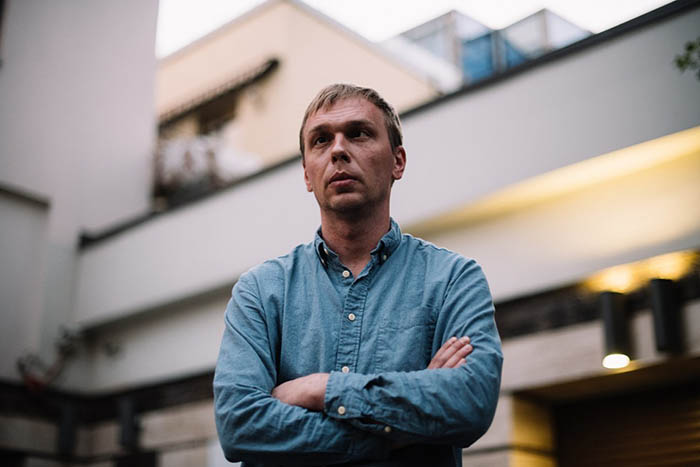
Russia must investigate cases of trumped-up charges against journalists such as Ivan Golunov
RUSSIA
- Halt the extension of foreign agent legislation to individual journalists
Russia must refrain from finalising the legislative changes that would extend the scope of “foreign agent” to individual journalists. Existing problematic legislation already requires media outlets that receive funds from abroad to register as foreign agents. At the time of writing the Duma has approved changes that would extend this to individual journalists, including freelance journalists and bloggers. Any one of these receiving payments for services, or a salary from abroad, would need to register with the ministry of justice. All published work would need to display a “foreign agent” label. This legislation should not proceed, and existing legislation that labels media outlets as foreign agents should be reviewed.
- Ensure access for journalists to court proceedings
Access to court proceedings is a frequent problem for journalists. As stated in Opinion No. 8 of the Consultative Council of European Prosecutors: “Transparency in the performance of the prosecutor’s duties is an essential component of the rule of law, and one of the important guarantees of a fair trial. Not only must justice be done, but it must also be seen to be done. In order for this to be possible, the media should be able to provide information on judicial, criminal or other proceedings” (paragraph 30). The authorities must review existing processes for compliance with international standards.
- Investigate cases of trumped-up charges against journalists
The authorities must thoroughly investigate cases of trumped-up charges against journalists and ensure that the instigators are brought to justice. Recent incidents include the high-profile case of Ivan Golunov, arrested for possession and trafficking of drugs, and what appears to be a fake letter sent in the name of Nikita Telizhenko with the aim of discrediting him.
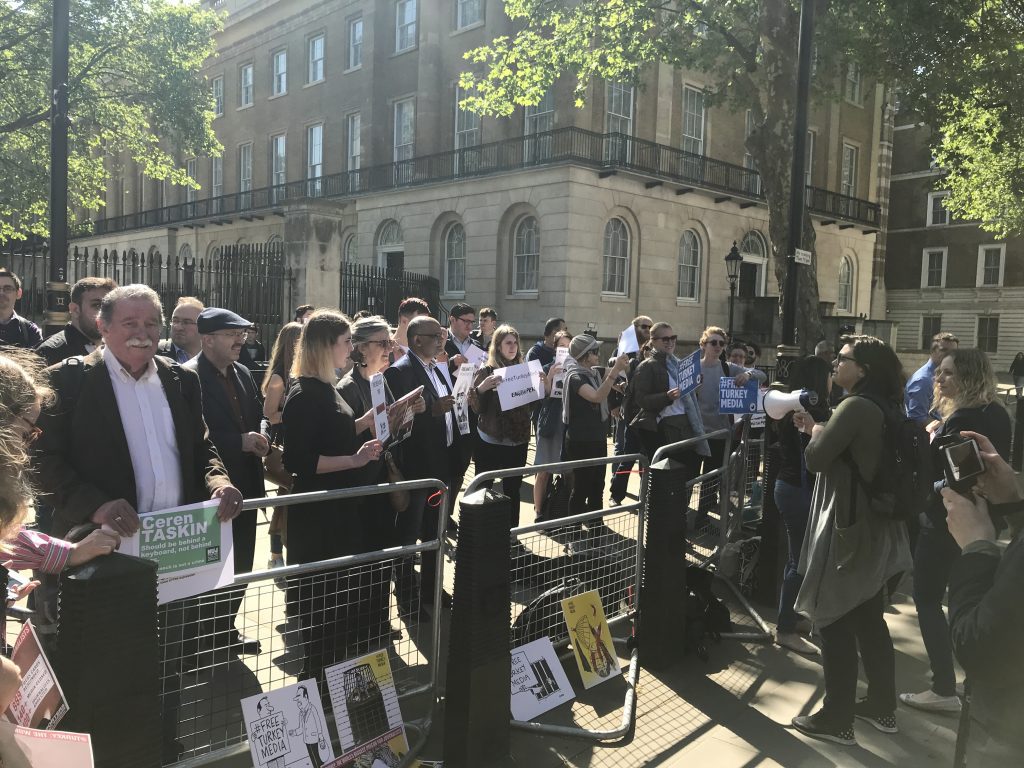
Index on Censorship magazine editor Rachael Jolley leads chants in support of Turkey’s jailed journalists ahead of Turkish President Erdogan’s visit to Downing Street in May 2018
TURKEY
- Other governments should not support Turkey’s judicial reform strategy, at least not in its current form
The judicial reform strategy (JRS), launched in May, 2019, will not achieve any meaningful change, at least not in its current form. Turkey’s judicial system is not independent: it is overloaded with cases, many which concern journalists, and it has been undermined through the large-scale dismissal of judges. It is extremely important that other countries and international organisations scrutinise the judicial reform strategy, and make it clear that in its current form it is completely inadequate when it comes to addressing the enormous structural problems of the judiciary.
- Implement the recommendations of the United Nations special rapporteur
In May 2019, the United Nations special rapporteur on the promotion and protection of the right to freedom of opinion and expression published a follow-up report to an earlier visit to Turkey in 2016. The rapporteur had made a series of recommendations in 2016, which included releasing jailed journalists and reversing the closure of media outlets. The follow-up report found that Turkey had either failed to implement or had contravened all the recommendations, with the exception of one (lifting the state of emergency). Turkey should urgently implement all the recommendations made by the United Nations special rapporteur.
- Support trial observation
Diplomatic representations and international organisations, including the EU, need to support observation of trials that involve journalists and media outlets. High-profile trials in central locations can be well-attended by observers, but coverage of trials in remote locations is more limited. Support can include sending representatives to follow trials and/or financial support for organisations that monitor trials.
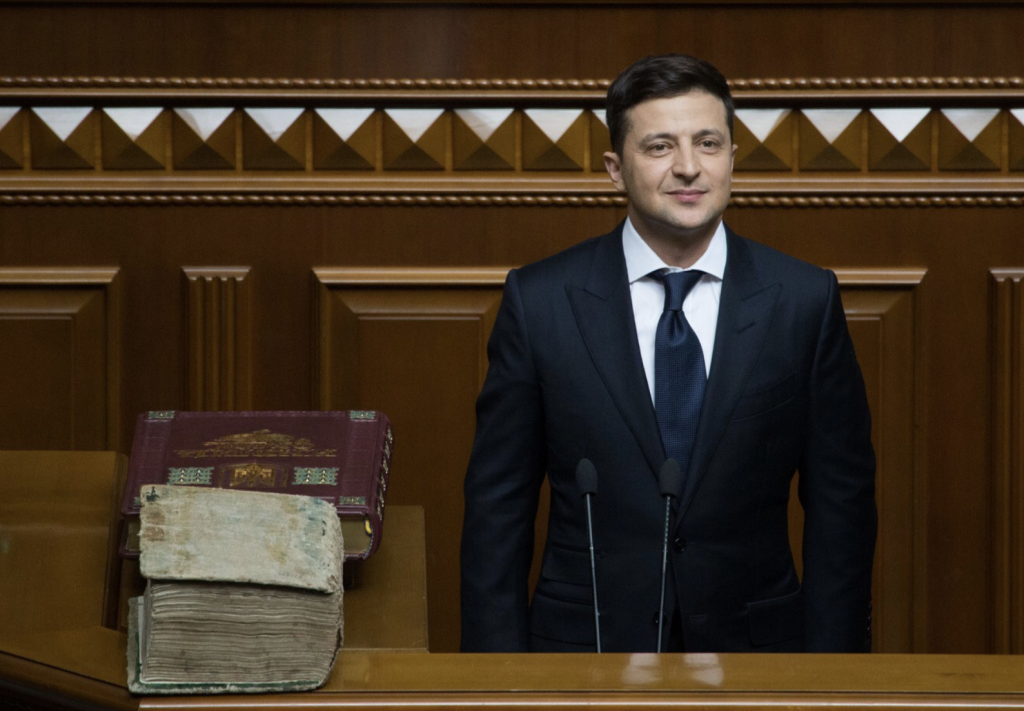
Ukraine President Volodymyr Zelenskiy must engage with the media. Photo: Wikimedia
UKRAINE
- The government must review state support for far-right groups associated with extremism
The government needs to undertake an independent and transparent review of state support, including financial support for far-right groups associated with extremism. The review should involve international experts. It should include investigating the possibility of state security force collusion with paramilitary and extremist organisations and thorough investigations of alleged involvement in violence against journalists, such as the unsolved murder of Oles Buzina.
- Elected representatives must engage with the media
President Volodymyr Zelenskiy reportedly held a 14-hour press conference in October, attended by 300 journalists. Whether it signals a new era in the relationship between Ukraine’s elected representatives and the media remains to be seen. The failure of the president and lawmakers to engage meaningfully with the media in the past has been a challenge for journalists and this needs to change.
- Invest in the public service broadcaster
In the highly divisive media landscape, the role of the public broadcaster is extremely important. Ukraine’s public broadcasting company is severely underfunded and currently has a very small audience. As Index on Censorship outlined in its Demonising the Media report a year ago, a significant but underreported trend in the region is the threat to public broadcasters. A number of national broadcasters in the EU and neighbouring countries were brought under closer government control in 2014-18. Ensuring both sufficient funding and editorial independence are crucial in ensuring the public’s right to know is defended.
28 Nov 2019 | Belarus, Belarus Incident Reports
[vc_row][vc_column][vc_column_text]
Index on Censorship’s Monitoring and Advocating for Media Freedom project tracks press freedom violations in five countries: Azerbaijan, Belarus, Russia, Turkey and Ukraine. Learn more.
[/vc_column_text][/vc_column][/vc_row][vc_row][vc_column][vc_row_inner][vc_column_inner][vc_custom_heading text=”6 Incidents” use_theme_fonts=”yes”][vc_column_text]
Court upholds local council’s decision to deny a journalist accreditation
17 October 2019 – The Economic Court of the Brest Region dismissed an appeal from independent regional newspaper Hantsavitski Chas against a court decision in September, which ruled to uphold Hantsavichy Local Council’s decision to deny accreditation to Hantsavitski Chas journalists.
Hantsavitski Chas’ editor-in-chief, Piotr Huzajeuski, said that he believed that the journalists are being deprived of their right to cover events held by the local council.
In March 2019, the editorial board of the newspaper Hantsavitski Chas sent a letter to the local council asking to accredit its journalists to cover the council’s activities. However, the leadership of the council denied them the accreditation, referring to the fact that a procedure for accrediting journalists by this institution had not been established.
Link:
https://baj.by/be/content/sud-adhiliu-apelyacyyu-gancavickaga-chasu-nakont-admovy-u-akredytacyi-zhurnalistau
https://baj.by/be/content/sud-abavyazau-savet-deputatau-raspracavac-palazhenne-ab-akredytacyi-zhurnalistau
http://www.ganc-chas.by/by/page/news/18156/
http://www.ganc-chas.by/by/page/news/17842/
Category: Blocked Access, Legal Measures
Source(s) of violation: Court/Juducial, Government/State Agency/Public official(s)/Political party
Journalist barred from attending a session of the election commission in Minsk
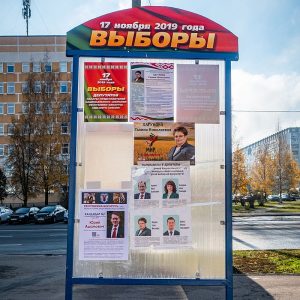
A billboard showing some of the candidates for November’s parliamentary election.
17 October 2019 – Journalist Volha Bykouskaya of the independent online newspaper Bdg.by was not allowed to attend the election commission in the Minsk district, where one of the candidates in attendance was Yury Hubarevich, chairman of the oppositional Movement for Freedom.
The commission demanded accreditation papers from her and told her to leave the room, ignoring her press card. The journalist appealed to the Central Election Commission, which responded that Belarusian journalists do not need any accreditation to attend such events.
Separately, the Belarusian Association of Journalists contacted the District Election Commission #107 for an explanation. The Commission’s representatives claimed that the journalist had been asked to show her press card, and failed to do so.
Link: https://baj.by/en/content/journalist-volha-bykouskaya-barred-meeting-election-commission-minsk
Category: Blocked Access
Source(s) of violation: Government/State Agency/Public official(s)/Political party
Freelance journalist denied accreditation for the 11th time
17 October 2019 – Hrodna journalist Viktar Parfionenka has been denied accreditation by the Belarusian Ministry of Foreign Affairs. That was his eleventh attempt to get official permission to work as a reporter for the Belarusian Radio Racyja, which is headquartered in Poland.
Since 2009, Parfionenka has been trying to obtain accreditation to be able to legally contribute to Radio Racyja. Each year he compiled a set of documents necessary for accreditation, but has so far failed become accredited.
This year he was denied again, under paragraph 15.4 of the Regulations on Accreditation of Foreign Journalists: “To refuse accreditation to journalists of a foreign media outlet for 6 months after known facts of this outlet using the services of unaccredited journalists and (or) other persons without accreditation.”
Link: https://baj.by/en/content/radio-racyja-journalist-denied-accreditation-11th-time https://vitebskspring.org/vyasna/4157-mzs-bielarusi-nie-akredytavala-viktara-parfionienku-11y-raz
Category: Blocked Access, Legal Measures
Source(s) of violation: Government/State Agency/Public official(s)/Political party
DDoS attack on Onliner.by news site
10 October 2019 – One of the most popular Belarusian websites, Onliner.by, appeared to have been the target of a significant DDoS attack. The website administrators reported difficulty loading the page and users reported having difficulty accessing the website. Suspicious activity was reported in users’ profiles.
Onliner.by, which is a news site that focuses mainly on digital technology, informed their audience about the incident and apologised for the inconvenience. An editorial letter suggested that website users improved their profiles’ security by changing their passwords and enabling two-step verification.
Link: https://tech.onliner.by/2019/10/10/ddos-4
https://baj.by/be/content/onliner-podvergaetsya-ddos-atake
Category: DDoS/Hacking/Doxing
Source(s) of violation: Unknown
YouTube blogger detained after covering opposition rally
5 October 2019 – Video blogger Siarhei Tsikhanouski, who is behind the popular YouTube channel Country for Life, was detained in central Minsk after he carried out a live broadcast of opposition politician Mikalai Statkevich’s pre-election rally.
Tsikhanouski said during the live broadcast that his car was surrounded by six traffic police cars, and that he was told that unpaid fines were registered to his car. Then the blogger was told to drive to the Leninski District Police Department. There he was informed that his car might have been stolen. After having filed a police report, he was released. He spent two hours at the police station.
UPDATE: 15 October 2019 – Tsikhanouski was fined 12.75 rubles for violating traffic rules. The blogger told Radio Liberty that he thought that it was unlikely that six traffic police cars were involved in his arrest only to give him a small fine. He said that he thought that the police wanted to confiscate the equipment, with which we were conducting the live broadcasting, or that they simply wanted to intimidate them. He said that because he let many people know that he was in the police department, people were calling him and going to the police department.
Link(s): https://belsat.eu/ru/news/avtora-kanala-strana-dlya-zhizni-zaderzhivali-shest-ekipazhej-gai/
https://www.svaboda.org/a/30201950.html
https://www.svaboda.org/a/30216368.html
Category: Arrest/Detention/Interrogation,
Source(s) of violation: Police
Blogger Andrei Pavuk subjected to attempts to frame him
4 October 2019 – Blogger Andrei Pavuk was contacted by a duty officer of the Aktsiabrski district police department, who stated that the police had received a phone call, allegedly from the blogger’s phone number. The police said that the man on the phone, who claimed to be Andrei Pavuk, said that he had “killed his wife Volha and her lover.” The male caller also provided the blogger’s home address. Pavuk’s wife, who was with him at the time of the police call, had to explain the officer that the call was a hoax. She then filed a police report, demanding that the perpetrator be found.
The attempts to frame Pavuk came as the court is considering his lawsuit against local police for compensation for non-pecuniary damages from the police for his unlawful detention and search in March 2019.
On 20 March, the Ministry of Emergency Situations received a hoax message about a mine at a local government building, allegedly sent from Pavuk’s email. The blogger was detained and searched, and his equipment was confiscated.
Link(s): https://udf.by/news/main_news/200208-ja-ubil-svoju-zhenu-i-ee-ljubovnika-neizvestnye-terrorizirujut-semju-izvestnogo-blogera.html
https://naviny.by/article/20191006/1570369644-blogeru-andreyu-pauku-pozvonili-iz-milicii-utochnit-ubival-li-svoyu
Category: Online Defamation/Discredit/Harassment/Verbal Abuse
Source(s) of violation: Unknown [/vc_column_text][/vc_column_inner][/vc_row_inner][/vc_column][/vc_row][vc_row][vc_column][vc_basic_grid post_type=”post” max_items=”4″ element_width=”6″ grid_id=”vc_gid:1574848372226-a9d8b457-3ad8-0″ taxonomies=”8996″][/vc_column][/vc_row]
21 Oct 2019 | Belarus, Belarus Incident Reports
[vc_row][vc_column][vc_column_text]
Index on Censorship’s Monitoring and Advocating for Media Freedom project tracks press freedom violations in five countries: Azerbaijan, Belarus, Russia, Turkey and Ukraine. Learn more.
[/vc_column_text][/vc_column][/vc_row][vc_row][vc_column][vc_row_inner][vc_column_inner][vc_custom_heading text=”5 Incidents” use_theme_fonts=”yes”][vc_column_text]
Public official sues Telegram blogger
26 September 2019 – The head of the Slonim district government Henadz Khomich sued Stiapan Putsila (better known by his pseudonym Stsiapan Sviatlou), the blogger behind NEXTA, one

Blogger Stsiapan Sviatlou is being sued by the head of Slonim district government
of Belarus’ most popular Telegram channels.
Khomich’s is suing Putsila for 50,000 roubles (nearly £20,000) worth of compensation for what he says is “moral damage” for a post that Putsila published in August 2019. In the post, Putsila said that Khomich had been detained for drunk driving and suggested that corruption was involved. Similar lawsuits have been filed against news websites belaruspartisan.by, 21.by, and bobruisk.ru, which republished the message.
Link(s): https://nn.by/?c=ar&i=238079&lang=ru
https://nn.by/?c=ar&i=238083
Category: Subpoena/Court Order/Lawsuits
Source(s) of violation: Known private individual(s)
Blogger receives threats
24 September 2019 – Blogger Andrei Pavuk from the town of Aktsiabrski in the Homel region received threats from an unknown person via Viber.
The messages were received on the eve of the court hearing of his lawsuit against the police aimed at receiving compensation for an unlawful search and detention, which Pavuk believes was done to intimidate him and to exert psychological pressure on him.
In March 2019, police raided Pavuk’s apartment, seized his professional equipment, handcuffed him and brought to the local department of the Investigative Committee for interrogation. The blogger was told he was held on suspicion of knowingly submitting a false danger warning to the authorities under under Art. 340 of the Criminal Code of the Republic of Belarus. Investigators alleged that the Ministry of Emergency Situations received a warning message from his email.
Link(s):https://euroradio.fm/ru/blogeru-andreyu-pauku-ugrozhayut-s-filippin-podumay-padla
https://baj.by/be/content/skazhy-dzyakuy-shto-nichoga-tabe-ne-padkinuli-blogeru-andreyu-pavuku-daslali-pagrozy-i
Category: Online Defamation/Discredit/Harassment/Verbal Abuse
Source(s) of violation: Unknown
Police filed report against Belsat TV journalists
19 September 2019 – Darya Chultsova, a Mahiliou-based freelance journalist, was summoned to Bialynichy District Police Department for questioning. Because she is not associated with an accredited news outlet, a police report was filed against her for illegally producing and distributing media content under Article 22.9 of the Code of Administrative Offences.
The police report stated that on 21 August 2019, Chultsova interviewed students’ parents at a high school. The next day, the interviews were allegedly shown on Belsat TV.
Link(s): https://baj.by/ru/content/posle-zatishya-vozobnovilos-presledovanie-zhurnalistov-za-sotrudnichestvo-s-belsatom
https://baj.by/be/content/sud-adpraviu-spravu-zhurnalistki-dari-chulcovay-na-dapracouku
Category: Arrest/Detention/Interrogation, Criminal Charges/Fines/Sentences, Subpoena/Court Order/Lawsuits
Source(s) of violation: Police/State security
Freelance journalist fined for working without accreditation
18 September 2019 – Freelance journalist Zmitser Mitskevich was fined by Pastavy District Court (Vitsebsk region) for contributing to Belsat TV. Because he is not associated with an accredited news outlet, he was charged with illegally producing and distributing media content under Art. 22.9 of the Code of Administrative Offences.
Link: https://baj.by/en/analytics/fines-journalists-violating-article-229-administrative-code-chart-updated
Category: Criminal Charge/Fines/Sentences
Source(s) of violation: Police/State security
Bloggers sued for covering environmental protests
17 September 2019 – Brest-based bloggers Siarhei Piatrukhin and Aliaksandr Kabanau learned that they are being sued for defamation by the lead-acid battery plant, I-Power, at the Brest Region Economic Court.
The lawsuit stems from the journalists’ interview with two environmental activists who claimed that contamination resulted from environmental violations committed by I-Power. The interview appeared on the YouTube channel Narodnyj Reportior.
It is not the first time that Kabanau and Piatrukhin have been sued by I-Power: in 2018, a judge ordered the bloggers to remove their YouTube video about the construction of I-Power’s battery plant and to publish an apology.
Link: https://baj.by/be/content/blogery-syargey-pyatruhin-i-alyaksandr-kabanau-raptouna-apynulisya-adkazchykami-u-sprave-ab
Category: Subpoena/Court Order/Lawsuits
Source(s) of violation: Known private individual(s)[/vc_column_text][/vc_column_inner][/vc_row_inner][/vc_column][/vc_row][vc_row][vc_column][vc_basic_grid post_type=”post” max_items=”4″ element_width=”6″ grid_id=”vc_gid:1571647405268-b77e79c5-1924-10″ taxonomies=”8996″][/vc_column][/vc_row]
18 Sep 2019 | Belarus, Monitoring and Advocating Coverage, News
On the surface, Belarus is one of the quieter places for journalists – one rarely hears about gruesome violations, physical assaults or murders of media workers in this post-Soviet country. But a lack of horror stories does not mean there is a liberal policy towards the media. In 2017, Belarus scored 83 points out of 100 (100 indicating the least free) in the Freedom of the Press rating compiled by Freedom House, and in 2018 it was ranked 153rd out of 180 countries in the World Press Freedom Index by Reporters Without Borders.
In a country where most media outlets are state-owned, one of the most common ways of interfering with journalism is the legislation banning foreign media workers and outlets from reporting without state accreditation – Article 22.9 of the Administrative Code. In 2018, the Belarusian Association of Journalists (BAJ) recorded 118 fines imposed on freelance journalists collaborating with foreign media without accreditation, totalling €43,000.
No outlet faced the consequences of this policy like Belsat TV.
Index on Censorship’s Monitoring and Advocating for Media Freedom project documents, analyses, and publicises threats, limitations and violations related to media freedom in Azerbaijan, Belarus, Russia, Turkey and Ukraine, in order to identify opportunities for advancing media freedom in these countries. The project collects, analyses and publicises limitations, threats and violations that affect journalists as they do their jobs. Its staff also advocate for greater press freedom in these countries and raises alerts at the international level. The project builds on Index on Censorship’s 4.5 years monitoring media freedom in 43 European countries, as part of Mapping Media Freedom platform.
The curious case of Belsat TV
 “In the spring of 2017, Belsat TV contributors have been repeatedly arrested, tried and heavily fined for covering the protests. The total amount of fines reached $9,000. In addition, our journalists spent more than 30 days in prison,” states the channel’s website.
The tensions between the office of Belarusian President Alexander Lukashenko and the Poland-based, Belarus-centred Belsat TV date back to its founding in 2007. Lukashenko had called it a “stupid, uncongenial and unfriendly project” even before it launched. The independent media outlet is sponsored by the Polish government, and is owned by public broadcasting corporation Telewizja Polska.
As the channel’s website outlines: “Its original content is prepared by more than 100 associates from all over Belarus supported by around 80 editors, managers and technicians in Warsaw.”
The “associates” in question are independently-minded Belarusian journalists whose work is hindered by the restrictive state legislation. Belsat TV is not accredited or recognised in the country, and neither are any of its correspondents and stringers. The Belarusian Ministry of Foreign Affairs has repeatedly declined to accredit the outlet, prompting its journalists to do partisan work. The state punishes them with repeated fines, with no limit on how many times a single journalist can be punished.
“The definition of accreditation in Article 1(1) of the Law on Mass Media is as follows: ‘The confirmation of the right of a mass medium’s journalists to cover events organised by state bodies, political parties, other public associations, other legal persons as well as other events taking place in the territory of the Republic of Belarus and outside it’,” said BAJ law expert Volha Siakhovich.
In practice, she explains, the law blocks freelance journalists and independent media outlets from covering the activities of the government and makes accreditation a requisite for a career in journalism. Although refusing accreditation does not equal a total ban on a journalist’s professional activities, it creates obstacles for accessing information. This discriminatory structure is especially acute for freelance journalists and those who work for independent media outlets.
“Article 35(4) of the Law on Mass Media prohibits the activities of foreign journalists in Belarus without accreditation of the Foreign Ministry,” she said. “As Belarusian authorities are unable to control foreign media, they aim to control Belarusian citizens contributing to them. Their aim is to punish and intimidate in order to show that they are under their control at any given time.
“Under Article 22.9, the courts can rule that journalistic activity without accreditation equals ‘illegal production and/or distribution of media content’. The reason for prosecuting journalists for this offence is not the content of their work but that they were published through foreign media.”
And she added: “[When] freelancers are gathering information while filming or interviewing people, they can be detained and accused under Article 22.9. Police officers file reports against freelance journalists and send them to the court. In such cases, the usual evidence is the testimony of the police officers who detained the journalists, and of the people interviewed by the journalists. Then the judges sentence the accused to pay a fine. It’s not unusual if the fine exceeds an average monthly wage in the country [which is about €400].”
Case studies
Here are some of the incidents recorded by Index on Censorship between February and July 2019.
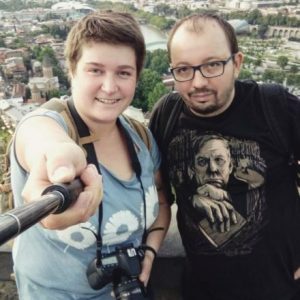
Ales Lyauchuk and Milana Kharytonava
On 31 May, a judge in the Maskouski district of Brest fined journalists Ales Lyauchuk and Milana Kharytonava for “illegal production and distribution of media content”. They were contributing to Belsat TV, covering the ongoing protests against the construction and launch of the iPower battery plant in the city. They were tried in absentia, and learned about the fines only upon returning from their holiday. They had to pay 1,020 Belarusian rubles each (about $1,000 in total).
This wasn’t the first time Lyauchuk and Kharytonava got fined this year. On 21 March, a judge fined them 2,250 Belarusian rubles (about $1,100). The pair had been repeatedly spotted covering protests against the same factory near Brest and interviewing local people, and the trial was based on reports filed by police.
“The materials of the case did not include information about the exact time of our being in the square, no names of people whom we had interviewed; there were no witnesses but, still, we have got a fine of 2,550 rubles,” Lyauchuk told his colleagues at Belsat TV.
On 18 April, the journalists were fined 1,275 Belarusian rubles (about $600) each, also for co-operating with Belsat TV without accreditation. The story they filmed was about the forgotten village of Veluyn, cut off from Brest by a lack of roads and public transportation.
In all, they were fined six times in 2018.
On 15 May, the trial of independent journalists Alena Shabunia and Viachaslau Lazarau took place in Navapolatsk. A judge found both journalists guilty of “illegal production and distribution of media content” under Article 22.9 and fined them 637.5 Belarusian rubles (over $300) each. The case was built around a video of an accident at the Polimir Navapolatsk plant that was broadcast on Belsat TV – the team interviewed worker Andrei Shvilpo, who saved his colleagues but was later convicted of causing harm to production.
Viktar Stukau, head of the Polatsk-Navapolatsk BAJ branch, told online outlet Charter27: “What these journalists did was the usual work of journalists. Moreover, according to our constitution, any person can create such materials, since everyone has a camera in a pocket, and can send them to social networks or to some mass media, Belarusian or foreign. How is it possible to prohibit this?”
On 30 April, Andrei Tolchyn, a Homel-based freelance journalist, was taken to court in connection with four unpaid fines. He was informed that his bank account had been frozen and he would have 10 days to pay the fines to regain access. The hefty fines for “illegal production of media content” came as a result of his unaccredited work for Belsat. The fines totalled 3,200 Belarusian rubles ($1,523). Tolchyn’s account was unblocked after he paid the fines but, in May, he filed a complaint with the UN Human Rights Committee.
Tolchyn used to work with Konstantin Zhukovsky, producing video stories and publishing them on YouTube. Their content was used by a variety of media outlets, including Belsat, so the courts applied Article 22.9 and the journalists were hit with mounting fines. As a result, Zhukovsky and his family left the country in January this year.
On 15 April, a freelance journalist from Hlybokaye, Zmitser Lupach, stood trial in the Sharkaushchyna district court for contributing to Belsat TV without accreditation. A judge imposed a fine of 892.5 Belarusian rubles (about $440) over a news story about the economic situation and low salaries in the district. This was the second time Lupach was fined in a month: on 11 April, the same court fined him 1,020 Belarusian rubles ($485).
He was tried under Article 22.9 (illegal production and/or distribution of media content) and Article 23.34 (violation of the procedure for organising or conducting mass events).
In the first case, the journalist was punished for his report aired on Belsat TV; in the second, for raising a white-red-white flag during Freedom Day, the anniversary of the Belarusian People’s Republic.
Lupach was also tried on 21 February for a story aired on Belsat TV about the monument erected in honour of the Komsomol in Hlybokaye. A judge fined him 892.5 Belarusian rubles (around $430). The previous year, Lupach was in court nine times on the same charges.
On 11 April, a judge in the Leninski district court of Mahiliou fined freelance journalist Alina Skrabunova 1,275 Belarusian rubles ($600). She was found guilty of “participation in the illegal production of media content”, as her video about the opening of an inclusive cafe operated by wheelchair-users had been broadcast on Belsat TV. The police documentation contained the wrong date for the alleged violation and a different charge. However, Skrabunova lost the case.
On 15 March, the Vitsebsk district court found journalist Vitaly Skryl guilty of illegal production and distribution of media content under Article 22.9. He was fined 637.5 Belarusian rubles (about $300) for his video on the closure of an enterprise which was broadcast on Belsat TV. Skryl told Radio Raciyja that he wasn’t surprised by the fine as he’d been fined on a similar charge the year before, for covering the unemployment situation in Orshy.
On 1 February, Ales Kirkevich and Ales Dzianisau were fined 765 Belarusian rubles (about $370) each in the Leninski district court of Hrodna. The charge followed their story titled Historians Exploring the Ancient Hrodna Cellars which was broadcast on Belsat TV. Both journalists were charged with Article 22.9 offences.
However, journalists collaborating with Belsat TV weren’t the only ones who got fined. Bloggers and freelance reporters whose work appeared in foreign or unaccredited media outlets met the same fate.
On 12 April, freelance journalist Yauhen Skrabets was fined 765 Belarusian rubles ($364) in Brest for “production of information content for a foreign media outlet that was not accredited in the Republic of Belarus”.
His article, entitled Activists and Independent Journalists Not Allowed Into the Press Conference at the I-Power Plant, had appeared on the website of Belarusian Radio Racyja, which is based in Poland. Like Belsat, the radio station had been previously denied accreditation by the Belarusian Ministry of Foreign Affairs.
Just a day before, the Leninski district court of Brest reviewed another case against the journalist on similar charges. The police report stated that he “interviewed without accreditation, thus violating the rights and obligations of a foreign media journalist”. As a result, a judge fined him 765 Belarusian rubles ($364). Skrabets insists that he never sent the article in question to Radio Racyja.
The judge assigned to the case, Aliaksandr Semianchuk, also handled the criminal case of the blogger Siarhei Piatrukhin, accused under Part 2 of Article 188 (“Slander”) and Part 2 of Article 189 (“Insult”) of the Criminal Code on 18 April. The criminal case was opened after a request by a police officer over a video on the blogger’s YouTube channel, Narodnyj Reportior, where people accused police officers of violence.
Piatrukhin was fined 9,180 Belarusian rubles ($4,590) and told to pay damages to the four police officers. The bill totalled $8,840, to be paid within a month, and the judge ordered him to pay the legal fees. The blogger also made a written undertaking not to leave the country, and his property was seized until his dues were paid.
But Piatrukhin remained defiant.
“I’m confident that if there wasn’t this case, there would be another one. They are demonstrating that, if they want, they would do anything,” he told Radio Svoboda. “To make me shut up they should at least shoot me. Whatever they do, they can’t hurt me any more. If they exile me, they’d make me a martyr, a star, draw attention to me. Look at how I live – I don’t have a car or anything. So they can go you-know-where with this fine and the compensation to the policemen. I’m not going to pay anything. Let them do whatever they want. Let them ban me from travelling abroad, I don’t care. This is my country, and I’ve never planned to leave it.”
Piatrukhin’s fundraising campaign, which he later launched on the MolaMola website in order to pay the fines, was suspended by the service provider on 5 May. It explained in a letter that “such activity could be seen as an attempt to evade criminal prosecution” and that it didn’t comply with the current Belarusian legislation. He was able to withdraw the money collected up until that date.
On 12 February, a judge in the Biaroza district court fined blogger Aliaksandr Kabanau 510 Belarusian rubles ($245) for failing to comply with the ruling of the Brest Economic Court. He was found guilty of damaging the reputation of a battery plant being built near Brest in his video published on YouTube. The court decided that Kabanau must remove the video – Lead Will End Up with Brest – from the platform, and publish an apology letter written on his behalf by the battery plant management. Kabanau refused to apologise, and the video has not been removed.
Andrei Bastunets, head of BAJ
The persecution of freelance journalists collaborating with foreign media began in 2014. This was not due to a change in legislation, but the police and the courts began to apply Article 22.9 in order to fine journalists for “illegal production and/or distribution of media products”.
The most difficult period was 2018, when the persecution intensified sharply. Before this, journalists of various foreign publications were fined. This year, it was only Belsat and Radio Rasyja.
Since the beginning of 2019, 38 fines have been imposed. The most recent penalty was on 31 May but, since then, the application of Article 22.9 has been suspended. Perhaps this is because Belarus is hosting the European Games and there are approaching elections. Usually, temporary “liberalisation” occurs before elections in the hope of a more favourable assessment by the international community. The degree of pressure on journalists is, in principle, determined by the political situation in the country.
By penalising freelance journalists for collaborating with foreign media, Belarus violates its international obligations – in particular, Article 19 of the International Covenant on Civil and Political Rights. The Belarusian Association of Journalists is in favour of lifting the ban on the activities of foreign journalists without accreditation.
Blocked Access
The second most common category of press freedom violation in Belarus this year is blocked access, as recorded by the Monitoring Media Freedom project. Cases range from denying accreditation for political events to journalists being detained prior to mass protests.
In Brest, blogger Aliaksandr Kabanau was detained by riot police in February as he left fellow blogger Siarhei Piatrukhin’s apartment.
The detention occurred just before the start of one of the weekly protests against the construction of a battery factory near Brest that have been taking place every Sunday for a year. Kabanau was released soon after the protest ended.
On 26 May, Piatrukhin was detained by Brest police on a flimsy pretext shortly before the start of an ecological protest. He was held for an hour.
On 9 July, police detained Belsat TV journalist Ihar Kuley and camera crew Syarhei Kavaliou and Maksim Harchanok, who were filming an episode of the programme Belsat Near You at the local market in Hantsavichy, in the Brest region. Officers told them to go to the police station, claiming they were not allowed to film there, and forced them to turn off their cameras. After the police got explanations, the journalists were released.
No journalists were allowed at the meeting held between Anatol Lis, the head of the Brest regional government, and environmental protesters on 12 June, despite the fact that three independent journalists had been included in the list of participants. Audio recording and photography during the meeting were banned.
The management of the iPower battery plant held a press conference on 11 June, but did not allow the majority of independent media representatives and bloggers regularly covering the protests and events connected with this plant to enter.
On 7 June, a Brestskaya Gazeta journalist was told she could not enter a new court building after its inauguration, citing her lack of accreditation.
The foreign ministry officer told Hrodna journalist Victar Parfionenka in a telephone conversation on 14 May that he had again been denied accreditation.
Parfionenka has been contributing to Radio Racyja for 10 years. Every year he appeals to the Belarusian Ministry of Foreign Affairs for accreditation as a foreign correspondent and always gets rejected.
On 18 April, journalists for news website TUT.BY,news agency BelaPAN, newspaper Belorusy I Rynok and European Radio for Belarus were denied accreditation to cover the annual address by Alexander Lukashenko to the National Assembly the following day. This was despite two of them – BelaPAN’s Tattyana Karavenkova and Zmitser Lukashuk, special correspondent for European Radio for Belarus – having permanent accreditation in the parliament.
Index on Censorship’s Monitoring and Advocating for Media Freedom project documents, analyses, and publicises threats, limitations and violations related to media freedom in Azerbaijan, Belarus, Russia, Turkey and Ukraine, in order to identify possible opportunities for advancing media freedom in these countries. The project collects, analyses and publicises limitations, threats and violations that affect journalists as they do their job, and advocates for greater press freedom in these countries and raises alerts at the international level. The project builds on Index on Censorship’s 4.5 years monitoring media freedom in 43 European countries, as part of Mapping Media Freedom platform.
