11 Sep 2015 | Campaigns, Mapping Media Freedom, mobile, Press Releases
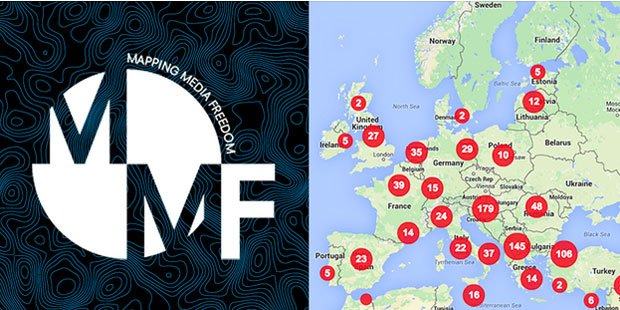
Index on Censorship, the European Federation of Journalists and Reporters Without Borders are delighted to announce the expansion and redesign of Mapping Media Freedom, which records threats to journalists across Europe, and which will now also cover Russia, Ukraine and Belarus.
First launched in May 2014, the map documents media freedom violations throughout the European Union and neighbouring countries including the Balkans and Turkey.
More than 700 reports were logged on the map in its first year, lifting the lid on the everyday threats to media freedom that have previously gone largely unreported or undocumented.
“Mapping Media Freedom has highlighted the kinds of threats faced by media organisations and their staff everyday throughout Europe — from low-level intimidation to threats of violence, imprisonment, and even murder. Having a detailed database of these incidents – most of which previously went unreported — helps us and others to take action against the culprits,” said Index on Censorship CEO Jodie Ginsberg.
The relaunched online platform will make it easier for policy makers and activists to identify trends in media freedom and to respond efficiently with immediate assistance or to campaign on specific issues. It also provides support such as legal advice and digital security training to journalists at risk. Anyone can submit their own reports to the site for verification by project officers.
“At a time when freedom of information is facing threats not seen since the times of the Soviet Union, supporting journalists and bloggers is crucial. While part of the continent is sinking in an authoritarian drift, online surveillance has become a common challenge”, said RSF Programme Director Lucie Morillon.
Following renewed funding from the European Commission earlier this year, the crowd-sourced map incorporates new features including country filters and an improved search facility. The project also aims to forge new alliances among journalists across the continent, especially young media practitioners who will find useful resources and in depth coverage on a dedicated “Free Our Media!” page.
In reaction to new draconian measures and violence in the region, the new design coincides with an expansion into Russia, Ukraine and Belarus. All new reports from this area will be available in English and the regional language.
“The enlargement of the monitoring process to Ukraine, Russia and Belarus is good news for journalists and media workers in the region. Journalists are usually at the heart of violent demonstrations, clashes and armed conflicts where they may be shot, assaulted, kidnapped, arrested, abused and killed. They are facing difficult professional challenges between extremists or propaganda agents. Thanks to its affiliates, the EFJ will continue to document all media violations and raise awareness to end impunity when violations occur”, said Mogens Blicher Bjerregård, EFJ President.
Partners, country correspondents and affiliates to the project — including Human Rights House Ukraine, Media Legal Defence Initiative and European Youth Press — will work together to ensure the growing threats to media freedom in the region are highlighted, and tackled.
For further information please contact Hannah Machlin, project officer,[email protected], +44 (0)207 260 2671
Mapping Media Freedom
Click on the bubbles to view reports or double-click to zoom in on specific regions. The full site can be accessed at https://mappingmediafreedom.org/
|
12 Aug 2015 | Events, mobile
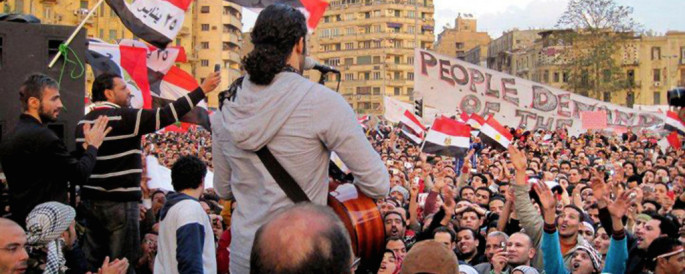
Photo – Ramy Essam, Tahrir Square – Festival 800
Join us in Lincoln for Festival 800, a celebration of the 800th anniversary of the sealing of the Magna Carta – a unique and powerful statement that began the world’s march to freedom and liberty.
Index on Censorship are delighted to be supporting Festival 800 and Freemuse who are staging a special day focused on musicians who have been banned from performing their work in their own countries. Events include:
13:30 – Listen to the Banned
Listen to the Banned is a compilation album that features the music of banned, censored and imprisoned artists from the Middle East, Africa and Asia. Project co-founders, music producer Deeyah Khan and Ole Reitov, executive director of Freemuse discuss the album’s origins and their wider work. Khan is a critically acclaimed composer, award-winning documentary film director and celebrated human rights activist. (£8)
16:00 – Talking With the Banned
Two international musicians who have faced censorship, “exiled bard of the Egyptian revolution” Ramy Essam and Basque artist Fermin Muguruza, join others including Deeyah Khan, editor of Index on Censorship magazine Rachael Jolley, and author and academic Martin Cloonan (chair) for a conversation about censorship. (£5)
19:30 – The Banned – Live and unplugged in concert.
A live gig featuring folk musician Ramy Essam who was catapulted to fame by the events of Tahrir Square; Lavon Volski, an icon of Belarusian rock music and Fermin Muguruza, who sings against the oppression that he feels Spain has over Basque Country. With Attila the Stockbroker as MC. (£10)
When: Saturday 5 September 2015, timings as above.
Where: Lincoln Performing Arts Centre, LN6 7TS (map)
Tickets: Special Index offer for whole day £15, quote INDEX when booking.
17 Jun 2015 | Azerbaijan News, mobile, News
Governments don’t really like coming across as authoritarian. They may do very authoritarian things, like lock up journalists and activists and human rights lawyers and pro democracy campaigners, but they’d rather these people didn’t talk about it. They like to present themselves as nice and human rights-respecting; like free speech and rule of law is something their countries have plenty of. That’s why they’re so keen to stress that when they do lock up journalists and activists and human rights lawyers and pro-democracy campaigners, it’s not because they’re journalists and activists and human rights lawyers and pro-democracy campaigners. No, no: they’re criminals you see, who, by some strange coincidence, all just happen to be journalists and activists and human rights lawyers and pro-democracy campaigners. Just look at the definitely-not-free-speech-related charges they face.
1) Azerbaijan: “incitement to suicide”
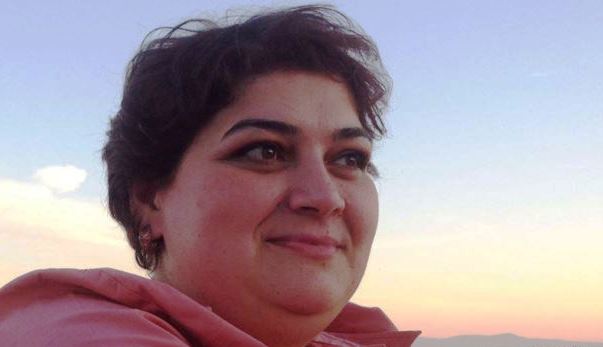
Khadija Ismayilova is one of the government critics jailed ahead of the European Games.
Azerbaijani investigative journalist Khadija Ismayilova was arrested in December for inciting suicide in a former colleague — who has since told media he was pressured by authorities into making the accusation. She is now awaiting trial for “tax evasion” and “abuse of power” among other things. These new charges have, incidentally, also been slapped on a number of other Azerbaijani human rights activists in recent months.
2) Belarus: participation in “mass disturbance”
Belorussian journalist Irina Khalip was in 2011 given a two-year suspended sentence for participating in “mass disturbance” in the aftermath of disputed presidential elections that saw Alexander Lukashenko win a fourth term in office.
3) China: “inciting subversion of state power”
Chinese dissident Zhu Yufu in 2012 faced charges of “inciting subversion of state power” over his poem “It’s time” which urged people to defend their freedoms.
4) Angola: “malicious prosecution”
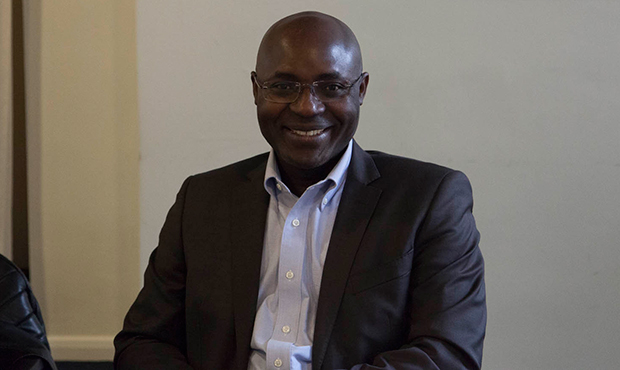
Journalist and human rights activist Rafael Marques de Morais (Photo: Sean Gallagher/Index on Censorship)
Rafael Marques de Morais, an Angolan investigative journalist and campaigner, has for months been locked in a legal battle with a group of generals who he holds the generals morally responsible for human rights abuses he uncovered within the country’s diamond trade. For this they filed a series of libel suits against him. In May, it looked like the parties had come to an agreement whereby the charges would be dismissed, only for the case against Marques to unexpectedly continue — with charges including “malicious prosecution”.
5) Kuwait: “insulting the prince and his powers”
Kuwaiti blogger Lawrence al-Rashidi was in 2012 sentenced to ten years in prison and fined for “insulting the prince and his powers” in poems posted to YouTube. The year before he had been accused of “spreading false news and rumours about the situation in the country” and “calling on tribes to confront the ruling regime, and bring down its transgressions”.
6) Bahrain: “misusing social media
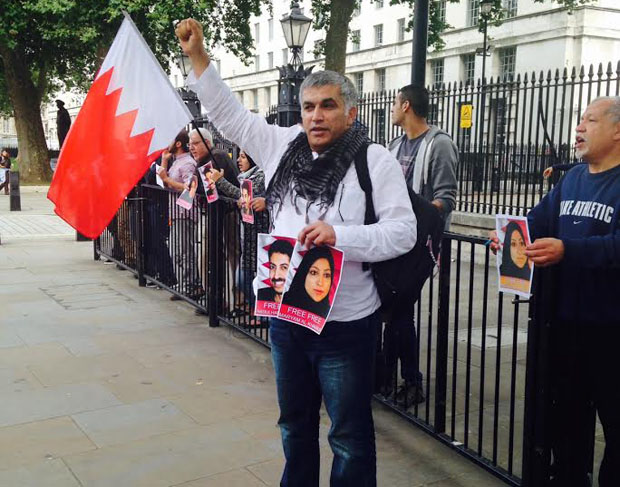
Nabeel Rajab during a protest in London in September (Photo: Milana Knezevic)
In January nine people in Bahrain were arrested for “misusing social media”, a charge punishable by a fine or up to two years in prison. This comes in addition to the imprisonment of Nabeel Rajab, one of country’s leading human rights defenders, in connection to a tweet.
7) Saudi Arabia: “calling upon society to disobey by describing society as masculine” and “using sarcasm while mentioning religious texts and religious scholars”
In late 2014, Saudi women’s rights activist Souad Al-Shammari was arrested during an interrogation over some of her tweets, on charges including “calling upon society to disobey by describing society as masculine” and “using sarcasm while mentioning religious texts and religious scholars”.
8) Guatemala: causing “financial panic”
Jean Anleau was arrested in 2009 for causing “financial panic” by tweeting that Guatemalans should fight corruption by withdrawing their money from banks.
9) Swaziland: “scandalising the judiciary”
Swazi Human rights lawyer Thulani Maseko and journalist and editor Bheki Makhubu in 2014 faced charges of “scandalising the judiciary”. This was based on two articles by Maseko and Makhubu criticising corruption and the lack of impartiality in the country’s judicial system.
10) Uzbekistan: “damaging the country’s image”
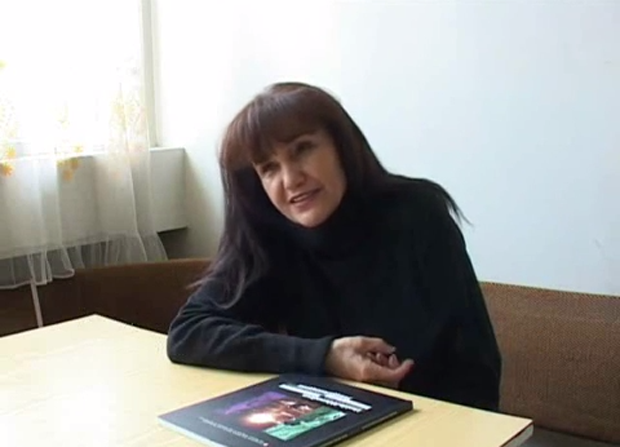
Umida Akhmedova (Image: Uznewsnet/YouTube)
Uzbek photographer Umida Akhmedova, whose work has been published in The New York Times and Wall Street Journal, was in 2009 charged with “damaging the country’s image” over photographs depicting life in rural Uzbekistan.
11) Sudan: “waging war against the state”
Al-Haj Ali Warrag, a leading Sudanese journalist and opposition party member, was in 2010 charged with “waging war against the state”. This came after an opinion piece where he advocated an election boycott.
12) Hong Kong: “nuisance crimes committed in a public place”
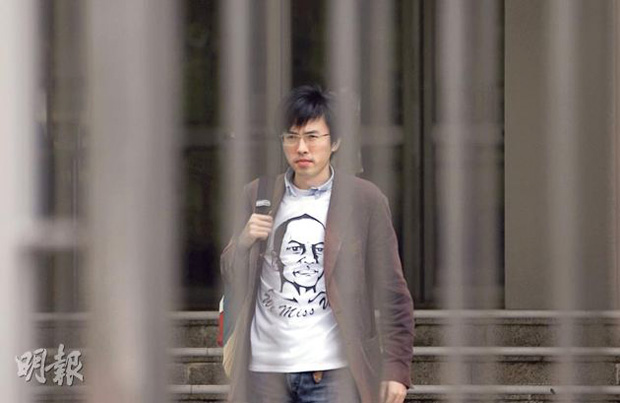
Avery Ng wearing the t-shirt he threw at Hu Jintao. Image from his Facebook page.
Avery Ng, an activist from Hong Kong, was in 2012 charged “with nuisance crimes committed in a public place” after throwing a t-shirt featuring a drawing of the late Chinese dissident Li Wangyang at former Chinese president Hu Jintao during an official visit.
13) Morocco: compromising “the security and integrity of the nation and citizens”
Rachid Nini, a Moroccan newspaper editor, was in 2011 sentenced to a year in prison and a fine for compromising “the security and integrity of the nation and citizens”. A number of his editorials had attempted to expose corruption in the Moroccan government.
This article was originally posted on 17 June 2015 at indexoncensorship.org
22 Dec 2014 | Belarus, Digital Freedom, News
Belarusian authorities attempt to hide a financial crisis by silencing critical voices in a new clampdown on media.
Several independent news sites were blocked in Belarus on 20 December. They include Naviny.by, Charter97.org, belaruspartizan.org, UDF.by, gazetaby.com, onliner.by and the website of BelaPAN, the only independent news agency in the country. No official explanations have been provided so far.
“It is still unknown who did that and for what reason. However, it is clear that the decision to block the ID addresses could only be made by authorities as in Belarus the government has monopoly on providing IP addresses,” the statement of BelaPAN Information Company reads.
These actions coincided with the decision of the government to introduce a 30% fee for purchasing of foreign currency as expectations of devaluation grew among the population of Belarus. On Saturday, Liliya Ananich, the Information Minister, gathered editors of leading non-state media and advised them “not to escalate the panic in the Belarusian society”. According to the minister, the coverage of the financial crisis in independent media “contravenes the interests of the state”.
“In times like these all media, both state and non-state, must work for the country,” Ananich told the editors, and warned that those who do not get the message might face sanctions.
Just three days before that, on 17 December, the parliament of Belarus adopted amendments to the Media Law that provides for official status of mass media for online news publications. Thus, online media might face the same restrictions, warnings and even closure for infringements of the Media Law as offline. The Law was adopted urgently without any discussions with civil society and independent professional community. It comes into force from 1 January 2015 – but, as it turns out, the authorities do not need any legal provisions to block news sites.
The special services of Belarus have a significant arsenal of means of blocking content online that they have used before. As it was revealed in Index’s Belarus: Pulling the plug policy paper, there are different ways the state authorities restrict freedom of expression online, including a repressive legal framework, online surveillance, website blocking and filtering, and cyber-attacks against independent websites and content manipulation.
The recent developments show the authorities of Belarus have no intention to stop its restrictive practices towards free speech. Internet has remained the last relatively free domain of freedom of expression in Belarus. As the country is moving into 2015, the year of the next presidential election, this space looks set to be shrinking further.
This article was posted on 22 December 2014 at indexoncensorship.org