The Supreme Economic Court of Belarus has upheld a decision by the Ministry of Information to cancel the licence of the Lohvinau Publishing House.
The company, owned by Ihar Lohvinau is well-known for publishing independent Belarusian literature and promoting national culture.
In September 2013 the Ministry of Information decided to withdraw its publishing license “for gross violations of the licensing legislation.”
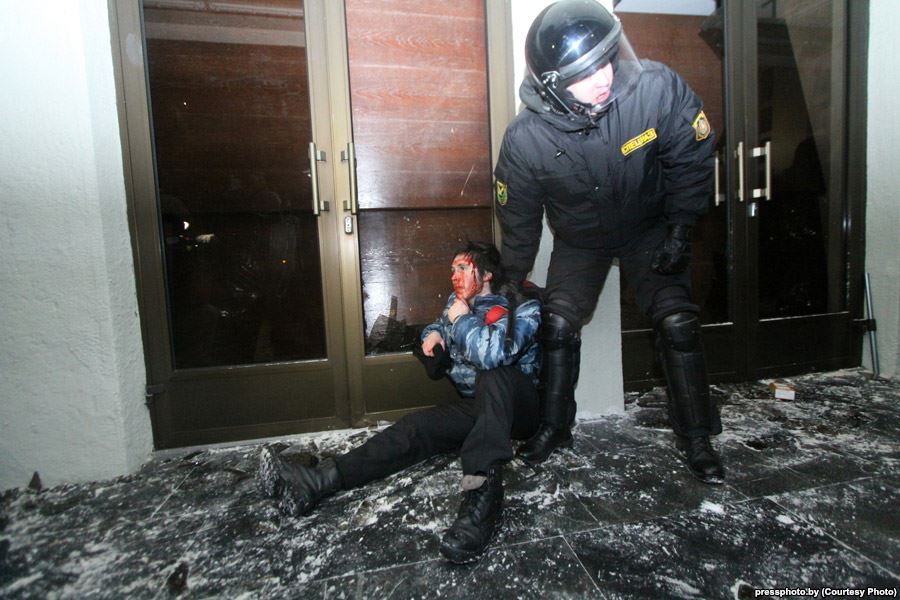
The reason for the decision was Lohvinau’s publication of the Belarus Press Photo 2011 album, which was found to contain “extremist material” by a district court in Ashmiany in April 2013.
“It is quite obvious that the decision is unfair and we are going to seek justice. The Ministry of Information didn’t provide us with answers to our questions in the court room. We are going to appeal against the decision,” said Ihar Lohvinau after the hearings on 18 November 2013.
“The Ministry of Information interprets the licensing law too broadly; the licensing regulations in Belarus contain no reference to any ‘extremist materials’. Besides, the photo album in question was published long before it was considered ‘extremist’, it was sold freely in book shops, and the publisher bares no responsibility for the content of it or any later court decisions,” says Andrei Bastunets, a media lawyer and a Vice Chairman of the Belarusian Association of Journalists.
Belarusian law does not contain a clear definition of extremism, thus allowing arbitrary implementation of anti-extremist legislation. It has been used to silence critical voices and independent media in the country in the past.
As well as pictures of cute animals, the album, printed to accompany an exhibition of the best of press photography, featured images of bleeding protesters taken during a crackdown on an anti-government demonstration in Minsk after the presidential election of 2011.
Bryan faces a charge of ‘hooliganism’ after he was arrested while filming a Greenpeace protest on an Arctic Ocean oil rig.
Hooliganism is defined in article 213 of the Russian criminal code as “a gross violation of the public order which expresses patent contempt for society, attended by violence against private persons or by the threat of its use, and likewise by the destruction or damage of other people’s property”
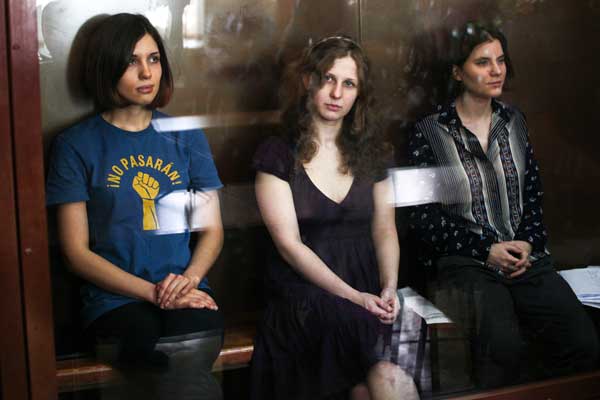
Bryon could end up with a two-year sentence should he be convicted. That’s what Nadezhda Tolokonnikova, Maria Alekhina and Ekaterina Samutsevic of Pussy Riot received after they were convicted of “hooliganism motivated by religious hatred” in October 2012. Samutsevic has been released on bail, but Alekhina and Tolokonnikova remain in prison. There were fears for the wellbeing of Tolokonnikova recently after authorities could not confirm her whereabouts in the course of a prison transfer.
In the past week, artist Pyotry Pavlensky was charged with hooliganism for nailing his scrotum to Red Square, in what he said was a protest against political apathy.
Azerbaijan meanwhile, defines it as “deliberate actions roughly breaking a social order, expressing obvious disrespect for a society, accompanying with application of violence on citizens or threat of its application, as well as destruction or damage of another’s property…”
In May of this year, Azerbaijani activist Ilkin Rustamzadeh was sentenced to two months pre-trial detention for a hooliganism charge after he allegedly took part in a “Harlem Shake” video. Rustamzadeh, who had been active in calling for investigations into the deaths of young soldiers in Azerbaijan’s army, denied ever having taken part in the videos.
Before that, in 2009, Azerbaijan had jailed two young activists for hooliganism after they posted a video on YouTube satirising the government’s expenditure on importing donkeys from Germany.
It was suggested that the donkey import was a cover for money laundering. Shortly after the video was posted, the activists, Emin Milli and Adnan Hadjizadeh, were attacked in a Baku cafe. They were blamed for the fight and sentenced two and a half years and two years respectively.
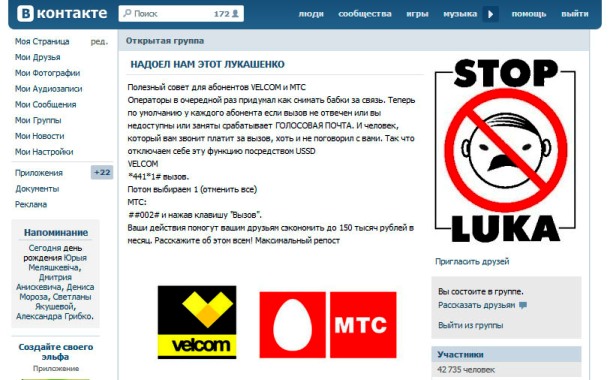
In Belarus, Alexander Lukashenko’s regime frequently uses hooliganism charges to harass journalists and activists. Lukashenko is so paranoid about dissent that he at one point banned clapping in public, so its unsurprising that moderators of online anti-government groups get arrested. In August 2012, Pavel Yeutsikheieu and Andrei Tkachou, administrators of the “We are fed up with Lukashenko” group on Russian social network VKontakte, were both given short prison sentences for “minor hooliganism”.
In the old Soviet Union, inconvenient people were often declared mad and locked up by the authorities. Now, they’re classified as hooligans.
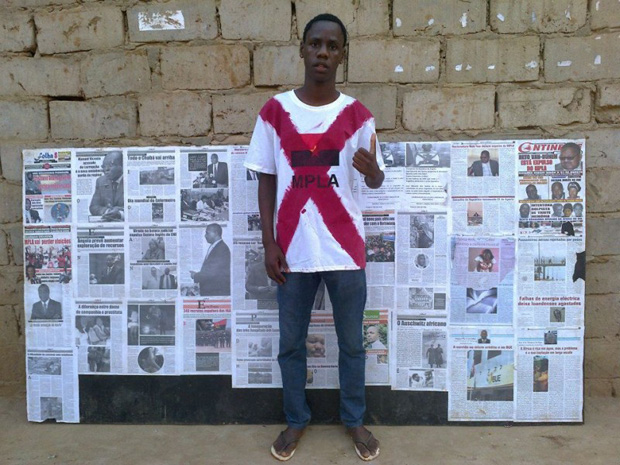
Manuel Chivonde Nito Alves was held in solitary confinement for printing t-shirts. Image from his Facebook page.
Angolan 17-year-old Manuel Chivonde Nito Alves went on hunger strike on Tuesday, following his arrest on 12 September for printing t-shirts with the slogan “Out Disgusting Dictator”. The message was aimed at the country’s President Jose Eduardo dos Santos, who has held power in since 1979. The shirts were to be worn at a demonstration in the capital Luanda, highlighting corruption, forced evictions, police violence and lack of social justice under dos Santos’ regime. Nito Alves has been charged with “insulting the president”, and has now spent almost two months in detention – parts of it in solitary confinement. His family were barred from seeing him, and three weeks went by before he was allowed to speak to a lawyer. The hunger strike is in protest at his “unjust and inhumane treatment”.
2) Belarus
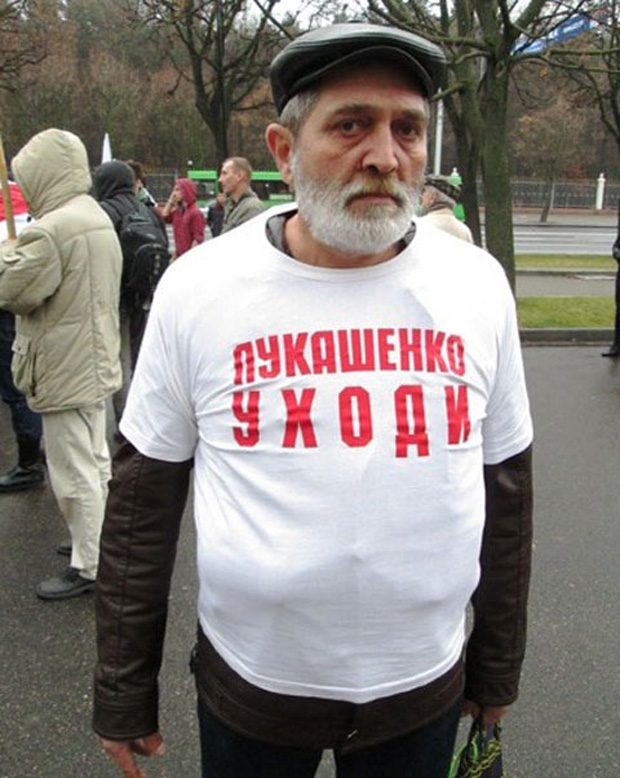
Yury Rubstow wearing the t-shirt that landed him in prison. (Image Viasna Human Rights Centre)
On Monday, Belarusian opposition activist Yury Rubstow was sentenced to three days in jail for wearing a t-shirt with the slogan “Lukashenko, go away” on the front, and “A four-time president? No. This is not a president but an impostor tsar” on the back.” The message was aimed at the country’s dictator Alexander Lukashenko, during an opposition protest march. He was found guilty of disobedience to police officers under Article 23.4 of the Civil Offenses Code.
3) Swaziland
In 2010, Sipho Jele, a member of Swaziland’s People’s United Democratic Movement, was arrested for wearing a t-shirt supporting the party during a May Day parade. He was arrested under the country’s Suppression of Terrorism Act, and died in custody. The police said he had hanged himself, while the party say the police of killed him.
4) Egypt
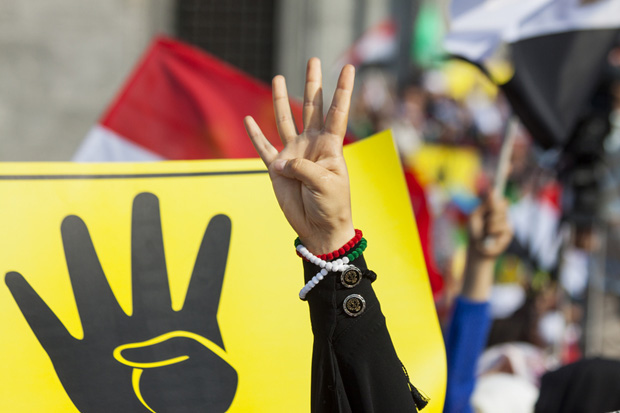
The Rabaa symbol displayed at a protest in Turkey (Image Bünyamin Salman/Demotix)
In September, three Egyptian men were arrested for wearing t-shirts emblazoned with the Rabaa symbol. A hand holding up four fingers, it is widely used by those opposing Egypt’s interim military-backed government, and the coup that ushered in in. Mohamed Youssef, the country’s kung fu champion, was also suspended by the national federation for wearing a similar t-shirt during a medal ceremony.
5) Hong Kong
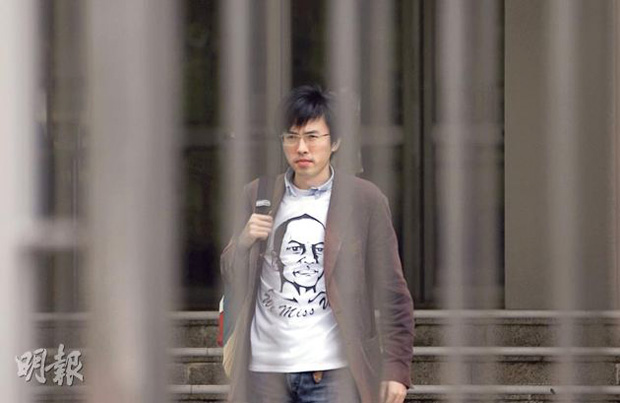
Avery Ng wearing the t-shirt he threw at Hu Jintao. Image from his Facebook page.
An activist from Hong Kong was arrested last December for throwing a t-shirt at former Chinese president Hu Jintao during an official visit almost six month earlier, on 1 July. League of Social Democrats Vice Chairman Avery Ng threw a t-shirt with a drawing of the late Chinese dissident Li Wangyang, a Tiananmen Square activist who died under suspicious circumstances only weeks before the visit. Ng was charged “with nuisance crimes committed in a public place”.
6) Malaysia
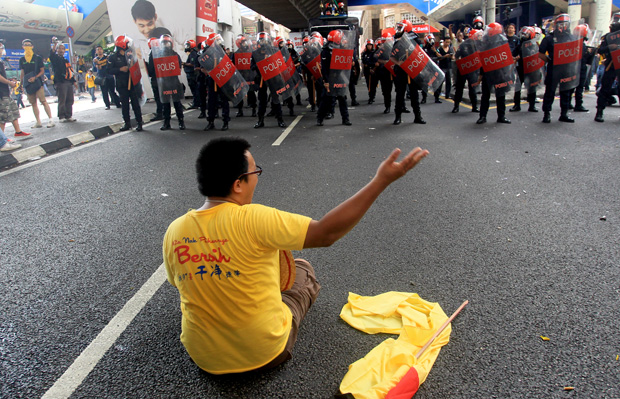
Malaysian protester wearing a Bersih shirt. (Image Syahrin Abdul Aziz/Demotix)
In June 2011, Malaysian police arrested 14 opposition activists for wearing t-shirts promoting a rally in Kuala Lumpur calling for election reform. The shirts carried the slogan “bersih” which means “clean”, and is the name of one of the groups behind the protest. Authorities claimed the demonstration was an “attempt to create chaos on the streets and undermine the government”, and they were therefore within their rights to arrest the protesters. They also confiscated t-shirts from the group’s headquarters.
7 & 8) The US
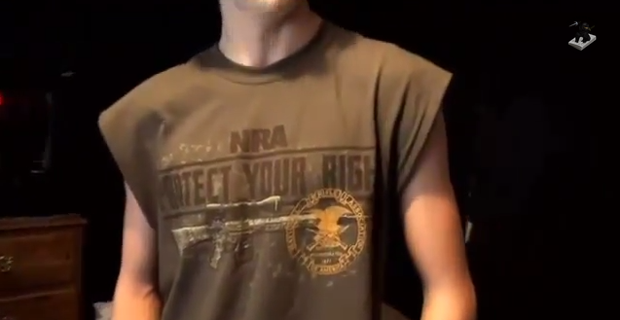
Jared Marcum wearing his NRA t-shirt in a TV report. (Image Youtube)
A 14-year-old student from West Virginia was in April suspended from school and subsequently arrested for refusing to remove a t-shirt supporting the pro-gun National Rifle Association. Jared Marcum was charged with “obstructing an officer” and faced a $500 fine and up to one year in prison.
On the flip side, a Tennessee man was arrested for wearing a t-shirt in support of stricter gun control laws. Stanley Bryce Myszka was wearing a shirt that read “Has your gun killed a kindergartener today?” at a shopping centre, following the shooting at Sandy Hook Elementary School. He was approached by security guards, who called the police when he when he refused to remove the shirt. He was also banned from the shopping centre for life.
9) United Kingdom
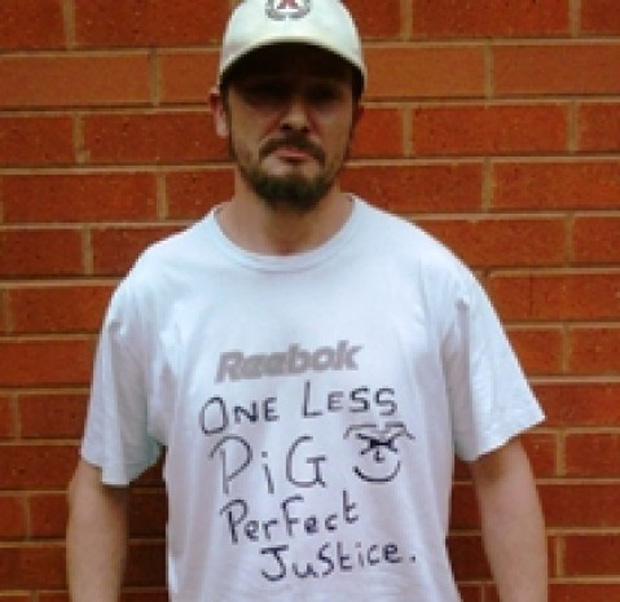
The front of Barry Thew’s t-shirt. (Image Greater Manchester Police)
A Manchester man was in October 2012 sentenced to eight months in prison in part for wearing a t-shirt emblazoned with offensive comments referencing the murders of two policewomen. Barry Thew had written “One less pig; perfect justice” on the front of his t-shirt and “killacopforfun.com haha” on the back. While four months of the sentence was handed down for breach of a previous suspended sentence, he was charged on a Section 4A Public Order Offence for the t-shirt incident.
The status quo between the European Union and Belarus remains in place. The EU Council prolonged its present sanctions against Belarusian officials last week.
On 29 October 2013 the Foreign Affairs Council of the European Union extended its restrictive measures against Belarus for one more year.
“This is because not all political prisoners have been released, no released prisoner has been rehabilitated, and the respect for human rights, the rule of law and democratic principles has not improved in Belarus,” the press service of the EU Council reported.
The EU reiterated its policy of “critical engagement” with the Belarusian government. At the same time, it updated the list of persons and companies, subjected to the EU sanctions. Thirteen people and five enterprises — all belonging to a Belarusian businessman Vladimir Peftiev — were excluded from the list.
Two more officials were added to the ban list in return: Aliaksandr Kakunin and Yury Trutko, who are the chief officers of Babruysk Correctional Institution No. 2, a prison where Ales Bialiatski, a famous Belarusian human rights defender, is serving a 4.5 year term.
At the moment the EU ban list contains the names of 232 Belarusian officials, including President Alexander Lukashenko, who were involved in human rights violations. They are banned from travelling in the EU; all their possible assets in the European Union must be frozen. The EU ban list also includes 25 companies owned by Yury Chizh and Anatoly Ternavsky, who are sometimes called “the bagmen of the regime.”
The decision of the EU to exclude from the “black list” 13 people, who no longer occupy their positions within the authorities of the country, was criticised by some representatives of Belarusian civil society.
“The reason they were included in the list was their participation to certain extent in human rights violations. For instance, there are several judges who passed politically motivated sentences to civil activists, involved in peaceful protests against the election fraud on 19 December 2010. Despite the fact they left their jobs, none of them has publically announced he or she regrets what they did and they are sorry. The reason why those 13 people were on the list is still there,” Uladzimir Labkovich, an activist of the Human Rights Centre Viasna, told Naviny.by.
Andrei Yahorau, the director of the Centre for European Transformation, thinks there is nothing new in principle in the EU Council decision.
“The reasons for the restrictive measures are still there, so it is natural the EU went on with them. But the changes in the ‘black list’ are purely technical. The issue with the list is not the changes themselves, but the closed way of compiling the list and making these changes. As there are no clearly defined criteria for inclusion to or exclusion from the ban list, such decisions give way to questions and unnecessary speculations,” Andrei Yahorau told Index.
The authorities of Belarus expressed a restrained approval to the EU decision. The Foreign Ministry welcomed shortening of the ban list, but stated the overall approach is still “anti-productive” and insists all sanction must be lifted. There is no change in attitudes towards the issues of human rights of the Belarusian government. For instance, on the day of the EU decision several journalists were detained in Minsk. The official delegation of Belarus confirmed once again at the session of the UN General Assembly in New York this week the authorities of the country do not recognise the mandate of the UN Special Rapporteur on the situation of human rights in Belarus, Miklós Haraszti, and are not going to cooperate with him.
The situation seems to be kept dead-locked, and Andrei Yahorau suggests Belarusian civil society “cannot blame the EU for the fact the situation in Belarus is not changing.” Despite the fact the European Union still lacks a clear and effective strategy towards the country, Yahorau believes “if no changes happen inside of Belarus itself, we should not expect anything from Europe.”