8 Jun 2017 | Azerbaijan, Digital Freedom, Europe and Central Asia, France, Mapping Media Freedom, News, Russia, Spain
[vc_row][vc_column][vc_column_text]

Over the last seven days, violence, intimidation, harassment and assault have been used to stop journalists from doing their job in the countries covered by Index on Censorship’s project Mapping Media Freedom.
Project manager Hannah Machlin explained why incidents in Azerbaijan and Ukraine are particularly alarming. She called the Azerbaijani incident “the most serious violation to press freedom in the past few days and it shows the situation in the region continues to be disturbing”.
The violation, which took place in late May, was against exiled Azerbaijani journalist Afgan Mukhtarli, who was abducted and allegedly tortured before being taken across the border and put in pre-trial detention in Azerbaijan.
“This shows that Georgia can’t be considered a safe haven for opposition journalists and activists as well as reiterates the continued crackdown on press freedom in Azerbaijan,” Machlin said. The incident has been reported to the Council of Europe’s platform on the protection of journalism to enable that organisation to pursue discussions with the country’s representatives. Index on Censorship joined other press freedom organisations to request the Georgian government take action on the incident.
Machlin said the situation in Ukraine “indicates a complex issue in a war-torn area”. She said the “the report shows that there’s still renewed violent intimidation tactics perpetrated by the separatists against Ukrainian public broadcasters in Donbas”. She explains this is interesting because it shows that the separatists are targeting channels of free information set up by Kyiv and that Ukraine is even trying to install public broadcasters in the eastern region controlled by self-proclaimed authorities because the country “is trying to put a press presence back in there”.
29 May 2017 – Azerbaijani journalist Afgan Mukhtarli was on his way home but never made it.
Mukhtarli was reportedly kidnapped from his neighbourhood after being forced into a car with his hands tied together. He was also beaten with a broken nose and bruises all over his head and face.
He then was transported back to Azerbaijan without a passport.
Mukhtarli was charged for illegally crossing the border, smuggling and resisting law enforcement and was also accused of being in possession of 10,000 EUR during the police search at the border.
One day later on 30 May, he was sentenced to three months in pretrial detention.
Mukihtarli’s wife and child in still in Tbilsi where they fled after escaping Azerbaijan in 2015 when Mukhtarli was threatened over his investigative reporting on corruption in the Azerbaijan.
26 May 2017 – Do TeBe, a new TV channel, endured a smashing of their front door by two unidentified assailants.
Police came to the channel, located in Donetsk oblast and are now investigating the incident.
Do TeBe’s deputy director Ilya Suzdalyev said “We are in the front line region, even what looks like hooliganism must be thoroughly investigated and perpetrators should be punished. Especially when it is, in fact, an attack on the public broadcaster, which was just created in Ukraine.”
Do TeBe TV channel is a regional branch of the National Public Broadcasting Company of Ukraine.
31 May 2017 – Outside the parliament building where the 2017 presidential inauguration took place journalists were assaulted by supporters of the new president.
Lidija Valtner, a journalist for daily Danas, was filming and interviewing an anti-government protester when she was assaulted by a group of supporters. Not only did they shove her around and try to take her mobile phone, but they also assaulted the protester she was interviewing.
Another journalist on the scene was reporting for Radio Belgrade when she was pushed and her equipment thrown to the ground.
Journalists for Balkan Investigative Reporting Network (BIRN) and Vice Serbia were also harassed with violence from the crowd whilst they were taking photos of the clashes. The police asked for their IDs after they witnessed a few men ripping a protest banner.
The assailants are still on the loose.
31 May 2017 – An unknown person called the editor-in-chief of the local news website Kurier.Sreda.Berdsk and threatened her and the editorial staff. Galina Komornikova’s outlet is located in the Novosibirsk region in Berdsk.
On the call, the individual said that “the Syrian theme is not one for journalists”.
The call may have been in response to a story published by the outlet the day before about the secret funeral of a Berdsk resident and Russian military officer. Yevgeni Tretyakov, who was killed in Syria on 15 May, may have belonged to private Russian military troops as he was not an official Russian army contractor.
The outlet then commented on the article saying “An unknown individual called us and promised to ‘come and handle us on behalf of law enforcement agencies’ following the article.”
Para-military private troops are not a new concept. Both Russian and international civil investigative groups and media outlets have been reporting evidence for these groups in the Syrian conflict.
A comment was also left by user “The Animal” stating “Actually, data on military casualties is classified, therefore, I would not be surprised if special people came to visit you to shake a bit, you and your sources.”
29 May 2017 – After elimination while being interviewed, tennis player Maxime Hamou tried to kiss channel Eurosport journalist Maly Thomas several times.
It was at the Rolland Garros tournament where Hamou grabbed Thomas and tired kiss her on the neck and cheek.[/vc_column_text][/vc_column][/vc_row][vc_row][vc_column][vc_column_text]
Mapping Media Freedom
Click on the bubbles to view reports or double-click to zoom in on specific regions. The full site can be accessed at https://mappingmediafreedom.org/[/vc_column_text][/vc_column][/vc_row]
14 Oct 2015 | About Index, Campaigns, Mapping Media Freedom, Press Releases
Strasbourg, 13.10.2015 – The Committee to Protect Journalists and Index on Censorship became partners to the Platform to promote the protection of journalism and safety of journalists, which will allow them to alert the Council of Europe on violations to media freedom in Europe.
“Joining the Council of Europe platform is part of our continued efforts to increase visibility of media freedom violations in the region. We look forward to working with the Council and engage in a constructive dialogue with governments to address the too many threats journalists face for simply doing their job,” Melody Patry, senior advocacy officer Index on Censorship, said.
Chief Executive of Index on Censorship Jodie Ginsberg, and European Union correspondent of the Committee to Protect Journalists Jean-Paul Marthoz signed the agreement on behalf of their organisations during a meeting with Council of Europe Secretary General Thorbjørn Jagland.
Secretary General Jagland said: “Visibility for threats against journalists is crucial and cannot be underestimated. The fact that we have this platform means that we can also take concrete threats against journalists to governments in question and discuss with them to take joint actions. We already have good examples of how this works in a positive way”.
Since its launch in April 2015, the platform has recorded 84 alerts concerning 21 states. Twenty-five alerts concern physical attacks on journalists, 21 alerts the detention and imprisonment of journalists, 8 impunity of attacks, 8 harassment or intimidation, and other 22 acts that may have a chilling effect on media freedom. Eleven alerts concerned cases in which journalists were killed, eight of them in the Charlie Hebdo attack.
The platform was launched with the participation of five partner organisations with which the Council of Europe signed a Memorandum of understanding: Article 19, the Association of European Journalists, the European Federation of Journalists, the International Federation of Journalists and Reporters Without Borders.
The platform allows these partners to issue alerts concerning media freedom threats and to bring them to the attention of the Council of Europe institutions. Once the alerts are published, the Council of Europe sends them to the authorities of the country concerned. The Council of Europe institutions may react publicly or start a dialogue on the issue with the authorities. Subsequently, responses of the member states and follow-up action taken by the competent bodies are also posted on the platform. The governments of the states concerned by the 84 alerts received have so far replied to 26 cases.
Contact: Jaime Rodriguez, Spokesperson/Media officer, tel. +33 3 90 21 47 04
——
Le Comité pour la protection des journalistes et Index on Censorship se joignent à la Plateforme du Conseil de l’Europe pour la protection des journalistes
Strasbourg, 13.10.2015 – Le Comité pour la protection des journalistes et Index on Censorship se joignent aujourd’hui aux organisations partenaires de la Plateforme pour renforcer la protection du journalisme et la sécurité des journalistes, ce qui leur permettra d’alerter le Conseil de l’Europe sur les cas de violation de la liberté des médias en Europe.
“Rejoindre la plateforme du Conseil de l’Europe fait partie de nos efforts continus pour accroître la visibilité des violations de la liberté des médias dans la région. Nous avons hâte de travailler avec le Conseil et d’engager un dialogue constructif avec les gouvernements pour confronter les menaces trop nombreuses qui pèsent sur les journalistes,” dit Melody Patry, chargé de plaidoyer principal Index on Censorship.
Jodie Ginsberg, directrice d’Index on Censorship, et Jean-Paul Marthoz, correspondant pour l’Union européenne du Comité pour la protection des journalistes, ont signé l’accord de partenariat au nom de leur organisation lors d’une réunion avec Thorbjørn Jagland, Secrétaire Général du Conseil de l’Europe.
M. Jagland déclaré : « faire connaître les menaces qui pèsent sur les journalistes revêt une importance cruciale, c’est un levier qu’on ne saurait sous-estimer. En outre, grâce à cette plate-forme, nous pouvons approcher les gouvernements concernés au sujet des menaces concrètes qui pèsent sur les journalistes, en vue de prendre des mesures conjointes. Nous avons d’ores et déjà obtenu des résultats positifs avec cette méthode. »
Depuis son lancement en avril 2015, la plate-forme a enregistré 84 alertes concernant 21 Etats. Vingt-cinq alertes portent sur des agressions physiques contre des journalistes, 21 sur la détention et l’emprisonnement de journalistes, 8 sur l’impunité des agressions, 8 sur le harcèlement ou l’intimidation, et 22 sur des actes pouvant avoir un effet dissuasif sur la liberté des médias. Onze alertes concernent des cas dans lesquels des journalistes ont été tués ; parmi ceux-ci figurent notamment huit victimes de l’attentat contre Charlie Hebdo.
La plate-forme a été lancée avec la participation de cinq organisations partenaires, qui ont signé un mémorandum d’accord avec le Conseil de l’Europe : Article 19, l’Association des journalistes européens, la Fédération européenne des journalistes, la Fédération internationale des journalistes et Reporters sans frontières.
La plate-forme permet à ces organisations de publier des alertes concernant des menaces qui pèsent sur la liberté des médias, et de les porter à l’attention des institutions du Conseil de l’Europe. Lorsqu’une alerte est publiée, le Conseil de l’Europe la transmet aux autorités du pays concerné. Les institutions du Conseil de l’Europe peuvent réagir publiquement aux alertes ou entamer un dialogue à ce sujet avec les autorités. Par la suite, les réponses des Etats membres et les suites données par les organes compétents sont également publiées sur la plate-forme. A ce jour, 84 alertes ont été reçues, qui ont donné lieu à 26 réponses de la part des gouvernements concernés.
Contact: Jaime Rodriguez, Porte-parole/Attaché de presse, tél. +33 3 90 21 47 04
24 Nov 2014 | Azerbaijan, Azerbaijan News, Azerbaijan Statements, Europe and Central Asia, News
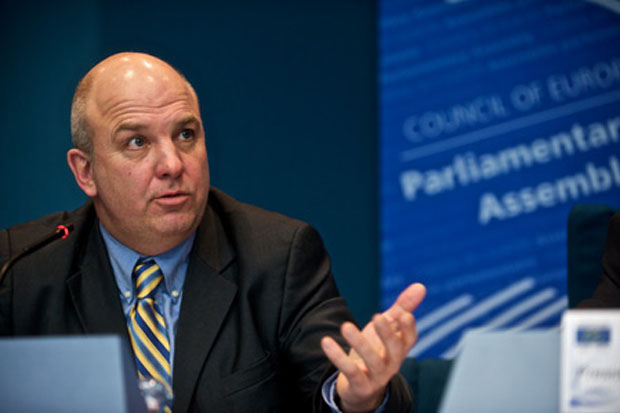
Council of Europe Commissioner for Human Rights Nils Muižnieks (Photo: Council of Europe)
I recently returned from one of the most difficult missions of my two-and-a-half year tenure as Council of Europe Commissioner for Human Rights. In late October I was in Azerbaijan, the oil-rich country in the South Caucasus, which just finished holding the rotating chairmanship of the 47-member Council of Europe. Most countries chairing the organisation, which prides itself as the continent’s guardian of human rights, democracy and the rule of law, use their time at the helm to tout their democratic credentials. Azerbaijan will go down in history as the country that carried out an unprecedented crackdown on human rights defenders during its chairmanship.
All of my partners in Azerbaijan are in jail. It was heart-wrenching to visit Leyla Yunus in pre-trial detention outside of Baku, Azerbaijan’s capital. Head of the Institute for Peace and Democracy, Leyla is Azerbaijan’s most prominent human rights activist and one of three finalists for this year’s prestigious Sakharov award, granted by the European Parliament. I do not know whether it was due to her cataracts or her emotional distress, but she cried throughout our half-hour meeting. The 58-year-old also has diabetes, Hepatitis C and kidney problems. She was in particular anguish for not having had the chance to see Arif, her husband of 26 years, for more than three months. He is also in pre-trial detention, despite having had a stroke just prior to his arrest.
The Yunus couple are among the brave activists in the region that have sought to promote dialogue with their counterparts in Armenia, a country with which Azerbaijan has been at war for the last 25 years over the Nagorno-Karabakh region, which was violently wrested from Azerbaijan as the Soviet Union collapsed. Arif and Leyla Yunus have both been charged with the crime of treason. Leyla regularly compiled lists of the country’s political prisoners for submission to international organisations. On October 24, the day I left Azerbaijan, a Baku court prolonged Leyla’s pre-trial detention for another four months.
Another difficult meeting was with Intigam Aliyev, one of Azerbaijan’s most renowned human rights lawyers, who is also in pre-trial detention for allegedly violating the restrictive provisions that make human rights work virtually impossible in the country. Until his arrest three months ago, Intigam was the co-ordinator of the Council of Europe’s legal training programme in the country. He was also legal counsel for dozens of cases against Azerbaijan before the European Court of Human Rights. When the authorities seized all of his documents, including the case files, he said he felt like the rug had been pulled from under his feet. He did not know how he could continue pushing the cases at the European Court or how he could defend himself. Again, the day I left Azerbaijan, his pre-trial detention was prolonged for another three months. When the judge announced his decision, Intigam nearly fainted.
I had a more upbeat meeting with Anar Mammadli, winner of this year’s Vaclav Havel prize, granted by the Parliamentary Assembly of the Council of Europe. Anar has already been convicted to a five-and-a-half-year prison sentence for violating the country’s cumbersome NGO laws (the formal charges were tax evasion, illegal entrepreneurship and abuse of authority). Anar was appealing his conviction and was in good spirits, despite the scant chances of success of his appeal. As one of the country’s most professional organisers of election monitoring, Anar had been harshly critical of several previous ballots in the country. Anar spends most of his time exercising and reading books on political science, philosophy and history. He wanted to know how from prison he could provide input to the Council of Europe’s efforts to assist Azerbaijan improve the legal framework for NGOs.
I also left heartened by a meeting with Rasul Jafarov, the head of an NGO called the Human Rights Club. Though he had had his pre-trial detention extended for another three months the day before I met him, Rasul was in good spirits. Rasul made a name for himself by organising a campaign called “Sing for Democracy” in the run-up to the holding of the Eurovision Song contest, which Azerbaijan hosted in 2012. He had planned to organise a new campaign called “Sports for Democracy” in the run-up to the holding of the European Games in Azerbaijan in 2015. Though he is charged with violations of the NGO law, as we bid farewell to each other, he related his plans to organise a human rights NGO among detainees.
While most of my partners are in detention, others discontinued their human rights work, left the country over the summer, or went into hiding as the crackdown spread. I visited one of the activists in hiding, Emin Huseynov, head of the Institute for Reporters’ Freedom and Safety, an NGO defending journalists in Azerbaijan’s restrictive media context. Though Emin is only 35 years old, he has very high blood pressure and an old spinal injury caused by an encounter with Azerbaijani police batons at an “unauthorised” demonstration a few years ago. Doctors who have examined him say he will not survive an Azerbaijani prison.
These are just some of the activists and journalists languishing in prison or under pressure in Azerbaijan. They are core partners for the Council of Europe – they have all attended roundtables for human rights defenders organised by my office or participated in events organised by the Parliamentary Assembly. The Council of Europe’s primary friends and partners in the country have almost all been targeted. While this pains me deeply, it also makes practical cooperation between Azerbaijan and the Council of Europe extremely difficult. The reprisals must stop. Now.
This article was originally posted on the Facebook page of the Council of Europe Commissioner for Human Rights. It is republished here with permission from the Council of Europe and the Council of Europe Office of the Commissioner for Human Rights.
8 Aug 2014 | Azerbaijan, Azerbaijan News, Europe and Central Asia, News
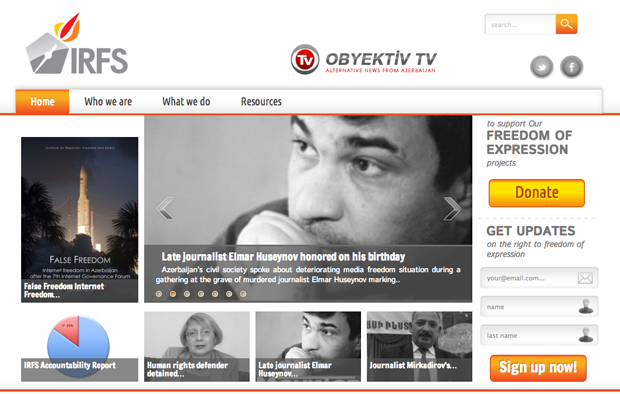
(Image: IRFS)
The offices of Azerbaijani press freedom organisation Institute for Reporters’ Freedom and Safety (IRFS) were on Friday searched by police – the latest in a new clampdown by authorities on human rights groups in Azerbaijan. Human rights lawyer Intigam Aliyev also had his home searched, and has been sentenced to three months pretrial detention.
The IRSF offices were today surrounded by police officers according to reports from Azerbaijan. There are unconfirmed reports that Emin Huseynov, the head of the organisation, has been detained. He was already under a travel ban.
Over the past two weeks, human right defenders Leyla and Arif Yunus and Rasul Jafarov have been sentenced to three months of pretrial detention, facing charges including high treason, state betrayal and tax evasion. One of the country’s few remaining independent newspapers, Index Award winner Azadliq, has been forced to suspend publication due to financial troubles.
IRFS has been reporting on these and other instances of apparent state targeting of opposition voices. The NGO was founded in 2006, “in response to growing government restrictions on freedom of expression and freedom of press,” according to their mission statement. The latest global press freedom index from Reporters Without Borders ranks Azerbaijan at 160 out of 180 countries, and the recent estimates puts the number of political prisoners in the country at over 140.
The recent cases have taken place against a backdrop of heightening tensions between Azerbaijan and neighbouring Armenia, which so far has left at least 14 people dead. President Aliyev on Thursday published a series of tweets on his personal Twitter account which seemed to threaten war with Armenia. The troubled relationship between the two countries has also played a part in cases against dissidents, including Leyla Yunus who has been accused of spying for Armenia.
In May, Azerbaijan assumed chairmanship of the Council of Europe’s (COE) Committee of Ministers, whose tasks include “ensure[ing] that member states comply with the judgments and certain decisions of the European Court of Human Rights”.
In a statement on Friday, the COE said Secretary General Thorbjørn Jagland has “revealed his deep concern at the arrest of Azerbaijan human rights defender Leyla Yunus and the prosecution case against her husband Arif”.
“By stifling dissent, Azerbaijan is failing to comply with its international obligations which require safeguarding freedom of expression, assembly and association. It is necessary that Azerbaijan reverse the situation,” COE Commissioner for Human Rights Nils Muiznieks has told Azerbaijani media.
Index on Censorship, along with 60 other NGOs, has called for the immediate and unconditional release of Leyla and Arif Yunus and Rasul Jafarov. Today Index reiterates this call and raised its concerns with Britain’s Foreign and Commonwealth Office.
“It is deeply worrying that while international attention is directed at conflicts elsewhere, Azerbaijan appears to be resuming oppression of dissent,” said Jodie Ginsberg, CEO of Index on Censorship. “This is a country showing blatant disregard for human rights while presiding over an institution that describes itself as the continent’s ‘leading human rights organisation.’ The fellow members of the Council of Europe must do more to show Azerbaijan its actions must cease immediately.”
This article was published on August 7, 2014 at indexoncensorship.org
