13 Feb 2026 | Africa, Asia and Pacific, Europe and Central Asia, Features, France, Kenya, Madagascar, Nepal, United Kingdom
This article first appeared in the Winter 2025 issue of Index on Censorship, Gen Z is revolting: Why the world’s youth will not be silenced, published on 18 December 2025.
Gen Z are in revolt. In Kenya, in Madagascar, in Nepal, young people are exercising their freedom of expression, taking to the streets and demanding change. They are at times being silenced with force, at other times with subtlety.
As a team of predominantly non-Gen Z people, we spoke with young people from across the world to better understand how they see themselves. How free are their voices? Do they have hope for the future? Are we all doomed?
We talked to a young man from France, who described the hate and division he sees online, particularly targeted at men, with far-right politicians using memes and AI-generated videos to spread or soften hateful rhetoric. Marine Le Pen petting cats, for instance.
He believes social collapse is coming. In a country like France, with its strong record of demonstrations, it is shocking to hear him say that protests make no difference. They are dangerous places to be, where police use weapons against those raising their voices. People are fed up, and politicians are out of touch. In his words, “the Boomer generation is fucking us up”. What is most striking is that he doesn’t feel he can say any of this in public. Politics has become too divisive.
He described a landscape where young people are struggling to even pay grocery bills, and politicians aren’t listening. At the same time, he and his peers are trying to find meaning, a reason for being on the planet. Their issues are existential. In the UK too, people struggle to get jobs, to meet rising costs, and to afford a home.
The same is true in Finland, where a woman in her mid-twenties told us about her experiences. She said she is scared for the future.
While her social media algorithm is full of lifestyle influencers and calming content, she has witnessed a growing conservatism among the lower age bracket of Gen Z on TikTok. Her peers are cautious about saying anything that might get them cancelled, while she sees a slew of right-wing views from those in their mid-teens.
Here in the UK, our editorial assistant (and resident Gen Zer) Connor O’Brien has seen “young men being pumped with manosphere content”. He approached a number of Reform UK voters, keen to hear their perspectives, but none of them were willing to talk to Index.
Students from Ukraine, Palestine, Afghanistan and Malaysia joined us for a round table discussion about why Gen Z is in revolt. They talked about the bravery of Gen Z, growing up in the wake of the Arab Spring, and the feeling of having nothing left to lose. That, they said, is how revolutions start. They too agreed – the older generations have failed them, and the world is going to burn. Why wouldn’t they revolt?
They described what makes Gen Z distinct. The huge step change in their access to information, the way they consume media and how they share their opinions. Through the power of the internet, their generation has been shaped by global connection.
They also discussed how it’s impossible to generalise for a whole generation. They’re right, and even the views we heard were only a small sample. The Frenchman does not represent all of France, nor the Finnish woman all of Finland.
A recent report for Demos by Shuab Gamote and Peter Hyman, who interviewed hundreds of British 16-18 year olds, demonstrated just that. For starters, the 15-28 age bracket (as of 2025) is simply too wide. They focused their research on 15-18 year olds as the future change-makers. They also designed five archetypes, which the young people they spoke with felt represented them well. They are the activist (left-wing, cares about climate change, deeply principled), the entrepreneur (believes in meritocracy), the critical realist (apathetic or anti-establishment, questioning of everything), the traditionalist (right-leaning, patriotic) and the connector (disengaged from political discussions and interested in pop culture).
The media and, if we’re honest, those of us outside the Gen Z age bracket, have made some quick assumptions about who is influencing young people today. It must be Andrew Tate. The news tells us this, television dramas tell us this, and we probably tell it to each other. But, according to Gamote and Hyman’s research, “Tate is dead.” Figuratively.
When they mentioned Tate in their sessions, students rolled their eyes. Instead, young people in the UK are being influenced by five key types of social media star: entertainers, adult content creators, news explainers, right-wing thinkers and left-wing voices. Gender is a huge dividing line, shaping young people’s views.
“Young people today are immersed in a constant stream of content,” they said. “Young people are not following one person’s ‘ideology’. They follow and are ‘influenced’ by tens if not hundreds of creators. Their feeds are shaped by algorithms, not loyalty.”
The students at our round table echoed this, describing an ever-spinning carousel of influencers, who hold their attention for a week or so. One spoke about the gentle path of breadcrumbs – first a funny video, and then a bait and switch to far-right ideology, or videos of angry people shouting at hotels in Epping which they are being pushed because they live in Essex. For the women, “trad wives” content had made its way onto their feeds.
All this is about a fight for the future; for the youth protesters, for the young men demanding patriotic values and for the powerful seeking to gain influence on the young. From the Millennial, Gen X and Boomer sidelines, it might look like that future is hopeless. But Gen Z have a binary choice. It’s all or nothing.
22 Dec 2025 | Europe and Central Asia, News, Serbia
On the second evening of my stay in Belgrade, I wondered if someone had been rummaging around in my Airbnb. I was pretty sure that I’d double-bolted the door, but when I came back from the restaurant the door wasn’t bolted at all. It was as if it had just been pulled shut. There was nothing missing, though I searched the high-ceiling-ed narrow studio flat just to make sure someone wasn’t hiding behind a curtain or in a cupboard. The apartment was empty. And I comforted myself with the thought that an intruder wouldn’t have found much anyway. I only had a small backpack, and I had decided to take my phone and laptop everywhere I went.
Belgrade is a city which induces paranoia. I’d spent the last couple of days listening to journalists and human rights defenders talking about the unknown sonic weapon used against student demonstrators in March, and about an activist who had been arbitrarily detained for hours while spyware was installed on his phone. Amnesty International reports this is common practice now, and human rights defenders I spoke to try to check their phones regularly for spyware.
The Serbian authorities are not very friendly to foreign journalists either. Tamara Filipović, the secretary general of the Independent Journalists Association told me that Croatian and Slovenian reporters had been turned away at the border in March because they were a “threat to the country”.
But even more worrying, from my point of view, was the sinister camp just a five-minute walk away from my apartment known locally as Ćaciland. I was staying in the very centre of Belgrade and Ćaciland was in the Pionirski (Pioneer) park in front of the National Assembly building, a large baroque revival edifice in the centre of the city. The encampment was the brainchild of Serbian President Aleksandar Vučić, who had called on the Serbian people to come and defend the parliament to protect it from student demonstrators.
The students have been up in arms for more than a year marching and blockading streets and university buildings, since the collapse of a concrete canopy in the newly rebuilt Novi Sad station which killed 16 people and injured many more in November 2024. Their initial demands: an investigation into why the station was so unsafe, and the suspected government corruption around the entire building project.
As the protests became more vociferous and attracted more members of the public, Vučić and his Serbian Progressive Party (SNS) decided to mount a counter demonstration. People – supposedly “students who wanted to study” – were recruited from round the country to come defend the parliament ahead of the March demonstrations (which were attended by more than 300,000 anti-government protesters). At one point in the recruitment drive, a phone line was set up and a local investigative journalist from the news channel N1 rang it to find out what would happen. He was told that he would be paid between 50 and 80 euros a day to sit and lie down. Women were paid the lower rate, according to one human rights defender I met.
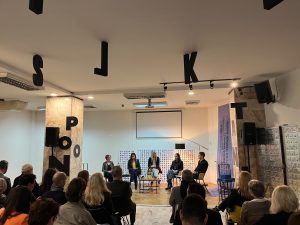
Human Rights House Serbia celebrates Human Rights Day despite threats. Photo: Sally Gimson
In reality, it wasn’t students who were attracted to the camp, but, according to various sources, petty, and even some more serious criminals. The camp now extends to the whole park and into the carpark in front of the parliament building. I saw white tents with music, portable toilets and swarms of police officers, there “to protect” the demonstrators. I also saw what seemed to be more disturbing elements, older men in masks and woollen hats, who I was told were likely Serbian veterans from the 1990s Balkans war. Even if they weren’t, they were dressed to suggest that. The whole place was fenced off with provisional metal railings, used the world round for crowd control. A few days before I arrived the top of the fencing had been greased and no one knew what the substance was.
I didn’t take any pictures on my phone and was warned not to peer too closely as I walked past. Last month, a television crew from N1, which is one of the few independent TV companies in the capital, was attacked by a man from the camp who turned out to be a convicted murderer. He was identified through footage recovered by the cameraman after his equipment was smashed. In July 2025 reporters filming Ćaciland had eggs thrown at them.
A journalist told me that the camp combined the dystopian aspects of Black Mirror mixed with the comedy of The Simpsons. It is called Ćaciland because when the students first started blockading universities and striking over the Novi Sad disaster, someone scrawled graffiti outside a local secondary school urging students in the town to go back to school. The graffitist spelled the word students as Ćaci instead of the correct spelling of Đaci. It led to a joke about their lack of education, hence Ćaciland (probably best rendered in English as Chavland).
The worst thing according to human rights defender Uroš Jovanović is that the police didn’t defend the attacked journalists but allowed them to act with impunity. Most prosecutors’ offices are dragging their feet when complaints are made to them. Students and journalists on the other hand have been detained and charged with “not following police instructions”. In August in some parts of the country – this is not just a Belgrade movement – demonstrations turned violent, with police beating protesters and some masked people throwing fireworks and stones.
The fight in Serbia is between students and a president they accuse of deep-seated corruption. Academics and schoolteachers have supported their students too. One human rights campaigner said that 100 secondary school teachers have been laid off because of their support, and some 25 headteachers and co-principals dismissed. Many ordinary members of the public have joined the protests, like the 50-year-old woman I met in a café who had been on the marches and started talking to me unprompted. She told me she had lived through five regimes in her lifetime and Vućić’s was by far the worse. She hoped the government would be overthrown soon.
Like Gen Zers around the world the students eschew politics, discuss actions through “forums” and have no leadership structure so they can’t be dismantled by the authorities. They organise primarily over social media. Those who have broken cover or have been arrested have found intimate pictures of themselves disseminated online and in government media. They’ve also been doxxed and smeared. Women have been particularly affected. Biljana Janjic, the executive director of FemPlatz, said out of 170 female activists they talked to, 87 had been assaulted and attacked by the police and pro-regime activists, and that sexual violence and rape threats had been normalised by the police. In smaller communities, women have been much more vulnerable to such attacks. The students’ ideology is unclear, except they dislike mainstream politics which they believe is so fundamentally corrupt that it resembles a big pot of shit – as one disillusioned politician described it – so that anyone who takes part becomes covered in excrement.
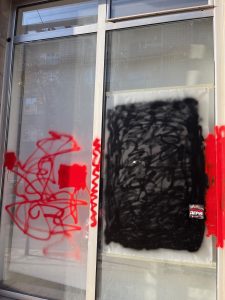
Graffiti on the HRH headquarters in Belgrade. Photo: Sally Gimson
I heard a lot about the suppression of protest and the media, not only through individual conversations, but also at the Human Rights House (HRH), just down the road from the National Assembly and the Ćaciland encampment. The front of the office has been daubed with red graffiti which covers the HRH logo: the authorities have refused to remove it for them. At least the building still rents space to the HRH Serbia team, alongside other civic society organisations.
Last week the House organised an event to celebrate Human Rights Day. The meeting was open and defiant. The leaders were mainly women. They discussed the situation in Serbia and their fears about increasing repression. Prizes were given to the director of news at N1, who HRH workers said had been vital in defending them and giving them “the courage to stay and fight”. Prizes were also given to a small group of prosecutors called Let’s Defend our Professionalism, who were praised for defending the rule of law where most of their colleagues had toed the government line. A representative from the Russian HRH in exile handed on to the director Sonja Tosković and her team the Golden Dove of Peace.
Despite their mistrust of politics and the persecution of many activists and journalists, students are organising for elections and announcing their candidates on 28 December. But there is deep tension in Serbia. Students have a history of toppling governments they don’t like. In October 2000, Slobodan Milosevic, the Serb leader in the 1990s war, was forced from power by a student-led revolution. In Belgrade’s Museum of Yugoslavia there is an celebratory exhibition about the 20th century revolutionary socialist politician Veljko Vlahović, a former student leader, and one of the leading figures in the communist government after the Second World War. In neighbouring Bulgaria, the government was overthrown by Gen Z students this December.
I’ll never know if someone really was in my apartment, but paranoia is rife in Serbia, and all have good cause to feel that way.
19 Dec 2025 | Africa, Features, Middle East and North Africa, Morocco, Volume 54.04 Winter 2025
As the Africa Cup of Nations kicks off on Sunday and tens of thousands of football fans descend on Morocco, we should remember the thousands of Gen Z protesters who were arrested and beaten when they took to the streets following the death of eight women in a maternity hospital in Agadir. They are now being prosecuted and some – including minors under 12 – have already been sentenced to hundreds of years in prison. It was partly football that sparked the anger. Young people saw beautiful stadiums being built, but hospitals so crumbling they couldn’t even keep mothers safe. Read the full story by Omar Radi, whose piece appears in the Winter 2025 issue of Index on Censorship, Gen Z is revolting: Why the world’s youth will not be silenced, published on 18 December 2025.
Saturday, 27 September. At Casablanca’s Arab League Park, riot police and plainclothes agents gather in uneasy groups. Their presence is heavy and full of expectation, a show of state power preparing for a confrontation it doesn’t fully understand. By late afternoon the reason for the confusion is clear. For the first time, the authorities are facing a youth protest movement without leaders, without clear origins, formed not in political party offices or student unions, but on Discord – a platform that feels almost like science fiction to old-style security forces. The youth are anonymous, impossible to track, and everywhere.
At first, they were gamers and football supporters – voices echoing through Discord chat rooms, more familiar with memes than with political public life. Politics had been something happening elsewhere. But then there was a shift. The country’s quiet crisis found its way into their feeds. The trigger? Eight women admitted into a maternity ward at a public hospital in Agadir, in southern Morocco. None came out alive – a shortage of staff, a lack of resources, and a system too broken to respond until it was too late.
Football’s soft power
Following Morocco’s unexpected fourth-place finish at the 2022 FIFA World Cup in Qatar, football has become the cornerstone of the country’s soft power strategy. The momentum carried into 2023, when Morocco was awarded co-hosting rights for the 2030 World Cup alongside Spain and Portugal – a diplomatic victory dressed in sport. Since then, public policy has tilted toward a single, obsessive goal: turning parts of the country’s major cities into acceptable playgrounds for the global guests who will descend upon Morocco for one month in 2030. Billions of dollars are being poured into infrastructure, stadiums and urban makeovers.
The contradiction, however, is hard to ignore. In a country where hospitals resemble warzones and schools are crumbling, the dazzling promise of football has become, for many, a bitter spectacle. Morocco is a nation in love with the game – few would deny that. But among its citizens, the joy of hosting the World Cup is tinged with disillusion. The tragic deaths of eight women during childbirth was a tipping point. For the country’s youth, the women’s fate was no longer just about bad governance. It was personal.
“We don’t want to do politics,” one young activist who uses Discord, told Index. “We’re not asking for a new constitution or a regime change. We just want our hospitals to be as good as our football stadiums.”
At 6.00pm, as the protest was set to begin, the government issued a blanket ban on all public gatherings across Morocco. In Casablanca, police blocked access to public squares, surrounded potential meeting points, and deployed familiar intimidation tactics – threats, beatings, arrests. Undeterred, young protesters splintered into smaller groups, reappearing in alleyways and side streets, improvising a kind of urban guerrilla choreography. The same scene played out across the country: cat-and-mouse chases, baton charges, and standoffs stretching late into the night.
One thing became immediately clear to Morocco’s notoriously powerful political police. This was a new kind of activism – more agile, more defiant, and far more determined than anything they had seen before.
Minors charged over protests
Figures released on 29 October by Morocco’s judicial authorities surpassed even the bleakest estimates shared by rights groups such as the Moroccan Association for Human Rights (AMDH). Of the 2,480 people swept up during the protests, 1,473 were still behind bars awaiting trial. The others, while free, have been ordered to appear before judges in due course.
The charges are familiar, hallmarks of the state’s playbook against public dissent: armed rebellion, incitement to commit felonies, participation in armed gatherings.
Hundreds of detainees are being pushed into the criminal justice system by way of more severe accusations: violent assembly, insulting law-enforcement officers, possession of offensive weapons.
The first rounds of sentencing, swift and unyielding, have already handed down hundreds of years of prison time to several dozen people, including a significant number of minors under the age of 12, with sentences ranging from 5 to 15 years.
In Lqliâa, a town on the outskirts of Agadir in Morocco’s south, security forces killed three protesters with live ammunition before moving in to arrest others. The authorities insist that the shootings were acts of self-defence. Yet no independent inquiry has been launched, and public opinion remains divided after videos contradicting the official narrative began to circulate on Discord.
What the state is offering
When King Mohammed VI finally addressed the nation on 10 October in a speech read to members of Morocco’s parliament, the country braced itself for some acknowledgment of the turmoil that had shaken Morocco in the preceding weeks. But the King made no mention of the unrest and did not offer even an oblique response to the demands surging through the streets.
The disappointment was palpable. Yet, the movement itself did not harden its stance. Its demands remain well short of any direct criticism of the monarchy. Still, the speech was widely felt as a deliberate slight – an act of indifference toward a generation that has insisted, from the outset, on peaceful protest and loyalty to the Crown.
“The King ghosted us. I feel humiliated,” said an organiser of the GenZ212 Discord server, which has played a key role in the demonstrations and now boasts 200,000 members.
Two weeks later, the King presided over a cabinet meeting that approved increased budgets for healthcare and education, as well as a new fund to support young candidates in upcoming elections.
There was money being offered by one hand, in the other an invitation into institutional politics. But for many, the gesture was not received as good news.
“It’s hard to believe these promises,” a young protester declared during a public meeting in Rabat. “There are no details, no assurances that any of this will be implemented effectively.”
His scepticism, he added, is only strengthened by the way the police and courts have treated protesters.
“Shouldn’t they start by releasing all the detainees?” he asked.
Gen Z: a new source of protest
The demonstrations continue. Persistent, if modest in scale, they rarely attract more than a few dozen people per city. To the movement’s initial demands for better healthcare and education, new calls have been added within GenZ212’s discourse: the release of detainees, the dismissal of all charges, and the end of the hogra – a Moroccan term for the violence and arrogance wielded by authority against the powerless.
For observers, journalists and scholars alike, a paradox sits at the centre of any analysis of this movement. On one hand, it is the smallest in numbers and the most restrained in its demands when compared with earlier, more overtly political movements, like the 20 February 2011 protests of the Arab Spring. On the other hand, the repression has been astonishingly severe – disproportionate both in terms of the movement’s size and its relatively “diplomatic” aspirations.
There is also the question of the mark the GenZ212 will leave behind. For the first time, a protest movement in Morocco did not emerge from the political left, political Islam, or labour unions. Instead, it was born out of activity on online chat groups – out of a kind of virtual street. It was immediately echoed, even if only verbally, by social categories traditionally aligned with the regime: artists, influencers, sports champions.
Raid, a Casablanca-based rapper, became an early casualty of this shift. Arrested, released, then rearrested and placed in police custody before being charged with inciting illegal demonstrations, he has become one of the most emblematic figures of the movement, alongside others who lent their voices to the cause. Songs, art performances, widely followed podcasts: all rallied behind the movement, at least in its early days.
Here is a generation that declared itself apolitical from the outset – yet through just a few missteps by those in power was pushed headlong into politics. A generation now shouting to the world: “No, there is no freedom in Morocco – and we are the proof”.
On the streets, the popular dialect, laced with profanity, usually banished from state media, schools and family spaces, has forced its way into political life. As one protester yelled: “Free freedom, you sons of bitches!”
11 Dec 2025 | Asia and Pacific, Australia, News
Read Index’s statement on why Australia’s ban on social media for under 16s is disproportionate
When Australia passed a world-first social media ban for teens, there was a display of national pride from the prime minister, and even the Sydney Harbour Bridge was lit up in the country’s national colours, green and gold, to celebrate the historic achievement.
The law, which came into effect on 10 December, requires 10 platforms to take “reasonable steps” to prevent under-16s from having accounts on their platforms, or risk fines of up to $49.5 million.
The Online Safety Amendment (Social Media Minimum Age) Bill 2024 had bipartisan support and sailed through Australian parliament last December. Seventy per cent of Australians are said to support it.
Australia is being feted. The EU, Malaysia, and others are said to be watching, including the UK, although the culture secretary has expressed doubts over whether it could be enforced in the country.
But a barrage of human rights groups and others, including Index on Censorship, Amnesty International and Save the Children, have all criticised or opposed the ban.
Tom Sulston, head of policy at Australian charity Digital Rights Watch, told Index that they were broadly supportive of the idea that internet access is a human right. While the new law only restricts teens from accessing 10 specific sites – X, TikTok, Instagram, Snapchat, Threads, Facebook, YouTube, Reddit, Kick and Twitch – he said that the space these social media companies represent is enormous.
“They do occupy this space as the town square of digital society,” Sulston said. “So, is it proportionate to remove that right of access to a group of people in order to protect their safety, or under the guise of protecting their safety? We don’t think so.”
He added that there were alternative measures that many organisations were asking for, such as regulation and investment in digital literacy, which could have been put in place instead of an outright ban.
There is now an interesting legal conversation to be had about the ban, Sulston said. On 26 November, two 15-year-olds launched a legal challenge to the law, supported by rights group the Digital Freedom Project (DFP), in Australia’s High Court. They are arguing that all Australians have a constitutional implied right to freedom of political communication.
“Young people like me are the voters of tomorrow,” said one plaintiff Macy Neyland in a statement. “Why on earth should we be banned from expressing our views?” Neyland added that the situation was “like Orwell’s book Nineteen Eighty-Four”.
Noah Jones, who is also suing the government, told the media: “We’re disappointed in a lazy government that blanket-bans under-16s rather than investing in programmes to help kids be safe on social media. They should protect kids with safeguards, not silence.”
A direction hearing for the teens’ court challenge will be heard in February at the earliest.
Digital Freedom Project president John Ruddick, who is also a member of the New South Wales Legislative Council with the Libertarian Party, has branded the ban the world’s most draconian legislation. He said that it was “as Big Brother as you can get” and that “even the Chinese Communist Party would be drooling over this”.
Reddit was also reportedly looking at legal action, but has confirmed it will comply with the restrictions.
In submissions to Australia’s Senate Standing Committees on Environment and Communications last November, before it became law, the Australian Human Rights Commission said that it had “serious reservations” about the legislation. While it said that it understood the significance of protecting young people from online harm and the negative consequences of social media, the ban would affect some human rights outlined in international human rights treaties including the International Covenant on Civil and Political Rights and the UN Committee on the Rights of the Child.
These include the right to freedom of expression and information, and the freedom of association and peaceful assembly, as contained in both treaties.
Digital Rights Watch’s Sulston said that he was also worried about autocracies eyeing up the law. According to digital rights non-profit Access Now, 2024 was the worst year on record for internet shutdowns.
“Young people are not represented democratically, even in democratic societies. If you’re under the age to vote, then you get nothing,” Sulston said. “So being able to organise and develop political understanding and take political action online is really important for that cohort. You can see why it would be very attractive for authoritarian regimes to clamp down on that.”
But Sulston said that even though he considered the law a “disaster” and there was no evidence that it would improve children’s lives, it had already been showcased at the UN General Assembly and “deemed a great success”.
He said: “It’s really hard to see what a path to change looks like, because no matter how harmful it is, it seems we’re stuck with it.”
Read Index’s statement on why Australia’s ban on social media for under 16s is disproportionate
