British journalist Jake Hanrahan and cameraman Philip Pendlebury were arrested last Thursday, 27 August, whilst reporting from south-eastern Turkey along with two Vice News colleagues. One colleague was later released but Hanrahan, Pendlebury and their colleague Mohammed Ismael Rasool were subsequently charged with ‘working on behalf of a terrorist organisation’. They were reportedly moved to a high security prison on Wednesday 2 September, before being released earlier today, 3 September.
While we warmly welcome the news that Jake Hanrahan and Philip Pendlebury have been released we nevertheless remain seriously concerned for Mohammed Ismael Rasool. Reports suggest that Rasool is still in detention, and we join Vice News in continuing to call on the Turkish authorities to release him immediately and unconditionally.
Following their arrest last Thursday, 27 August, Index on Censorship, English PEN and PEN International wrote to the EU, the Council of Europe, of which Turkey and the UK are members, and to the UK Foreign Secretary Philip Hammond to raise the case. Today’s release comes a day after the Foreign Office issued a statement echoing the groups’ concerns and reminding Turkey of their international obligations.
We also remain extremely concerned about the current crackdown on freedom of expression in Turkey. We recognise that Turkey is facing a period of heightened tension. However at such a time it is more important than ever that both domestic and international journalists are allowed to do their vital work without intimidation, reporting on matters of global interest and concern.
TAKE ACTION
Send a message of support
Tweet your support for Mohammed Ismael Rasool with the handle @vicenews and hashtags #FreeViceNewsStaff #FreeRasool
Write to the authorities
Calling on the Turkish authorities to release Mohammed Ismael Rasool immediately; Urging the authorities to allow journalists to fulfil their essential role of reporting events that are in the public interest and of international concern at a time of tension in Turkey and throughout the region; Reminding the authorities that Turkey has the obligation to respect the right to freedom of expression under the European Convention on Human Rights (ECHR) and the International Covenant on Civil and Political Rights (ICCPR), to which it is a state party.
A UK Supreme Court judgment today has overturned an injunction preventing publication of the musician James Rhodes’ memoir Instrumental.
The case known as OPO v MLA was brought by Rhodes’s ex-wife, who claimed that publication of the book would cause psychological harm to their son, who suffers from Asperger’s syndrome, attention deficit hyperactivity disorder, dyspraxia and dysgraphia. The memoir, to be published by Canongate, is an account of James Rhodes’s traumatic childhood in which he was the victim of sexual abuse and its impact on his adult life. He recounts the vital role of music and how it saved him from self-harm, addiction and suicide.
The High Court struck out the proceedings, arguing that there was no precedent for an order preventing a person from publishing their life story for fear of its causing psychiatric harm to a vulnerable person. But a temporary injunction was granted by the Court of Appeal until the case came to trial, on the grounds of an obscure Victorian case Wilkinson v Downton, in which a man who played a practical joke on the wife of a pub landlord was found to be guilty of the intentional infliction of mental distress.
English PEN, Index on Censorship and Article 19 intervened in the appeal at the Supreme Court as third parties, arguing that the Court of Appeal’s decision would have a chilling effect on the production and publication of serious works of public interest and concern.
In a robust defence of freedom of expression, the court ruled: ‘The only proper conclusion is that there is every justification for the publication. A person who has suffered in the way that the appellant has suffered, and has struggled to cope with the consequences of his suffering in the way that he has struggled, has the right to tell the world about it.’
The Supreme Court criticised the Court of Appeal’s ruling in its judgment, stating that the terms of the injunction were flawed and voicing its concern about the curtailment of freedom of speech:
‘Freedom to report the truth is a basic right to which the law gives a very high level of protection. It is difficult to envisage any circumstances in which speech which is not deceptive, threatening or possibly abusive, could give rise to liability in tort for wilful infringement of another’s right to personal safety. The right to report the truth is justification in itself. That is not to say that the right of disclosure is absolute, for a person may owe a duty to treat information as private or confidential. But there is no general law prohibiting the publication of facts which will cause distress to another, even if that is the person’s intention.’
‘This an important judgment overturning an injunction that not only prevented the public from reading a powerful book of wide interest, but posed a significant threat to freedom of expression more broadly. It’s encouraging to see the Supreme Court’s clear and unequivocal support for free speech,’ said Jo Glanville, Director, English PEN.
‘The decision of the Supreme Court is an important verdict for free expression. In particular we commend the court’s recognition that freedom to report the truth is a basic right protected in law and its reassertion of the right to produce material that others may find offensive,’ said Jodie Ginsberg, CEO, Index on Censorship.
Last October, 20 leading writers, including David Hare, Michael Frayn, William Boyd and Tom Stoppard wrote to the Daily Telegraph to say that they were ‘gravely concerned about the impact of this judgment on the freedom to read and write in Britain’.
They added: ‘The public is being denied the opportunity of reading an enlightening memoir, while publishers, authors and journalists may face censorship on similar grounds in the future.’
Datuk Seri Najib Tun Razak,
The Prime Minister of Malaysia,
Office of The Prime Minister,
Main Block, Perdana Putra Building,
Federal Government Administrative Centre,
62502 Putrajaya, MALAYSIA
19 May 2015
Dear Prime Minister Najib,
We, the undersigned international organisations, urge the Malaysian authorities to drop charges against cartoonist Zulkiflee Anwar Haque “Zunar”, who is currently facing a record-breaking nine charges under the Sedition Act for comments made on the social media network Twitter, for which – if convicted – he could face up to 43 years in prison.
We also call upon the Malaysian authorities to repeal the Sedition Act, a law that is used as a tool to stifle legitimate debate and dissent. In 2012, Prime Minister Najib Razak made a commitment to repeal the Sedition Act. However, following the most recent election, he has instead extended the Sedition Act’s reach and strengthened the penalties for infringement in a move we believe is intended to help maintain his party’s hold on power.
Freedom of expression is an essential part of any democratic society and the Malaysian authorities must protect this right for all, including those who are critical of government. Rather than safeguard this right, the authorities have intensified their crackdown on journalists, writers, activists, students, academics and artists. We, the undersigned international organisations, condemn these violations and urge the international community to support Zunar and everyone in Malaysia to speak freely in accordance with the Universal Declaration of Human Rights.
Sincerely,
ARTICLE 19
English PEN
Index on Censorship
Media Legal Defence Initiative
PEN International
CC:
Tan Sri Abdul Gani Patail, Attorney General
Tan Sri Dato’ Sri Khalid bin Abu Bakar, Inspector General of Police
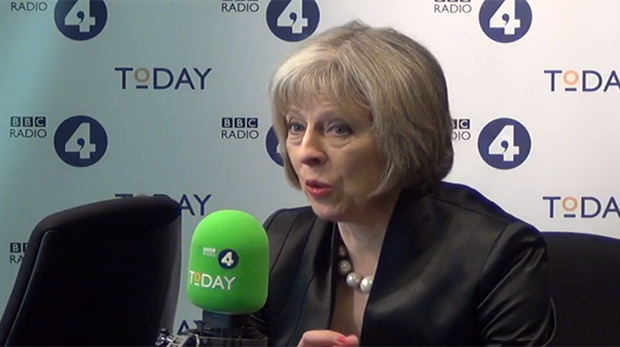
Home Secretary Theresa May appeared on BBC Radio 4 Today programme. View the video. (Photo: BBC)
The UK Home Secretary’s preview of a proposed new counter-extremism bill raises the stakes for freedom of expression in the United Kingdom. Index on Censorship is disturbed by the potential impact on free speech embedded in the proposals.
“While the exact wording of the law remains to be seen, it is unclear why new legislation is needed. Current laws on incitement to violence and hatred can already be applied to extremist individuals or groups. New laws risk simply stifling a far broader range of speech”, Index on Censorship CEO Jodie Ginsberg said.
Under previous proposals put forward by Theresa May, extremists would have been banned from TV and stricter controls on what could be said on the internet would have been imposed.
May’s insistence that the proposed law would be applied to those seeking to undermine vaguely defined “British values” is a broad brush that could end up being applied to anyone who simply disagrees with the government. As Index said in October 2014, the proposals smack of the McCarthy witch-hunts of the 1950s in the United States.
According to May, the UK already has the world’s toughest anti-terrorism legislation. Adding to this body of laws is unnecessary. Index remains convinced that driving debate underground is not the answer in tackling extremism or terrorism.