26 Sep 2014 | About Index, Campaigns, Statements
Before the cancellation of Exhibit B at the Barbican this week, Index published an article from associate arts producer Julia Farrington in which she addressed the role of the institution in managing controversial art and a lack of diversity in arts management in the UK. Those who read the article following the cancellation and our short comment on it have interpreted our stance as one that in some way excuses or condones the protesters and the cancellation of the piece. This was certainly not our intention, but we realise that by failing to publish a detailed article or statement on the cancellation, we muddied our position.
So let’s be clear. People have every right to object to art they find objectionable but no right whatsoever to have that work censored. Free expression, including work that others may find shocking or offensive, is a right that must be defended vigorously. As an organisation, while we condemn in no uncertain terms all those who advocate censorship, we would – as a free expression organisation – defend their right to express those views. What we do not and will never condone is the use of intimidation, force or violence to stifle the free expression of others.
As an anti-censorship organisation we think it is self-evident that no work should be censored for causing ‘offence’. But we also know that controversial art will inevitably cause controversy, including demands it be censored. Some of those who object to the work may protest. Some of those protests may turn violent. So we have also sought in much of our work on this issue not simply to condemn those who wish to censor, but also to examine what more arts organisations and institutions can do to ensure that controversial works are put on: Taking the Offensive – defending artistic freedom of expression in the UK.
We hope the debate generated by the cancellation of Exhibit B will reignite discussion on both the necessity of, and mechanisms for, staging controversial work.
This statement was posted on 26 September 2014 at indexoncensorship.org
18 Aug 2014 | Campaigns, Honduras, Statements
Attorney General Oscar Chinchilla Banegas
Ministerio Público, Lomas del Guijarro
Avenida República Dominicana
Edificio Lomas Plaza II
Tegucigalpa, Honduras
Email: [email protected]
13 August 2014
Dear Sir,
Dina Meza [1], journalist and human rights defender, is seeking a formal update on the investigations into threats that have been received towards her and her family.
The threats forced her to leave Honduras in 2012. Since her return in 2013, the threats have restarted and have recently been growing. She has reported being followed and receiving threating phone calls at home late at night.
As defenders of free speech, we urge you to take these threats very seriously and help ensure that Dina can continue to work without fear. Last month alone, political radio presenter Luis Alonso Fúnez Duarte and TV reporter Herlyn Espinal have both been killed.
We urge you to make Honduras a safe place for all journalists in accordance with the Universal Declaration of Human Rights. Please could you ensure that Dina Meza receives a formal update within 30 days.
Signed
Jodie Ginsberg, CEO Index on Censorship
Dario Ramirez, Article 19 Central America
—
Estimado Señor Fiscal General,
Dina Meza, periodista y defensora de derechos humanos, está solicitando un informe oficial sobre las investigaciones de las amenazas recibidas en su contra y la de su familia.
Las amenazas la obligaron a abandonar Honduras en 2012 y desde su regreso en 2013, estas se han reanudado y recientemente hasta han aumentado.
Meza ha denunciado haber sido seguida y haber recibido llamadas amenazas telefónicas en su casa a altas horas de la noche.
Como defensores de la libertad de expresión, le instamos a que tome estas amenazas con suma seriedad y a que ayude a garantizar que Dina pueda seguir trabajando sin miedo.
En el último mes, fueron asesinados el presentador de radio política Luis Alonso Fúnez Duarte y el reportero de televisión Herlyn Espinal.
Le solicitamos que convierta a Honduras en un lugar seguro para los periodistas, como lo indica la Declaración Universal de los Derechos Humanos. Le pedimos que le envíe a Dina Meza un informe oficial antes dentro de 30 días.
Atentamente
Jodie Ginsberg, CEO Index on Censorship
Dario Ramirez, Article 19 Central America
—
[1] Dina Meza was nominated for an Index Award for journalism in 2014.
See Amnesty’s latest report on Dina Meza’s situation
13 Aug 2014 | Azerbaijan, Azerbaijan Letters, Campaigns, Statements
Mr Thorbjørn Jagland
Secretary General of the Council of Europe
67075 Strasbourg Cedex
France
Fax: +33 3 88 41 27 99
Email: [email protected]
13 August 2014
Re: Wave of repression in Azerbaijan
Dear Secretary General,
We are writing to you to express our concern and disappointment with your 11 August 2014 public statement, following your agreement with President Ilham Aliyev that a joint Committee between the Presidential Administration and representatives of the civil society, established in 2005, would be re-convened. You called this initiative “a good opportunity to go through the charges brought against the human rights defenders and to re-launch dialogue between the authorities and civil society.”
This announcement comes in the midst of an “unprecedented repression against civil society leaders in Azerbaijan.”[1]
Just in the last days many indispensible voices were indeed arrested in an attempt to silence them: a well-known and widely respected human rights defender Rasul Jafarov[2]; human rights defenders Leyla Yunus, a Chevalier of the National Order of the Legion of Honour as a tribute for her longstanding work promoting human rights; and human rights lawyer Intigam Aliyev, “a man who many refer to as ‘müəllim’, or ‘teacher’ – an honorific that in Azerbaijan bestows the utmost respect, who […] taught, educated, trained, and provided guidance to Azerbaijan’s newest generation of human rights defenders.”[3] Intigam Aliyev is also engaged as a regional tutor in the Human Rights Education for Legal Professionals (HELP) programme of the Council of Europe.
This new wave of repression comes after the sentencing on 26 May of Anar Mammadli and Bashir Suleymanli to respectively 5 years and 6 months and 3 years and 6 months imprisonment. Those two human rights defenders are the leaders of the only independent group monitoring elections in Azerbaijan. At the same time, 8 activists of NIDA, a non-governmental youth movement, were convicted on charges of hooliganism, possessing drugs and explosives as well as intent to cause public disorder. On Friday, 4 July, another NIDA activist, Ömar Mammadov was sentenced to 5 years imprisonment on charges of drug possession with the aim of selling it.
We are disappointed that you have abstained from any public comment on the charges against the human rights defenders. The Council of Europe Commissioner for Human Rights considers the charges against Rasul Jafarov and the travel ban against Emin Huseynov as “another disturbing illustration of how human rights defenders in Azerbaijan are systematically threatened with an instrumental use of criminal suits.”[4] In her statement issued on 3 August 2014,[5] the rapporteur on human rights defenders of the Parliamentary Assembly of the Council of Europe Mailis Reps denounced Leyla Yunus’ arrest and detention and expressed “concern for the true motivation underlying the charges levied against her,” calling the arrest “another example of the unrelenting suppression of independent voices and crackdown on civil society in the country. This is an unacceptable violation of Azerbaijan’s duties as a member of the Council of Europe.”
We are surprised that you did not publicly call for the release of the detained human rights defenders, at least from the pre-trial detention, which is not necessary[6] and presents a risk to the heath condition of Leyla Yunus. Intigam Aliyev and Arif Yunus also have problematic health conditions.
It is unclear to us which committee you refer to, and we understand it is in fact a working group established in 2005 on political prisoners in the country. The people, who have been over the last years working on the issue of political prisoners in the country and on core human rights issues, are now behind bars or left the country for security reasons. The civil society in Azerbaijan has grown in size and developed in professionalism in the last decade, and now includes strong voices for the promotion of human rights, such as the Institute for Reporters’ Freedom and Safety (IRFS), which was sealed whilst you spoke with President Aliyev on 11 August.[7] Who will today choose the representatives of Azerbaijani civil society in that working group?
To launch a dialogue platform in these conditions and without first step by the government, meaning the unconditional and immediate release of human rights defenders, will at best be ephemeral, and might possibly be counterproductive. How will this group operate without the key professional and defenders who are now jailed or detained? There is no need to “go through the charges brought against the human rights defenders”; they just need to be dropped because they are unfounded and unfair, and indeed based on laws, which de facto criminalise the work of human rights defenders. As Secretary General, you indeed give the impression that you endorse policies by which governments can choose their civil society, fostering it with support for loyal voices and repression for critical voices, contrary to the values embodied by the Council of Europe.
Those persecuted and arrested human rights defenders in Azerbaijan are also the ones, which inform and cooperate with institutions of the Council of Europe, including yourself. They have international recognition and wide outreach. In June 2014, when President Aliyev addressed the Parliamentary Assembly of the Council of Europe, Emin Huseynov, Rasul Jafarov and Intigam Aliyev together organised a side-event in Strasbourg, critical of the Azerbaijani human rights record. This wave of repression is related to Azerbaijan’s chairmanship of the Council of Europe and indeed a reprisal against critical voices cooperating with and reporting to the Council of Europe mechanisms.
This reprisal did not start recently but started with the order to the Human Rights House Azerbaijan to cease its activities in March 2011, following an event organised by HRH Azerbaijan at the Parliamentary Assembly of the Council of Europe in January 2011.[8]
We believe that your role is to protect and defend Council of Europe institutions, including those cooperating with them. We therefore regret that you have not chosen to use your influence and the power of your office to call for immediate and unconditional release of those human rights defenders and have not condemned their arrest.
As said by the Commissioner in the statement quoted above “by stifling dissent, Azerbaijan is failing to comply with its international obligations which require safeguarding freedom of expression, assembly and association. It is necessary that Azerbaijan reverse the situation. A first step would be to free all those detained because of the views they expressed.”
Sincerely,
Jodie Ginsburg Florian Irminger Adela Pospichalovaon
Index on Censorship Human Rights House Foundation People in Need
For correspondence:
Florian Irminger
Head of Advocacy and HRHF’s Geneva Office
Human Rights House Foundation (HRHF)
Rue de Varembé 1, PO Box 35
1211 Geneva 20
Tel: +41 22 33 22 552
Fax: +41 22 33 22 559
Email: [email protected]
[1] Human Rights House Foundation’s press release of 9 August 2014, available at http://humanrightshouse.org/Articles/20335.html.
[2] More information on that case available at http://humanrightshouse.org/Articles/20306.html.
[3]Article about Intigam Aliyev’s arrest by Giorgi Gogia, Senior Researcher at Human Rights Watch, available at http://www.hrw.org/news/2014/08/08/dispatches-azerbaijan-jails-yet-another-rights-defender.
[4] Council of Europe Commissioner for Human Rights statement of 7 August 2014, available at http://tinyurl.com/qh6snqc.
[5] Mailis Reps’ statement is available at http://assembly.coe.int/nw/xml/News/News-View-EN.asp?newsid=5153&lang=2&cat=5.
[6] Human rights defenders have been facing travel bans and hence, cannot leave the country, despite the fact that they do not present any risk to society if not detained. Conditions making a pre-trial detention necessary are hence not fulfilled, abiding by article 5 of the Convention for the Protection of Human Rights and Fundamental Freedoms.
[7] The visible persecution of IRFS and its leader began on 8 August with a search of its offices. More information available at http://www.indexoncensorship.org/2014/08/azerbaijan-press-freedom-arrest-free-expression-baku/.
[8] More information on the situation of the Human Rights House Azerbaijan available at http://humanrightshouse.org/Articles/20037.html.
9 Jul 2014 | Campaigns, Press Releases
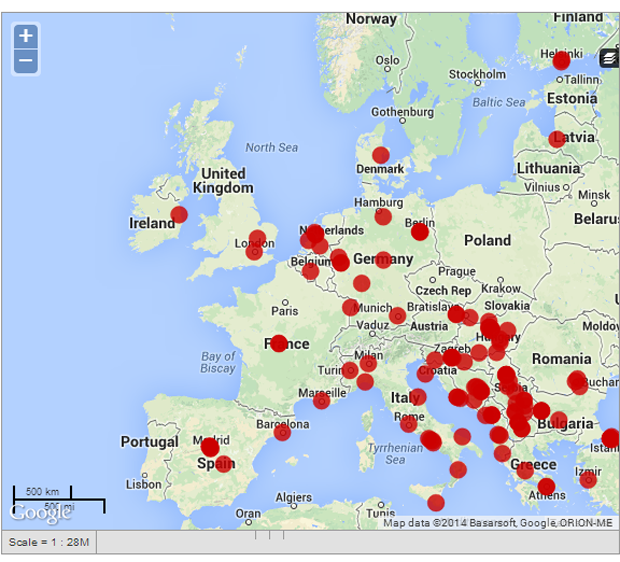
Over 170 cases have been submitted on a new media freedom crowdsourcing platform since its launch in May, while about half of the mapped cases of censorship and violations that spread in all 28 EU member states and candidate countries occurred in southern and southeast Europe.
Mediafreedom.ushahidi.com is a website that enables media professionals and citizen journalists to report and map media freedom violations across the 28 EU member states plus candidate countries. Ushahidi means ‘testimony’ in Swahili. Single cases can be uploaded through direct reporting on the platform or sent via email and be visualised on a Google map.
Information on the map reveals some common trends and similar problems across the region.
Over 40 of the reported cases involve legal measures taken against a journalist or a media, suggesting the pressing need of legal support and protection of those affect. Despite the existence of several associations and NGOs offering such support, journalists often fail to get the help they need on time, if ever.
Meanwhile arrests, verbal and physical attacks continue to be used as a tool to scare or discredit professionals. In some cases, journalists are detained in the field without clear explanation or warrant only to be released several hours later, when they can no longer report the event they originally intended.
A high concentration of violations is observed in Turkey, Italy and Serbia.
In Turkey, where 17 cases have been reported, financial and legal pressure seems to be one of the main tools used to silence critical voices.
In Serbia, where 16 cases have been reported, May’s devastating floods unleashed a series of worrying developments that made the international and local community turn their eyes towards the state of media freedom and spreading censorship in the country. For instance, several blogs experienced blockades and attacks after criticizing the government’s role and reaction to the floods.
In Italy 15 cases have been reported, with many involving threats and assault.
About the project
The Ushahidi media freedom crowd-sourcing platform has been developed in partnership by Osservatorio Balcani e Caucaso and Index on Censorship. OBC participates in the initiative as part of the EU-funded Safety Net for European Journalists project, implemented in partnership with SEEMO, Ossigeno Informazione, Professor Eugenia Siapera (Dublin City University).
For more information please contact:
[email protected]
[email protected]