[vc_row][vc_column][vc_single_image image=”117025″ img_size=”full” add_caption=”yes”][vc_column_text]Myanmar’s military authorities this week began to release more than 2,000 people who had been jailed as part of the protests against the country’s military coup in February. Those released included journalists, actors and other celebrities.
Military spokesman Zaw Min Tun said earlier this week that around 2,300 people were being released.
“They took part in protests but not in leading roles. They didn’t participate in violent acts,” he told the news website Irrawaddy.
Myanmar’s Assistance Association for Political Prisoners (AAPP) said in a statement: “The junta detained innocents. Torture is used as policy by this military, detainees will suffer long-term physical and mental illness. There was no recognition of the injustice and suffering caused today, and no mention of the right to compensation.”
“They are arresting people who should never have been detained in the first place, those released will be threatened and suffer from trauma. They will need rehabilitation and understanding of the injustice they experienced”, said AAPP joint secretary U Bo Kyi. “Any release must aim at real reform, including the release of Aung Sun Suu Kyi. Violence must end, and those who committed torture and murder brought to justice.”
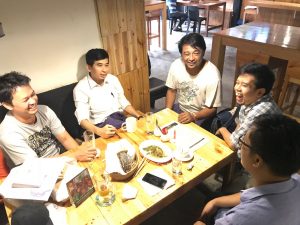
Poets in Myanmar in 2018 before the current horrors. Maung Yu Py is far right, laughing
Not everyone detained following the coup is so lucky and the country’s poets are suffering at the military’s hands more than most.
In the summer issue of Index on Censorship magazine, out later this month, we publish the poems of K Za Win and Khet Thi, who have both died at the hands of Myanmar’s military in recent months.
Other poets’ lives have been spared but they remain in jail despite the prisoner release.
Maung Yu Py, a household name in contemporary Burmese poetry, was arrested at a protest in his hometown of Myeik on 9 March. Two months later, he was sentenced to two years in Myeik prison for “making statements conducing to public mischief” where he remains today.
Fellow poet Ko Ko Thett has translated his work “A poem for real” into English for Index. We call for Maung Yu Py’s release.
[vc_row][vc_column][vc_single_image image=”116621″ img_size=”full” add_caption=”yes”][vc_column_text]Fifty years ago today, the Cuban poet Heberto Padilla made a dramatic public confession at the Union of Artists and Writers of Cuba under the watchful eye of State Security agents.
In his auto-da-fe, Padilla denounced himself, his wife and several close friends as counterrevolutionaries.
The confession sent shockwaves around the world.
Two days earlier, Padilla had been released from a 36-day detention at Cuba’s State Security headquarters.
Padilla had fallen foul of the island’s authorities after his return from an extended stay in the Soviet Union, where he opened Cuba’s first press agency in Moscow and befriended dissident poets.
Padilla’s ritualised public penance sent ripples across the literary world while the Cuban government tried to use his “confessions” as proof of its right to imprison the poet.
Internationally, Padilla’s confession was seen as Cuba’s version of a Stalinist show trial – footage of the confession was suppressed by the authorities.
However, his supporters were conflicted. Index wrote at the time how the feeling began to grow that Padilla’s confession had been forced in some way and that perhaps he had been subjected to brainwashing techniques or possibly even torture.
“A majority of the original letter’s signatories seemed to share this view and signed another letter of protest against the whole affair while a minority accepted the confession at its face value and supported the government position. As a result, progressive left-wing literary circles were split in their assessment of the affair and this led to a series of charges and counter-charges that continued for many months,” we wrote.
Whatever the reason for his confession, it served as a harbinger of what was to follow: a period known as the Grey Five Years in which dozens of Cuban artists and writers were banished from public life.
The Cuban government’s treatment of Padilla made its protocol for handling intellectuals and artists visible and has since functioned as a warning to those that seek to challenge the primacy of state authority.
The passage of five decades means that Padilla’s public show of defiance has been largely forgotten internationally but the words he spoke retain their power even today.
Cuba’s government is once again cracking down again on a new generation of Cuban artists and intellectuals, portraying them as lackeys of foreign powers.
It is against this backdrop that Padilla’s words are again being spoken as part of Padilla’s Shadow, a project of MSI and 27N, which protest against state censorship of artistic freedom in the country.
Twenty Cuban intellectuals and artists, including Hamlet Lavastida and Cuban poets Néstor Díaz de Villegas and Katherine Bisquet , will today livestream a choral reading of Padilla’s confession under the direction of Cuban American artist Coco Fusco.
Many of the project’s participants have told Fusco that they are shocked by the text, that it has provoked bouts of anxiety, sleeplessness and nightmares.
Néstor Díaz de Villegas said, “In stark contrast to History Will Absolve Me, the self-defence speech that Fidel Castro gave in court in 1953, Heberto Padilla indicted history by incriminating himself with his auto-da-fe. His confession is the definitive comedy of errors of the Cuban Revolution.”
Hamlet Lavastida, who has designed the commemorative project, said, “Heberto Padilla’s confession represents the irruption of Sovietism in Cuban cultural life. In order to create ‘perfect literature’ it became necessary to purge from the creator everything that was antagonistic to the great disciplinary story of the State.
“Skepticism, disenchantment, cosmopolitanism and existentialism had to be extirpated. This form of cultural repression was undoubtedly and absolutely novel in the Latin American cosmos. Never before had State Communism been so effectively virulent within Latin American culture. This was its contribution, its regrettable contribution, one contribution that is ongoing.”
Katherine Bisquet said, “The confession is disturbing. It plunges you into a desolate time, not because of its vitality, because of its existential nullity.”
“Those words tell me emphatically that we have had to stop feeling everything we could feel, which is to say we had to fake madness in order to survive the real induced madness, the madness from which we do not return.”
When drawings being scribbled,
colours dripping red,
words being silenced,
thoughts being limited,
lives turn to nothing,
can you touch pain with politics?
Can you perceive pain with your beliefs?
Lives smeared with blood,
your loved ones lying on the ground
lifeless…
Can you hold on to reason,
and when fear like dark clouds
leaks within everyone,
and when fear feeds more fears
and when fear swells hatred
with its giant steps,
can you cure desperation with laws?
When walls are being built again
for the sake of freedom and security,
with violence and blood,
can you create peace with concepts,
when a person without blinking an eye
can kill another person,
when another can glorify death
for the sake of religion?
The moment you declare
you believe,
if the world stops turning,
if reasoning,
sensibility,
sensitivity,
goes blind against beliefs
and even a pen could be perceived as a weapon,
how can thoughts be free?
What would expressing yourself mean?