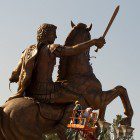
Macedonia: media freedom sliding backwards
The International Partnership Group of freedom of expression organisations visited Macedonia last month to assess the state of media freedom in the country. Mike Harris reports on the findings

The International Partnership Group of freedom of expression organisations visited Macedonia last month to assess the state of media freedom in the country. Mike Harris reports on the findings
In an horrific story that brings to mind the Soviets’ reworking of history, Yenesew Gebre, an Ethiopian citizen, a 29 year-old Ethiopian school teacher and human rights activist set himself ablaze outside a public meeting hall in the town of Tarcha located in Dawro Zone in Southern Ethiopia. He died three days later from his injuries. Later his sister and his father both claimed he had mental health issues (although no record exists of medication or treatment), and no-one was allowed to visit him in hospital. The death certificate, which was not signed by the official hospital coroner (who refused to sign it) stated blood poisoning as the cause of death. There are allegations that this was a faked death certificate.
Yenesew walked out of a public meeting on 11 November , saying the words “I want to show to all that death is preferable than a life without justice and liberty and I call upon my fellow compatriots to fear nothing and rise up to wrest their freedom and rights from the hands of the local and national tyrants.” He then set fire to himself. Yenesew was one of about 50 young men from the area who were protesting the reworking of civil boundaries, and were taking their case to federal courts, in the capital Addis Ababa.
President Meles Zenawi’s immediate response was to send in a reinforcement of some 300 police officers, and to impose a complete news blackout and seal off the town. Telephone services to the town were cut prevent all news of Yenesew’s sacrifice from spreading throughout Ethiopia. Yenesew was buried by police without his family being allowed to attend. Presumably the intention of preventing a public funeral and burying Yenesew in an unmarked grave was to divert attention from the young man’s actions.
This action takes place within the context of Ethiopia’s extremely poor human rights and freedom of expression record. After Eritrea, it is the area where most journalist alerts originate, according to International Federation of Journalists.
In addition to the six journalists held in custody without bail since June 2011, on 14 November, 24 people, including senior opposition politicians and an outspoken Internet journalist, were charged with with plotting terrorist acts to create public chaos. They are accused of violations of Ethiopia’s harsh anti-terrorism law, which has been criticised by human rights and press freedom groups.
Speaking at the Leveson Inquiry into the culture, practice and ethics of the press on Tuesday, Paul McMullan, the former deputy features editor at the News of the World, said this:
“In 21 years of invading people’s privacy I’ve never actually come across anyone who’s been doing any good. Privacy is the space bad people need to do bad things in …Privacy is evil; it brings out the worst qualities in people … Privacy is for paedos; fundamentally nobody else needs it.”
You can almost hear the horrified gasps as this heresy sank in. But ask yourself: at moments in your life when you’ve most fervently desired that something about you should remain private, wasn’t it often the case that this was because you thought — or thought others might think — that there was something disgraceful there?
It is no different with public figures, celebrities, politicians — the class of individuals that, for all the focus that there’s been on Milly Dowler’s family, occupy 99 percent of the media’s intrusive attention.
When an MP I felt very strongly about my privacy as an (undeclared) gay man; but I remain unconvinced that my constituents had no right to know about this; I was happy enough to tell them about the happy, shiny parts of my personal life — my marathon running, etc.
It’s my firm belief that one of the drivers of reform of the laws on homosexuality, and one of the motives that drove many MPs into the Equality lobby — and indeed one of the reasons many have chosen to come out of the closet — was precautionary: they supposed the media would eventually find out. How sure are you that this was to be regretted?
Matthew Parris is a journalist and a trustee of Index on Censorship
A TV journalist in Pakistan was shot and critically injured during a riot on Sunday. Ehsan Kohati, a senior reporter for the Waqt News TV channel was wounded in the chest and abdomen whilst reporting at a rally than turned violent in Karachi on November 27. Kohati was rushed to a nearby hospital, where he remains in a stable condition. Seven other people were injured and two were killed in the attack on a rally of Shiite Muslim mourners on the first day of the Islamic calendar month of Muharram, the first month of the Islamic calendar.