15 Mar 2016 | Europe and Central Asia, mobile, News, Turkey, Turkey Uncensored
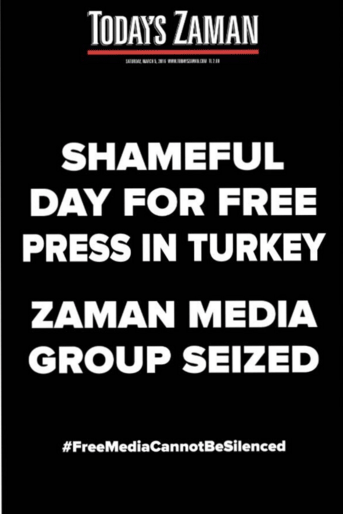
This column was originally submitted to Today’s Zaman, but was rejected by the new management. Ihsan Yilmaz is the founding president of the Istanbul Institute, a think tank based in Turkey, and was a columnist for Today’s Zaman.
Just before I wrote my last piece for Today’s Zaman, there were rumors that the Zaman daily, written in Turkish, and Today’s Zaman, would be seized by the government. Thus, I wrote that if that happens, “about 90% of media coverage would directly or indirectly be in [President Recep Tayyip] Erdoğan’s hands. What does that mean? This means no one will ever be able to defeat him and his party in any election. This means a death warrant for Turkish democracy. No one will have the chance to learn about the mistakes of the [Justice and Development Party] AKP. In this Orwellian nightmare, even the mistakes of the AKP will be sold to voters as its great successes. For instance, even though Turkey is now divided in two, the AKP will successfully convince its voters that Turkey has gotten rid of its ineffective parts and is now ready to be stronger and conquer the world. Even as of today, the AKP has about 40% of the voters, and they would swallow this stupid propaganda despite the news coverage of non-AKP media. Imagine how many more could start believing AKP fabrications after these media outlets are turned into mouthpieces of the AKP?”
I also added that: “In such a setting, no party other than the AKP will ever be able to convince the AKP’s voters, who now make up about 50-55% of the electorate, that they are not working for the CIA. Turkey will continue to hold elections, but similar to Iran, only Erdoğan-approved candidates will be able to contest. In the meantime, Erdoğan will continue to deal with his NATO allies, the West, the EU, etc., with his infamous stick and carrot policies…”
Well, the AKP regime has indeed seized those two newspapers and as it did with the Bugün daily, the Millet daily, Bugün TV and Kanaltürk TV, which it seized them several months ago, it transformed these critical media outlets into mouthpieces of the AKP government. And, as I claimed, neither the US government nor the EU or NATO governments could seriously criticise the AKP regime for its seizure of the country’s best-selling Turkish and English dailies. These two dailies have joined many others in becoming the Orwellian propaganda and brainwashing tools of the AKP regime but all these Western governments could say is that they are concerned about the developments. It is like a joke. It is similar to seeing a murderer slaughtering a human and instead of doing anything, just saying that you are concerned that this person might be harmed.
As a result of the AKP seizure of the Zaman daily, Today’s Zaman, the Bugün daily, the Millet daily, Bugün TV and Kanaltürk TV, and the forced closure of STV, SHaber and a few others, the AKP indeed controls 90% of media coverage in Turkey. What is more, the AKP regime has also seized the biggest news private news agency in Turkey, the Cihan news agency. Cihan has been the only private news agency to monitor elections and report from every ballot box. For the last two elections, the efforts of the state news agency, the Anatolia news agency, to manipulate the results were neutralized by Cihan’s objective coverage of the counting of the votes. Now, it is in the hands of the AKP. It is crystal clear that Turkish voters will not have a chance to monitor the elections results, given the fact that the opposition parties are very weak and their members who work at the ballot boxes on elections day could easily be made pro-AKP with all sorts of stick and carrot methods that the AKP is infamously known for.
All in all, Turkey will never be able to have genuine elections and Turkey will never be able to count the votes fairly. Now, the AKP wants to change the Constitution with a referendum to create a presidential system without checks and balances. The AKP can easily get 60% of the vote to approve such a tyrannical system under the current conditions. Our NATO allies will continue to be concerned about such a despotic regime, but on the other hand, they will happily continue to work with such a regime.
What a shame.
Turkey Uncensored is an Index on Censorship project to publish a series of articles from censored Turkish writers, artists and translators.
14 Mar 2016 | Europe and Central Asia, mobile, News, Turkey, Turkey Uncensored
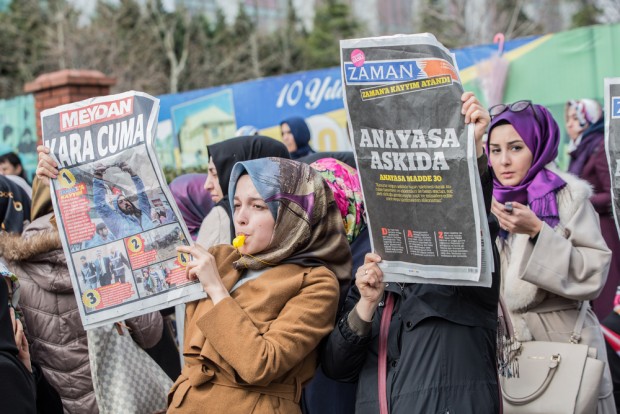
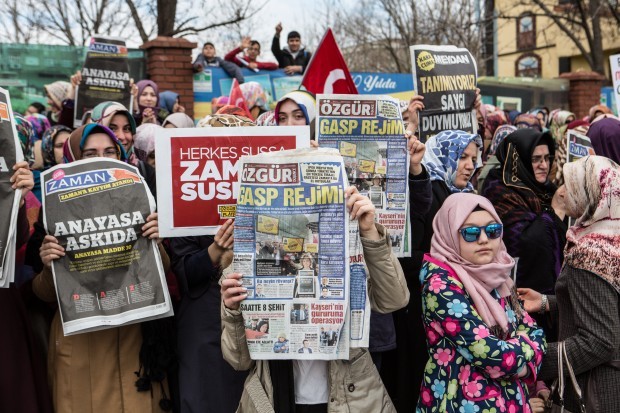
Thousands of people gather in solidarity outside Zaman newspaper in Istanbul on 5 March 2016.
Nicole Pope is an independent writer, journalist, Turkey analyst, translator, editor, consultant. Pope was a columnist for Today’s Zaman since its launch on 15 January 2007. This column was rejected by the new management of Zaman.
How do you write a column for a newspaper that still exists nominally but has been taken over by trustees appointed by an “independent” court? Such are the dilemmas in a country where democratic standards are slipping rapidly. No journalism school or manual of ethical journalism prepares one for such a situation.
Do you stop writing immediately to stand against an obvious violation of press freedom and show solidarity with colleagues who have already been dismissed? Or do you sit down to pen one last column in support of the journalists and employees still at work, whose livelihood is under threat? They are doing their job and preparing a newspaper even though they know, as I do, that in the current hostile environment it is unlikely to be published in its original form or even published at all.
I opted for the latter, which potentially also offers the opportunity to thank the readers who have followed me over the years and to comment on the rapid deterioration of fundamental freedoms in Turkey.
The takeover of the Zaman group, supported by tear gas and water cannons, was reflected on television screens around the world in all its brutality. It needs to be viewed in a broader context as the latest of many blows inflicted to the independence of the media in Turkey where journalists’ ability to cover events and hold those in power accountable has been shrinking for some time.
In recent months, the crackdown has intensified. Few independent outlets remain, particularly on television, which reaches the widest audience. This allows the authorities to control the narrative and produce a sanitized version of events that suit their purposes.
The notion that criticism can be constructive, allowing societies to improve, grow and be more innovative and also ensuring that those in power serve the interests of the population as a whole, has vanished entirely in the black and white, with us or against us world that the “new” Justice and Development Party (AKP) has constructed.
After spending more than a quarter of a century covering Turkey, I’m aware that media independence has always been an elusive concept, not just for politicians, but also for media groups — even this one, in some instances — and among journalists themselves. In the twists and turns of Turkish politics, we’ve all been caught short at one point or another.
What makes the current decline particularly painful is that for a brief moment in its early years, the AKP lifted some red lines and allowed sensitive topics to be discussed more openly. But the window did not remain open for long. Today, the power exercised in the past by the military-backed state has shifted to different hands and it is more concentrated than ever before.
Some 30 journalists are currently behind bars. Countless others face judicial harassment and pay regular visits to court to answer ludicrous charges designed to intimidate and silence them. The recent Constitutional Court’s decision to release Can Dündar and Erdem Gül provided only a brief respite.
Media independence and freedom of expression are important in and of themselves, but they also underpin other rights, allowing violations to be exposed to public scrutiny. In the absence of free media access, the human cost and the devastation caused by the blanket curfews imposed in places like Cizre and Sur, where government forces are fighting Kurdistan Workers’ Party (PKK) militants, have not received adequate attention, for instance, although ministers acknowledge that 355,000 residents have been displaced.
With much of the media under government control, the voices of progressive women are also being drowned. As the world marks International Women’s Day, the Turkish authorities have resorted to prohibitions and rubber bullets to prevent Turkish women from taking their demands to the streets.
Violence against women and the struggle for gender equality have always occupied an important place in this column because I view the prevailing brand of macho politics, which imposes views instead of seeking compromise and rules through confrontation rather than consensus, as a major hindrance to Turkey’s democratic and economic development.
This patriarchal approach, based on traditional gender roles, currently reigns supreme. It goes hand-in-hand with a top-down understanding of politics that brooks no dissent and wants to silence independent voices in the media and in society. As I bid readers goodbye, I wish I could have ended on a more optimistic note.
Sign Index on Censorship’s petition to end Turkey’s crackdown on press freedom.
Turkey Uncensored is an Index on Censorship project to publish a series of articles from censored Turkish writers, artists and translators.
11 Mar 2016 | Europe and Central Asia, mobile, News, Turkey, Turkey Uncensored
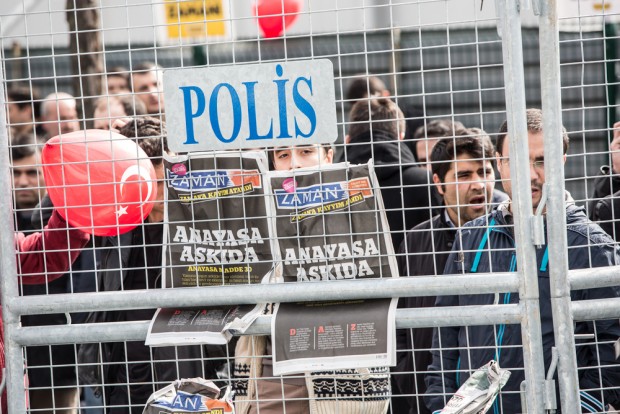
Watching the surreal videos of the police takeover of Turkish newspaper Zaman last week — inside the building police officers played cards behind the newspaper’s reception desk and devoured plates of baklava in the cafeteria as journalists looked on — I was reminded of the events of the past eight years that so definitively transformed Turkey’s media scene.
The change happened so gradually over the years that many missed the transformation. But journalism in Turkey has turned into a scene of feuds and long-held hostilities. The job description of a Turkish journalist now includes the ability to help lock up journalists from the opposite political camp.
Over the past eight years, a spate of legal cases have altered Turkey’s media environment beyond return. The most recent of these was the 2014 Selam Tevhid case, in which prosecutors intended to jail Turkey’s pro-government journalists who were accused of being foreign spies and aiding terrorist organisations.
But it was the OdaTV case of 2011 that had the greatest impact on journalism. The outcome silenced the popular and populist voice of secular nationalists and spread fear and paranoia to all media workers.
Earlier, in September 2008, after selling off his secular-nationalist broadcaster KanalTurk, Turkish journalist Tuncay Özkan was detained by Turkish police in relation to the Ergenekon investigation. He was detained in the Silivri Penitentiary, Europe’s largest penal facility where he would await the outcome of his trial for more than two years. One of Özkan‘s friends, Mustafa Balbay, the Ankara correspondent of Cumhuriyet newspaper, was also imprisoned in the same trial.
To many observers, Özkan’s and Balbay’s ideas were old fashioned, parochial and too nationalistic, views that somehow defined the way they were treated in the public sphere. There was little international reaction when Özkan’s KanalTurk‘s staunchly secularist and republican editorial line was changed overnight. The same broadcaster now defended polar opposite views.
After five years in detention, Özkan was sentenced in April 2013 to life imprisonment for being part of Ergenekon, a “ultra-secularist organisation that plotted a coup”. Balbay was luckier: he received 34 years and 8 months. Again, there was little world reaction to this surreal turn of events, but, in Turkey, many progressive voices applauded the verdicts, seeing them as part of what they ominously called the country’s “normalisation”.
Throughout 2008, Turkey’s media sphere changed enormously through these trials that made the criminalisation of Turkey’s media part of the journalistic occupation. More than a dozen journalists were detained in the OdaTV trials, accused of being members of the “media arm” of the terrorist organisation Ergenekon, named after Turks’ founding myth. There were so many arrests that the prison’s sports hall needed to be transformed into a courtroom to accommodate all the defendants.
Many of Turkey’s progressives bought into the idea that what was happening was a good thing. Once “ultra-secularist coup plotters” would be placed behind bars, Turkey would finally achieve its long-awaited “liberal consensus”. Those who opposed the arrests were branded reactionaries who should have known better.
According to the newspapers, Turkey was cleaning its bowels: there were lone dissenting voices but the general reaction to the prison verdicts was that all the bad, radical people were finally getting what they had long deserved.
The normalisation discourse was built on the idea that Turkey needed a “liberal consensus” where the extreme elements of politics and the media needed to leave the public sphere to moderates of all political persuasions. Thanks to this, Turkey would be able to become “a model democracy” in the Middle East.
As the trials continued, and more than 40 Kurdish journalists were imprisoned because of their alleged ties to terrorist groups, Turkey was represented as its most liberal self in the international scene — what made it democratic, the argument ran, was the trials themselves. In fact, Turkey was being its most illiberal self, having the highest number of journalists in prison at the time. In 2012, just a year before the anti-government Gezi Park protests, the country was being held up as a paradigm. A Reporters Without Borders report from that year, read: “With a total of 72 media personnel currently detained, of whom at least 42 journalists and four media assistants are being held in connection with their media work, Turkey is now the world’s biggest prison for journalists – a sad paradox for a country that portrays itself a regional democratic model.”
Worryingly, the Ergenekon and OdaTV trials moulded a new type of journalist who took pleasure in the jailing of his colleagues. After journalist and IPI World Press Freedom Hero Nedim Sener and his colleague Ahmet Sik were detained in 2011, they were conveniently added to the list of coup plotters. When journalist and editor Soner Yalcin was arrested in February 2011 along with other OdaTv journalists, this was seen as a blow to Turkish nationalism, rather than journalism. In the fight with nationalism, the locking up of nationalist journalists was seen as a necessary evil.
By 2011, the process that had begun in 2008 reached new heights, when the character assassination of journalists became commonplace in the Turkish press. It was now acceptable to publish transcripts of phone conversations between journalists who might have been plotting a coup.
A more troubling development was the rise of a new genre: more and more journalists devoted all their work to making incriminating accusations against their colleagues. The success of a journalist’s work was now defined by the outcome of trials he had supported with his columns: if he managed to get his colleagues convicted through defaming their character, he was promoted.
No political group was able to resist the attraction of this new, adrenaline-ridden form of journalism and, most alarmingly, readers who followed those developments, started taking joy in this spectacle, a development that would surely fascinate Michel Foucault. Journalism became meta: newspaper front pages tallied which journalists were locked up and which were freed. There was fresh material every other month: the political identities of imprisoned journalists changed but the end result was the same.
It is now clear how Turkey’s fake “liberal consensus” failed spectacularly. However unpalatable progressives found them, Turkey’s secularist-nationalists, socialists and communists defended their right to exist in a society where they constitute a historical phenomenon alongside Turkey’s conservatives. Their imprisonment in the name of normalisation was unacceptable and immoral.
Instead of a liberal consensus, what Turkey needs is a proper dissensus: the coexistence of these different political camps.
Turkey Uncensored is an Index on Censorship project to publish a series of articles from censored Turkish writers, artists and translators.
11 Mar 2016 | mobile, News, Turkey, Turkey Letters, Turkey Statements
A week and 2,611 signatures later, our work denouncing the Turkish authorities for the takeover of Zaman — a formerly independent publication once critical of President Recep Tayyip Erdogan’s regime — is far from over.
Leading UK newspaper editors and journalists including Tony Gallagher (The Sun) and Paul Dacre (Daily Mail) have already joined journalists Tim Stanley, Peter Oborne and James Ball — among others, including artist and author Molly Crabapple, historian and author Tom Holland and Greg Lukianoff, president and CEO of the Foundation for Individual Rights in Education (FIRE) — to condemn the seizure by signing Index on Censorship’s open letter. If you haven’t already, please join them.
The call to action reads: “Today Turkey seized one of the country’s leading newspapers. In so doing, Turkey has confirmed that it is no longer committed to a free press, which is the bedrock of any democratic society.”
In the days following the attack on Zaman with tear gas and water cannons, Turkey’s prime minister Ahmet Davutoğlu was greeted in Brussels with offers of billions of dollars in aid, visa-free travel for Turks in Europe and renewed prospects for joining the European Union. In return, Turkey says it will help Europe manage its refugee crisis. As talks continue, so must our efforts to ensure the most basic standards of democracy and a free press are upheld in Turkey.
As Index on Censorship’s Mapping Media Freedom project shows, Zaman is just the latest in a long line of media violations in Turkey. In the wake of the takeover, the crackdown looks set to continue.
We must ensure Turkish authorities are held to account for their actions. Start now, with the small act of signing the petition calling for the court to reverse its decision and show solidarity and support afflicted journalists.
