3 Nov 2020 | News
[vc_row][vc_column][vc_column_text]
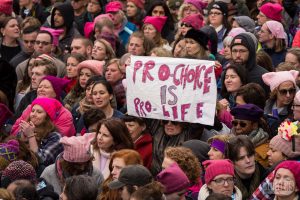
A Women’s March in 2017. Credit: Mark Dixon/Flickr
“I had a second trimester abortion,” tweeted Erica Goldblatt Hyatt, a Canadian living in the USA. “Our son never formed an airway. Had he survived birth he would have been brain dead. That wasn’t the life I wanted for him. It was the first true parenting decision I ever made.”
Goldblatt Hyatt’s story was included in a CNN article, along with stories from a mother of two who didn’t want more children and a woman who got pregnant at 16 with no family support, about the reasons women have abortions.
Since the passing of Roe v Wade in the Supreme Court in 1973, abortion has been enshrined in law in the USA. Some states have restrictions on access to abortion, but the ruling that it is a legal right has remained in place.
The passing of Ruth Bader Ginsburg in September, and her replacement by Amy Coney Barrett, has fuelled the fire of panic in women that this right could soon be snatched away, a panic they have felt since 2016 when Donald Trump said that if he is able to select enough justices for the bench, over-turning Roe v Wade “will happen automatically”.
The USA is not the only country where reproductive rights are being dismantled. Mass protests have broken out in Poland over the last few weeks after the constitutional court ruled that, even in the case of severe foetal abnormalities, women will be forced by law to carry the pregnancy to term. This is a further encroachment on reproductive freedom in a country that already has some of the most restrictive abortion laws in Europe.
The women of Northern Ireland are also facing barriers to reproductive freedom. Despite abortion being decriminalised in October 2019, access to clinics is severely lacking, prompting the Royal College of Obstetricians and Gynaecologists to write a letter, sections of which were published by the Independent on 26 October, warning of the risks to women.
“There have already been at least two cases of attempted suicide by women in Northern Ireland unable to access care,” it says, adding that there has been a dramatic increase in women “turning to unregulated methods of abortion during the pandemic.”
Reproductive rights are a freedom of expression issue. We do not only express ourselves verbally and artistically, we express ourselves through the choices we make about how we live our lives and what happens to our bodies. The decisions about when, if ever, to become a mother, and to how many children, are some of the biggest a woman can make. When states take control of this decision, they are taking control of our self-expression.
This is not to say that these decisions cannot be discussed and debated. Debate is at the heart of freedom of expression and that extends to the topic of abortion. People should be allowed to talk about the questions surrounding it, such as “when does life start?” For some it starts at the moment of conception, meaning abortion at any stage, even the very early weeks, would constitute ending a life. But this is not a consensus. And even if life does start at conception, that would not necessarily mean that abortion should be banned. After all, there are all kinds of practises that we allow as a society even if we question them morally because we believe banning them would ultimately go against freedom and autonomy.
Pro-life advocates must of course have their right to this view respected, and no one should force them to abort. But equally people attempting to force their beliefs on others, and control their actions to be in line with these beliefs, is when the defenders of freedom of expression must step in.
It should go without saying that the consequences of being forced to have a child are far-reaching. There’s the toll on mental health for one. According to research by scientists at King’s College London one in four pregnant women suffer from mental health problems. This can be even more extreme for those in unwanted pregnancies. In 2017 a young woman, who became known as Ms Y, sued the official health service in Ireland after she was not only denied an abortion but held against her will and forced medication to prolong the pregnancy. She had arrived in Ireland in 2014 seeking asylum and soon discovered she was pregnant. She said she’d been raped and was suicidal because of the pregnancy.
Research also shows that having a baby can hold a woman’s career back six years. Inflicting career disruptions on women by forcing them to continue with unwanted pregnancies is an infringement on their self-expression in the workplace that can have long-spanning repercussions. And then there are all the negative impacts it can have on relationships, finances, social support networks – the list could go on. None of these are trivial matters. Rather they’re all choices that are part of our free expression.
The Polish ruling also highlights that many abortions are because either the baby or the mother, or both, are seriously ill. Abortion is not always a lifestyle choice. It is often a very traumatic decision a woman is forced to make about an intended pregnancy. Heart-breaking as these decisions undoubtedly are, the most profound forms of expression are often the choices we make about our health and that of our families.
Incidentally, as is often the case with censoring behaviour, removing someone’s choice can actually be counter-productive. A study by the National Library of Medicine concluded that women who had had an abortion were more likely to have an intended pregnancy within the next five years than women forced to continue with an unwanted pregnancy. Diane Greene Foster, one of the academics who conducted the study, concluded: “Being able to access abortion gives women the opportunity to have a child later with the right partner, at the right time”. She added that a woman who is denied an abortion is likely to “face diminished opportunities to achieve other life goals, gain secure financial footing, and have a child she can cherish and support”.
Remaining childless, or having children with the right partner when it is the right time to do so, is an umbrella of self-expression under which so many other forms of expression shelter; expression through work, through lifestyle choices, through parenting ability. It is a form of expression which must remain in the hands of individuals and be kept out of the grips of the state.[/vc_column_text][/vc_column][/vc_row]
4 Apr 2018 | Awards, Fellowship 2018, News
[vc_row][vc_column][vc_video link=”https://youtu.be/Ev3C9EZqY48″][vc_column_text]Fereshteh Forough is the founder and executive director of Code to Inspire, which opened its first coding school for girls in Afghanistan in November 2015, and aims to address the low levels of female education and paltry levels of economic participation by women in the labour market. 
This is a widely recognised innovative project that helps women and girls learn computer programming. The aim is to tap into the commercial opportunities offered by the online world to liberate women in Afghanistan and offer them economic independence.
Afghanistan is still a male-dominated country where ordinary women find it difficult even to socialise or trave, let alone work, use technology or be economically independent. Women are also discouraged from working where men are present and experience sexual harassment if they do.
Forough believes that with programming skills, an internet connection and using bitcoin for currency, women in Afghanistan can be independent, transform their society and create wealth and economic opportunity.
“Some of the girls had never touched a computer, been online – nothing,” said Forough. “Today, they are able to create web pages and a some are now going out and talking to women-based companies and offering their expertise to them, to help them create websites. This is a real act of resistance in a country where women are still being pushed back for accessing the internet and computers.”
Only 21% of Afghan women receive secondary education according to a UNICEF study and in Afghanistan there is only a 16% female participation in the labour market.
Afghanistan is still economically and politically unstable and parts of it are dangerous and violence-prone, which presents many hurdles to entrepreneurs who want to drive change like Forough, and the women and girls she teaches and helps get jobs.
However Forough is used to challenges. She herself was a refugee. Born to Afghan parents in Iran, she returned to Afghanistan after the fall of the Taliban, and took a position teaching computer sciences at Herat University after studying for a Masters in Germany.
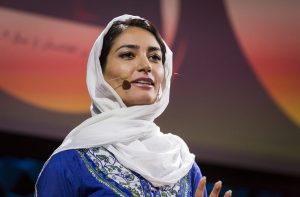
Forough has received support from abroad for Code to Inspire, particularly from the USA with Google, GitHub, but she is still working on a relatively small scale. She needs more support to expand and build her vision round the country franchising the model to other larger cities such as Mazar-e Sharif and Kabul. Forough also wants to organise the first Afghan women hackathon at a national level.
Forough was a 2013 TED Talks speaker and took part in the 2015 Clinton Global Initiative.
In 2017, Code to Inspire enrolled about 20 girls for new graphic and design classes, and later on in the year another group of 60 girls took classes in unity (a gaming software), mobile applications and full stack development.
“It doesn’t matter where you are or what you are, what you have or don’t have,” said Forough. “You should never be afraid to do what you believe in and that’s what Index of Censorship Award means to me, to raise my voice and share my story freely”.
See the full shortlist for Index on Censorship’s Freedom of Expression Awards 2018 here.[/vc_column_text][/vc_column][/vc_row][vc_row full_width=”stretch_row_content” equal_height=”yes” el_class=”text_white” css=”.vc_custom_1490258749071{background-color: #cb3000 !important;}”][vc_column width=”1/2″][vc_custom_heading text=”Support the Index Fellowship.” font_container=”tag:p|font_size:28|text_align:center” use_theme_fonts=”yes” link=”url:https%3A%2F%2Fwww.indexoncensorship.org%2Fsupport-the-freedom-of-expression-awards%2F|||”][vc_column_text]
By donating to the Freedom of Expression Awards you help us support
individuals and groups at the forefront of tackling censorship.
Find out more
[/vc_column_text][/vc_column][vc_column width=”1/2″ css=”.vc_custom_1521479845471{background-image: url(https://www.indexoncensorship.org/wp-content/uploads/2017/05/2017-awards-fellows-1460×490-2_revised.jpg?id=90090) !important;background-position: center !important;background-repeat: no-repeat !important;background-size: cover !important;}”][/vc_column][/vc_row][vc_row][vc_column][vc_basic_grid post_type=”post” max_items=”4″ element_width=”6″ grid_id=”vc_gid:1523376151785-23b6414e-add3-5″ taxonomies=”10735″][/vc_column][/vc_row]
28 Mar 2018 | Awards, Fellowship 2018, News
[vc_row][vc_column][vc_video link=”https://youtu.be/eqJSvqcp968″][vc_column_text]The women behind Open Stadiums risk their lives to assert women’s rights to attend public sporting events in Iran. It’s a daring campaign which challenges the established Islamic order of Iran, and engages women in an issue many human rights activists have not in the past thought important.
Currently in Iran women face many restrictions on using public space. Swimming pools, schools, sports hall and even parks are gender segregated.
But the most potent example of their banishment from public life is that they are prohibited from going to popular sporting fixtures where men compete.
One of the successes of the Open Stadiums campaign has been to build the awareness of this as an issue.
Iran particularly enjoys competing in, and hosting international football and volleyball tournaments, and the Open Stadiums campaign has used Iran’s desire to take part in international competition to challenge the government’s ban on women attending events. In theory international sporting bodies do not allow member nations to use discriminatory practices during matches.
The campaigners face many difficulties. The organisers are worried that as their campaign becomes more successful, they will be identified and tracked. They cannot expand their campaign because they fear any foreign funds they receive will lead to then being identified and jailed, as the Iranian government continues to stifle dissent of any kind. The Iranian regime has a history of putting women’s rights activists under pressure.
Despite the difficulties and fears, 2017 has been a successful year for the Open Stadiums campaign. But the success of the group has put them increasingly in the spotlight and therefore heightened the risk for them.
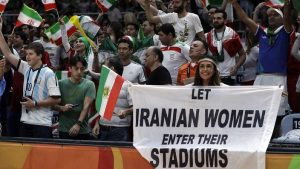 In May, the group used the slight easing of restrictions on public debate during the presidential election campaign to publish 21 demands for women and specifically pushed for women to be able to use public spaces and go to stadiums.
In September, the world’s media covered the fact women, despite having tickets, were refused entry to the football world cup qualifier between Syria and Iran in Tehran.
Two things this year have changed according to Open Stadiums. First, men and women in every match now complain about the ban on women at stadiums. They have been made to feel aware of the discrimination and it is talked about it a lot on social media. Second, MPs and people in power are beginning to talk about women’s rights to attend sports events in a way that would have been taboo before.
“I was happy down in my heart, especially when I read about the other nominees,” said Open Stadiums. “They were such great campaigns and people. I hadn’t heard of them before, and it was amazing to see how many individuals in this world are doing works not for more money but for better days for other people and society. This nomination gave me strength – yesterday when I was at risk of being arrested, I was thinking if i get arrested i know some people at least know about my passion and works i did these years.”
See the full shortlist for Index on Censorship’s Freedom of Expression Awards 2018 here.[/vc_column_text][/vc_column][/vc_row][vc_row full_width=”stretch_row_content” equal_height=”yes” el_class=”text_white” css=”.vc_custom_1490258749071{background-color: #cb3000 !important;}”][vc_column width=”1/2″][vc_custom_heading text=”Support the Index Fellowship.” font_container=”tag:p|font_size:28|text_align:center” use_theme_fonts=”yes” link=”url:https%3A%2F%2Fwww.indexoncensorship.org%2Fsupport-the-freedom-of-expression-awards%2F|||”][vc_column_text]
By donating to the Freedom of Expression Awards you help us support
individuals and groups at the forefront of tackling censorship.
Find out more
[/vc_column_text][/vc_column][vc_column width=”1/2″ css=”.vc_custom_1521479845471{background-image: url(https://www.indexoncensorship.org/wp-content/uploads/2017/05/2017-awards-fellows-1460×490-2_revised.jpg?id=90090) !important;background-position: center !important;background-repeat: no-repeat !important;background-size: cover !important;}”][/vc_column][/vc_row][vc_row][vc_column][vc_basic_grid post_type=”post” max_items=”4″ element_width=”6″ grid_id=”vc_gid:1522067393647-a5588697-4f78-2″ taxonomies=”10735″][/vc_column][/vc_row]
24 Apr 2013 | Comment, News, United Kingdom
Mumsnet co-founder Justine Roberts explains the site’s commitment to giving women access to free speech
(more…)
