11 Mar 2014 | Americas, News, United States
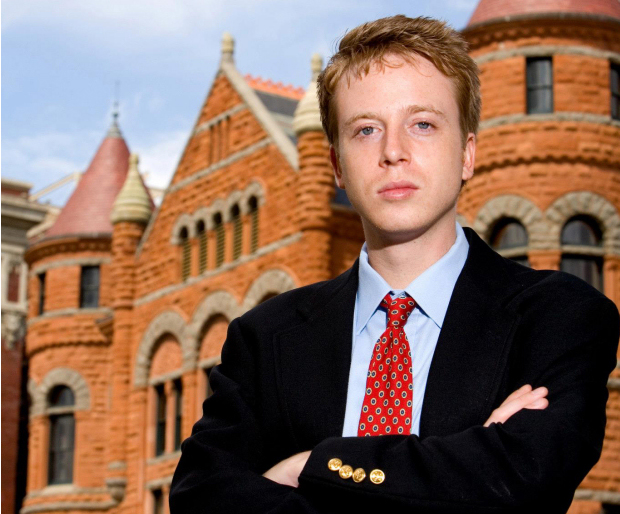
(Image: Free Barrett Brown)
On 7 March, a US federal judge granted the government’s motion to dismiss the majority of its criminal case against journalist Barrett Brown. The 11 dropped charges, out of 17 in total, include those related to Brown’s posting of a hyperlink that led to online files containing credit card information hacked from the private US intelligence firm Stratfor.
Brown, a 32-year old writer who has had links to sources in the hacker collective Anonymous, has been in pre-trial detention since his arrest in September 2012 – weeks before he was ever charged with a crime. Prior to the government’s most recent motion, he faced a potential sentence of over a century behind bars.
The dismissed charges have rankled journalists and free-speech advocates since Brown’s case began making headlines last year. The First Amendment issues were apparent: are journalists complicit in a crime when sharing illegally obtained information in the course of their professional duties?
“The charges against [him] for linking were flawed from the very beginning,” says Kevin M Gallagher, the administrator of Brown’s legal defense fund. “This is a massive victory for press freedom.”
At issue was a hyperlink that Brown copied from one internet relay chat (IRC) to another. Brown pioneered ProjectPM, a crowd-sourced wiki that analysed hacked emails from cybersecurity firm HBGary and its government-contracting subsidiary HBGary Federal. When Anonymous hackers breached the servers of Stratfor in December 2011 and stole reams of information, Brown sought to incorporate their bounty into ProjectPM. He posted a hyperlink to the Anonymous cache in an IRC used by ProjectPM researchers. Included within the linked archive was billing data for a number of Statfor customers. For that action, he was charged with 10 counts of “aggravated identity theft” and one count of “traffic[king] in stolen authentication features”.
On 4 March, a day before the government’s request, Brown’s defence team filed its own 48-page motion to dismiss the same set of charges. They contended that the indictment failed to properly allege how Brown trafficked in authentication features when all he ostensibly trafficked in was a publicly available hyperlink to a publicly available file. Since the hyperlink itself didn’t contain card verification values (CVVs), Brown’s lawyers asserted that it did not constitute a transfer, as mandated by the statute under which he was charged. Additionally, they argued that the hyperlink’s publication was protected free speech activity under the First Amendment, and that the application of the relevant criminal statutes was “unconstitutionally vague” and created a chilling effect on free speech.
Whether the prosecution was responding to the arguments of Brown’s defense team or making a public relations choice remains unclear. The hyperlink charges have provoked a wave of critical coverage from the likes of Reporters Without Borders, Rolling Stone, the Committee to Protect Journalists, the New York Times, and former Guardian columnist Glenn Greenwald.
Those charges were laid out in the second of three separate indictments against Brown. The first indictment alleges that Brown threatened to publicly release the personal information of an FBI agent in a YouTube video he posted in late 2012. The third claims that Brown obstructed justice by attempting to hide laptops during an FBI raid on his home in March of that year. Though he remains accused of access device fraud under the second indictment, his maximum prison sentence has been slashed from 105 years to 70 in light of the dismissed charges.
While the remaining allegations are superficially unrelated to Brown’s journalistic work, serious questions about the integrity of the prosecution persist. As indicated by the timeline of events, Brown was targeted long before he allegedly committed the crimes in question.
On 6 March 2012, the FBI conducted a series of raids across the US in search of material related to several criminal hacks conducted by Anonymous members. Brown’s apartment was targeted, but he had taken shelter at his mother’s house the night prior. FBI agents made their way to her home in search of Brown and his laptops, which she had placed in a kitchen cabinet. Brown claims that his alleged threats against a federal officer – as laid out in the first indictment, issued several months later in September – stem from personal frustration over continued FBI harassment of his mother following the raid. On 9 November 2013, Brown’s mother was sentenced to six months probation after pleading guilty to obstruction of justice for helping him hide the laptops – the same charges levelled at Brown in the third indictment.
As listed in the search warrant for the initial raid, three of the nine records to be seized related to military and intelligence contractors that ProjectPM was investigating – one of which was never the victim of a hack. Another concerned ProjectPM itself. The government has never formally asserted that Brown participated in any hacks, raising the question of whether a confidential informant was central to providing the evidence used against him for the search warrant.
“This FBI probe was all about his investigative journalism, and his sources, from the very beginning,” Gallagher says. “This cannot be in doubt.”
In related court filings, the government denies ever using information from an informant when applying for search or arrest warrants for Brown.
But on the day of the raids, the Justice Department announced that six people had been charged in connection to the crimes listed in Brown’s search warrant. One, Hector Xavier Monsegur (aka “Sabu”), had been arrested in June 2011 and subsequently pleaded guilty in exchange for cooperation with the government. According to the indictment, Sabu proved crucial to the FBI’s investigation of Anonymous.
In a speech delivered at Fordham University on 8 August 2013, FBI Director Robert Mueller gave the first official commentary on Sabu’s assistance to the bureau. “[Sabu’s] cooperation helped us to build cases that led to the arrest of six other hackers linked to groups such as Anonymous,” he stated. Presuming that the director’s remarks were accurate, was Brown the mislabeled “other hacker” caught with the help of Sabu?
Several people have implicated Sabu in attempts at entrapment during his time as an FBI informant. Under the direction of the FBI, the government has conceded that he had foreknowledge of the Stratfor hack and instructed his Anonymous colleagues to upload the pilfered data to an FBI server. Sabu then attempted to sell the information to WikiLeaks – whose editor-in-chief, Julian Assange, remains holed up in the Ecuadorian embassy in London after refusing extradition to Sweden for questioning in a sexual assault case. Assange claims he is doing so because he fears being transferred to American custody in relation to a sealed grand jury investigation of WikiLeaks that remains ongoing. Though Sabu’s offer was rebuffed, any evidence linking Assange to criminal hacks on US soil would have greatly strengthened the case for extradition. It was only then that the Stratfor data was made public on the internet.
During his sentencing hearing on 15 November 2013, convicted Stratfor hacker Jeremy Hammond stated that Sabu instigated and oversaw the majority of Anonymous hacks with which Hammond was affiliated, including Stratfor: “On 4 December, 2011, Sabu was approached by another hacker who had already broken into Stratfor’s credit card database. Sabu…then brought the hack to Antisec [an Anonymous subgroup] by inviting this hacker to our private chatroom, where he supplied download links to the full credit card database as well as the initial vulnerability access point to Stratfor’s systems.”
Hammond also asserted that, under the direction of Sabu, he was told to hack into thousands of domains belonging to foreign governments. The court redacted this portion of his statement, though copies of a nearly identical one written by Hammond months earlier surfaced online, naming the targets: “These intrusions took place in January/February of 2012 and affected over 2000 domains, including numerous foreign government websites in Brazil, Turkey, Syria, Puerto Rico, Colombia, Nigeria, Iran, Slovenia, Greece, Pakistan, and others. A few of the compromised websites that I recollect include the official website of the Governor of Puerto Rico, the Internal Affairs Division of the Military Police of Brazil, the Official Website of the Crown Prince of Kuwait, the Tax Department of Turkey, the Iranian Academic Center for Education and Cultural Research, the Polish Embassy in the UK, and the Ministry of Electricity of Iraq. Sabu also infiltrated a group of hackers that had access to hundreds of Syrian systems including government institutions, banks, and ISPs.”
Nadim Kobeissi, a developer of the secure communication software Cryptocat, has levelled similar entrapment charges against Sabu. “[He] repeatedly encouraged me to work with him,” Kobeissi wrote on Twitter following news of Sabu’s cooperation with the FBI. “Please be careful of anyone ever suggesting illegal activity.”
While Brown has never claimed that Sabu instructed him to break the law, the presence of “persons known and unknown to the Grand Jury,” and whatever information they may have provided, continue to loom over the case. Sabu’s sentencing has been delayed without explanation a handful of times, raising suspicions that his work as an informant continues in ongoing federal investigations or prosecutions. The affidavit containing the evidence for the March 2012 raid on Brown’s home remains under seal.
In comments to the media immediately following the raid, Brown seemed unfazed by the accusation that he was involved with criminal activity. “I haven’t been charged with anything at this point,” he said at the time. “I suspect that the FBI is working off of incorrect information.”
This article was posted on March 11, 2014 at indexoncensorship.org
11 Mar 2014 | Americas, Brazil, News
Image: Ksenia Ragozina/Shutterstock
Brazil’s government and security forces have put themselves on a war footing ahead of this summer’s FIFA World Cup, hosted by the South American country.
The security apparratus designed to stop demonstrations from disrupting the tournament consists of a set of procedures for general intelligence and data surveillance during the conduct of major sporting events – both the 2014 World Cup and the 2016 Summer Olympics, which will be held in Rio. It is a strategically integrated operation involving the Ministries of Defence and Justice, the Brazilian Intelligence Agency (Abin), the Armed Forces, the Metropolitan Polices, the Federal Police and the Highway Police. In addition to high-tech security equipment, the security plan could see state agents embedded in demonstrations.
The monitoring of social networks like Facebook, Twitter, Instagram and YouTube is one of the main means of surveillance, and is already in operation. The focus is not only on profiles of members or supporters of the Black Blocs: any citizen can be targeted for investigation. Someone that likes a post in Facebook about violence in protests, for example, may be viewed as a suspect.
Advanced technology is being used to locate computers, access communications, collect data and emails and control electronic activities. Special departments have been created for this with extraordinary budgets.
The Special Secretariat for Large Events Security (SESGE, in Portuguese), of the Ministry of Justice, was created by decree in 2011 with the purpose of driving, planning, coordinating and evaluating the security actions for the major sporting events. The Core Cyber Defence Centre, a kind of “crisis room”, related to the Army and the Ministry of Defence, was also created in order to control actions of cyberterrorism, a concept that opens space for electronic surveillance of any person.
“Brazil is a winner Country and its people, their city mayors and their state governments participate in this journey of victory”, said President Dilma Rousseff, announcing the 14 command centre units in the Brazilian cities that will host World Cup games.
The command centres are built like bunkers, able to withstand explosions. The monitoring structure, equipped with cameras and 360° videowall, allows to identify people in detail, and share information. The centres also come equipped with bomb disposal kits, high observation decks, trucks for capturing images and aerial imaging systems.
The public safety plan for the World Cup will cost R$ 1.170 billion (about £ 300 million). “Most of the amount was invested in equipment that will be a legacy for the states”, explained the secretary Andrei Rodrigues, of the SESGE.
The legacy is doubtful. According to the strategic security plan, the operation has strict goals of protecting interests of the makers of the sporting events. What will remain will be equipment, technology and also laws. Thus, there is a possibility that the legacy will be a strong apparatus to spy on Internet communications, legitimised by laws enacted for the safety of the events, but generalized to contain demonstrations.
The SESGE already is monitoring news “misleading or distorted content”; if something of this nature is identified, the news will be “promptly rectified by the publisher”. However, such activity directly attacks the freedom of the press and of expression, besides and configuring censorship.
It is noteworthy that the issue is not approached by the Brazilian press, who benefit from advertising revenue from the government and FIFA.
The Brazilian full security plan ignores the rights to privacy and presumption of innocence. Its definitions of public disorder, of who can be considered suspicious and of which are the laws by which citizens are detained and criminalized are open to abuse.
This article was posted on 11 March, 2014 at indexoncensorship.org
11 Mar 2014 | Awards, News, Uganda
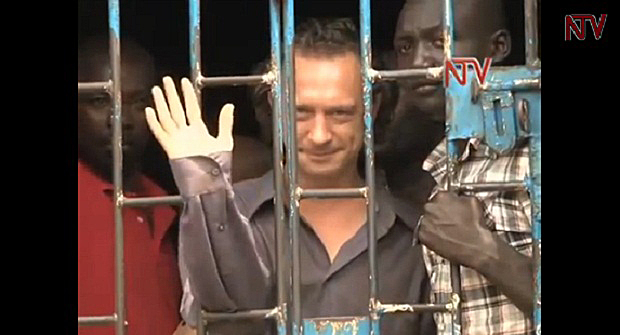
British theatre producer David Cecil brought worldwide attention to Uganda’s homophobic criminal code after he was arrested and charged for producing a “pro-gay” play in the country.
The Anti-Homosexuality Bill, a version of which was first introduced in 2009, was passed just before Christmas and signed by President Museveni at the end of February, meaning certain homosexual acts are now punishable with life in prison in Uganda.
The River and The Mountain tells the story of a successful young businessman who is killed by his employees after coming out as gay. Cecil was arrested in September 2012, when his theatre company refused to halt its production pending a content review by the Ugandan Media Council, and staged two performances in Kampala. The Council later deemed the play to be promoting homosexuality. Cecil spent four nights in a maximum-security prison and faced a two-year prison sentence or deportation if convicted.
The case attracted media attention both in Uganda and abroad, and Index on Censorship and David Lan, the artistic director of the Young Vic, launched a petition calling for the charges against Cecil to be dropped. It was signed by more than 2,500 people, including director Mike Leigh, Stephen Fry, Sandi Toksvig and actor Simon Callow, bringing attention to the wider issue of gay rights and freedom of expression in Uganda.
The charges were finally dropped on 2 January 2013, as the prosecution had failed to disclose any evidence. However, Cecil was re-arrested in February, spent five nights in prison, and was finally deported on the grounds that he was an “undesirable person”.
Cecil was deported from Uganda as a result of his play. He has been nominated for the Index Freedom of Expression Arts Award and spoke with Alice Kirkland about what this means to him.
Index: How does it feel to be nominated for the Index on Censorship arts award and why do you think you have been nominated?
David: The honour is bittersweet, as I am unable to continue living in Uganda because of what I did; the last year has been fraught with anxiety and uncertainty. Since meeting your representatives in early 2013, I stumbled across a load of back issues of your magazine from the 1980s. Reading through articles by Umberto Eco and Ronald Dworkin made me feel part of something bigger, a story unfolding over time.
I believe I was nominated because we were perceived as standing up for gay rights in a country where it’s hard to talk about homosexuality publicly. To me, at the time, we were just putting on a play and had little idea of how much impact it would have.
Index: You spent time in prison in Uganda for your part in the production of the “pro-gay” play The River and The Mountain. What impact has this had on your work and life since the incident? Would you or have you produced a play since on the same topic in a country that implements homophobic laws?
David: Since February 2013, I’ve been living in the UK as a deportee from Uganda, where I had spent 6 years building a career and a life with my new family (girlfriend and 2 kids, all Ugandan). With the recent (February 2014) signing of the Anti-Homosexuality Bill into law, plus other sinister developments, I now have to accept that Uganda is no longer safe for me and my family. So that chapter in my life is now closed and my family are now finally joining me here in London. This is a huge blow.
One colossal irony in all of this is that our play was not actually “pro-gay”. It simply portrayed a gay character sympathetically and satirised the politicisation of sexuality in Uganda. The people who targeted us have done all the work of promoting awareness of homosexual issues in their country.
Gay issues and rights are no obsession of mine. So, if I ever do tackle this subject again, it will be coincidental; I am primarily interested in the quality of a script or the enthusiasm of a moment.
Index: By having your production shut down, spending time in jail and facing a criminal trial you obviously had your right to free speech quashed. How did this make you feel?
David: Excited, then bemused, then frustrated, then furious, now a bit depressed – the latter mainly about Uganda, my erstwhile adopted country.
Ugandan prison was very relaxing and even pleasant. Initially, I was in the section for remand prisoners, short sentences and white-collar crime. The people were friendly, relaxed and understanding. Later, I was locked up for a week in a crowded, rough police station. That had its interesting moments, such as ghost-story-telling by candle-light, and a brilliant cast of characters. I rose to become “resident police” (prison boss) by slapping a Fagin-type with a flipflop.
My feelings are less important. I am not the victim in this story. The ones suffering are my family, and the Ugandan people.
Index: Can you explain about the run up to the production of the play in Uganda? Were you aware before the opening night that running the show could land you in jail?
David: It is important to note that the original genesis of the play comes from a meeting with a local theatre group, Rafiki. They, a group of young, heterosexual Ugandan actors and actresses, wanted to produce a play on the theme of “homosexuality”. I agreed to help, as long as it would be a comedy. Coincidentally, a friend of a friend was visiting from the UK at the time; this was Beau Hopkins, a poet and playwright, who agreed to work on the script according to a story developed in a collaborative workshop. Angella Emurwon, an award-winning Ugandan playwright, agreed to direct. It is important to note also that all the Ugandans involved are religious; one of them describes himself as a “devout Christian”.
Fast forward 4 months. I was told a week before the press premiere night that we needed to get special clearance from the Ugandan Media Council (UMC). I had already tried to secure this three months before and was told it was not necessary. (The junior UMC worker who told me this was correct; normally, one would not have to get any clearance for a theatre play in Uganda.) In the end, the secretary of the UMC decided to politicise what we were doing and, at the very last minute, insisted that I sign a letter asking us to desist until they had reviewed the script with their 11-strong committee. Pius, the secretary knew that this meant the play would not be performed, due to subsequent commitments of the director and the key actors, as I had already informed him of all that. The letter was cc-ed to the prime minister’s office, the chief of police, the head of media crimes CID and the minister of ethics & integrity. Because the letter made no mention of legal consequences, articles or anything binding, I signed.
I immediately visited a friend of mine, a human rights lawyer, Godwin Buwa, whose prognosis proved remarkably accurate in all but one regard. The letter was indeed a threat – it could not stand up in a court of law – however, one of the agencies cc-ed may try and act on it. I could be charged with something, possibly, but since the letter was so badly phrased, the worst I would suffer would be a few nights on remand. Since the case would have no water, I would be guilty of no crime and would not be deported.
We had a meeting with the cast. My name was on the paper, they were not in danger. We had worked too hard to be bullied into silence by a badly-phrased letter. We agreed to go ahead and face the consequences.
Perhaps I carried over an element of bravado from my experiences organising underground raves and music festivals in Europe, sometimes in the teeth of official sanction. At worst we had our sound system seized and threatened on numerous occasions, but always continued doing what we loved doing.
Index: Your trial brought global media attention to the situation in Uganda regarding the Anti-Homosexuality Bill, but did this attention do anything to change the laws in the country?
David: To make a faintly disgusting analogy, I think that much of the attention (from our case and others) has been like squeezing a pimple. It has brought the pus to the top.
It was never my attention to directly talk about minority rights or the laws in Uganda — I would not presume to do so. It is none of my business, in every sense. What we were trying to do was to make fun of the nonsense surrounding attitudes to gays – the very bigotry and politicisation that took us down – without getting involved in a “right or wrong” argument. Our play was funny; it was entertainment. I hope that we changed the attitudes of some audience members.
I believe communities are the source of meaning. The law either follows or clashes with that meaning. Sometimes a law may be passed to protect a minority; maybe…
The problem with international activism is that it plays right into the hands of people who argue that homosexuality is a “foreign menace”. At least, people who care about these issues should spend a significant amount of time in the countries to understand why ordinary, sound people may be homophobic. Then they can judge and engage with them.
Activism is a label with revolutionary connotations. I am certainly no activist. At most, we wanted to get people talking.
Index: What role does freedom of expression have to play in discussions about homophobia, especially in countries where it is a crime to be gay?
David: Without freedom of expression, government propaganda and lazy “common sense” prevails, especially regarding taboos or controversies. In a country where religious, ethnic and gender identities are so important and politicised, it is essential that we can discuss politics in terms of our identity, without fear of arrest.
Index: How important are awards like the Index on Censorship one in advocating free speech as a human right?
David: In Uganda, there’s a fantastic organisation called “Freethought Kampala”. They’d benefit from exposure and affiliation. I’d love to see the Index organising an event with their founder James Onen and his friends.
This article was posted on March 11, 2014 at indexoncensorship.org
10 Mar 2014 | News, Uncategorized
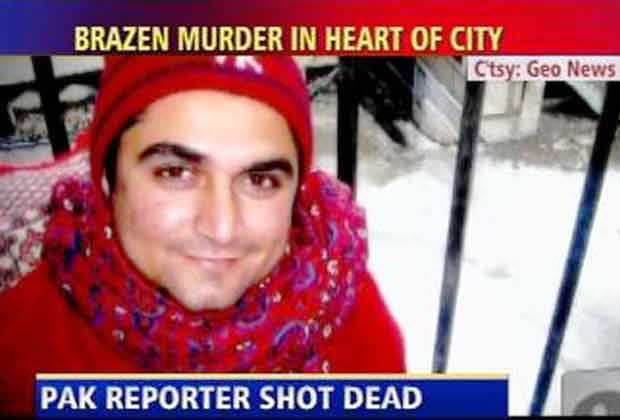
(Image: GEO TV)
On 1 March an anti-terrorism court in Pakistan, found six men guilty of the murder of 28-year old journalist Wali Khan Babar. Four have been sentenced to life imprisonment, and two, in absentia, were sentenced to death.
The young reporter was shot dead on January 1, 2011, while working for GEO TV in the Liaquatabad area of Karachi. According to Committee to Protect Journalists, his was a work-related murder.
Convictions for attacks on journalists can be complicatd in Pakistan. Ahmed Omar Saeed Sheikh, who was convicted for the murder of US reporter, Daniel Pearl is the only previous journalist killer to have been sentenced to death. However, Pearl’s case remains in dispute and Sheikh has been incarcerated at the Hyderabad Central Jail for the last 12 years. His lawyers are appealing the conviction, saying he was framed. The confusion arose after Khalid Sheikh Mohmmad (currently being held in Guantanamo) confessed to the murder.
Therefore, Mazhar Abbas, former secretary general of the Pakistan Federal Union of Journalists (PFUJ) while terming this month’s conviction as an “important decision” remains sceptical that Babar’s family will get justice given the abysmally low conviction rate once the case goes to higher courts. “It may take years to get a decision if the case goes to the Sindh High Court for appeal,” he said pointing to deep-rooted “corruption” that prevailes in the judicial system.
But that is not the only reason for the delay in justice. Despite setting up anti-terrorist courts (ATCs) for speedy disposal of cases, the conviction rate has not made an appreciable difference. People like former prosecutor general of Sindh province, Shahadat Awan, links the high rate of acquittal (almost 73 percent), to weak investigation and witnesses retreating.
Since Babar’s trial began, six witnesses, a lawyer and two policemen linked to the investigation have been assassinated.
After these murders, and amid threats to the prosecutors and lawyers, the trial was shifted from Karachi to another city in Sindh, Shikarpur. “The case has been tried under extremely difficult circumstances and to that extent I am satisfied,” acknowledged Abbas.
However, not everyone is wholly satisfied.
According to Zohra Yusuf, chairperson of the independent Human Rights Commission of Pakistan (HRCP) “justice has not been fully served as two culprits are absconding and six witnesses and a prosecution lawyer were killed while the case was being heard.”
For Ambreen Agha, research assistant with New Delhi’s Institute for Conflict Management, the conviction was a welcome step but ensuring justice was equally important.
“It is a significant step in a place where a culture of impunity dominates” she said, citing the example of Malik Ishaq, a militant leader, who, despite his involvement in the massacre of minority Shias and his association with the defunct terrorist outfit, Lashkar e Jhangvi, “goes scot free”.
At the same time, a recent attack on the Islamabad courthouse showed how vulnerable those delivering justice were.
“Despite the threat that looms large on any functioning institution of Pakistan, the judiciary will have to stand strong and determined in bringing justice in this case. The onus lies on the judiciary despite the precarious times in Pakistan,” Agha emphasized.
Nevertheless, for the media community, the conviction of Babar’s killers is historic.
Media analyst, Adnan Rehmat, said the verdict was a “turning point in the battle for defence of beleaguered media practitioners” and Abbas termed it a “ray of hope” showing that Pakistan can improve its record on protecting journalists and pursuing their killers.
But Ambreen Agha warned that a sustained policy was required to “protect the media from the extreme intolerance of the militants and the political class”.
Further, she added: “The political lobby and its attempts to shrink spaces for freedom of expression by shutting down private TV channels, intimidating and blocking certain media outlets, has, in the past, emboldened the terrorists and opened the spaces for the perpetrators of violence.”
This article was posted on March 10, 2014 at indexoncensorship.org
