12 Jan 2015 | Events
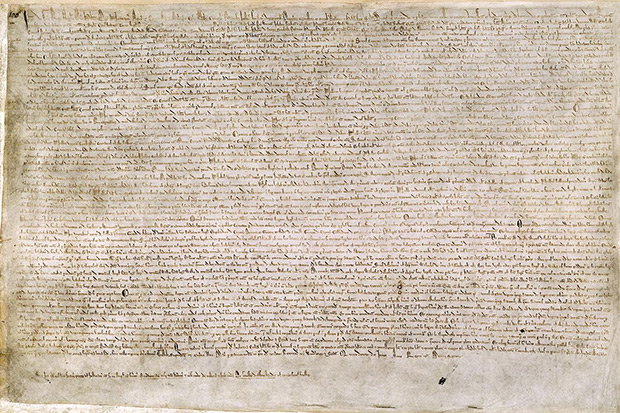
On the day when the four surviving copies of the original 1215 Magna Carta are being briefly brought together for the first time, join us to debate whether we need a US-style written First Amendment?
With a panel hailing from both sides of the Atlantic, speakers include former Attorney General Dominic Grieve, academic Sarah Churchwell, Artistic Director of the Bush Theatre Madani Younis and political analyst Peter Kellner.
Please note that the debate is invitation only, please email [email protected] if you are interested in attending.
WHERE: British Library, London
WHEN: Monday 2 February 2015, 5:30pm
This event is presented in association with the British Library
12 Jan 2015 | News, Statements, Turkey Statements
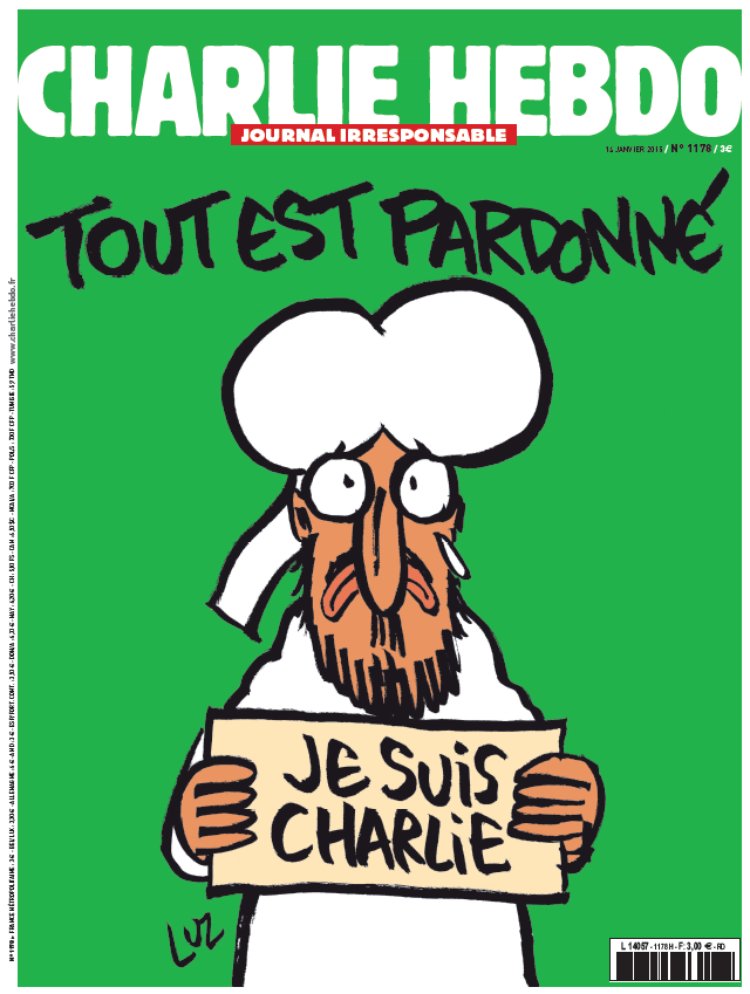
Tout est pardonne or all is forgiven, the first post attack cover of Charlie Hebdo
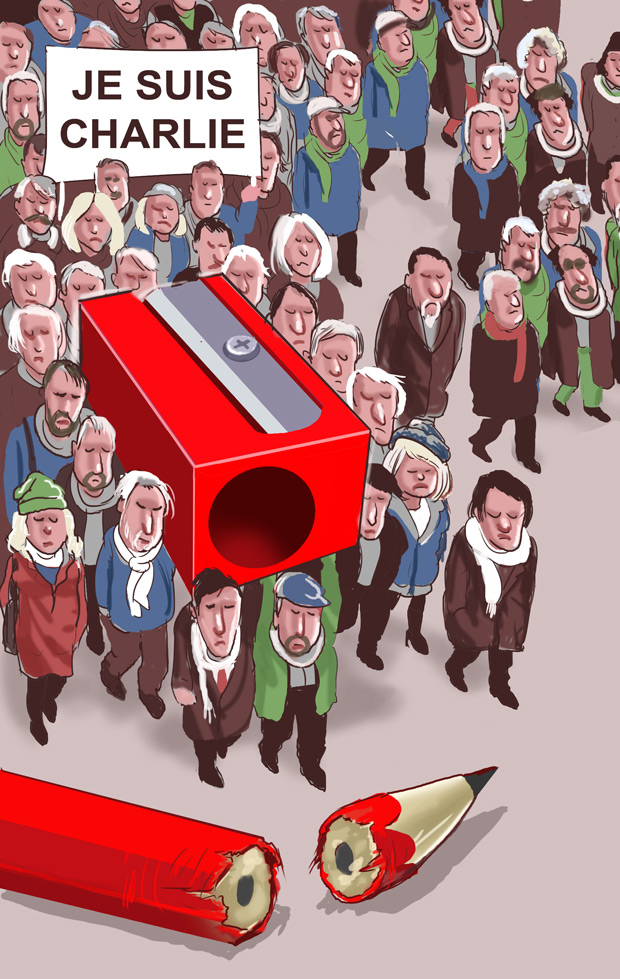
If you said “I believe in free expression, but…” at any point in the past week, then this is for you. If you declared yourself to be “Charlie”, but have ever called for an offensive image to be removed from public viewing, then this is for you. If you “liked” a post this week affirming the importance of free speech, but have ever signed a petition calling for a speaker to be banned, then this is for you.
Because the rush to affirm our belief in free expression in the wake of Charlie Hebdo attacks ignores a simple truth: that free speech is being eroded on all sides, and all sides are responsible. And it needs to stop.
Genuine free expression means being able to articulate thoughts, feelings and ideas without fear of harm. It is vital because without it individuals would be subject to the whim of whichever authority dictated what ideas and opinions – as opposed to actions – are acceptable. And that is always subjective. You need only look at the world leaders at Sunday’s Paris solidarity march to understand that. Attendees included Ali Bongo, President of Gabon, where the government restricts any journalism critical of the authorities; Turkish Prime Minister Ahmet Davutoglu, whose country imprisons more journalists in the world than any other; and the UK’s David Cameron, who declared his support for free expression and the right to offend, while his government considers laws that could drive debate about extremism underground.
It is precisely the freedom for others to say what you may find offensive that protects your own right to express your views: to declare, say, your belief in a God whom others deny exists; or to support a political system that others dismiss. It is what enables scientific and academic thought to progess. As soon as we put qualifications around “acceptable” free expression, we erode its value. Yet that is precisely what happened time and again in response to the Charlie Hebdo attacks, with individuals simultaneously declaring their support for free expression while seeming to suggest that the cartoonists and anyone else who deliberately courts offence should choose other ways to express themselves – suggesting that the responsibility for “better” speech always lies with the person deemed to be causing offence rather than the offended.
“The free communication of ideas and opinions is one of the most precious of the rights of man. Every citizen may, accordingly, speak, write and print with freedom…”
French National Assembly, Declaration of the Rights of Man, August 26, 1789
Index believes that the best way to tackle speech with which you disagree, including the offensive, and the hateful, is through more speech, not less. It is not through laws and petitions that restrict the rights of others to speak. Yet, increasingly, we use our own free speech to call for that of others to be limited: for a misogynist UK comedian to be banned from our screens, or for a UK TV personality to be prosecuted by police for tweeting offensive jokes about ebola, or for a former secretary of state to be prevented from giving an address.
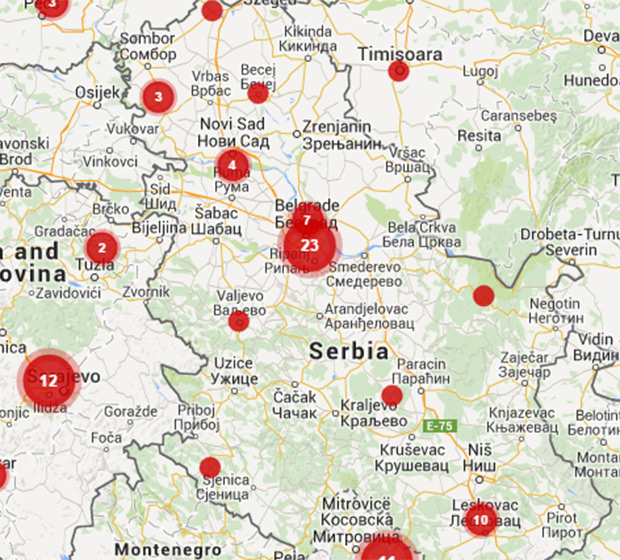
A project mapping media freedom in Europe, launched by Index just over six months ago, shows how journalists are increasingly targeted in this region, including – prior to last week’s incidents – 61 violent attacks against the media. Globally, the space for free expression is shrinking. We need to reverse this trend.
If you genuinely believe in the value of free speech – that all ideas and opinions must be heard – then that necessarily extends to the offensive and the vile. You don’t have to agree with someone, or condone what they are saying, or the manner in which it is said, but you do need to allow them to say it. The American Civil Liberties Union got this right in 1978 when they defended the rights of a pro-Nazi group to march in Chicago, arguing that rights to free expression needed apply to all if they were to apply to any. (As did charity EXIT-Germany late last year, when it raised money for an anti-fascism cause by donating money for every metre walked during a neo-Nazi march).
Countering offensive speech is – of course – only possible if you have the means to do so. Many have observed, rightly, that marginalisation and exclusion from mainstream media denies many people the voice that we would so vociferously defend for a free press. That is a valid argument. But this should be addressed – and must be addressed – by tackling this lack of access, not by shutting down the speech of those deemed to wield power and privilege.
Voltaire has been quoted endlessly in support of free expression, and the right to agree to disagree, but British author Neil Gaiman, who discusses satire and offence in the latest Index magazine, also had it right. “If you accept — and I do — that freedom of speech is important,” he once wrote, “then you are going to have to defend the indefensible. That means you are going to be defending the right of people to read, or to write, or to say, what you don’t say or like or want said…. Because if you don’t stand up for the stuff you don’t like, when they come for the stuff you do like, you’ve already lost.”
In the coming weeks, Index will redouble its efforts to build greater understanding of the benefits of free speech, to promote a better informed and wider public debate on censorship, and on offence. We will run a series of articles, public debates and workshops to encourage people to consider what it really means to support free expression, with the aim of reversing a tide of censorship-by-offence, and encouraging more speech, not less.
What can you do? Join the debate. #Keeptalking
This article was posted on 12 January 2015 at indexoncensorship.org
12 Jan 2015 | Draw the Line, Young Writers / Artists Programme
“We want to laugh at the extremists – every extremist. They can be Muslim, Jewish, Catholic. Everyone can be religious but extremist thoughts and acts we cannot accept,” Laurent Léger, a journalist at Charlie Hebdo–a satirical magazine where an extremist attack killed 12 people on Wednesday—told BFM-TV in 2012. Some weeks ago, a violent extremist attack also killed three people in Sydney. In 2011, Anders Breivik killed 77 people in a terrorist attack in Norway. During the late 20th century, the conflict between Catholics and Protestants also claimed the lives of thousands in Northern Ireland. The list of conflicts goes on.
Religious extremism is one of the greatest challenges facing society in the 21st century. Many world conflicts are closely linked to restrictions on religious freedoms. These horrific attacks will continue until there is an understanding of how important it is for people to be free to believe and practice their religion.
Religious freedom is enshrined in Article 18 of the Universal Declaration of Human Rights. We have the right to change religion or belief. We have the right to pray in private or public. We have the right to teach about our religion, but we can only keep these rights if we do not give in to religious discrimination, such as Islamophobia, Anti-Semitism or even discrimination against atheists.
On the #IndexDrawtheLine Twitter feed, some readers emphasised the importance of institutions in countering religious extremism. @KayRobinson thinks that institutions should adopt a secular law but “hold an authentic respect for religious values.” Organisations, such as governments, have to effectively counter extremism but society also has a responsibility. We have to support the values of religious freedom, and to ensure people expressing a range of differing views and values are not silenced.
This article was published on 12 January 2015 at indexoncensorship.org
12 Jan 2015 | Europe and Central Asia, Mapping Media Freedom, News, Serbia
Around 1 am on Thursday 3 July 2014, Davor Pasalic, editor of Serbian news agency FoNet, was brutally assaulted as he made his way home from the office. Pasalic, who had stopped for pizza, was accosted by three young men who demanded money and told him they had a gun. Pasalic refused and the men began beating him while shouting nationality-based slurs. Pasalic estimates that they struck him about 30 times before leaving him alone. The injured man then crossed a bridge leading to his apartment and was again attacked by the three men. The two attacks left him with cuts and bruises to his head and body. Four of his teeth were broken or knocked out.
“I have no clue why those three guys attacked me,” Pasalic told Index on Censorship. “One of the guys asked me: Are you a Croat? I was born in Belgrade. I have no accent. I look like every other citizen of Belgrade. Nobody has ever asked me that question before. How did he figure out that I am ethnic Croat?”
Six months have elapsed since the brutal assault, but police have made no progress in unmasking the culprits or discovering their motives. Nebojsa Stefanovic, Serbian minister of internal affairs, insists authorities are handling the incident as a priority, while Pasalic has said he is not certain whether police are unwilling or unable to resolve the assault. Journalists’ associations in Serbia are worried, vowing they “won’t allow” the beating to become just another case in the long line of unresolved attacks on media workers in Serbia.
From 2008 to 2014, Serbian has seen a total of 365 physical and verbal assaults, intimidations and attacks on property of media professionals, according to a report by the Independent Journalists’ Association of Serbia (NUNS). The numbers should be taken as provisional, it added, since many media workers do not report attacks. The real figure is likely higher than the official one. Since May 2014 alone, Index’s European Union-funded Mapping Media Freedom has received 48 reports of violations against Serbian media including attacks to property and intimidation and physical violence, one of which was the attack on Pasalic.
“In the period between 2008 and 2011 less than 10 per cent of all attacks were processed,” NUNS said. “We also have problems with the judicial process, even in cases where the identity of the aggressor is very obvious. In Serbian courts it is common for attackers to receive minimum sentences, which obviously encourages attacks,” said NUNS’ President Vukasin Obradovic in a statement. He believes this situation leads to self-censorship within the country’s press.
Media freedom violations are also covered in the annual reports on human rights in Serbia by the Belgrade Center for Human Rights (BCHR). In 2013 they reported, among other things, that hand grenades had been thrown at the home of the owner of the website Telegraf and that four journalists were under 24 hour police protection. In 2012 they pointed out, pointed out that despite a high number of attacks on the media, trials of press workers progressed faster than trials of perpetrators of attacks on journalists: “Minister Velimir Ilic was at long last found guilty and fined almost 1.4 million RSD for physically assaulting a journalist of the Novi Sad TV Apolo back in 2003. The assailant on TV B92 cameraman in 2008 was sentenced to one year in jail in 2012. The men who threatened to kill the author of the B92 show Insider Brankica Stankovic in 2009 were sentenced to 16 months’ imprisonment and six-month and one-year conditional sentences respectively.”
BCHR noted in its 2011 report that some court judgments confirmed the suspicion that perpetrators who attack journalists can count on lenient sentences. In 2010, they found that journalists were mostly being attacked by politicians, policemen and local businessmen dissatisfied with their reporting, and that — like in the previous years — most of the perpetrators went unpunished.
There are also cases where law enforcement authorities appear to simply not be doing their jobs, according to lawyer Kruna Savovic, who is part of the NUNS legal team. Speaking to Radio Free Europe, she shared the story of a journalist who reported death threats against him and his mother to the police. He stated the identity of the suspect, named witnesses and filed a report, but instead of processing the case, officers told him he would be charged if he continued to bother them.
The attacks on Pasalic were not captured by surveillance cameras in the area, and according to Stefanovic’s statement, the lack of video is complicating the investigation. The minister also asserted that a report was not filed on the night of the incident. Pasalic refutes that, saying he had sought medical treatment at the military medical academy after the assaults and told the on-duty officers what had occurred.
Serbian journalists’ associations have been unified in condemning the incident. “Serbian society is burdened with numerous attacks on journalists which remain unsolved and their perpetrators unpunished, sometimes for decades. This encourages the attackers and contributes to spreading fear and insecurity both among journalists and the society as a whole,” the Association of Independent Electronic Media (ANEM) pointed out.
The international community has also taken note. “Journalists’ safety is a key issue in the OSCE region. There must be no impunity for crimes committed against media workers”, said OSCE Representative on Freedom of the Media Dunja Mijatovic, and in its 2014 progress report on Serbia, the European Commission stressed that threats and violence against journalists “still remain a concern”. The Commission and other international non-governmental organisations urged Serbian authorities to keep their promised to investigate the killings of journalists Radislava Dada Vulasinovic in 1994, Slavko Curuvija in 1999 and Milan Pantic in 2001, as well as other attacks.
So far a Serbian special commission, which was created in 2013 and tasked with reopening the unresolved murders of journalists has achieved progress in the case of Curuvija. The commission found information that connects four former state security officials with the killing. They were all charged. Three of them were imprisoned while “one of the indicted men is believed to be on the run and living in an African country”. In 2014, NUNS reported, there was only one journalist under 24 hour police protection.
After six months of investigation and zero progress Pasalic ironically says that his case is “no big deal.” But, he said that the assault has had no impact on his work.
Veteran B92 journalist Veran Matic has worked against impunity and to bring murders of Vulasinovic, Curuvija and Pantic to justice. “The culture of producing fear is the most efficient form of censorship,” he told Index last November. But he added: “In the same way as impunity restricts freedom of speech, solving of these cases, at least 20 years later, will surely contribute to journalists being encouraged to do their job in the best possible way.”
Recent reports from mediafreedom.ushahidi.com
Serbia: Prime minister calls BIRN’s journalists “liars”
Serbia: Journalist fired after demotion
Serbia: “Doctors” send death threats after report
Serbia: Mayor criticised for implying journalists not welcome
Serbia: Journalist demoted after publishing report
This article was posted on 12 January 2015 at indexoncensorship.org