14 Jan 2015 | Campaigns, Statements
The arrest of French comedian Dieudonné today appears to be connected to a Facebook comment he posted after Sunday’s march in Paris in which he said he felt he “finally returned home… I feel like Charlie Coulibaly” – remarks that have been interpreted as condoning the action of one of the terrorists involved in the killings of 17 people in Paris last week.
It is important to be clear that while incitement to terrorism is a crime, commentary or jokes about terrorism – no matter how offensive or tasteless – are not. Opinions are protected by the right to freedom of expression.
“You cannot address bigoted and offensive ideas by banning them. To do so simply drives them underground,” said Index CEO Jodie Ginsberg. “The attacks on Charlie Hebdo should be a spur to every one of us to defend ever more vigorously free speech in all forms – even and especially when it represents opinions we find abhorrent or disagree with – so that all views are represented and can be challenged.”
The full text of the Dieudonne remark, later deleted, is as follows: “After this historic march what do I say…Legendary. Instant magic equal to the Big Bang that created the universe. To a lesser extent (more local) comparable to the coronation of Vercingétorix, I finally returned home. You know that tonight as far as I’m concerned I feel like Charlie Coulibaly”.
As Article 19 points out in a statement today, publicly condoning (faire publiquement l’apologie) acts of terrorism is a crime under Article 421-2-5 of the French Criminal Code.
The offence is punishable with up to five years’ imprisonment, and a fine of €75,000. Harsher penalties for the offence are available when it is committed online, allowing up to seven years’ imprisonment and a fine of €100,000.
“International standards are clear that terrorism offences should not be so broad or vague as to encompass expression where there is no actual intent to encourage or incite terrorist acts,” Article 19 said. “To impose criminal sanctions, there must be a direct and immediate connection between the expression at issue, and the likelihood or occurrence of such violence.”
14 Jan 2015 | Europe and Central Asia, France, News, Turkey
In October, Turkish cartoonist Musa Kart was the subject of a global solidarity campaign from his fellow artists. Kart was facing nine years in jail for insulting President Recep Tayyip Erodgan through a caricature for Cumhuriyet, where he commented on Erdogan’s alleged hand in covering up a high-profile corruption scandal. In response, his colleagues from around the world rallied in support of Kart, publishing their own #ErdoganCaricature on Twitter, and he was acquitted of the charges. This time, Kart is joining cartoonists in standing with Charlie Hebdo.
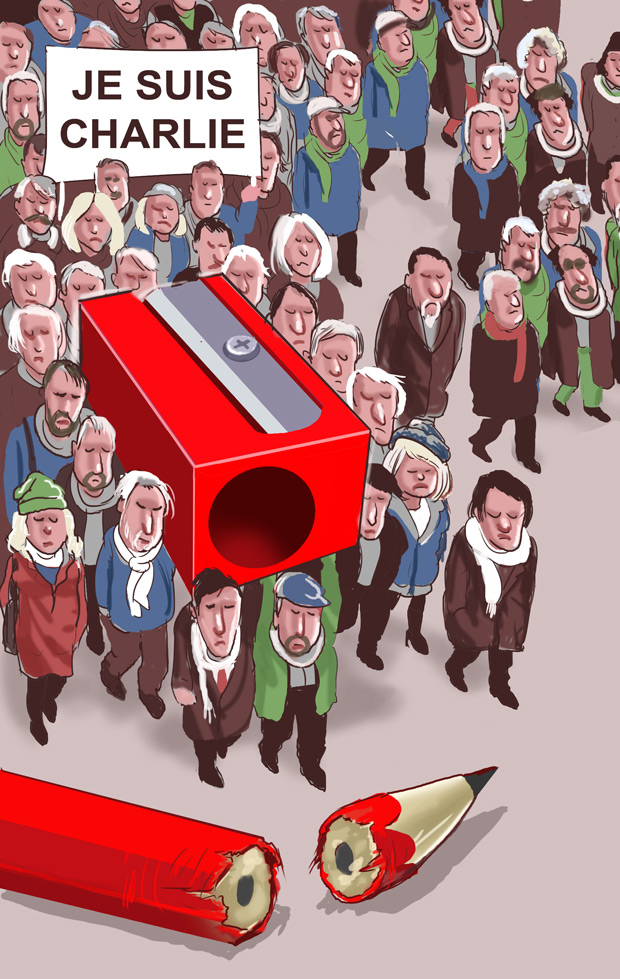
Cartoon courtesy Musa Kart
Kart told Index he feels “so sorry” and he has “lost his brothers” in last Wednesday’s brutal attack on the French satirical magazine’s offices, where 12 people — including cartoonists Stéphane Charbonnier aka Charb, Jean Cabut aka Cabu, Georges Wolinski and Bernard Verlhac aka Tignous — were killed.
Kart also ran into trouble with Turkish authorities back in 2005, when he was fined 5,000 Turkish lira for drawing then-Prime Minister Erdogan as a cat entangled in yarn. Kart puts the spotlight on Erdogan’s chequered history with cartoonists rights in a second piece, where the president declares that: “I condemn the attack. Ten years prison would have been enough for the cartoonists.”
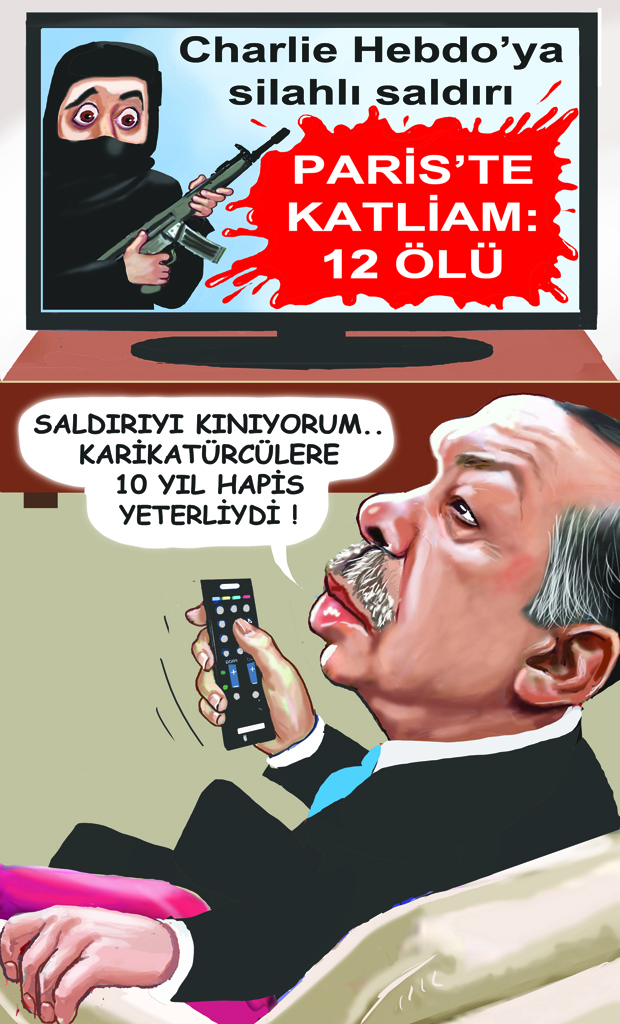
TV: “Massacre in Paris. Twelve dead.” President Erdogan: “I condemn the attack. 10 years prison would have been enough for the cartoonists.”
Erdogan condemned the “heinous terrorist attack” and Turkey’s Prime Minister Ahmet Davutoglu joined last Sunday’s march for unity in Paris. Much has been made of the apparent hypocrisy of world leaders who have suppressed free speech at home, taking part in what many considered a defiant show of support for that very right.
As Index CEO Jodie Ginsberg pointed out, Turkey imprisons more journalists than any other country in the world. Index’s media freedom map has received 72 reports of press freedom violations from Turkey since May 2014 alone. In the wake of the attacks in Paris, other Turkish cartoonists have been threatened by pro-government social media users. Police also raided the printing press of Cumhuriyet, as it prepared to publish selections from today’s issue of Charlie Hebdo.
Ecuadorian cartoonist Xavier Bonilla — known as Bonil — has also been targeted for his work. In 2013, the country got a new communications law which allows the government to fine and prosecute the media. After drawing a cartoon for El Universo, based on a raid on the home of a journalist and opposition advisor, Bonil became a victim of the new legislation. President Rafael Correa — who has been known to personally file lawsuits against critical journalists — ordered that a case be opened against the cartoonist. It found that his piece had invited social unrest and should be “rectified”, while El Universo was fined $92,000.
“I believe that humour is the best antidote to fear and the best defence against abuses of power. I have been drawing for 30 years, and I am not going to back down,” he wrote in an article in the current issue of Index on Censorship magazine.
Below are his cartoons in support of Charlie Hebdo.
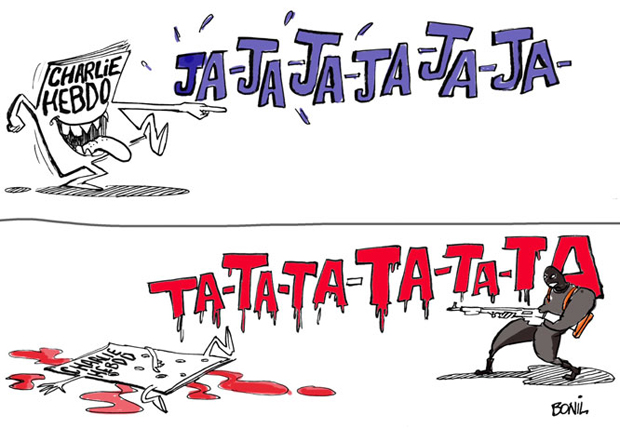
Cartoon courtesy of Bonil
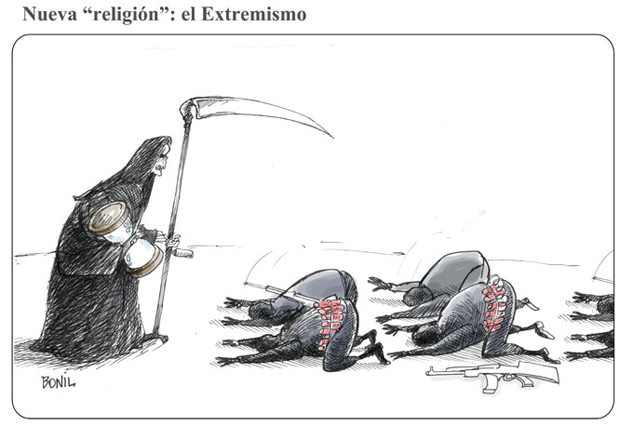
“New ‘religion’: extremism”
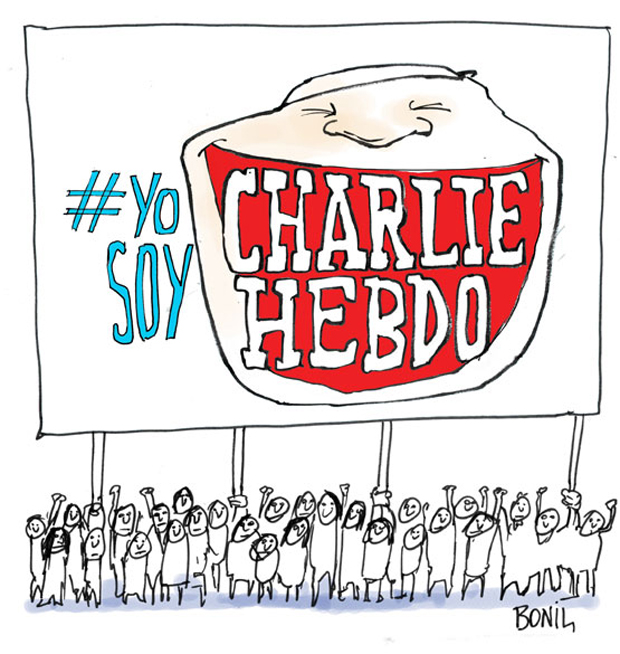
#IAmCharlieHebdo
This article was posted on 14 January 2015 at indexoncensorship.org
14 Jan 2015 | France, News, United Kingdom

When drawings being scribbled,
colours dripping red,
words being silenced,
thoughts being limited,
lives turn to nothing,
can you touch pain with politics?
Can you perceive pain with your beliefs?
Lives smeared with blood,
your loved ones lying on the ground
lifeless…
Can you hold on to reason,
and when fear like dark clouds
leaks within everyone,
and when fear feeds more fears
and when fear swells hatred
with its giant steps,
can you cure desperation with laws?
When walls are being built again
for the sake of freedom and security,
with violence and blood,
can you create peace with concepts,
when a person without blinking an eye
can kill another person,
when another can glorify death
for the sake of religion?
The moment you declare
you believe,
if the world stops turning,
if reasoning,
sensibility,
sensitivity,
goes blind against beliefs
and even a pen could be perceived as a weapon,
how can thoughts be free?
What would expressing yourself mean?
This poem was posted on 14 January 2015 at indexoncensorship.org
13 Jan 2015 | News, United Kingdom
Nadhim Zahawi is a member of the BIS Select Committee, the Party’s Policy Board and MP for Stratford on Avon. This article is from Conservative Home
You can’t kill an idea by killing people. The sickening attack on Charlie Hebdo has shown that to be true. As France mourns her dead, millions around the world are discovering the work of her bravest satirists. Nous sommes Charlie.
Unfortunately, the same is true of the terrorists. Bin Laden may be at the bottom of the sea, but his poisonous ideology lives on. As long as it inspires deluded young men to kill, these attacks will keep happening. We can’t win this fight unless we also win the battle of ideas.
This is an urgent task. Thousands of EU citizens have travelled to the Middle East to serve under ISIS’s black banner. Many will return with combat experience and carrying the virus of radicalism. Some will be eager to put their new terrorist skills to work. It’s vital that we stop them.
Our security services have an important role to play, but research suggests that the most effective way of tackling terrorism is “changing the narrative”. That means challenging the stories used by extremists to justify their twisted worldview.
First and foremost, this means rejecting the idea that this this is a clash of civilizations: Islam versus the West. The reality is that jihadists have claimed more lives in the Islamic world than anywhere else. In December last year, the Pakistani Taliban gunned down 132 schoolchildren in their classrooms. On the same day as the attack in Paris, a car bomb exploded in Yemen killing at least 38 people. Muslim-majority countries, as much as the West, have a clear interest in stamping out this ideology.
It’s time the Islamic world took a leadership position on this issue. When the news from Paris broke, countries such as Saudi Arabia, Pakistan and Afghanistan were quick to condemn the attacks. Yet all three have legal systems carrying the death penalty for blasphemy. In virtually every Muslim-majority country, publishing a magazine like Charlie Hebdo would earn you a fine or imprisonment.
These laws support the idea that religious offence is a crime to be punished rather than a price we must pay for freedom of expression. They also fuel extremist violence. In Pakistan, blasphemy charges are often levied at religious minorities on the flimsiest of pretexts. Those accused are sometimes lynched by vigilante mobs while awaiting trial. Politicians who’ve dared to speak out against the laws have been assassinated.
One of the best tributes we could pay to the brave men and women of Charlie Hebdo would be to use our diplomatic influence to get some of these laws repealed. Change won’t happen overnight, and we will have to be patient with these countries. After all, the last successful prosecution for blasphemy in Britain was as recent as 1977, and the laws only came off the statute books in 2008.
I am not arguing that we should preach to Islamic governments; but nor should we turn a blind eye to this issue. Reforming attitudes to blasphemy would send a powerful message to extremists: freedom of speech isn’t just a Western value – it’s our common birthright as human beings.
And we shouldn’t be frightened of having a conversation about religion here at home. Talking about religion doesn’t come naturally. As a culture, we ‘don’t do God’. Yet it’s vital that mainstream Muslims feel comfortable discussing their faith in public. They, not the Government, are best placed to take on the dodgy imams and self-appointed sheikhs in open debate.
The Qur’an is clear that it’s the role of Allah, not man to judge unbelievers. In the 7th Century, Ali bin Abi Talib, the cousin of the Prophet and a leader of the original Islamic Caliphate, said: “Whoever does not accept others’ opinions will perish”. There’s a sound Islamic case for freedom of expression, and it needs a good airing.
Last, we have to practice what we preach. If we want Muslims to come out and say “not in my name” every time there’s a terrorist atrocity we too need to be vocal in our condemnation of attacks on Muslims and mosques in the West.
Charlie Hebdo was a target because humour is dangerous. You can’t be the all-powerful Islamic Caliphate and be the butt of someone else’s joke. The goal of terrorism is to frighten us – so laughter is one of our most powerful weapons.
This article was originally posted at Conservative Home on January 12, 2015. It is reposted here with permission.
