26 Jan 2015 | Events, mobile
Lord Avebury, the Vice Chairman of the Parliamentary Human Rights Group cordially invites you to a press conference on:
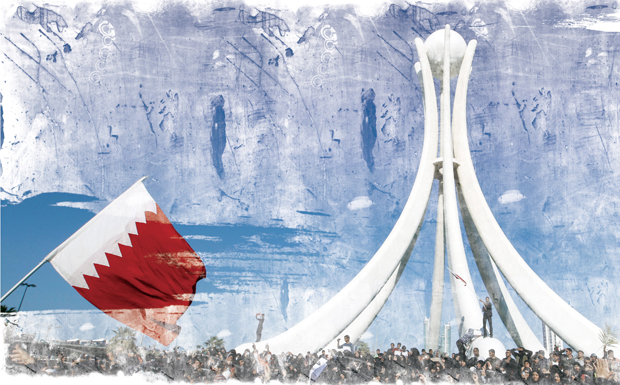
Four years of revolution: Bahrainis insist on political change
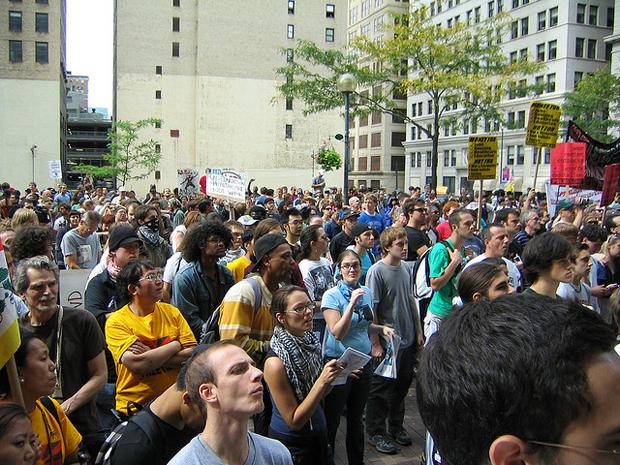
Four years ago the people of Bahrain flocked to the streets in their thousands seeking fundamental political change after decades of discriminatory rule. They were repressed by the regime which adopted reprehensible tactics including systematic torture, extra-judicial killing, and the revocation of citizenships. The UK Government has chosen to stand by the regime, turning a blind eye to its rights abuses. It is time for the UK to change direction on Bahrain starting by designating it as a “country of concern” in line with the Foreign Affairs Committee recommendations.
WHERE: Fielden House, 13 Little College Street, London SW1P 3SH
WHEN: Tuesday 10 February 2015, 11:00am
26 Jan 2015 | News, Politics and Society, Sri Lanka
Any nation’s media would be hard pressed keeping track of a landslide of political change, environmental crises, imminent constitutional reform and a general election, all while keeping safe from a generation of assassins used to impunity.
When the media itself needs reform too, the problems might seem overwhelming. This is why Sri Lanka needs a constitutionally recognised national commission to oversee that reform and ensure freedom of expression is properly defended.
Maithripala Sirisena’s unexpected and virtually peaceful election win over incumbent President Mahinda Rajapaksa was quickly painted as a game changer for the country’s media.
He and new Prime Minister Ranil Wickremesinghe began well by lifting blocks on independent news websites banned by the old regime. Exiled journalists were urged to return. Sirisena also promised to use his new authority to investigate the 2009 murder of combative political journalist Lasantha Wickrematunge, whose killers are still free.
But the early offers soon began to look token. There was no matching commitment to identify the killers of cartoonist Prageeth Eknelygoda, who went missing five years ago, or the men behind the notorious “white van” abductions of peaceful activists. In fact Sirisena’s commitment to media freedom looks somewhat qualified.
A series of special expert commissions will be established to oversee an independent review of the judiciary, police, public services, elections, human rights and anti-corruption measures, written into authority by a 19th amendment to the constitution. Pointedly perhaps, the list does not include a commission on the media.
Plans for an independent media commission are not new, and were excluded from what was eventually enacted as the 17th amendment to Sri Lanka’s Constitution in 2001. Media rights groups should steel themselves for a fight to ensure that the much-needed body is not excluded again.
Uvindu Kurukulasuriya, editor of the once banned Colombo Telegraph, thinks it unfortunate that the new government will not establish a media commission, but thinks it was deliberate. “They are not willing to transform state media into (independent) public service broadcasters, and they don’t want to broad-base (collectivise) the state owned Lake House newspaper group.”
The journalist and legal scholar Asanga Welikala calls for the founding of an independent media commission on the recommendation of the constitutional council and representing working journalists, academics, proprietors and new media.
“The commission once constituted would have overall oversight of public service media and would be answerable to parliament,” he argued for the online political journal Groundviews. “Its primary role would be to oversee the public service media institutions, but may include other powers and functions, including the regulation of the (new and traditional) media marketplace, and to promote the freedom of expression in all its forms including through new technology.”
Kurukulasuriya urges action to break the grip of the political appointees heading the country’s major public and private media companies. The co-option of the owners was the subtler side of the old regime’s system of media control, he says. “The previous Rajapaksa regime changed the ownerships of several media institutions through intimidation.”
Self-censorship drove the majority; more deadly means of censorship were reserved for the small cadres of independent journalists who could not be bought or fired, says Kurukulasuriya. Will the government go on reading “media freedom” as owners’ rights, not journalists’ rights?
Reforming the Sri Lankan media is a vast task. The counter-intuitively named Independent Television Network needs privatisation and the nominally public Sri Lanka Broadcasting Corporation (SLBC), and the Sri Lanka Rupavahini Corporation (SLRC), need a proper public service broadcast mandate and an end to political interference. A constitutionally mandated media commission could appoint and “audit” the works of a new independent broadcasting authority founded to oversee their works.
There is justice still to be found too. According to the Committee to Protect Journalists (CPJ), Sri Lanka has the fourth worst record on its 2014 Impunity Index, which spotlights countries where journalists are murdered and the killers remain free.
In an open letter to Rajapaksa on the eve of elections, Wickrematunge’s widow Sonali Samarasinghe wrote: “At no time in the history of our country has the freedom of expression so brutally been repressed as it is now. Such media as do operate in the country, have been transformed either into propaganda mouthpieces for you and your brothers, or bullied into submission.”
The state media’s job is to “reflect the line of whatever government is in power,” admitted Rajpal Abeynayake, the editor of the state-run Daily News in a memorable post-election quote to The Guardian’s Amantha Perera. “If the government changes, so does the newspaper. It’s as simple as that. If they want to change that practice they could, but so far no government has done it.”
That Sirisena is showing little inclination to substantively change matters. Bandula Padmakumara — the chairman of the Lake House newspaper group, morning news show anchor and well documented supporter of the Rajapakse family — went just a few hours after the election results came in. But few others have followed.
The new president may have to rely on established partners in self-censorship to help shore up his “fragile, sprawling and diverse” coalition, as the New York Times described it. With parliamentary elections set for late April under Sirisena’s 100 day schedule, the campaign may see old favours be called in and the media expected to help paper over the coalition’s cracks.
Without greater independence the Sri Lankan media will not be able to fairly and accurately report the campaign. International and regional media rights groups need to heap pressure of their own on Sirisena’s new media ministry secretary, Karunarathna Paranawithana, who describes himself on his Facebook page as a “diplomat, journalist (and) political activist”.
The appointment of a constitutionally recognised commission for the media next month would not do much to change the situation in time for the election, but it would send a clear message to embattled journalists that change was on the agenda and risks were worth taking.
According to Sirisena’s own strict timetable, his administration will establish the independent commissions on Wednesday 18 February. There’s still time to add one on media to the list.
This article was posted on 26 January 2015 at indexoncensorship.org
23 Jan 2015 | News
Bahrain
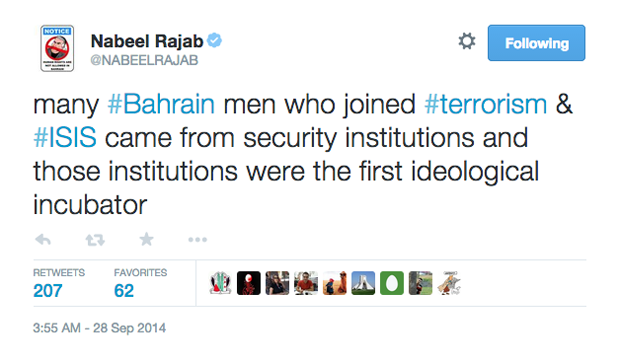
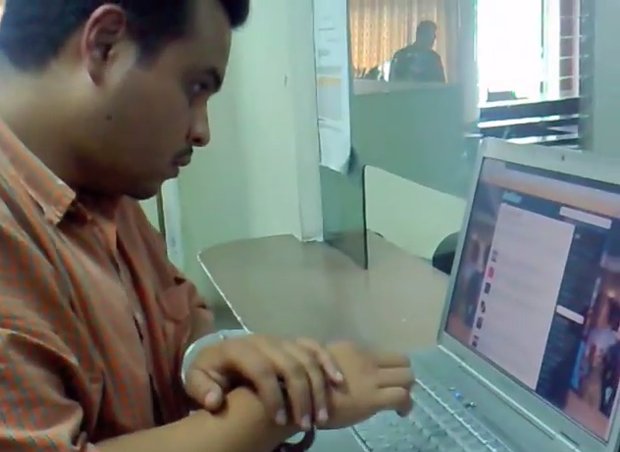
This week, prominent Bahraini human rights activist Nabeel Rajab was handed down a six month suspended sentence over a tweet in which both the country’s ministry of interior and ministry of defence allege that he “denigrated government institutions”. Rajab was only released last May after two years in prison, over charges that included sending offensive tweets. His experience is not unique in Bahrain. In May 2013, five men were arrested for “insulting the king” via Twitter.
Turkey
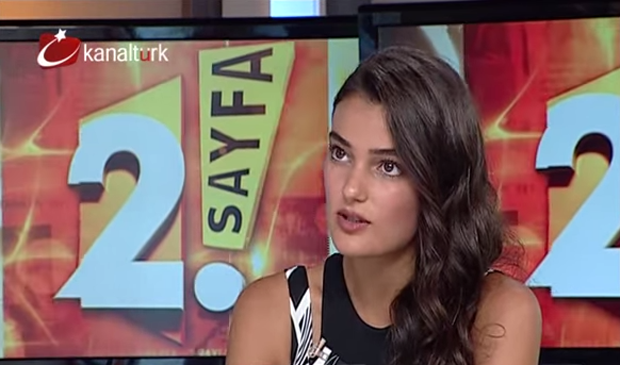
A former Miss Turkey was recently arrested for sharing a satirical poem criticising the country’s President Recep Tayyip Erdogan on her Instagram account. She is set to go on trial later this year. Turkey has a chequered relationship with social media, temporarily banning both Twitter and YouTube in the wake of the Gezi Park protests, in large part organised and reported through social media. In 2013, authorities arrested 25 individuals for spreading “untrue information” on social media.
Saudi Arabia
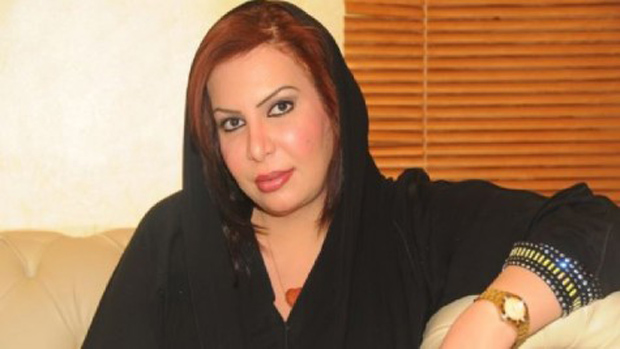
(Photo: Gulf Centre for Human Rights)
In late 2014, women’s rights activist Souad Al-Shammari was arrested during an interrogation over some of her tweets. The charges against her include “calling upon society to disobey by describing society as masculine” and “using sarcasm while mentioning religious texts and religious scholars”, according to the Gulf Centre for Human Rights.
France
![(Photo: « Source : Réseau Voltaire » [CC BY-SA 3.0 (http://creativecommons.org/licenses/by-sa/3.0)], via Wikimedia Commons](https://www.indexoncensorship.org/wp-content/uploads/2015/01/Dieudonné_Axis_for_Peace_2005-11-18.jpg)
(Photo: Réseau Voltaire [CC BY-SA 3.0], via Wikimedia Commons)
Following the series of terrorist attacks in Paris in early January, at least 54 people have been detained by police for “defending or glorifying terrorism”. A number of the cases, including against comedian Dieudonne M’bala M’bala, are believe to be connected to social media comments.
Britain
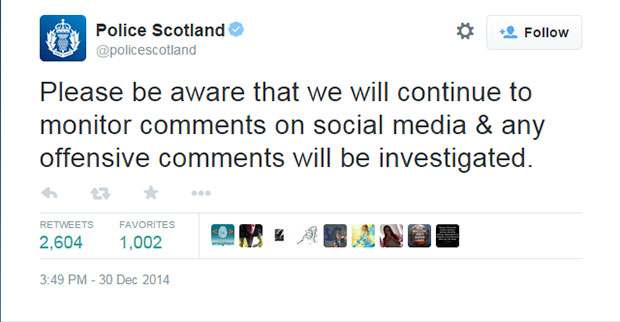
A 22 year old man was arrested in for “malicious communication” following Facebook messages made in response to the murder of soldier Lee Rigby, and another user was arrested after taunting Olympic diver Tom Daly about his dead father. More recently, police arrested a 19-year-old man over an “offensive” tweet about a bin lorry crash in Glasgow that killed six people. TV personality Katie Hopkins, known for her controversial tweets, was also reported to Scottish police following some tasteless tweets about about Scots. The incident prompted Scottish police the to post their now infamous tweet declaring they would continue to “monitor comments on social media“.
China
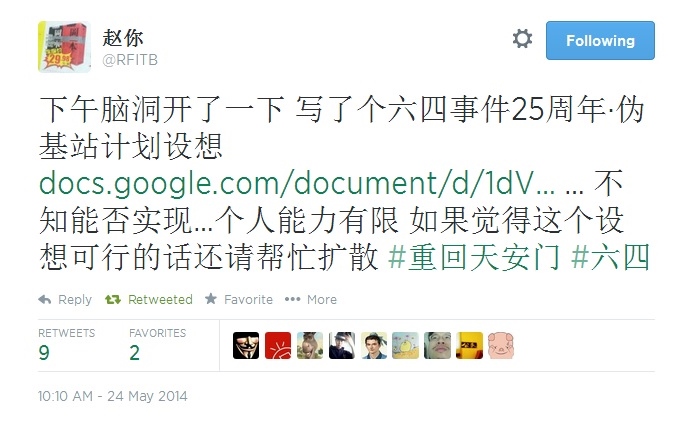
Online activist Cheng Jianping was arrested on her wedding day in 2010 for “disturbing social order” by retweeting a joke by her fiance. She was sentenced to one year of “re-education through labour”. Twitter is officially banned in China, and microblogging site Weibo is a popular alternative. In 2013, four Weibo users were arrested for spreading rumours about a deceased soldier labelled a hero and used in propaganda posters. The four were said to have “incited dissatisfaction with the government”, according to the BBC.
Australia
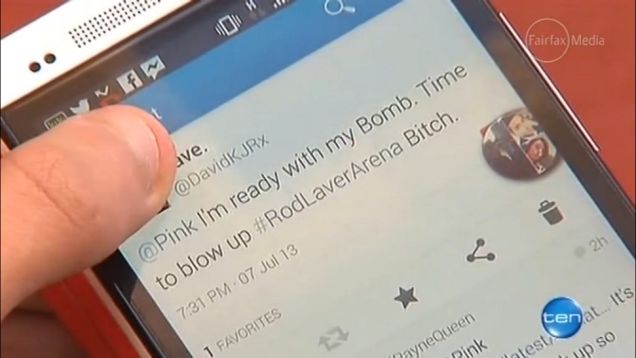
A teen was arrested prior to attending a Pink concert in Melbourne for tweeting: “I’m ready with my Bomb. Time to blow up #RodLaverArena. Bitch.” The tweet referenced lyrics from the American popstar’s song Timebomb.
India
An Indian medical student was arrested in 2012 over a Facebook post questioning why her city of Mumbai should come to a standstill to mark the death of a prominent politician. Her friend was arrested for liking the post. Both were charged with engaging in speech that was offensive and hateful.
United States
Back in 2009, a New York man was arrested, had his home searched and was placed under £19,000 bail for tweeting police movements to help G20 protesters in Pittsburgh avoid the officers. According to Global Voices, it is unclear whether his actions were actually illegal at the time.
Guatemala
A man was arrested in 2009 for causing “financial panic” by tweeting that Guatemalans should fight corruption by withdrawing all their money from banks.
This article was posted on 23 January, 2015 at indexoncensorship.org
22 Jan 2015 | Europe and Central Asia, News, United Kingdom
Does The Sun’s Page 3 still exist? The paper’s pagination remains, humble but resolute: the very best in British pagination. As surely as curry follows beer on this sceptered isle, the nation’s favourite newspaper will have a third page, facing the second page, on the reverse of the fourth. And despite what those who would disparage our way of life would want, it will always be page three.
Briefly, this week though, it seemed the tradition (est 1970), of putting a picture of a topless young woman on page three — the “Page 3 girl” — had ended. And then it came back. What’s going on? Is there a Page 3 or isn’t there? Or are we witnessing Shroedinger’s glamour shot?
The Page 3 girl was a typical product of the British sexual revolution. What started, with the availability of contraception to women in the 1960s, as a liberation, quickly became another way to reduce them. Freed from the terror of unwanted pregnancy, women and girls were now expected to be in a permanent state of up-for-it-ness. The popular films of the late 60s and early 70s, the On The Buses, the Carry Ons, the Confessions…, portrayed British society as a parade of priapic middle-aged men, always attempting to escape their middle-aged, old-fashioned wives, in pursuit of seemingly countless, always available, young women.
It was fun, it was cheeky, it was vampiric — depending on how you wanted to look at it.
Page 3 was part of this culture; this idea that sweet-natured young women with absolutely no qualms about sex were out there, just needing a wink and a Sid James cackle to persuade them into a bit of slap and tickle. Slap and tickle, though, is not the same as sex, or at least not sex as we might hope to understand it. The slap and tickle of the British imagination owes more to the pre-pill “sort of bargaining” described by Philip Larkin. In spite of the poet’s hopes, sexual intercourse hadn’t really begun in 1963.
Page 3 models were (are? Who knows?) very rarely erotic creatures. They were “healthy” and “fun”, perhaps a little “naughty”; always girls and never women.
The phenomenon survived the attentions of feminist campaigns of varying strengths. Page 3 perhaps peaked in the 80s, when it was possible to move beyond the tabloids to become an actual star, even with clothes on (80s Page 3 icon Sam Fox is still, apparently, in demand as a singer in eastern Europe). This, ironically, coincided with an era of politically correct criticism of Page 3 led by senior Labour MP Clare Short.
In the 90s, new laddism, spearheaded by James Brown’s Loaded magazine, somewhat rehabilitated the Page 3 girl, or, more accurately, made looking at topless models seem respectable to men who would never buy the Sun (“men who should know better” as Loaded’s tagline went).
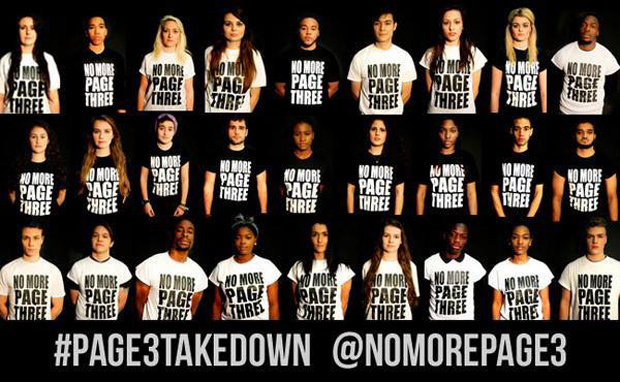
As the post-Loaded rush for young men’s money descended into boasting of nipple counts, the focus of feminist campaigning switched to the weekly Nuts and Zoo magazines. The Sun’s Page 3 carried on, outliving the rise and fall of Nuts (somehow, Zoo is still going), but is now taking a severe battering from the No More Page 3 campaign, led by young feminists. The very fact that there is uncertainty over the future of the feature is testament to that campaign’s success.
It would be easy to look for a free speech angle on this and come up with “killjoy feminists” versus, decent honest yeomen of England.
But it would be false. In truth, what we have here is an example of how free speech works. The No More Page 3 campaign, as it has pointed out, has a right to call for an end to something they don’t like. They make the argument, they are criticised, and that’s absolutely fine. No one gets hurt, no one goes to court, no one tries to pass a prohibitive law (yet).
Meanwhile, there are some half-hearted defences floating around, mostly attempting to claim that Page 3 is a PROUD BRITISH INSTITUTION, like ugly dogs or barely suppressed tears.
“Tradition!”, the defenders shout, like a legion of leery, thigh-rubbing Topols. The Daily Star, which runs pictures of topless women on its own Page 3, but has escaped the ire of campaigners for the fundamental reason that no one really cares what’s in the Daily Star, proclaimed: “Page 3 is as British as roast beef and Yorkshire pud, fish and chips and seaside postcards. The Daily Star is about fun and cheering people up. And that will definitely continue!”. But really, it all seems a bit half-hearted.
Fundamentally, this week’s wind-up aside, The Sun’s topless Page 3 will cease to exist because people don’t really want it to exist, and no one can really think of a good reason for it to exist.
It’s not censorship, or prudishness, that will eventually kill Page 3. We’ve moved on, regardless of what the editors of The Sun do or say. It’s not them; it’s us.
This article was posted on 22 January, 2015 at indexoncensorship.org.