21 Jan 2015 | News, United Kingdom
Cressida Brown is the artistic director of Offstage Theatre. The views presented in this guest post are the author’s own.
I have been asked to write about why I decided to initiate Walking the Tightrope, and explain why I think a project exploring how politics and art interact is important and urgent now.
The answers to both those questions lie in the very experience I have had in putting on this festival of strongly opinionated plays which touch on art censorship, cultural boycott, offensive art, and accusations of racism. Throughout I have genuinely felt as if I am walking a tightrope. And now, in the wake of the Charlie Hebdo attacks, this feels more so than ever.
Nerve racking questions have stayed unanswered; Should I censor a play about art censorship if it is offensive? Might it offend people? How can I make sure we get a balanced sense of opinions? Is it possible to be neutral hosting these explosive plays? How can I get a debate going but avoid a backlash? How do I make sure I don’t get anyone in trouble, including myself?
The fact freedom of expression seems so complicated to negotiate at the moment is exactly why I think we should raise it.
Last summer I did not feel so cautious when I posted the question “How can this be seen as anti-Semitic?” on to my Facebook timeline. I was referring about the Tricycle Theatre offering to replace Israeli funding of the Jewish Film Festival. I assumed that everyone I was friends with, especially those who were in the arts, would agree with me.
A couple of hours later my page had exploded in over 60 warring comments about the Tricycle but also about the Underbelly decision to cancel an Israeli government funded show.
And then I did something that triggered my eventual decision to initiate this festival. I deleted the entire 60 strong thread from my wall. I had worried how my opinions might be regarded by others. Or whether my politics were going to affect my relationships in the art community. I had self-censored.
Hot on the heels of the Tricycle came the Exhibit B affair. It suddenly started to seem very unwise to post a political view online about what an art venue should or shouldn’t do.
Why was I so worried about others seeing my opinions? Shouldn’t this be what art is about, passionately asserting an opinion? Why had I never found out what my peers opinions were on these topics before? How had I never realised what a thorny and perhaps paradoxical thing Freedom of Expression can be? Why was it that it took 3 controversies hot on the heels of one another for me to begin to ask these questions to myself? Why should it only be in the heat of the moment that I debate these issues with my peers? Why did that debate initiate online and not in person?
I am well aware how explosive this subject can be, and also that it may explode in a very bad way directly back onto me. However I have dedicated my life to this industry, I need to unpack what happened. I can’t have this debate by myself. Now, with some distance from the events of last year, I have decided to do this the only way I know how: theatre.
During this event’s shared experience, the audience responses are just as important as the artists’ vigorous plays. The post show discussions are geared towards replacing a fury of warring tweets with facilitated conversation on Freedom of Expression. The plays are meant to offer a springboard for the post show discussions to leap from. By the end of these festivals I want all of the audience to have listened and experienced greater understanding of their opponents, and considered positions they had never perhaps done before.
Several months have passed since those particular triggering events. I had wondered at times whether the conversation would still be relevant at the beginning of 2015, which seems now like a ridiculous concern. As I write the Charlie Hebdo attack has created solidarity across the world in the defense of free expression and society is left with a mine field of explosive commentary and grief. In other recent news American director Ari Roth has been fired for ‘insubordination’, BP have been told to reveal their funding of the Tate, and Sajid Javid announced his opposition to cultural boycott.
Who knows how these other controversies will have unfolded by the time we are actually performing these plays in front of you…
My hope however is, is that we will continue to meet these controversies with a renaissance in political theatre, discussing liberty through live, tangible art and conversation.
This guest posted was published on 21 January 2015 at indexoncensorship.org
21 Jan 2015 | Azerbaijan, Azerbaijan Letters, Campaigns, Germany, Statements
Chancellor Angela Merkel
Bundeskanzleramt
Willy-Brandt-Straße 1
10557 Berlin
Madam Chancellor,
As members of the international NGO coalition ‘Sport for Rights’ we are appealing to you to make human rights a central subject in your meeting next Wednesday, 21 January 2015, with president Ilham Aliyev of Azerbaijan.
In recent years, space for political activity and for civil society and journalism in Azerbaijan has gradually been curtailed, and the last six months in particular have witnessed a severe and unprecedented crackdown, with dozens of civil society activists and journalists serving or awaiting sentencing. The country’s most prominent investigative journalist and a number of leading human rights defenders are in prison, punished for their criticism of government policies. Sham charges such as ‘tax evasion’ are used to justify the criminalization of fundamental rights and freedoms.
The ‘Sport for Rights’ coalition has been established to raise this issue in the context of the forthcoming international sporting events to be hosted by Azerbaijan. Against a backdrop of systematic state-sponsored repression, these events will fail to reflect the spirit in which they were established. The next major sporting event is the Baku European Games, designed and regulated by the European Olympic Committees, scheduled for June 2015. A policy shift by the Azerbaijan towards an open society is urgently required if these Games are to be a success. Human rights defenders and journalists must be released, and we urge you to emphasize this point in your conversations with President Aliyev.
This issue is all the more important given that Azerbaijan is a member of the European community of nations: the country is a member of the Council of Europe (CoE), and part of the EU’s Eastern Partnership Initiative. By ratifying the European Human Rights Convention, Azerbaijan has made a commitment under international law to respect the fundamental freedoms contained therein. CoE officials have repeatedly called attention to Azerbaijan’s failure to uphold these freedoms for its citizens. In his retrospective on 2014, Nils Muiznieks, the CoE Human Rights Commissioner, declared:
One of the most difficult situations I have observed is in Azerbaijan, where the authorities are engaging in a systematic crackdown on human rights defenders, media professionals and civil society partners of the Council of Europe. The number of those in detention there or in exile continues to grow.
President Aliyev may point to token releases that take place from time to time – but please remember that not only are these rare, they are issued only after innocent people have served time in prison, losing months and years of their lives for exercising their basic rights to freedom of expression and association.
Among those unjustly arrested or convicted in 2014 are:
- Anar Mammadli and Bashir Suleymanli, co-founders of the Election Monitoring and Democracy Studies Centre – Mammadli and Suleymanli were arrested on 16 December 2013 and then sentenced to 5.5 and 3.5 years respectively in May 2014, following outspoken criticism of Azerbaijan’s presidential elections in October 2013. On 29 September 2014, Mammadli was awarded the Václav Havel Award for Human Rights by the Parliamentary Assembly of the Council of Europe.
- Leyla Yunus, Director of the Azerbaijan Institute of Peace and Democracy – Yunus was arrested on 30 July2014, and has remained in pre-trial detention since then, despite serious concerns about her health. She was awardedthe 2013 Theodore Hecker Award in Esslingen-am-Neckar “for her self-sacrificing contribution to the protection of human rights and civil freedoms in Azerbaijan.” Her husband Arif Yunus, Head of the Department of Conflict and Migration Institute of Peace and Democracy in Azerbaijan, Ph.D., a historian specializing in conflict studies, was arrested on 6 August 2014.
- Rasul Jafarov, one of the initiators and coordinators of the “Sing for Democracy” (2012) and “Art for Democracy” (2013) campaigns – Jafarov was arrested on 2 August2014 and has remained in detention since. His trial began on 15 January 2015.
- Intigam Aliyev, human rights defender and lawyer – Aliyev was has been in detention since his arrest 8 August 2014. In his capacity as a lawyer he has specialized in defending rights of citizens in the European Court of Human Rights. At the time of his arrest, he was dealing with over 100 cases pending before the Court.
- Khadija Ismayilova, investigative journalist; radio host for Radio Free Europe/Radio LibertyAzerbaijani service; member of the Organized Crime and Corruption Reporting Project – Ismayilova was arrested on 5 December 2014.
We ask you to unequivocally remind Azerbaijan of its obligations under the European Convention on Human Rights. Azerbaijan’s partners should insist that this terrible stainon the country’s human rights record is removed before Baku plays host to the European Games, and that these people be released immediately and unconditionally. Full execution of European Court of Human Rights should also be requested from Azerbaijan in this regard, aiming at amending legislation criminalising human rights defenders in line also with recommendations of the CoE Venice Commission.
We sincerely hope that we can count on your principled leadership on this urgentmatter. We thank you for your attention to the concerns set forth herein.
NGO coalition “Sport for Rights”, including:
- Centre for Civil Liberties (Ukraine)
- Helsinki Foundation for Human Rights (Poland)
- Index on Censorship (Great Britain)
- International Partnership for Human Rights (Belgium)
- Netherlands Helsinki Committee (The Netherlands)
- Norwegian Helsinki Committee (Norway)
- People in Need (Czech Republic)
- Platform (Great Britain)
- Youaid Foundation (Poland)
- A group of civil society activists from Azerbaijan who wish to remain anonymous out
of concern for the security of their family members
20 Jan 2015 | Bahrain, Campaigns, News, Statements
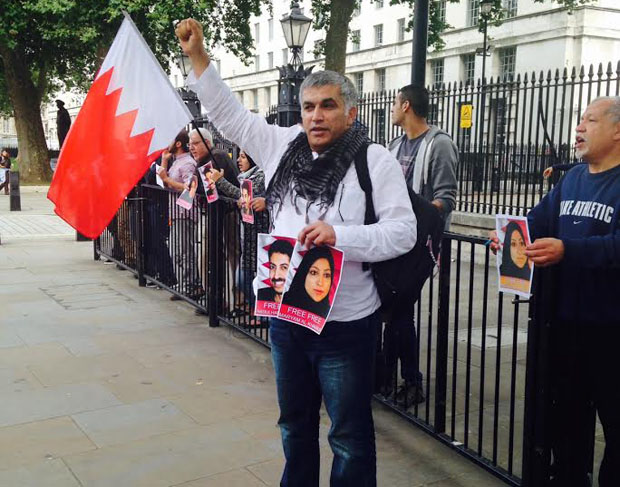
Nabeel Rajab during a protest in London in September (Photo: Milana Knezevic)
Human rights campaigner Nabeel Rajab was sentenced to six months, which would be suspended pending a fine, Rajab’s lawyer told the BBC.
Rajab has been granted bail while he appeals the verdict in his case.
In October a court ruled that Rajab would face criminal charges stemming from a single tweet in which both the ministry of interior and the ministry of defence allege that he “denigrated government institutions”. Rajab could have faced up to six years in prison.
“Nabeel Rajab has been sentenced for doing nothing more than exercising his right to express an opinion. We condemn the actions of the Bahraini authorities – whose foreign minister marched in Paris to defend freedoms that Bahrain denies the people in its own country. We urge the UK and other allies of Bahrain to join us in calling for this sentence to be overturned,” Index on Censorship CEO Jodie Ginsberg said.
In a visit to the Index on Censorship offices in September, Rajab campaigned on behalf of then-detained Maryam Al-Khawaja and spoke about the human rights situation in Bahrain.
19 Jan 2015 | Events
Presenting the world premiere of a collection of 12 explosive political five minute plays by writers including Mark Ravenhill, Neil LaBute and Caryl Churchill.
Arising from events and decisions relating to The Underbelly and Incubator Theatre’s The City, Exhibit B and the Barbican, and The Tricycle Theatre.
Each performance will include all twelve five minute plays and a lively post-show discussion exploring freedom of expression in UK arts today. Engage in discussion with the commissioned writers and a range of free expression advocates .
The post-show debate on on Friday 30th January will feature Index on Censorship CEO Jodie Ginsberg.
WHERE: Theatre Delicatessen, London, EC1R 3ER
WHEN: Monday 26th – Saturday 31st January, 7:30pm & Sat Matinee
TICKETS: £15 / £12 – available here
This event is produced by Offstage Theatre, in association with Theatre Uncut, and supported by Index on Censorship and Free Word.
