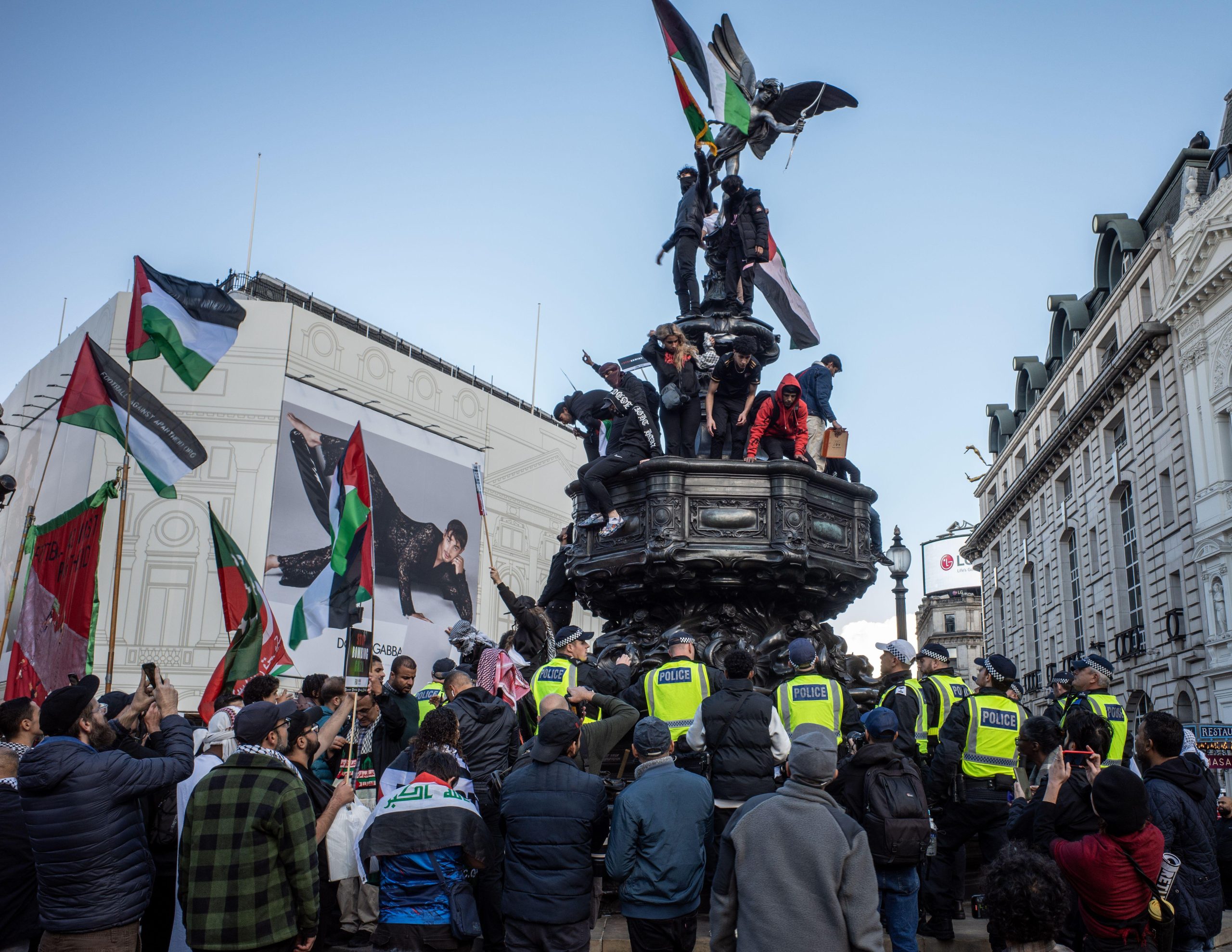
Since the shocking attacks on members of the Jewish community in Golders Green, north London on Wednesday, there have been calls to ban future marches in support of Palestinians, including from Jonathan Hall KC, the independent reviewer on terrorism legislation. It sounds like a reasonable demand. There have been expressions of antisemitism on these marches and political slogans are often chanted that many believe to be antisemitic, such as “From the river to the sea, Palestine will be free” as well as the phrase “Globalise the intifada”, which has led to arrests for stirring up racial hatred and which the prime minister described as “extreme racism” following the attacks.
However, this proposal is unwise for a number of reasons. The Jewish community needs protection, but so does the right to protest. It was significantly eroded by the last Conservative administration and Keir Starmer’s Labour government has already displayed an authoritarian zeal to limit free speech, including new powers that will allow police to put conditions on repeat protests, which became law in April. While this demand for a ban may appear to be targeting hate speech, and in this case specifically antisemitism, it would prevent legitimate and necessary protest. More than 70,000 Palestinians have been killed in Gaza since 7 October 2023 and settler attacks in the West Bank have resulted in multiple deaths and thousands of Palestinians being displaced from their homes. Protest is an essential means of demonstrating public outrage at these events and solidarity with Palestinians.
Nor will banning marches diminish the alarming growth in antisemitism, which has become normalised since 7 October. I have myself witnessed a new licence in disparaging Jews and Judaism in public life to a degree that I have never previously observed. It is as if a taboo has been broken. No distinction is made between the actions of Israel and a diaspora minority – not only by the individuals who commit these acts of violence, but even by apparently peace-loving people who would consider themselves to be opposed to racism.
This attitude towards Jews has a long history. The belief that the Jewish people are intrinsically evil and out to undermine society dates back to medieval times in England, when they were the most visible minority in the country. That connection between Jews and wrongdoing is so deeply ingrained in our culture (from Chaucer through to Shakespeare, Dickens and Roald Dahl) that anti-Jewish feeling is easily triggered. So, when the Jewish state commits war crimes, it’s the ancient, irrational charges that surface once again: Jews as bloodthirsty child killers seeking to control the world. That’s why the distinction between Jews and Israel is so readily blurred.
You don’t stamp out that deep cultural antipathy by banning a march. Instead, you marginalise Palestinians, who are in essential need of international support. You undermine a fundamental democratic right and you fail to address the root causes of antisemitism.
You also deny the possibility for a nuanced discussion. I have sympathy with fellow Jews who feel that the chants on marches are hostile and racist. But “Globalise the intifada” and “From the river to the sea, Palestine will be free” are political slogans open to interpretation. The Arabic word intifada, or shaking off, is an expression of rebellion against Israeli occupation that dates back nearly 40 years. After nearly 60 years of oppression, supporters of Palestinians have every right to call for it in solidarity. Likewise, “From the river to the sea” could be interpreted as a legitimate call for self-determination or for a one-state solution, which an increasing number of Jews are now calling for too since there is no possibility of a two-state solution in sight.
We need to have the courage and vision to support the Jewish community without destroying a fundamental and necessary right. It is Jews who will ultimately be harmed too, as members of the UK population, if the right to protest is further eroded.