25 Feb 2025 | Asia and Pacific, Australia, News
Petrina Harley likens direct action to giving birth.
“My body knew it had a job to do, so I got on and focused on my inner strength,” the 53-year-old mother of two told Index via phone from Perth. “I find it really empowering.”
Harley is a climate activist of eight years facing trial in June for repeatedly blocking entry to Australia’s biggest gas hub to be built in a decade, a AU$16.5 billion ($10.35 billion) project in the Pilbara on the Burrup Peninsula of Western Australia (WA) by sector giant Woodside.
It may come as a surprise to some, but not to Harley, that new research from the University of Bristol released in December showed that Australia is now the world’s top country for arresting climate and environmental protesters.
“I’ve been arrested four times now,” said Harley. Alarmingly, arrest is now a common response in 20% of all climate and environmental protests in Australia, with the international average being 6.3%.
This is also part of a broader crackdown in the country, where new measures in the state of Victoria purportedly aimed at tackling recent cases of anti-Semitism could be used to target climate protesters, human rights lawyers have now warned.
There’s particular concern that a potential ban on “lock on” devices such as glue, chains or locks, could be used to take aim at environmental campaigners. Similar laws have been announced in New South Wales (NSW).
“The arrests [in Australia] are one dimension of criminalisation,” said Oscar Berglund, senior lecturer in International Public and Social Policy in the School for Policy Studies at the University of Bristol.
“There have also been multiple new anti-protest laws passed. What we are seeing currently is an intensifying criminalisation of protest in both democratic countries and less democratic countries.”
Harley, who began protesting after she had children, said that she had tried “everything under the sun” including running for the Senate in the lower house with the Socialist Alliance party, holding weekly stalls in town and gathering petitions, before she took part in two blockades in WA.
In the first one, in November 2021, Harley and another Scarborough Gas Action Alliance activist, Elizabeth Burrow, used a caravan to obstruct entry to the Woodside project. The activists bonded their arms into a concrete drum inside the vehicle. Harley was “locked on” for 16 hours. When she refused to move, she was arrested in the caravan and after being taken to hospital for injuries locked up overnight and charged. Harley said it was “complete overreach” by police.
The pair pleaded not guilty and used an emergency defence – normally reserved for cases like murder – arguing that the activities of Woodside are directly putting lives at risk. In 2023 they were found guilty by a magistrate’s court in Karratha in the Pilbara region of failing to obey an order given by an officer, obstructing public officers, and unreasonably obstructing or preventing the free passage on a path or carriageway.
They received a six-month community-based order, with a requirement to complete 100 hours of community service and were also handed a $600 fine each. Police initially sought more than $33,000 in compensation from the activists for removing them from the caravan, but this application was later dismissed.
Last July, Harley and another activist, Emma, a high school student, used a car and a boat to block the only access road to the same project, in a bid to stop its operations. Harley was “locked on” for 12 hours. She is now facing three obstruction charges over this.
At her trial in Perth in June, she will again plead not guilty using the extraordinary emergency defence.
“I’m very excited, I’ve got a really ethical lawyer who’s keen to test the case because it would be a precedent,” Harley said. “People have tried it before, but no one’s actually won. I’ve got some very high-profile witnesses to testify.”
David Mejia-Canales is a Sydney-based senior human rights lawyer at Australian group Human Rights Law Centre (HRLC). He said that an analysis of two decades’ worth of anti-protest legislation in Australia from 2003 onwards found that out of 49 pieces of legislation introduced, most target environmental protesters in the streets, at mines or logging sites. But laws are broad and vague despite peaceful protest being protected under international law.
“In Australia you just have to look out the window to notice that the climate crisis is getting worse and the thing that our governments are appearing to do is to jail climate protesters instead of actually doing anything that is meaningful and quick and long lasting about this,” said Mejia-Canales.
He said HRLC wasn’t aware of any activists in Australia who have been acquitted on an emergency defence. But framing the necessity defence (breaking the law to prevent greater harm) as an “extraordinary emergency defence” could allow protesters to use the growing acceptance of climate change as an emergency that requires urgent attention, he said.
However, just last week a climate activist in Melbourne was told that he cannot rely on evidence from climate experts following charges relating to an Extinction Rebellion protest.
Mejia-Canales said that Australia urgently needs a Human Rights Act, which could be crucial for climate activists, reinforcing arguments that their actions seek to uphold fundamental rights rather than merely disrupt public order.
A WA government spokesperson told Index: “Everyone is entitled to protest peacefully in WA, however police will respond to violent or threatening behaviour.”
Index approached the minister for climate change and energy for comment, but did not receive a reply.
Woodside said that it supported respectful debate. But it said acts intended to threaten, harm, intimidate or disrupt employees, their families or any other member of the community going about their daily lives “should be met with the full force of the law”.
Read more: UK journalists fall victim to new police tactics
29 Oct 2021 | About Index, Australia, News, The climate crisis, Volume 50.03 Autumn 2021, Volume 50.03 Autumn 2021 Extras
The bushfires that tore across Australia in the summer of 2019-20 left in their wake 18 million hectares of scorched land. A total of 33 people – including nine firefighters – lost their lives, and close to 3,500 homes were razed to the ground. Ecologists calculated that as many as one billion animals perished in the fires, while economists estimated the cost of recovery at an unprecedented AU$100 billion.
Faced with tallies of destruction too big to comprehend, Australians cast about for clarity on why this disaster was unfolding, and how it could be prevented from happening again the future. Conveniently, there was a living culture with 65,000 years of experience in caring for the country to turn to for answers.
The fires precipitated a sudden torrent of interest in traditional Aboriginal land management techniques. First Nations rangers, practitioners and traditional knowledge experts – so rarely afforded time on the airwaves – were widely consulted on national television and radio shows. For many Australians, it was their first time hearing about “cool burning” and “fire-stick farming”: traditional methods of burning patches of bushland at low temperatures to clear the undergrowth without damaging root systems and curtail the risk of out-of-control bushfires in the arid heights of summer.
Yet these practices are ancient. They’ve been passed down through generations of Aboriginal Australians, forming part of the symbiotic relationship that First Nations people have with the environment as custodians of the land.
“Think of it like this: an Aboriginal man 300 years ago didn’t have to worry about handing a climate emergency on to the next generation,” said indigenous cultural educator and Wiradjuri man Darren Charlwood.
“What they were handing on to their children was an understanding of how to survive, how to respect their country, how to respect their ancestors in doing so, and how to practise all this through land management, through ritual, through their interactions within their social organisation and systems.”
While the unprecedented interest in traditional knowledge from the media, the government and conservation organisations was undeniably welcome, for educators such as Charlwood – who works for Sydney’s Royal Botanical Gardens and the New South Wales government’s National Parks and Wildlife Service – it was also frustrating.
“If that sort of engagement had come into play a lot earlier, we probably wouldn’t have had as big a catastrophe as we did,” he said. “Traditional fire management is wonderful, and it can really help with the plight of our environment in Australia. But, mind you, this was a climate catastrophe. Traditional land management would have saved only so much. The bottom line is the climate is changing.”
The consultation-after-the-fact that occurred in the wake of the 2019-20 bushfires is symptomatic of a more troubling “selective listening” that Australia’s First Nations people encounter across the political spectrum – from the prime minister’s office to the halls of local government – especially on land and environment issues.
It’s something that Yvonne Weldon, Australia’s first Aboriginal candidate for Lord Mayor of Sydney, is looking to change.
For Weldon, the principle of inclusion is at the core of an indigenous approach to leadership and environmentalism. It’s a value she places at the heart of her campaign.
“Inclusion is who we are as First Nations people,” she said. “Our ability to be inclusive – to hear what others are saying and act with sensitivity to their existence – is how we have been able to survive.”
She added that the same logic applied to the environment. “Prior to Invasion we didn’t have polluted parts of our country. We didn’t take any more than was needed. Whatever ecosystem you were a part of, you had to live in harmony with it. You didn’t do it at the expense of other living things.”
Reaching for the top
Weldon and her team at Unite for Sydney launched their campaign at Redfern Oval in May, nearly 20 years after then-prime minister Paul Keating’s historic Redfern Speech, where he recognised the impact of dispossession and oppression on First Nations peoples, and called for their place in the modern Australian nation to be cemented.
“It’s about creating moments that represent a landmark for inclusion,” explained Weldon. “And, hopefully, those moments happen closer and closer together in time until inclusion is no longer the exception, it’s commonplace.”
Weldon is a proud Wiradjuri woman who grew up in the inner-city suburb of Redfern, Sydney. With 30 years of experience as a community organiser and campaigner, she has spent her adult life advocating for the disadvantaged. She is a board member of Domestic Violence NSW and Redfern Jarjum College – a primary school supporting Aboriginal and Torres Strait Islander children needing additional learning support – as well as deputy chair of the NSW Australia Day Council. She’s also the first Aboriginal person to run for the top job at the City of Sydney Council.
“To me, the fact that I’m the first Aboriginal person to run for Lord Mayor of Sydney in 2021 is insulting,” she said. “It’s an insult because it hasn’t been done before in this country, and yet we think we have progressed.”
Running on a platform of effective climate action, genuinely affordable housing and better community engagement, the campaigner-turned-candidate sees plenty of opportunities for improvement.
“True leadership has to be inclusive of all, and what I’ve seen in local government has fallen way short of that.”
She realised she had to take a run at the job after six years as elected chair of Sydney’s Metropolitan Local Aboriginal Land Council (LALC) – an organisation set up by law to advocate for the interests of local Aboriginal people in relation to land acquisition, use and management.
In her experience, representatives of the City of Sydney Council have chosen to engage only when it suits their purposes, and either reject proposals for meaningful change out of hand or use inordinate process as a way of keeping them in check.
It’s an all-too-familiar story in Australia, where the government has been unwilling to reach a treaty with its indigenous people comparable to those of New Zealand, Canada or the USA.
Aboriginal calls for recognition were formalised in 2017 with the Uluru Statement from the Heart, which called for a First Nations Voice enshrined in the constitution, and a treaty to supervise agreement-making and truth-telling with governments.
But the historical consensus was rejected outright by then-prime minister Malcolm Turnbull and denigrated by the deputy prime minister, Barnaby Joyce, who called it an “overreach”.
Following a 2018 parliamentary inquiry which found the Statement from the Heart should indeed be enacted, the current Australian government has delayed plans to introduce relevant legislation until after the next federal election in 2022.
A long fight
The application of “selective listening” to First Nations calls for autonomy over their own land is, historically speaking, one of the foundations that modern Australia was built on.
“The damage that’s been done to Australia over 250 years of not respecting indigenous people or knowledge… you can really see it in our environment, it’s very much on show,” said Charlwood. “Because of the way that people have introduced invasive animals and plants to Australia, because of practices like mining and the way people engage with the landscape here, Australia has lost more wildlife in a shorter time than anywhere else on Earth.”
According to Heather Goodall – professor emerita of history at the University of Technology in Sydney – there is historical evidence that Aboriginal people in New South Wales made efforts to secure broad tracts of land where they could feel a sense of safety and belonging, access sites of cultural significance and act as custodians for the environment as early as the 1840s, when the first “reserves” were established.
Despite a movement which involved direct action, writing their own petitions and recruiting sympathetic white men to convey their demands to authorities, Aboriginal people were gradually moved to government-delineated reserves, missions or small parcels of land for agricultural use.
“Consultation is often about seeking opinions which will be used to justify a decision that has already been made. It’s a very hard-to-define term that often doesn’t mean having decision-making power,” said Goodall.
That’s a sentiment Weldon can relate to. “Aboriginal people are not one people – there are hundreds of different nations and tribes and clans all across the country,” she said.
“Bearing in mind the diversity of Aboriginal Australia, often what people in power do is if they don’t want to hear what one group has to say, they’ll go to another group until they find someone to say what they want to hear. I call it ‘shopping around’.
“They’ll play people off each other, they’ll offer little crumbs, they’ll do all these types of things because that’s the colonial viewpoint. It’s about creating the notion that you’re open and inclusive, when actually you’re orchestrating it all for self.
“Sydney represents ground zero, where the impact of colonisation began,” she added. “But you can’t talk about reviving or respecting traditional knowledge if you’re not inclusive of First Nations people.”
As another generation of Aboriginal Australians stands ready to share knowledge and lead the way to a more sustainable future, the question remains whether other Australians are ready to listen – and ready to vote.
21 Oct 2019 | Awards, Campaigns -- Featured, Fellowship, Fellowship 2019, Statements
[vc_row][vc_column][vc_column_text]
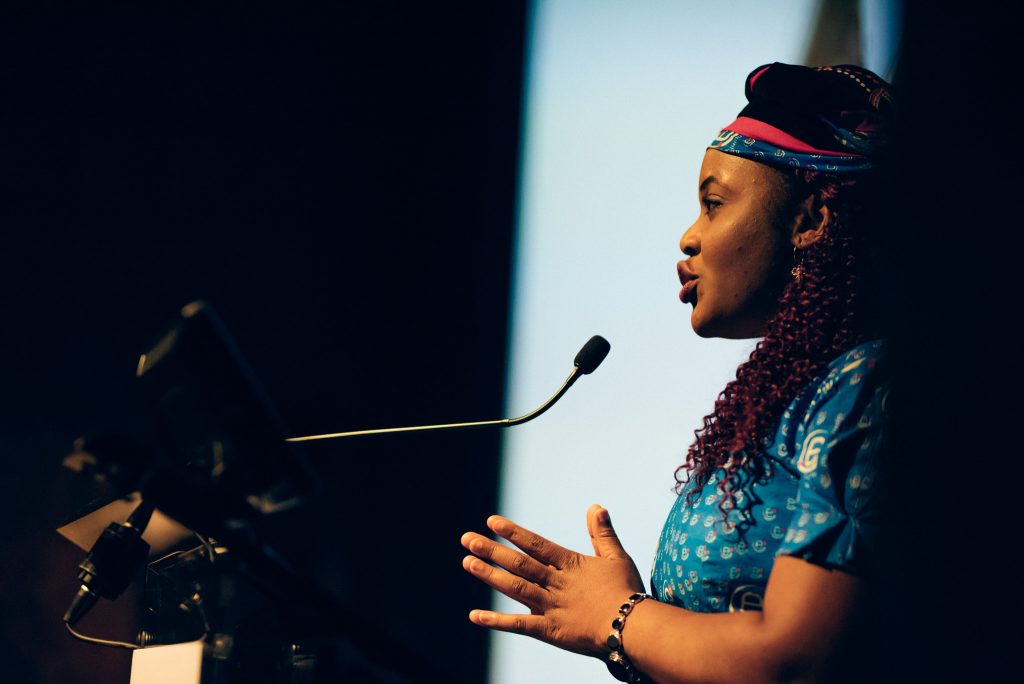
Journalism award-winning journalist Mimi Mefo (Photo: Elina Kansikas for Index on Censorship)
Mimi Mefo, winner of this year’s Index on Censorship Freedom of Expression Award, is due to give a keynote speech at the Integrity 20 conference in Brisbane. The conference, hosted by Griffith University, is an internationally renowned event bringing together the world’s leading thinkers and activists to discuss global issues.
Mefo is due to speak on Friday October 25 on media freedom and the challenges she faces as a journalist in Cameroon.
Her visa was refused because authorities said they “were not satisfied that the applicant’s employment and financial situation provide an incentive to return.”
Mimi – who flew to London in July from Berlin to speak as the guest of the UK government at a major global conference on media freedom – is currently working as a freelance journalist in Germany.
“Australia prides itself on its democratic values, including freedom of expression,” said Index on Censorship chief executive Jodie Ginsberg. “This means it needs to support and champion those being denied the right to speak in their own countries. Denying visas to journalists who have faced oppression and censorship in their own countries simply emboldens the oppressor.”
“It is frankly insulting and belittling to suggest Mimi Mefo would use the opportunity of this keynote to seek asylum in Australia.”
Mefo is due to fly from Australia straight to give the prestigious Carlos Cardoso memorial lecture at the 15th African Investigative Journalism Conference in South Africa on October 28, where Nobel Prize-winning economist Joseph E. Stiglitz will give the keynote.
Contact: Joy Hyvarinen, head of advocacy, [email protected] + 44 (0)20 3848 9820[/vc_column_text][/vc_column][/vc_row][vc_row][vc_column][vc_basic_grid post_type=”post” max_items=”4″ element_width=”6″ grid_id=”vc_gid:1571649254262-2677266b-c9f9-2″ taxonomies=”8935″][/vc_column][/vc_row]
