2 Aug 2019 | About Index
Summer is here! As Index gets its tent ready for another festival this weekend, I wanted to share some highlights from the past few months and give you a sneak peek of what we have in store for the autumn.
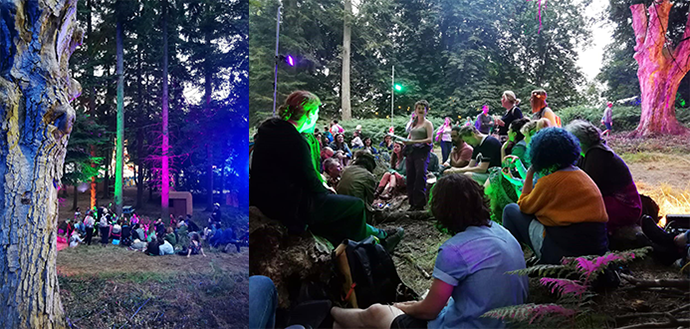
Above right, Jemima Foxtrot performs at Latitude Festival.
This Friday, we’ll be gathering festival goers around the campfire for a series ofuncensored folk tales at the Cambridge Folk Festival, where we are this year’s talks partner. Cambridge comes hot on the heels of our story-telling sessions at Latitude where writers including Scarlett Curtis, Max Porter and Jemima Foxtrot entertained crowds with wild stories.
Speech of a different kind was in focus at a talk earlier in July when UN rapporteur David Kaye discussed the thorny question of who polices speech online. Our magazine launch and summer party at the Goethe Institut, with German crime writer Regula Venske, was also a chance to reflect on the ways censorship creeps up to become authoritarianism.
Other events included two special talks in London and at the Hay Festival to mark the 30th anniversary of the Tiananmen Square killings. Speakers included authors Xinran and Karoline Kan, journalist Tania Branigan and academic Jeff Wasserstrom.
China will be in focus again in October when we have an exclusive screening of the film China’s Artful Dissident, which features the work of leading political dissident cartoonist Badiucao. Badiucao, who revealed his identity earlier this year after years of anonymity and who is flying from Australia to attend, will be in conversation with cartoonist Martin Rowson after the film. This is an invitation only event. Please email [email protected] if you would like to attend.
At the end of September, Index celebrates the freedom to read. Watch out for Banned Books Week events at the British Library and Foyles bookshop as well as at independent bookshops and libraries around the UK where midnight openings will celebrate the launch of Margaret Atwood’s new book ‘The Testaments’.
Press freedom in focus
In advocacy, we were delighted at news that the investigation into Northern Irish reporters Trevor Birney and Barry McCaffrey was dropped in May. Index – alongside colleagues English PEN – intervened in the judicial review of their case and we are grateful for the support of Phoenix Law in Belfast and Doughty Street Chambers in London. Birney and McCaffrey had their homes and office raided last year following their documentary investigating police collusion in the murders of six men.
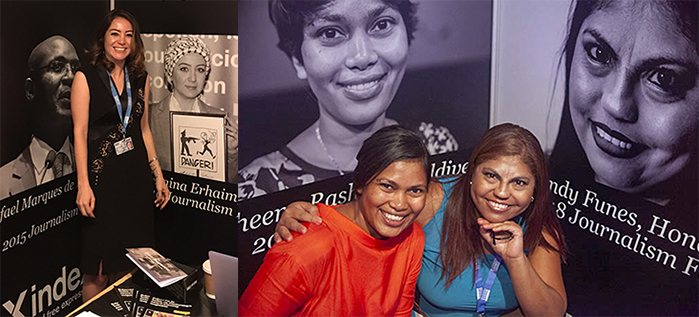
From left: Freedom of Expression Awards Journalism Fellows Zaina Erhaim (2016), Zaheena Rasheed (2017) and Wendy Funes (2018) in the Index booth at the Defend Media Freedom conference in July.
Media freedom is the focus of a major campaign spearheaded by the UK and Canada this year. I spoke on the issue at the UK’s launch of its annual human rights report and Index played an active role in a global conference hosted in London in July to launch the campaign. We were excited to see so many Index fellows there, including journalism fellows Zaina Erhaim, Zaheena Rasheed and Mimi Mefo, who all spoke on panels at the event, as well as Wendy Funes, NetBlocks and CRNI. We’ve also published reports looking at the wave of physical threats that journalists are facing in Russia, Turkey and Ukraine — drawn from our latest media monitoring project.
Current arts fellow Zehra Dogan had an exhibition at the Tate in May and was also one ofthe designers of flags developed to mark the 70th anniversary of the UN declaration on human rights.
Also in arts, Index continued to raise questions about the UK’s policing of drill music and spoke at the launch of a new single by two artists who are subject to controversial new orders that are forcing musicians to censor their work.
Knowledge sharing
Our expertise is in high demand. In May, Index launched a new advisory service for arts organisations facing censorship, offering consultancy services, workshops and training. We also continue to provide expertise through the media, and have featured widely in international and national press and broadcast. Head of advocacy Joy Hyvarinen has been active in raising Index’s concerns about the UK’s strategy for online safety. We also gave evidence to Parliament’s Joint Committee on Human Rights about harassment ofMPs – on and offline.
We are recruiting for two new roles over the summer. The Head of Communications & Media and Senior Partnerships Manager positions are currently being advertised and we look forward to welcoming new additions to the Index family who will help us spread the free speech message even further.
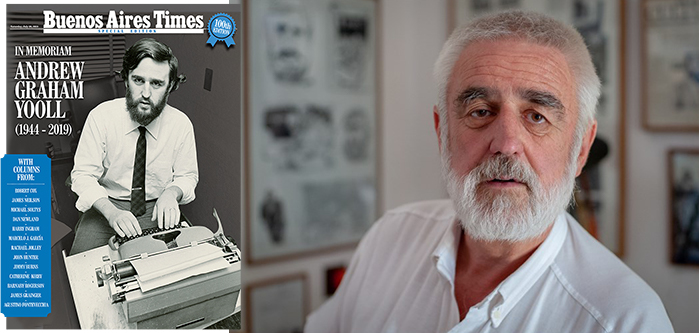
Andrew Graham-Yooll
Finally, we were sorry last month to learn of the death of a great Index friend and freespeech champion – former editor of Index magazine, Andrew Graham-Yooll, who was a leading figure in the reporting of Argentina’s repressive regime in the 1970s and 1980s. Andrew’s family have kindly asked that people give to Index in Andrew’s memory. If you would like to do this, please visit the justgiving page.
As another former Index colleague, Matthew d’Ancona, wrote in a recent article, the right to free speech is needed not by the few but by everyone – and we are grateful to have had known individuals like Andrew who help us maintain that fight.
25 Jun 2019 | Events
[vc_row][vc_column][vc_single_image image=”82824″ img_size=”full”][vc_column_text]On 13th June 2019, UK Home secretary Sajid Javid signed a request for Julian Assange to be extradited to the USA. He has since been ordered by the court to face a full extradition hearing in February next year. If granted, the Wikileaks founder could face 18 indictment charges in the US, including those under the Espionage Act. If found guilty he could receive a potential prison sentence of 175 years.
Now that Assange has been ejected from the Ecuadorian embassy and is serving a 50-week sentence in Belmarsh Prison for bail violations, how does the journalism community view the founder of Wikileaks? Assange claims Wikileaks was never involved in hacking classified information and is “nothing but a publisher”. His QC says the US extradition case “represents an outrageous and full-frontal assault on journalistic rights.” For many, there are still unanswered questions.
Does Julian Assange merit our support and solidarity – as a journalist and a defender of the freedom to inform? Or does his personal conduct – in light of allegations of rape and sexual assault, and his documented collaboration with Russian intelligence to disrupt Hillary Clinton’s election campaign – cancel out the debt owed to him by the editors and journalists who used the Wikileaks documents to publish, broadcast and post their many ground-breaking stories and reports?
Join us as the Frontline Club brings together all sides of the debate to discuss the legacy and future of Julian Assange. Each speaker will be cross-examined for 10 minutes by our chair, and face five minutes of questions from the floor. Former editor-in-chief of the Guardian Alan Rusbridger will be joined by columnist and broadcaster David Aaronovitch, chief executive of Index on Censorship Jodie Ginsberg and freelancer Vaughan Smith, with more panellists to be announced.[/vc_column_text][/vc_column][/vc_row][vc_row][vc_column][vc_custom_heading text=”Panel” font_container=”tag:h3|text_align:left” use_theme_fonts=”yes”][vc_row_inner][vc_column_inner width=”1/3″][vc_single_image image=”107623″ img_size=”full”][vc_column_text]Chair
Robin Lustig is a journalist and broadcaster. From 1989-2012 he presented Newshour on BBC World Service and The World Tonight on BBC Radio 4. He studied politics at the University of Sussex and began his journalistic career as a Reuters correspondent in Madrid, Paris and Rome. He then spent 12 years at The Observer before moving into broadcasting in 1989. He has extensive experience of covering major world events for the BBC, and has broadcast live programmes from Abuja, Amman, Baghdad, Berlin, Harare, Hong Kong, Islamabad, Istanbul, Johannesburg, Jerusalem, Kabul, Kosovo, Moscow, New York, Paris, Rome, Sarajevo, Shanghai, Tehran, Tokyo and Washington. He has won a number of awards, including the 1998 Sony Silver Award for Talk/News Broadcaster of the Year. In 2013 he received the Charles Wheeler award for outstanding contribution to broadcast journalism.[/vc_column_text][/vc_column_inner][vc_column_inner width=”1/3″][vc_single_image image=”107624″ img_size=”full”][vc_column_text]David Aaronovitch is a writer, broadcaster and commentator on culture, international affairs, politics and the media. His regular column appears every Thursday in The Times. A former television researcher, producer and programme editor, he has previously written for The Independent, The Guardian and The Observer, winning numerous accolades, including Columnist of the Year 2003. He has appeared on the satirical TV current affairs programme Have I Got News For You, presented a number of radio and television series and programmes on current affairs and historical topics. His first book, and account of a journey by kayak on the rivers and canals of England, Paddling to Jerusalem, was published in 2000 and won the Madoc Prize for travel writing. In 2009 he published Voodoo Histories, a book on the history and attraction of conspiracy theories.[/vc_column_text][/vc_column_inner][vc_column_inner width=”1/3″][vc_single_image image=”103419″ img_size=”full”][vc_column_text]Jodie Ginsberg is Chief Executive of Index on Censorship, a London-based organisation that has published work by censored writers and artists and campaigned globally on freedom of expression issues since 1972. Prior to joining Index, Jodie worked as a foreign correspondent and business journalist and was UK Bureau Chief for Reuters news agency. She sits on the council of global free expression network IFEX and the board of the Trust for The Bureau of Investigative Journalism, and is a regular commentator in international media on freedom of expression issues.[/vc_column_text][/vc_column_inner][/vc_row_inner][vc_row_inner][vc_column_inner width=”1/3″][vc_single_image image=”107625″ img_size=”full”][vc_column_text]Suzanne Moore is an English journalist and columnist.[/vc_column_text][/vc_column_inner][vc_column_inner width=”1/3″][vc_single_image image=”107627″ img_size=”full”][vc_column_text]Alan Rusbridger was Editor in Chief of the Guardian from 1995-2015. He is currently Principal of Lady Margaret Hall, Oxford, and Chair of the Reuters Institute for the Study of Journalism. During his time at the Guardian, both he and the paper won numerous awards, including the 2014 Pulitzter Prize for Public Service Journalism. The Guardian grew from a printed paper with a circulation of 400,000 to a leading digital news organisation with 150m browsers a month around the world. He launched now-profitable editions in Australia and the US as well as a membership scheme which now has 1m Guardian readers paying for content.[/vc_column_text][/vc_column_inner][vc_column_inner width=”1/3″][vc_single_image image=”107626″ img_size=”full”][vc_column_text]Vaughan Smith founded the Frontline Club in London in 2003 as an institution to champion independent journalism. During the 1990’s he ran Frontline Television News, an agency that represented the interests of freelance video journalists. Since 1988 Vaughan has filmed in Iraq, Afghanistan, Bosnia, Chechnya, Kosovo and elsewhere, including the only uncontrolled footage of the Gulf War in 1991 while disguised for two months as a British Army officer. His home was refuge to WikiLeaks founder Julian Assange for thirteen months in 2011/12.[/vc_column_text][/vc_column_inner][/vc_row_inner][vc_column_text]
When: Tuesday 2 July 7:30pm BST
Where: Frontline Club, 13 Norfolk Place, London W2 1QJ
Tickets: This event is fully booked
[/vc_column_text][/vc_column][/vc_row]
6 Jun 2019 | Asia and Pacific, Global Journalist, Media Freedom, media freedom featured, News, Sri Lanka
[vc_row][vc_column][vc_column_text]This article is part of Index on Censorship partner Global Journalist’s Project Exile series, which has published interviews with exiled journalists from around the world.[/vc_column_text][vc_column_text]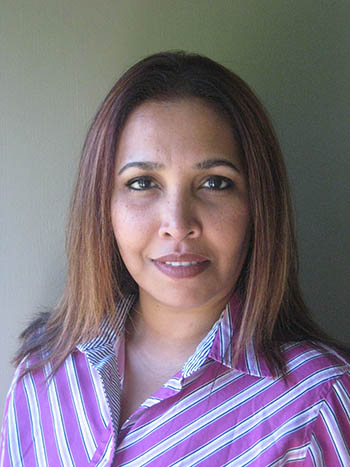 Sonali Samarasinghe remembers the last words of her husband Lasantha Wickrematunge on the day he was killed in 2009: “Don’t worry, I got it under control.”
Threats weren’t new to Wickrematunge. As the editor of The Sunday Leader, a Sri Lankan newspaper that published articles exposing government corruption, he’d been followed, attacked with clubs and received a funeral wreath at his office.
Samarasinghe was the chief investigative journalist and consulting editor for the newspaper and also the founding editor-in-chief of its sister paper, The Morning Leader.
Like other journalists, the couple worked in a difficult environment, as their newspapers competed with state-owned newsrooms and faced constant pressure for criticising the government of then-president Mahinda Rajapaksa. In late 2008 and early 2009, Rajapaksa’s government was in the final months of a brutal decades-long civil war with Tamil Tiger rebels. Still, Wickrematunge’s assassination shocked the south Asian nation and would force Samarasinghe into years of exile.
“For the Mahinda Rajapaksa administration, Wickrematunge was the biggest thorn in their flesh,” Samarasinghe wrote in a blog post. “He investigated corrupt military procurement deals, spoke out strongly and passionately for a negotiated settlement to the ethnic conflict and debunked blatant government propaganda on the war.”
Indeed Wickrematunge’s first wife, Raine, was so fearful for her family’s safety that she left Sri Lanka for Australia in 2002 with the couple’s three children. Samarasinghe worked for Wickrematunge for years before the couple married in 2008, just two months before his death.
She too made powerful enemies. Samarasinghe was once interrogated for more than four hours by Sri Lanka’s Criminal Investigations Department in an attempt to get her to reveal her sources in an investigation into the central bank’s dealings with a company accused of running a Ponzi scheme. In another incident, an article about tsunami relief accused Rajapaksa and other top officials of siphoning off millions in aid money. The Morning Leader’s printing presses were attacked and copies of the paper burned in 2007 by 15 gunmen after a separate exposé on the family of cabinet minister Mervyn Silva.
On 8 January 2009, Samarasinghe and Wickrematunge received a call from the newspaper while returning home from the pharmacy. It was a warning: they were being followed.
As they got out of their car, two men wearing black fatigues on a black motorcycle sped past them, staring them down, says Samarasinghe in an interview with Global Journalist. The couple went into the house and closed all their doors. Samarasinghe says she tried to keep Wickrematunge at home, but he was determined to go to the office to write his well-known political column.
On his way to the newspaper during rush hour, Wickrematunge was ambushed and killed in broad daylight by motorcycle-riding attackers, one of at least 19 journalists slain in Sri Lanka for their work since 1992, according to the Committee to Protect Journalists. Wickrematunge had been prepared for this outcome. He’d already written his own obituary, which included the line: “…when finally I am killed, it will be the government that kills me.”
“We were up against an administration that had taken impunity to the level of a martial art,” Samarasinghe says.
Samarasinghe continued receiving threats even after Wickrematunge’s assassination. Ttwo weeks later, she escaped to New York.
She became a Nieman Fellow at Harvard University in August 2009 and started the independent Lanka Standard news site in 2011. After Harvard, she spent time as a journalist in residence at City University of New York and Ithaca College.
Then in 2015 came an opportunity for justice. Rajapaksa suffered a surprise defeat to former ally Maithripala Sirisena in presidential elections. The six-year-old investigation into Wickrematunge’s death, which had yielded no convictions, was reopened. Samarasinghe was hired by the new administration to work in New York at Sri Lanka’s mission to the United Nations.
In 2016, a former soldier was found dead with an apparent suicide note in which he claimed responsibility for killing Wickrematunge’s. A police report implicated a special military unit led by Rajapaksa’s brother and defence secretary, Gotbaya Rajapaksa.
Yet progress stalled. Gotbaya, who is also being sued by Wickrematunge’s daughter in US courts for her father’s death, has announced he’s running for president to succeed Sirisena in elections later this year. Both Rajapaksas have denied involvement in the editor’s death. Meanwhile, after a wave of terrorist bombings in April killed more than 250 people, President Sirisena said that investigations into human rights abuses during the Sri Lankan Civil War had weakened the security forces and left the country at risk.
Samarasinghe spoke with Global Journalist’s Seth Bodine about the killing of her husband, the threats against her, and the prospect of those responsible escaping Sri Lankan justice. Below is an edited version of their interview.
Global Journalist: What was it like being a journalist in Sri Lanka around the time of your husband’s death?
Samarasinghe: We were up against an administration that had taken impunity to the level of a martial art. It had incrementally closed the democratic space, the space for freedom of expression. This didn’t happen overnight. It happened incrementally.
One by one private media organisations were being bought by businessmen or acolytes of the president at the time, Mahinda Rajapaksa. Even his own family.
Those who were not bought up chose to associate themselves with the ruling regime because then they could engage in lucrative business with the government. The state-controlled media was really state-controlled. It included the nation’s largest newspaper group. So, you could not compete with that.
At the time, when we were working, there was no freedom of information act. Speaking to journalists was actively discouraged by the government.
Even though the constitution provided for freedom of expression, that freedom of expression right was infringed upon by other laws. With emergency power regulations, anything could happen. There was the Prevention of Terrorism Act, which was another draconian piece of legislation which really curtailed freedom. And there were other laws, giving the government and the armed forces power to arrest without warrant.
So you could be detained at that time for up to 20 months without charge. Officials were shielded from prosecution so you couldn’t even challenge them.
The culture of impunity was just staggering. I mean, at that time white vans would go around abducting journalists and activists. Some of them never to be seen again, some of them beaten to a pulp and thrown on the side of the road.
GJ: Was there any warning of the danger to you and Lasantha?
Samarasinghe: We weren’t given any warning about the motorcyclists except a few minutes before when someone from the office called to say that he was being followed. But before that, there were certain things that were happening.
For instance, he received a cutting of a newspaper which was drenched in red ink. This was like a week before. He himself knew. He was talking to me, and he said, “It’s very dangerous now.”
Then, two days before Wickrematunge’s death, a very independent TV network was destroyed. They came in and they burned the place down.
GJ: What led you to flee?
Samarasinghe: It was the trauma of going through the death of my husband in such a violent manner. Then, neighbours let us know that the motorcyclists had come back and were circling the premises.
So I immediately left my home. My mother didn’t know where I was, I didn’t tell anyone where I was, and I stayed with a friend.
Meanwhile things were happening at home. Two men walked into the house, and despite my mother’s protest, they very aggressively started taking photos of the inside and outside of my home. They photographed my little niece. Then they rushed out of the house. So, within two weeks I realised I had to leave.
Both the Australian and American ambassadors reached out to help. And ultimately, I fled to Europe and found shelter in the home of a European ambassador who took me in for two months.
GJ: What happened at The Sunday Leader after Lasantha’s death?
Samarasinghe: For the two weeks I was in charge of the newspaper following the assassination of my husband, I wrote the political column focusing on his death, the then-president’s reaction, and the immediate aftermath. I also had other journalists intensely focus on the investigation.
We ran half-page ads on a black background of threats made by president Rajapaksa to Lasantha. However, I was compelled to flee the country. The newspaper ground to a halt and understandably diluted itself and went into survival mode.
GJ: How did you feel when you left?
Samarasinghe: You really feel like your country has betrayed you. And you also have to face so many emotions. Those who knew Lasantha just denied knowing him. Everyone was scared. It was such a horrid time.
Some of my friends and family would no longer ride in the same car with me because I had to drive to work in those two weeks, fearing that they would be collateral damage, that I would be the next obvious target. For a long time, I couldn’t even convince a caretaker or friend to check in on my house because they were just scared people were watching it, or that they could be attacked or targeted.
Superstition was doing its bit. Nobody wanted to rent or buy a home they felt was one of tragedy – because it was a home of a couple whose dreams were dashed within two months of marriage. So they thought it was bad luck.
All these things, all of these cultural and political issues were just swirling around. It was a really torrid time because of that.
It was just the panic of having to leave and having to look undefeated for the cameras because you have to look strong. The panic of not seeing familiar faces, the stress of coming to an unknown place.
Language had failed me. And I was a journalist who wrote 10,000 words or more a week. It was then that I learned and was relieved to know that it was post-traumatic stress disorder.
GJ: Before Rajapaksa surprisingly lost the 2015 election, did you imagine that you would ever go back to Sri Lanka?
Samarasinghe: I had just abandoned all hope of getting back to Sri Lanka. I thought this was going to go on forever. In 2015, before the election, even the New York Times had an editorial that said the regime is going to remain. None of us expected this to happen. The next day, we all bought tickets to go back to Sri Lanka. Everyone was buying tickets.
GJ: Gotabaya Rajapaksa, who was defence minister at the time of your husband’s death, and who was linked to his killing by a police report, has announced he will run for president this year. Are you upset that the people responsible for his death are still free?
Samarasinghe: Investigations into Lasantha’s murder are still continuing. It is not for me to comment at this time. The people of Sri Lanka will decide in democratically-held elections.
I will say this: I believe in the rule of law and I believe in divine justice. As Dr. King noted: “Evil may so shape events that Caesar will occupy a place and Christ a cross, but that same Christ will rise up and split history into AD and BC, so that even the life of Caesar must be dated by his name…the arc of the moral universe is long, but it bends toward justice.” [/vc_column_text][/vc_column][/vc_row][vc_row][vc_column width=”1/2″][vc_video link=”https://youtu.be/6BIZ7b0m-08″][/vc_column][vc_column width=”1/2″][vc_column_text]Index on Censorship partner Global Journalist is a website that features global press freedom and international news stories as well as a weekly radio program that airs on KBIA, mid-Missouri’s NPR affiliate, and partner stations in six other states. The website and radio show are produced jointly by professional staff and student journalists at the University of Missouri’s School of Journalism, the oldest school of journalism in the United States. [/vc_column_text][/vc_column][/vc_row][vc_row][vc_column][vc_custom_heading text=”Don’t lose your voice. Stay informed.” use_theme_fonts=”yes”][vc_separator color=”black”][vc_row_inner][vc_column_inner width=”1/2″][vc_column_text]Index on Censorship is a nonprofit that campaigns for and defends free expression worldwide. We publish work by censored writers and artists, promote debate, and monitor threats to free speech. We believe that everyone should be free to express themselves without fear of harm or persecution – no matter what their views.
Join our mailing list (or follow us on Twitter or Facebook). We’ll send you our weekly newsletter, our monthly events update and periodic updates about our activities defending free speech. We won’t share, sell or transfer your personal information to anyone outside Index.[/vc_column_text][/vc_column_inner][vc_column_inner width=”1/2″][gravityform id=”20″ title=”false” description=”false” ajax=”false”][/vc_column_inner][/vc_row_inner][/vc_column][/vc_row][vc_row full_width=”stretch_row_content”][vc_column][three_column_post title=”Global Journalist / Project Exile” full_width_heading=”true” category_id=”22142″][/vc_column][/vc_row]