21 Jul 2015 | Art and the Law Case Studies, Artistic Freedom Case Studies
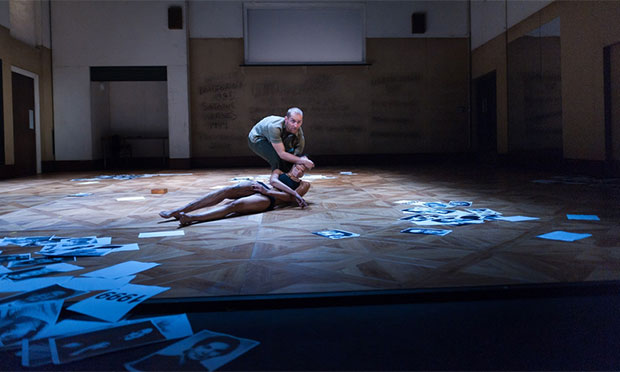
A scene from Can We Talk About This? (Photo: Matt Nettheim for DV8)
As part of our work on art, offence and the law, Julia Farrington, associate arts producer, Index on Censorship, interviewed Eva Pepper, DV8’s executive producer about how she prepared for potential hostility that the show Can We Talk About This? might provoke as it went on tour around the world in 2011-12.
Background
Can We Talk About This?, created by DV8’s Artistic Director Lloyd Newson, deals with freedom of speech, censorship and Islam. The production premiered in August 2011 at Sydney Opera House, followed by an international tour of 15 countries — Sweden, Australia, Hong Kong, France, Italy, Austria, Germany, Greece, Slovenia, Hungry, Spain, Norway, Taiwan and Korea and the UK between August 2011 and June 2012 — and was seen by a 60,000 people.
Extract from publicity of the show:
“From the 1989 book burnings of Salman Rushdie’s The Satanic Verses, to the murder of filmmaker Theo Van Gogh and the controversy of the ‘Muhammad cartoons’ in 2005, DV8’s production examined how these events have reflected and influenced multicultural policies, press freedom and artistic censorship. In the follow up to the critically acclaimed To Be Straight With You, this documentary-style dance-theatre production used real-life interviews and archive footage. Contributors include a number of high profile writers, campaigners and politicians.”
Q&A
Farrington: How did you set about working with the police for this tour?
Pepper: We focused on the UK with policing; I didn’t speak to any police forces in other countries at all, just in the UK cities we toured to: West Yorkshire Playhouse in Leeds; Warwick Arts Centre; Brighton Corn Exchange; The Lowry in Manchester and the National Theatre in London. But we did have a risk assessment and risk protocol that we shared with every venue we went to. We let them know the subject matter and the potential risks: security, safety of the audiences, media storms, safety of the people who were working on the show. They dealt either with their in-house security, or, in the UK, they would often alert the police as well.
Farrington: How did your preparations with police vary around the UK?
Pepper: We started with the Metropolitan Police, about six months before and told them our plans and that we would also contact other police forces. The National Theatre had their own contacts with the police who were already on standby. We still kept the MET events unit informed, but they [National Theatre] dealt with the police themselves. They were much more clued up, they had a head of security whom I briefed; we talked quite a lot. I made sure that he was copied in when anything a bit weird came up on the internet.
Our first venue was Leeds and we approached them about six weeks before the UK premiere. There was a bit of nervousness around Leeds, because of the larger Muslim population in the area. But we were only just beginning our liaison with the police and it took a little time to get a response. In the end we approached senior officers, but they often didn’t engage personally, just put us in touch with the appropriate unit to deal with.
Farrington: They didn’t see it as that important?
Pepper: They liked to be alerted that something might happen and they assured us that they were preparing. The venues also had their own police liaison; sometimes there was a bit of conflict if they had their own. I probably ruffled a few feathers when I went to a more senior officer.
Our starting point to the police was a very carefully worded letter which set out who we were. We didn’t ask permission to put it on we just alerted them that we might need police involvement. I did have some calls and a couple of meetings with officers, where they reiterated what is often said, which is that the police’s mandate is to keep the peace. It was made clear that they have as much of a duty to those people who want to protest or potentially might want to protest, as they have to allow us to exercise our freedom of expression. In Leeds nothing happened but there was a certain amount of nervousness around it.
Farrington: Where – at the venue?
Pepper: I think we were probably a bit nervous, and the police took it seriously enough. We had contact numbers to call. They were very much in the loop of the risk assessment.
Farrington: Was there a police presence on the night?
Pepper: I don’t remember seeing anybody. There was security of the venue of course, but regional venues only go so far with security. With some venues we were a little insistent that they get somebody upstairs and downstairs for example.
Farrington: And search bags, that kind of thing?
Pepper: We insisted people check in bags. The risk protocols weren’t invented for Can We Talk About This? They were really invented for To Be Straight With You [DV8’s previous show] and just tightened up for Can We Talk About This?. The risk protocols are just bullet points to get people thinking through scenarios.
Farrington: In general how would you describe your dealings with the police?
Pepper: I think generally supportive but we came to alert them that we might need them – there wasn’t a crisis. They said ‘thanks for letting us know let us deal with it.’ We would have quite liked to go through their risk assessments, but that didn’t happen. I think we were a little bit on their radar. They offered to send round liaison people to discuss practicalities around the office – stuff we hadn’t really thought about. It was a little bit tricky to get their attention.
The things we asked them to look out for were internet activity, if there was something brewing; sounds terribly paranoid. If there were issues around our London office or tour venues like hate mail, suspicious packages and then protests. So protest was just one thing our board was concerned about.
Farrington: Did you do anything else with the venue to prepare them for a possible hostile response from the media or a member of the public?
Pepper: I asked every venue artistic director or chief executive to prepare a statement. Lloyd would have been the main spokesperson for us if anything went wrong, but for a regional venue it is important that you are ready with a response and they all did that.
Farrington: What kind of thing did they say?
Pepper: We have supported this artist for the last 20 years. Lloyd has always been challenging in one way or another. This time he is challenging about this and we are going with him.
Farrington: Did you have any contact with lawyers?
Pepper: We looked carefully at the contents of the show. We had used interviews with real people and we wanted to be sure that nothing said was libellous or factually incorrect. So we had things looked at. The lawyer would say have you thought about that, did you get a release for this, are you using this from the BBC, do you have permission, have you spoken to this person, does he know you are doing it? And sometimes it is yes and sometimes it was a no.
Farrington: They pointed out some bases you hadn’t covered?
Pepper: Maybe one. We were really good and a bit obsessive. Sometimes we thought we didn’t have to ask because the information was in the public domain anyway, based on an interview that has been online for ten years for example. And the lawyer would or wouldn’t agree with that. It was good for peace of mind. That’s the thing with legal advice it doesn’t mean that nobody comes after you, because the law isn’t black and white.
Farrington: Were there some venues that you took the show to that didn’t think it was necessary to make special preparations?
Pepper: We always made them aware and we let them handle it. There are certain things that we always did. We asked them to consider security, and certainly PR. I was quite concerned that it would be a big PR story and then out of the PR story, as we saw with Exhibit B, comes the police. The protests don’t come from nowhere usually, somebody comes and stirs things up.
Farrington: Did you prepare the venue press departments?
Pepper: Yes we did, and we quite consciously had interviews, preview pieces before hand, where Lloyd could give candid interviews about the show. Almost to take the wind out of people’s sails, to put it out in the open so nobody could say they were surprised.
Farrington: How did you prepare with the performers for potential hostility?
Pepper: We talked through the risk procedure with them. We also got some advice from a security specialist, about being more vigilant than usual, noticing things that are out of the ordinary; if somebody picks a fight in the bar after the show, find a way to alert the others. So yes, the security specialist had a meeting with us here in the office, but also came up to Leeds to talk to the performers.
Farrington: Did it create a difficult atmosphere?
Pepper: It did yes, it got a bit edgy. Next time I would not do it around the UK premiere. It took a long time to set all of this up. To find the right people, to get people to take it seriously, to have meetings scheduled.
Farrington: It took time to find the right kind of security specialist?
Pepper: It also took a little while to get straight what we needed. We probably tried to figure it out for ourselves for a long time. And then got somebody in after all, just as maybe we, or the board got a bit more nervous. When you talk about protests you always worry about the general public, but as an employer there are the people who you send on tour who have to defend the show in the bar afterwards, potentially they are the targets.
Farrington: But they were behind the show?
Pepper: Yes, undoubtedly. But it’s an uncomfortable debate. There were so many voices in that show and you didn’t agree with every voice and it was never really said what really is Lloyd’s or DV8’s line. I would say that all the dancers were fine, but sometimes if somebody corners you in a bar it gets squirmy. No one is comfortable with everything.
Farrington: Can you summarise the response to the show?
Pepper: We had everything from 1 to 5 stars. We had people that loved the dance and hated the politics, who loved the politics and hated the dance. Occasionally somebody liked both. Occasionally somebody hated both. The show was discussed in the dance pages, in the theatre pages and in the comments pages. So in terms of the breadth and depth of the discussion we couldn’t have been more thrilled. Then we had dozens of blogs written about the show. For us Twitter really started with Can We Talk About This? and it was a great instrument for us. Social media was largely positive, though some people were picking a fight on Facebook at some point. It was very, very broad and very widely discussed.
Farrington: And did you interact with Twitter or did you let it roll?
Pepper: Mostly we let it roll. As part of the risk strategy we had a prepared statement from Lloyd which was very similar to the forward in the programme and anybody who had any beef would be redirected to the statement.
Farrington: Did the venues take this performance as an opportunity to have post show discussion and debate?
Pepper: Lloyd prefers preshow talks because he doesn’t like people to tell him what they thought of the shows. Quite often there is a quick Q&A before. In UK, we had one in Brighton [organised by Index] and one at the National. We had fantastic ones in Norway after the Breivik killings. In Norway they weren’t sure it was relevant and then the killings happened and then I got the call to say now we need to talk about it.
But having pre-show talks is certainly how we decided to deal with it. There is a conflict with having a white middle-aged atheist put on a show about Islam. But the majority of voices in the show were Muslim voices of all shades of opinion. It wasn’t fiction. It was based on his research and based on people’s stories – writers, intellectuals, journalists, politicians and who had a personal story to tell
Farrington: How did you prepare work with the board regarding potential controversies?
Pepper: Really the work with the board started with the previous show To Be Straight With You that already dealt with homosexuality and religion and culture; how different communities and religious groups make the life of gay people quite unbearable, internationally and in this country. And even then, we started to say, ‘can we say this? are we allowed to criticise these people like this?’ and out of that grew the ‘yes, I do want to talk about this’ because if we don’t a chill develops. Can We Talk About This? was a history about people who had spoken out about aspects of Islam that they were uncomfortable with or against and what happened to them.
Farrington: What kind of board do you need if you are going to be an organisation that explores taboos like this?
Pepper: We have got a fantastic board; it is incredibly responsible and so is Lloyd. There is a very strong element of trust in Lloyd’s work. They wouldn’t be on the board if they didn’t support him. But, as employers, they are aware of their responsibilities to everyone who works for us. As a company we have to be prepared in the eventuality that there is a PR or security disaster. What we were really trying to do was avoid that eventuality. We will never know. Maybe nothing bad would have happened. I think that Lloyd now wishes more people had seen it, that a film had been made, that it was more accessible to study by those who want to. He thinks that maybe we were a bit too careful. But as an organisation, as DV8, as an employer I think that we did the right thing by looking after people.
Farrington: What advice could you give to prepare the ground for doing work that you know will divide opinion and you know could provoke hostility?
Pepper:
E: If you can anticipate this you already have an advantage, but it’s not always possible to second-guess who might find what offensive. But if you know, I would suggest you ask yourself what buttons you are likely to push; you have to be confident why you are pushing them – usually in order to make an important point. It’s a good idea to articulate this reasoning very well in your head and on paper. Then you have got to be brave and get on with your project. Strong partners are invaluable, so try to get support. But in the end it is about standing up and being able to defend what you do.
Farrington: So you think you could have gone a bit further?
Pepper: I think if you prepare well you could go a bit further. I don’t think there is a law in this country that would stop you from being more offensive than we were. Every artist has to decide for themselves what they want to say and why they are saying it, and if they can justify it they can go for it.
21 Jul 2015
A scene from Can We Talk About This? (Photo: Matt Nettheim for DV8)
By Julia Farrington
July 2015
As part of our work on art, offence and the law, Julia Farrington, associate arts producer, Index on Censorship, interviewed Eva Pepper, DV8’s executive producer about how she prepared for potential hostility that the show Can We Talk About This? might provoke as it went on tour around the world in 2011-12.
Background
Can We Talk About This?, created by DV8’s Artistic Director Lloyd Newson, deals with freedom of speech, censorship and Islam. The production premiered in August 2011 at Sydney Opera House, followed by an international tour of 15 countries — Sweden, Australia, Hong Kong, France, Italy, Austria, Germany, Greece, Slovenia, Hungry, Spain, Norway, Taiwan and Korea and the UK between August 2011 and June 2012 — and was seen by a 60,000 people.
Extract from publicity of the show:
“From the 1989 book burnings of Salman Rushdie’s The Satanic Verses, to the murder of filmmaker Theo Van Gogh and the controversy of the ‘Muhammad cartoons’ in 2005, DV8’s production examined how these events have reflected and influenced multicultural policies, press freedom and artistic censorship. In the follow up to the critically acclaimed To Be Straight With You, this documentary-style dance-theatre production used real-life interviews and archive footage. Contributors include a number of high profile writers, campaigners and politicians.”
Q&A
Farrington: How did you set about working with the police for this tour?
Pepper: We focused on the UK with policing; I didn’t speak to any police forces in other countries at all, just in the UK cities we toured to: West Yorkshire Playhouse in Leeds; Warwick Arts Centre; Brighton Corn Exchange; The Lowry in Manchester and the National Theatre in London. But we did have a risk assessment and risk protocol that we shared with every venue we went to. We let them know the subject matter and the potential risks: security, safety of the audiences, media storms, safety of the people who were working on the show. They dealt either with their in-house security, or, in the UK, they would often alert the police as well.
Farrington: How did your preparations with police vary around the UK?
Pepper: We started with the Metropolitan Police, about six months before and told them our plans and that we would also contact other police forces. The National Theatre had their own contacts with the police who were already on standby. We still kept the MET events unit informed, but they [National Theatre] dealt with the police themselves. They were much more clued up, they had a head of security whom I briefed; we talked quite a lot. I made sure that he was copied in when anything a bit weird came up on the internet.
Our first venue was Leeds and we approached them about six weeks before the UK premiere. There was a bit of nervousness around Leeds, because of the larger Muslim population in the area. But we were only just beginning our liaison with the police and it took a little time to get a response. In the end we approached senior officers, but they often didn’t engage personally, just put us in touch with the appropriate unit to deal with.
Farrington: They didn’t see it as that important?
Pepper: They liked to be alerted that something might happen and they assured us that they were preparing. The venues also had their own police liaison; sometimes there was a bit of conflict if they had their own. I probably ruffled a few feathers when I went to a more senior officer.
Our starting point to the police was a very carefully worded letter which set out who we were. We didn’t ask permission to put it on we just alerted them that we might need police involvement. I did have some calls and a couple of meetings with officers, where they reiterated what is often said, which is that the police’s mandate is to keep the peace. It was made clear that they have as much of a duty to those people who want to protest or potentially might want to protest, as they have to allow us to exercise our freedom of expression. In Leeds nothing happened but there was a certain amount of nervousness around it.
Farrington: Where – at the venue?
Pepper: I think we were probably a bit nervous, and the police took it seriously enough. We had contact numbers to call. They were very much in the loop of the risk assessment.
Farrington: Was there a police presence on the night?
Pepper: I don’t remember seeing anybody. There was security of the venue of course, but regional venues only go so far with security. With some venues we were a little insistent that they get somebody upstairs and downstairs for example.
Farrington: And search bags, that kind of thing?
Pepper: We insisted people check in bags. The risk protocols weren’t invented for Can We Talk About This? They were really invented for To Be Straight With You [DV8’s previous show] and just tightened up for Can We Talk About This?. The risk protocols are just bullet points to get people thinking through scenarios.
Farrington: In general how would you describe your dealings with the police?
Pepper: I think generally supportive but we came to alert them that we might need them – there wasn’t a crisis. They said ‘thanks for letting us know let us deal with it.’ We would have quite liked to go through their risk assessments, but that didn’t happen. I think we were a little bit on their radar. They offered to send round liaison people to discuss practicalities around the office – stuff we hadn’t really thought about. It was a little bit tricky to get their attention.
The things we asked them to look out for were internet activity, if there was something brewing; sounds terribly paranoid. If there were issues around our London office or tour venues like hate mail, suspicious packages and then protests. So protest was just one thing our board was concerned about.
Farrington: Did you do anything else with the venue to prepare them for a possible hostile response from the media or a member of the public?
Pepper: I asked every venue artistic director or chief executive to prepare a statement. Lloyd would have been the main spokesperson for us if anything went wrong, but for a regional venue it is important that you are ready with a response and they all did that.
Farrington: What kind of thing did they say?
Pepper: We have supported this artist for the last 20 years. Lloyd has always been challenging in one way or another. This time he is challenging about this and we are going with him.
Farrington: Did you have any contact with lawyers?
Pepper: We looked carefully at the contents of the show. We had used interviews with real people and we wanted to be sure that nothing said was libellous or factually incorrect. So we had things looked at. The lawyer would say have you thought about that, did you get a release for this, are you using this from the BBC, do you have permission, have you spoken to this person, does he know you are doing it? And sometimes it is yes and sometimes it was a no.
Farrington: They pointed out some bases you hadn’t covered?
Pepper: Maybe one. We were really good and a bit obsessive. Sometimes we thought we didn’t have to ask because the information was in the public domain anyway, based on an interview that has been online for ten years for example. And the lawyer would or wouldn’t agree with that. It was good for peace of mind. That’s the thing with legal advice it doesn’t mean that nobody comes after you, because the law isn’t black and white.
Farrington: Were there some venues that you took the show to that didn’t think it was necessary to make special preparations?
Pepper: We always made them aware and we let them handle it. There are certain things that we always did. We asked them to consider security, and certainly PR. I was quite concerned that it would be a big PR story and then out of the PR story, as we saw with Exhibit B, comes the police. The protests don’t come from nowhere usually, somebody comes and stirs things up.
Farrington: Did you prepare the venue press departments?
Pepper: Yes we did, and we quite consciously had interviews, preview pieces before hand, where Lloyd could give candid interviews about the show. Almost to take the wind out of people’s sails, to put it out in the open so nobody could say they were surprised.
Farrington: How did you prepare with the performers for potential hostility?
Pepper: We talked through the risk procedure with them. We also got some advice from a security specialist, about being more vigilant than usual, noticing things that are out of the ordinary; if somebody picks a fight in the bar after the show, find a way to alert the others. So yes, the security specialist had a meeting with us here in the office, but also came up to Leeds to talk to the performers.
Farrington: Did it create a difficult atmosphere?
Pepper: It did yes, it got a bit edgy. Next time I would not do it around the UK premiere. It took a long time to set all of this up. To find the right people, to get people to take it seriously, to have meetings scheduled.
Farrington: It took time to find the right kind of security specialist?
Pepper: It also took a little while to get straight what we needed. We probably tried to figure it out for ourselves for a long time. And then got somebody in after all, just as maybe we, or the board got a bit more nervous. When you talk about protests you always worry about the general public, but as an employer there are the people who you send on tour who have to defend the show in the bar afterwards, potentially they are the targets.
Farrington: But they were behind the show?
Pepper: Yes, undoubtedly. But it’s an uncomfortable debate. There were so many voices in that show and you didn’t agree with every voice and it was never really said what really is Lloyd’s or DV8’s line. I would say that all the dancers were fine, but sometimes if somebody corners you in a bar it gets squirmy. No one is comfortable with everything.
Farrington: Can you summarise the response to the show?
Pepper: We had everything from 1 to 5 stars. We had people that loved the dance and hated the politics, who loved the politics and hated the dance. Occasionally somebody liked both. Occasionally somebody hated both. The show was discussed in the dance pages, in the theatre pages and in the comments pages. So in terms of the breadth and depth of the discussion we couldn’t have been more thrilled. Then we had dozens of blogs written about the show. For us Twitter really started with Can We Talk About This? and it was a great instrument for us. Social media was largely positive, though some people were picking a fight on Facebook at some point. It was very, very broad and very widely discussed.
Farrington: And did you interact with Twitter or did you let it roll?
Pepper: Mostly we let it roll. As part of the risk strategy we had a prepared statement from Lloyd which was very similar to the forward in the programme and anybody who had any beef would be redirected to the statement.
Farrington: Did the venues take this performance as an opportunity to have post show discussion and debate?
Pepper: Lloyd prefers preshow talks because he doesn’t like people to tell him what they thought of the shows. Quite often there is a quick Q&A before. In UK, we had one in Brighton [organised by Index] and one at the National. We had fantastic ones in Norway after the Breivik killings. In Norway they weren’t sure it was relevant and then the killings happened and then I got the call to say now we need to talk about it.
But having pre-show talks is certainly how we decided to deal with it. There is a conflict with having a white middle-aged atheist put on a show about Islam. But the majority of voices in the show were Muslim voices of all shades of opinion. It wasn’t fiction. It was based on his research and based on people’s stories – writers, intellectuals, journalists, politicians and who had a personal story to tell
Farrington: How did you prepare work with the board regarding potential controversies?
Pepper: Really the work with the board started with the previous show To Be Straight With You that already dealt with homosexuality and religion and culture; how different communities and religious groups make the life of gay people quite unbearable, internationally and in this country. And even then, we started to say, ‘can we say this? are we allowed to criticise these people like this?’ and out of that grew the ‘yes, I do want to talk about this’ because if we don’t a chill develops. Can We Talk About This? was a history about people who had spoken out about aspects of Islam that they were uncomfortable with or against and what happened to them.
Farrington: What kind of board do you need if you are going to be an organisation that explores taboos like this?
Pepper: We have got a fantastic board; it is incredibly responsible and so is Lloyd. There is a very strong element of trust in Lloyd’s work. They wouldn’t be on the board if they didn’t support him. But, as employers, they are aware of their responsibilities to everyone who works for us. As a company we have to be prepared in the eventuality that there is a PR or security disaster. What we were really trying to do was avoid that eventuality. We will never know. Maybe nothing bad would have happened. I think that Lloyd now wishes more people had seen it, that a film had been made, that it was more accessible to study by those who want to. He thinks that maybe we were a bit too careful. But as an organisation, as DV8, as an employer I think that we did the right thing by looking after people.
Farrington: What advice could you give to prepare the ground for doing work that you know will divide opinion and you know could provoke hostility?
Pepper:
E: If you can anticipate this you already have an advantage, but it’s not always possible to second-guess who might find what offensive. But if you know, I would suggest you ask yourself what buttons you are likely to push; you have to be confident why you are pushing them – usually in order to make an important point. It’s a good idea to articulate this reasoning very well in your head and on paper. Then you have got to be brave and get on with your project. Strong partners are invaluable, so try to get support. But in the end it is about standing up and being able to defend what you do.
Farrington: So you think you could have gone a bit further?
Pepper: I think if you prepare well you could go a bit further. I don’t think there is a law in this country that would stop you from being more offensive than we were. Every artist has to decide for themselves what they want to say and why they are saying it, and if they can justify it they can go for it.
Comfort zones are killing comedy
21 Jul 2015 | Magazine, mobile
Whenever I’m trying to fill an hour of stand-up for the Edinburgh Festival, the last thing I wonder is, “Jeez, will this set land me a spot on television?” The reasons are twofold: first, I do what makes me laugh, otherwise I get bored; second, I’ve done stand-up on television and it ain’t the apex of my career. Television producers and editors seem to have an uncanny knack for siphoning the humour out of just about anything, especially the royals, and particularly the pretty, dead ones.
Yet television comedy is held in some oddly high regard as a move up for a comic. I guess that’s because if you can’t get a TV profile going, your live shows in the provinces don’t sell very well. Why should someone in, say, Leeds, come and see you at the Varieties if you aren’t good enough to be on Les Dawson?
But to be on Les, or any television programme, your set must be “clean”. Which means few or no dirty words. Misogyny within social norms, fine, but save the word “cunt” for the wife beatings, mate. That’s right. No “cunts”, although the halls of the BBC are teeming with them. Which is sad, since “cunt” is plainly the most versatile word in the English language. It’s a verb, a noun, an adjective, and it’s really the last word on earth that, no matter how it’s used, makes my mother angry. One is also discouraged from using the word “fuck” on television, particularly as a verb. Particularly if you’re gay.
See, as an out cocksucker, there are lots of things I can get away with on stage but, on television, I’m already perceived as dangerous. TV companies treat me, in rehearsal for a taping, as though I’m retarded or a child or, worse yet, American. “Please be nice, Mr Capurro. You want the people watching to like you, don’t you? Good. We wouldn’t want everyone to think that you’re naughty, would we?”
Then they go through the litany of words I’m not supposed to use. When the show is edited and televised, other comics’ “fucks” are left in. Mine are removed. After all, being gay is dirty enough. Do I have to be dirtier with my dirty mouth?
I’m not really complaining. I’ve learned to manoeuvre my way throughout television. I can play the spiky-but-warm, take-the-cock-out-of-my-mouth-and-press-the-tongueto-my-cheek game with squeamishly positive results. Usually. But in Australia, during the taping of a “Gala” to honour a comedy festival in Melbourne, the director had a grand-mal seizure when I described Jesus as a “queerwannabe”. I saw papers fly up over the heads of a stunned, strangely silent audience. Later I found out it was the director’s script. Apparently they found him after the show, huddled in a corner, crying like a recently incarcerated prisoner who’d just taken his first “shower”.
He was afraid I’d pollute minds, I suppose. At least that’s what he told his assistant. So now, TV is promoting itself as a politically correct barometer? A sort of big-eyed nanny looking out for our sensitive sensibilities? In the six years that I’ve been performing in the UK, I’ve seen political correctness catch on like an insidious disease, like a penchant for black, like the need to oppress. Comics use the term to describe their own acts during TV meetings, and everyone around the table nods in appreciation and approval. Or are they choking? I can never tell with TV people.
Maybe they’re suffocating under a pillow of their own stupidity, since no one really understands the meaning behind political correctness, the arch, high-browed stance it panders to. The phrase was coined as a reaction to racism in the US, to respond with a sort of kindness that had been stifled when hippies disappeared from the US landscape. PC took the place of sympathy which has, since Reaganomics, had a negative, sort of “girlie” tone to it that few US politicians, especially those who served in ‘Nam, can tolerate. Being politically correct makes the user feel more in control and smarter, because they can manipulate a conversation by knowing the proper term to describe, say, an American Indian.
‘They’re actually indigenous peoples now,’ a talk-show host in
San Francisco told me while on air recently. ‘The word Indian is
too marginal.’
‘But where are they indigenous to?’
‘Well, here of course.’
‘They’re from San Francisco?’
‘No. I mean, yes. My boss’ — we were discussing his producer, Sam —
‘was born and raised here, but his parents are Cherokee from Kansas. Or
was it his grandparents?’
‘My grandfather is Italian, from Italy. What does that make me?’
‘Good in bed.’
Indigenous, tribal, quasi or semi. All these words are used to describe, politely, “the truth”. But, strangely enough, the truth is camouflaged. The white user pretends to understand the strife of the minorities, their emotional ups and downs, their need for acceptance and understanding, when all the minorities require is fair pay. I’ve never met a struggling Costa Rican labourer who was concerned that he be called a “Latino” as opposed to a “Hispanic”. He just wants to feed his family. Actually, I’ve never met a struggling Costa Rican, period. But that’s because I’m one of the annoying middle class who keep a distance from anyone who’s not like them, but who also has the time and just enough of an education to make up words and worry about who gets called what.
To the targets, the people we’re trying to protect – the downtrodden, the homeless, the forgotten – we must appear naive and bored, like nuns. It’s a lesson in tolerance that’s become intolerant. As if to say: “If you don’t think this way, if you don’t think that a black person from Bristol is better off being called Anglo-African, you’re not only wrong, you’re evil!” It’s pure fascism, plain and simple. It’s as if Guardian readers had unleashed their consciousness on everybody else, and so it’s naughty to make jokes about blacks, unless you’re black, and bad to make fun of fat people, if you’re not fat, etc. Suddenly, everyone is tiptoeing around everyone else, frightened they’ll be labelled racist because they use the word “Jew” in a punchline. Or horrified someone will think them misogynist because they think women deal better with stress.
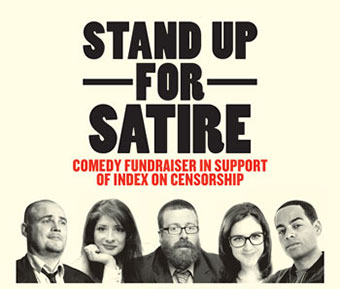 Index on Censorship has been publishing articles on satire by writers across the globe throughout its 43-year history. Ahead of our event, Stand Up for Satire, we published a series of archival posts from the magazine on satire and its connection with freedom of expression.
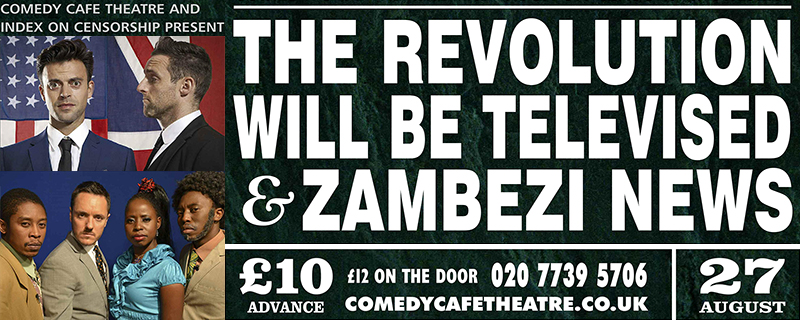
14 July: The power of satirical comedy in Zimbabwe by Samm Farai Monro | 17 July: How to Win Friends and Influence an Election by Rowan Atkinson | 21 July: Comfort Zones by Scott Capurro | 24 July: They shoot comedians by Jamie Garzon | 28 July: Comedy is everywhere by Milan Kundera | Student reading lists: Comedy and censorship
Somehow we’ve forgotten that it’s all in how you say it. To read a brilliant stand-up comic’s act is pedantic, but to see it performed is breathtaking. That’s because what we say might be clever, but the way we arrange and self-analyse and present is where the fun comes in. Same with all those words we use. They’re not “racist” or “dangerous” by definition.
Speaking of definitions, let’s talk about the word “gay”. Lots of people I meet are concerned about what I should be called. Is it gay, which pleases the press, or queer, which pleases the hetero hip, since they think gays are trying to reclaim that word? The fact is that all those words are straight-created straight identifiers. Gay is a heterosexual concept. It’s a man who looks like a model, dresses like a model and has the brain of a model. He has disposable income, he loves to travel, and he adores – thinks he sometimes is – Madonna. He’s a teenage girl really and straights love objectifying him the -way they do teenage girls. Or the way they do infants. Try watching a diaper commercial with the sound off. It’s like porn. You’ll think you’re in a bar in Amsterdam.
I’m about as comfortable with the word “gay” as I am with kiddy porn. I’d prefer to be called a comic. Not a gay comic. Not a queer comic. Not even a gay, queer comic, or a fierce comic, or an alternative comic. It’s just the mainstream trying to pigeonhole me, trying to say, OK, he’s gay, so it’s OK to laugh at his stuff about gays. Which is why, partially, in my act, I make fun of the Holocaust by saying “Holocaust, schmolocaust, can’t they whine about something else?”
The line is meant to be ambiguous, initially. It’s meant to start big, and then the actual subject gets small, as I discuss ignorance about the pink triangle as a symbol of oppression, which has since been turned into a fashion accessory. Like the red ribbon, it makes the PC brigade feel like they’ve done their part to ease hatred in the world by adorning their lapel with a pin. When pressed, they’re not even sure what oppression they’re curing, or why they should cure oppression, or how they’re oppressed.
But if you make fun of that triangle, or this Queen Mum, or that dead Princess, suddenly you’re — why mince — I’m the bad guy. I’ve broken away from the pack. I’m not acting like a good little queer should. I’m not being silent about issues that don’t concern a modern gay man, like hair-dos and don’ts. I’m being aggressive, I’m on to. And those straights, those in charge, the folks looking after “my minority group”, don’t like rolling over.
Nor are some cocksucking idiots happy about being bottom-feeders either. Which is why I come out against abortion in my act, and in support of the death penalty since, in the US at least, the two go hand in manicured hand. There I go, losing my last supporters: young women and single gay men. How can I say: “If you wanna talk Holocaust, how about abortion, ladies? 50 million. Can you maybe keep your legs together?”
That is truly evil. No, not really evil. Just wrong. Why? Particularly when I’m only opposed to abortion as a contraceptive device. Who decides what I can and cannot say? Isn’t it the people that aren’t listening? If I’ve got a good joke about it, a well-thought-out attack and a point to make, why is it bad? Why is the world dumbing down almost as fast as Woody Allen’s films? Why does it bother me? Why not just do my same old weenie jokes, keep playing the clubs and sleep with closeted straight comics? Just doing those three things – particularly the last – would keep me very busy and distracted, which is what “life” is all about.
But I imagine that when people go for a night out, they wanna see something different. It’s a big deal finding a babysitter, getting a cab, grabbing a bite and sitting your tired ass into a pricey seat to hear some faggot rattle on for an hour. So I try to offer them a unique perspective. One that might seem overwrought, desperate, or strangely effortless, but one that might make them look at, say, an Elton John photo just a bit differently next time
Look, it’s not my job to find anyone’s comfort zones. I don’t give a shit what people like, or think they like, or want to like. I’m not a revolutionary. I’m just a joke writer with an hour to kill, who wants to elevate the level of intelligence in my act to at least that of the audience.
If in doing that, I get a beer thrown at me or I lose a “friend” (read: jealous comic) then so be it. In the meantime, I’ll keep fending off my growing array of fans that are sick and tired of being lied to and patronised.
Gosh, get her! I mean me. Get me, sounding all holier than, well, everybody. Strangely enough, the more I find my voice on stage, the more serious comedy becomes for me. Maybe I should go back to telling those “Americans are so silly” jokes before I lose my mind, and throw all my papers up in the air.
Scott Capurro is a San Francisco-based stand-up whose performance at the
Edinburgh Fringe in August ended in uproar after he ‘made jokes’ about the
Holocaust. His book, Fowl Play, was published by Headline in September
1999
This article is from the November/December 2000 issue of Index on Censorship magazine and is part of a series of articles on satire from the Index on Censorship archives. Subscribe here, or buy a single issue. Every purchase helps fund Index on Censorship’s work around the world. For reproduction rights, please contact Index on Censorship directly, via [email protected]
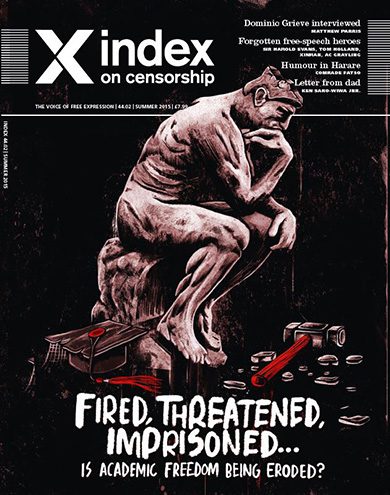
Letter: Academic freedom is under threat and needs urgent protection
26 Jun 2015 | Academic Freedom, Academic Freedom Letters, Magazine, News, Turkey Letters, Volume 44.02 Summer 2015
With threats ranging from “no-platforming” controversial speakers, to governments trying to suppress critical voices, and corporate controls on research funding, academics and writers from across the world have signed Index on Censorship’s open letter on why academic freedom needs urgent protection.
Academic freedom is the theme of a special report in the summer issue of Index on Censorship magazine, featuring a series of case studies and research, including stories of how setting an exam question in Turkey led to death threats for one professor, to lecturers in Ukraine having to prove their patriotism to a committee, and state forces storming universities in Mexico. It also looks at how fears of offence and extremism are being used to shut down debate in the UK and United States, with conferences being cancelled and “trigger warnings” proposed to flag potentially offensive content.
Signatories on the open letter include authors AC Grayling, Monica Ali, Kamila Shamsie and Julian Baggini; Jim Al-Khalili (University of Surrey), Sarah Churchwell (University of East Anglia), Thomas Docherty (University of Warwick), Michael Foley (Dublin Institute of Technology), Richard Sambrook (Cardiff University), Alan M. Dershowitz (Harvard Law School), Donald Downs (University of Wisconsin-Madison), Professor Glenn Reynolds (University of Tennessee), Adam Habib (vice chancellor, University of the Witwatersrand), Max Price (vice chancellor of University of Cape Town), Jean-Paul Marthoz (Université Catholique de Louvain), Esra Arsan (Istanbul Bilgi University) and Rossana Reguillo (ITESO University, Mexico).
The letter states:
We the undersigned believe that academic freedom is under threat across the world from Turkey to China to the USA. In Mexico academics face death threats, in Turkey they are being threatened for teaching areas of research that the government doesn’t agree with. We feel strongly that the freedom to study, research and debate issues from different perspectives is vital to growing the world’s knowledge and to our better understanding. Throughout history, the world’s universities have been places where people push the boundaries of knowledge, find out more, and make new discoveries. Without the freedom to study, research and teach, the world would be a poorer place. Not only would fewer discoveries be made, but we will lose understanding of our history, and our modern world. Academic freedom needs to be defended from government, commercial and religious pressure.
Index will also be hosting a debate in London, Silenced on Campus, on 1 July, with panellists including journalist Julie Bindel, Nicola Dandridge of Universities UK, and Greg Lukianoff, president and CEO of Foundation for Individual Rights in Education, US.
To attend for free, register here.
If you would like to add your name to the open letter, email [email protected]
A full list of signatories:
Professor Mike Adams, University of North Carolina, Wilmington, USA
Monica Ali, author
Lyell Asher, associate professor, Lewis & Clark College, USA
Professor Jim Al-Khalili OBE, University of Surrey, UK
Esra Arsan, associate professor, Istanbul Bilgi University, Turkey
Julian Baggini, author
Professor Mark Bauerlein, Emory University, USA
David S. Bernstein, publisher, USA
Robert Bionaz, associate professor, Chicago State University, USA
Susan Blackmore, visiting professor, University of Plymouth, UK
Professor Jan Blits, professor emeritus, University of Delaware, USA
Professor Enikö Bollobás, Eötvös Loránd University, Hungary
Professor Roberto Briceño-León, LACSO, Caracas, Venezuela
Simon Callow, actor
Professor Sarah Churchwell, University of East Anglia, UK
Professor Martin Conboy, University of Sheffield, UK
Professor Thomas Cushman, Wellesley College, USA
Professor Antoon De Baets, University of Groningen, Holland
Professor Alan M Dershowitz, Harvard Law School, USA
Rick Doblin, Association for Psychedelic Studies, USA
Professor Thomas Docherty, University of Warwick, UK
Professor Donald Downs, University of Wisconsin-Madison, USA
Professor Alice Dreger, Northwestern University, USA
Michael Foley, lecturer, Dublin Institute of Technology, Ireland
Professor Tadhg Foley, National University of Ireland, Galway, Ireland
Nick Foster, programme director, University of Leicester, UK
Professor Chris Frost, Liverpool John Moores University, UK
AC Grayling, author
Professor Randi Gressgård, University of Bergen, Norway
Professor Adam Habib, vice-chancellor, University of Witwatersrand, Johannesburg, South Africa
Professor Gerard Harbison, University of Nebraska-Lincoln
Adam Hart Davis, author and academic, UK
Professor Jonathan Haidt, NYU-Stern School of Business, USA
John Earl Haynes, retired political historian, Washington, USA
Professor Gary Holden, New York University, USA
Professor Mickey Huff, Diablo Valley College, USA
Professor David G. Hoopes, California State University, USA
Philo Ikonya, poet
James Ivers, lecturer, Eastern Michigan University, USA
Rachael Jolley, editor, Index on Censorship
Lee Jones, senior lecturer, Queen Mary University of London, UK
Stephen Kershnar, distinguished teaching professor, State University of New York, Fredonia, USA
Professor Laura Kipnis, Northwestern University, USA
Ian Kilroy, lecturer, Dublin Institute of Technology, Ireland
Val Larsen, associate professor, James Madison University, USA
Wendy Law-Yone, author
Professor Michel Levi, Universidad Andina Simón Bolívar, Ecuador
Professor John Wesley Lowery, Indiana University of Pennsylvania, USA
Greg Lukianoff, president and chief executive, Foundation for Individual Rights in Education (Fire), USA
Professor Tetyana Malyarenko, Donetsk State Management University, Ukraine
Ziyad Marar, global publishing director, Sage
Charlie Martin, editor PJ Media, UK
Jean-Paul Marthoz, senior lecturer, Université Catholique de Louvain, Belgium
Professor Alan Maryon-Davis, King’s College London, UK
John McAdams, associate professor, Marquette University, USA
Timothy McGuire, associate professor, Sam Houston State University, USA
Professor Tim McGettigan, Colorado State University, USA
Professor Lucia Melgar, professor in literature and gender studies, Mexico
Helmuth A. Niederle, writer and translator, Germany
Professor Michael G. Noll, Valdosta State University, USA
Undule Mwakasungula, human rights defender, Malawi
Maureen O’Connor, lecturer, University College Cork, Ireland
Professor Niamh O’Sullivan, curator of Ireland’s Great Hunger Museum, and Quinnipiac University, Connecticut, USA
Behlül Özkan, associate professor, Marmara University, Turkey
Suhrith Parthasarathy, journalist, India
Professor Julian Petley, Brunel University, UK
Jammie Price, writer and former professor, Appalachian State University, USA
Max Price, vice-chancellor, University of Cape Town, South Africa
Clive Priddle, publisher, Public Affairs
Professor Rossana Reguillo, ITESO University, Mexico
Professor Glenn Reynolds, University of Tennessee College of Law, USA
Professor Matthew Rimmer, Queensland University of Technology, Australia
Professor Paul H. Rubin, Emory University, USA
Andrew Sabl, visiting professor, Yale University, USA
Alain Saint-Saëns, director,Universidad Del Norte, Paraguay
Professor Richard Sambrook, Cardiff University, UK
Luís António Santos, University of Minho, Portugal
Professor Francis Schmidt, Bergen Community College, USA
Albert Schram, vice chancellor/CEO, Papua New Guinea University of Technology
Victoria H F Scott, independent scholar, Canada
Kamila Shamsie, author
Harvey Silverglate, lawyer and writer, Massachusetts, USA
William Sjostrom, director and senior lecturer, University College Cork, Ireland
Suzanne Sisley, University of Arizona College of Medicine, USA
Chip Stewart, associate dean of the Bob Schieffer College of Communication, Texas Christian University, USA
Professor Nadine Strossen, New York Law School, USA
Professor Dawn Tawwater, Austin Community College, USA
Serhat Tanyolacar, visiting assistant professor, University of Iowa, USA
Professor John Tooby, University of California, USA
Meena Vari, Srishti Institute of Art, Design and Technology, Bangalore, India
Professor Leland Van den Daele, California Institute of Integral Studies, USA
Professor Eugene Volokh, UCLA School of Law, USA
Catherine Walsh, poet and teacher, Ireland
Christie Watson, author
Ray Wilson, author
Professor James Winter, University of Windsor, Canada