26 Apr 2018 | Campaigns -- Featured, Statements
[vc_row][vc_column][vc_column_text]
Brussels, 26 April 2018
OPEN LETTER IN LIGHT OF THE 27 APRIL 2018 COREPER I MEETING
Your Excellency Ambassador, cc. Deputy Ambassador,
We, the undersigned, are writing to you ahead of your COREPER discussion on the proposed Directive on copyright in the Digital Single Market.
We are deeply concerned that the text proposed by the Bulgarian Presidency in no way reflects a balanced compromise, whether on substance or from the perspective of the many legitimate concerns that have been raised. Instead, it represents a major threat to the freedoms of European citizens and businesses and promises to severely harm Europe’s openness, competitiveness, innovation, science, research and education.
A broad spectrum of European stakeholders and experts, including academics, educators, NGOs representing human rights and media freedom, software developers and startups have repeatedly warned about the damage that the proposals would cause. However, these have been largely dismissed in rushed discussions taking place without national experts being present. This rushed process is all the more surprising when the European Parliament has already announced it would require more time (until June) to reach a position and is clearly adopting a more cautious approach.
If no further thought is put in the discussion, the result will be a huge gap between stated intentions and the damage that the text will actually achieve if the actual language on the table remains:
- Article 13 (user uploads) creates a liability regime for a vast area of online platforms that negates the E-commerce Directive, against the stated will of many Member States, and without any proper assessment of its impact. It creates a new notice and takedown regime that does not require a notice. It mandates the use of filtering technologies across the board.
- Article 11 (press publisher’s right) only contemplates creating publisher rights despite the many voices opposing it and highlighting it flaws, despite the opposition of many Member States and despite such Member States proposing several alternatives including a “presumption of transfer”.
- Article 3 (text and data mining) cannot be limited in terms of scope of beneficiaries or purposes if the EU wants to be at the forefront of innovations such as artificial intelligence. It can also not become a voluntary provision if we want to leverage the wealth of expertise of the EU’s research community across borders.
- Articles 4 to 9 must create an environment that enables educators, researchers, students and cultural heritage professionals to embrace the digital environment and be able to preserve, create and share knowledge and European culture. It must be clearly stated that the proposed exceptions in these Articles cannot be overridden by contractual terms or technological protection measures.
- The interaction of these various articles has not even been the subject of a single discussion. The filters of Article 13 will cover the snippets of Article 11 whilst the limitations of Article 3 will be amplified by the rights created through Article 11, yet none of these aspects have even been assessed.
With so many legal uncertainties and collateral damages still present, this legislation is currently destined to become a nightmare when it will have to be transposed into national legislation and face the test of its legality in terms of the Charter of Fundamental Rights and the Bern Convention.
We hence strongly encourage you to adopt a decision-making process that is evidence-based, focussed on producing copyright rules that are fit for purpose and on avoiding unintended, damaging side effects.
Yours sincerely,
The over 145 signatories of this open letter – European and global organisations, as well as national organisations from 28 EU Member States, represent human and digital rights, media freedom, publishers, journalists, libraries, scientific and research institutions, educational institutions including universities, creator representatives, consumers, software developers, start-ups, technology businesses and Internet service providers.
EUROPE
1. Access Info Europe
2. Allied for Startups
3. Association of European Research Libraries (LIBER)
4. Civil Liberties Union for Europe (Liberties)
5. Copyright for Creativity (C4C)
6. Create Refresh Campaign
7. DIGITALEUROPE
8. EDiMA
9. European Bureau of Library, Information and Documentation Associations (EBLIDA)
10. European Digital Learning Network (DLEARN)
11. European Digital Rights (EDRi)
12. European Internet Services Providers Association (EuroISPA)
13. European Network for Copyright in Support of Education and Science (ENCES)
14. European University Association (EUA)
15. Free Knowledge Advocacy Group EU
16. Lifelong Learning Platform
17. Public Libraries 2020 (PL2020)
18. Science Europe
19. South East Europe Media Organisation (SEEMO)
20. SPARC Europe
AUSTRIA
21. Freischreiber Österreich
22. Internet Service Providers Austria (ISPA Austria)
BELGIUM
23. Net Users’ Rights Protection Association (NURPA)
BULGARIA
24. BESCO – Bulgarian Startup Association
25. BlueLink Foundation
26. Bulgarian Association of Independent Artists and Animators (BAICAA)
27. Bulgarian Helsinki Committee
28. Bulgarian Library and Information Association (BLIA)
29. Creative Commons Bulgaria
30. DIBLA
31. Digital Republic
32. Hamalogika
33. Init Lab
34. ISOC Bulgaria
35. LawsBG
36. Obshtestvo.bg
37. Open Project Foundation
38. PHOTO Forum
39. Wikimedians of Bulgaria
CROATIA
40. Code for Croatia
CYPRUS
41. Startup Cyprus
CZECH REPUBLIC
42. Alliance pro otevrene vzdelavani (Alliance for Open Education)
43. Confederation of Industry of the Czech Republic
44. Czech Fintech Association
45. Ecumenical Academy
46. EDUin
DENMARK
47. Danish Association of Independent Internet Media (Prauda) ESTONIA
48. Wikimedia Eesti
FINLAND
49. Creative Commons Finland
50. Open Knowledge Finland
51. Wikimedia Suomi
FRANCE
52. Abilian
53. Alliance Libre
54. April
55. Aquinetic
56. Conseil National du Logiciel Libre (CNLL)
57. France Digitale
58. l’ASIC
59. Ploss Auvergne-Rhône-Alpes (PLOSS-RA)
60. Renaissance Numérique
61. Syntec Numérique
62. Tech in France
63. Wikimédia France
GERMANY
64. Arbeitsgemeinschaft der Medieneinrichtungen an Hochschulen e.V. (AMH)
65. Bundesverband Deutsche Startups
66. Deutscher Bibliotheksverband e.V. (dbv)
67. eco – Association of the Internet Industry
68. Factory Berlin
69. Initiative gegen ein Leistungsschutzrecht (IGEL)
70. Jade Hochschule Wilhelmshaven/Oldenburg/Elsfleth
71. Karlsruhe Institute of Technology (KIT)
72. Landesbibliothekszentrum Rheinland-Pfalz
73. Silicon Allee
74. Staatsbibliothek Bamberg
75. Ubermetrics Technologies
76. Universitäts- und Landesbibliothek Sachsen-Anhalt (Martin-Luther-University Halle-Wittenberg)
77. University Library of Kaiserslautern (Technische Universität Kaiserslautern)
78. Verein Deutscher Bibliothekarinnen und Bibliothekare e.V. (VDB)
79. ZB MED – Information Centre for Life Sciences
GREECE
80. Greek Free Open Source Software Society (GFOSS)
HUNGARY
81. Hungarian Civil Liberties Union
82. ICT Association of Hungary – IVSZ
83. K-Monitor
IRELAND
84. Technology Ireland
ITALY
85. Hermes Center for Transparency and Digital Human Rights
86. Istituto Italiano per la Privacy e la Valorizzazione dei Dati
87. Italian Coalition for Civil Liberties and Rights (CILD)
88. National Online Printing Association (ANSO)
LATVIA
89. Startin.LV (Latvian Startup Association)
90. Wikimedians of Latvia User Group
LITHUANIA
91. Aresi Labs
LUXEMBOURG
92. Frënn vun der Ënn
MALTA
93. Commonwealth Centre for Connected Learning
NETHERLANDS
94. Dutch Association of Public Libraries (VOB)
95. Kennisland
POLAND
96. Centrum Cyfrowe
97. Coalition for Open Education (KOED)
98. Creative Commons Polska
99. Elektroniczna BIBlioteka (EBIB Association)
100. ePaństwo Foundation
101. Fundacja Szkoła z Klasą (School with Class Foundation)
102. Modern Poland Foundation
103. Ośrodek Edukacji Informatycznej i Zastosowań Komputerów w Warszawie (OEIiZK)
104. Panoptykon Foundation
105. Startup Poland
106. ZIPSEE
PORTUGAL
107. Associação D3 – Defesa dos Direitos Digitais (D3)
108. Associação Ensino Livre
109. Associação Nacional para o Software Livre (ANSOL)
110. Associação para a Promoção e Desenvolvimento da Sociedade da Informação (APDSI)
ROMANIA
111. ActiveWatch
112. APADOR-CH (Romanian Helsinki Committee)
113. Association for Technology and Internet (ApTI)
114. Association of Producers and Dealers of IT&C equipment (APDETIC)
115. Center for Public Innovation
116. Digital Citizens Romania
117. Kosson.ro Initiative
118. Mediawise Society
119. National Association of Public Librarians and Libraries in Romania (ANBPR)
SLOVAKIA
120. Creative Commons Slovakia
121. Slovak Alliance for Innovation Economy (SAPIE)
SLOVENIA
122. Digitas Institute
123. Forum za digitalno družbo (Digital Society Forum)
SPAIN
124. Asociación de Internautas
125. Asociación Española de Startups (Spanish Startup Association)
126. MaadiX
127. Sugus
128. Xnet
SWEDEN
129. Wikimedia Sverige
UK
130. Libraries and Archives Copyright Alliance (LACA)
131. Open Rights Group (ORG)
132. techUK
GLOBAL
133. ARTICLE 19
134. Association for Progressive Communications (APC)
135. Center for Democracy & Technology (CDT)
136. COMMUNIA Association
137. Computer and Communications Industry Association (CCIA)
138. Copy-Me
139. Creative Commons
140. Electronic Frontier Foundation (EFF)
141. Electronic Information for Libraries (EIFL)
142. Index on Censorship
143. International Partnership for Human Rights (IPHR)
144. Media and Learning Association (MEDEA)
145. Open Knowledge International (OKI)
146. OpenMedia
147. Software Heritage
[/vc_column_text][vc_row_inner][vc_column_inner][vc_basic_grid post_type=”post” max_items=”4″ element_width=”6″ grid_id=”vc_gid:1524750347203-f1e70660-87dd-9″ taxonomies=”1908″][/vc_column_inner][/vc_row_inner][/vc_column][/vc_row]
23 Apr 2018 | News, Turkey, Turkey Uncensored
[vc_row][vc_column][vc_column_text]

Academic Sharo Ibrahim Garip
Even before the attempted coup in July 2016, the situation for academics within Turkey was drastically changing.
Marking a turning point for the country’s political environment, the failed July 2016 coup was an attempt to oust president Recep Tayyip Erdogan.
In 2016 hundreds of academics were dismissed from their positions without notice, including sociologist Sharo Ibrahim Garip, who taught at Yuzuncu Yil University in the East Anatolian city of Van, Turkey.
A German national with Kurdish roots, Garip was dismissed from his position at the university in February 2016. Accused of spreading terrorist propaganda, he was arrested in January 2016 and placed under a two-year travel ban, after he signed a petition, along with 1,227 other academics, urging the Turkish government to end its crackdown on Kurdish communities in Turkey’s southeast.
The petition by Academics for Peace called for a peaceful situation to the conflict with the Kurdish Workers Party (PKK), a terrorist group seeking an independent Kurdish state within Turkey. Garip and the other academics denounced “war-like conditions” in the south-east and accused the government of an “extermination and expulsion policy” following the end of a ceasefire with the group and Turkish security forces in 2015. President Erdogan referred to them as “so-called intellectuals” and accused the signatories of “treason”.
Although there was no evidence Garip supported the group, he was still unable to leave the country or practice his profession, although his German citizenship prevented him from being detained pre-trial. Now working at the University of Essen-Duisburg, Garip spoke with Danyaal Yasin of Index on Censorship about his dismissal and the situation for academics following the coup.
Index: After you and hundreds of other academics were dismissed, what were your initial thoughts?
Sharo Ibrahim Garip: I was at the university. I received just a one-sentence decision from the university administration: “Mr Garip’s contract has been cancelled as the university no longer requires his services.” It was not surprising to me because I had already expected such an outcome. The history of the Turkish state is rife with instances of the elimination of political opposition, particularly critical thinkers such as academics and journalists. It was a planned action to eliminate critical thinkers from universities and the public sector. All those changes in the bureaucracy and public sector started before the military coup and continued following the civilian putsch. I could clearly observe the regime change in silence, but it was not possible to stop.
Index: Where were you when you found out? How did this affect you and your family?
Garip: I was detained on 15 January 2016 at the university in Van. I had to spend one night and one day in a jail cell of the special anti-terror unit of the police. I realised that I was a hostage from the beginning. I was threatened and humiliated during my interrogation. My family (who live mostly in Norway and Austria) was extremely concerned for my life. They still recall the events of the 1990s in Turkey, when many people were jailed/tortured or murdered, including the well-known cases of Hrant Dink and Tahir Elci, as well as many other intellectuals. The signatories have also been publicly exposed in the press and social media by government supporters and nationalists, leading to fears of reprisals from a mafia boss who declared that they will “spill the blood” of the signatories.
Index: What was the most difficult part?
Garip: I was removed from my academic position at Yuzuncu Yil (One Hundredth Year) University in Van in February 2016 because I had signed the petition by Academics for Peace, calling on the Turkish government to pursue a peaceful approach in its conflict with the Kurds, and in order to further punish me, the government forbade me to leave the country. I experienced a kind of structural violence, to live in Turkey without a job, health insurance, or a home. I shared a flat with friends for a while. I was trying to survive under very difficult conditions. I also experienced psychological violence. For example, all my phone calls were tapped and I was under regular surveillance. These had a very deep psychological effect on me. I didn’t want to meet with friends because I was constantly afraid of being attacked, imprisoned, killed, or tortured.
Under such circumstances is almost impossible to teach or produce any kind of academic work, write articles, do research, and so on.
It was painful to observe a country sink into political disaster again. Escalation of tensions, political collapse, and the war go back to the 90s, with civil war, political murders, missing people, bombing attacks on peaceful gatherings and meetings. It is also difficult to accept that at the moment approximately 70,000 students are in prison. One of my best students (who is only 22 years old) has been sentenced to 10 years in prison.
Index: Did you have to conceal your Kurdish heritage when studying or teaching?
Garip: No, I have never concealed my heritage. On the contrary, I disclosed my Kurdish heritage from the first day of teaching at the university in Van. Every day I talked to my students first in Kurdish and then continued in Turkish or sometimes in English. I arranged a Kurdish language course for sociology students as well. Kurds in Turkey have been assimilated for many years, a humiliating experience. Most Kurdish students have been psychologically damaged/traumatised by the violence perpetrated by the Turkish government. It was important to me to give my students a feeling of self-worth. This enabled me to establish a foundation of trust with my students, something not many other academics did.
Index: Why do you think academics are being brought to trial? What is the government’s goal?
Garip: It should be mentioned that Turkey has never, since its inception in 1921 until today, been a truly democratic country. Neither academic freedom nor freedom of speech has ever truly existed. The Turkish government has always thought of academics as well-paid public servants, a position which enjoys great privilege. Most Turkish academics have generally been loyal to the state and supported the official ideology. The petition for peace represented the first time that academics showed disloyalty to the state ideology, especially with regard to the Kurdish issue. For an authoritarian regime, such criticism was simply not acceptable. In this way, the government will punish academics. Turkey now appears to be inclined to go from an authoritarian regime to a totalitarian one. All undemocratic regimes try to maintain total control over society (the consolidation of institutional powers such as the NS regime). The masses must be repressed, and the media and intellectuals must be silenced and browbeaten. This is the goal of the government, which is why academics have been brought to trial. The academics have been punished in a number of different yet effective ways: dismissal, foreign travel bans, disciplinary processes.
Index: What has been the biggest change for academics in the country since the attempted coup?
Garip: The universities, schools, media, judiciary, and also parliament are now under the total control of the government. In particular, schools, the media, and universities have been shaped by a new ideology, which is both religious and nationalist. Many academics have been dismissed; more than 150,000 people in the public sector have lost their jobs. In the wake of the civilian putsch, 40,000 teachers, 8,247 academics, and 4,000 prosecutors and judges have been dismissed.
At universities, cultural events and demonstrations are forbidden. Students are not allowed to choose topics for their master or doctoral studies. At the moment four academics are in prison and another 15 academics and I have been sentenced to one year and three months in prison. Academics in Turkey are trying to survive; many of them live in very poor conditions. They have come up with new ideas such as establishing houses of culture or academies on the street. It is important to mention that academics and intellectuals all over the world, including Judith Butler, Etienne Balibar, and many other prominent academics have supported academics in Turkey. The quality of education is declining rapidly because many well-educated professors and instructors are leaving Turkey.
Index: Was there backlash from other academics when the petition came out?
Garip: Yes, at first. After the petition for peace came out, a petition titled “We support our government against terrorism” was signed by 5,000 academics. Some colleagues at the university definitely distanced themselves from me. The reason for this was partly ideological and partly out of fear. However, some academics supported me, as did most of my students.
Index: Do you feel the current climate will ever improve within the country?
Garip: I don’t like to be completely pessimistic but it is very difficult to expect much change within a short period. Possibly the situation may improve over the long term. At the moment we are confronted with a regime change and a government acting in desperation. Turkish society is extremely polarised and the political climate embittered. Structures within the government have been almost completely stripped down. It will be not easy to shift society from an authoritarian structure to a democratic one. We cannot forget that half of Turkey wants a secular and democratic government.
Index: You are now based in Germany – how does it feel to teach again?
Garip: It is wonderful. Here I enjoy a climate of freedom with my students. As I stated above, I have academic freedom and freedom of speech here which I wish my Turkish friends also had. While I was in Van, Turkey I invited many professors from London, Canada, and Germany to give lectures to my students via Skype. I wish to thank them for their excellent contributions. If I have the opportunity I would like to teach my students in Van from Germany via Skype as well.
Index: How has your work changed since leaving Turkey?
Garip: To be honest it was not easy to settle down. I had to start from the bottom again. But thanks to the social government and constitutional democracy in Germany, I was fortunate to receive help from many of my friends. I received a scholarship first for three months from the University of Essen-Duisburg and now have a fellowship from the University of Cologne. I am currently working on a research project. I have finished a new article and can publish it without fear. In short, I enjoy academic freedom and freedom of speech again. I wish all my friends in Turkey could enjoy such freedoms as well.
Index: Do you think you will ever return to Turkey?
Garip: Yes, of course I will. Travelling is an essential human right. I will visit my friends there or attend conferences and work on research projects.
A previous version of this article incorrectly stated that “the intended coup was an attempt to protect the country’s democracy from president Recep Tayyip Erdogan”. This was updated on 24 April 2018[/vc_column_text][/vc_column][/vc_row][vc_row][vc_column][vc_basic_grid post_type=”post” max_items=”4″ element_width=”6″ grid_id=”vc_gid:1524653051961-3c4f18a5-613b-9″ taxonomies=”8607″][/vc_column][/vc_row]
30 Nov 2017 | Campaigns -- Featured
Dear President Juncker,
Dear President Tajani,
Dear Prime Minister Ratas,
Dear Prime Minister Borissov,
Dear Ministers,
Dear MEP Voss,
We write to you to share our respectful but serious concerns that discussions in the Council and European Commission on the Copyright Directive are on the verge of causing irreparable damage to our fundamental rights and freedoms, our economy and competitiveness, our education and research, our innovation and competition, our creativity and our culture.
We refer you to the numerous letters and analyses sent previously from a broad spectrum of European stakeholders and experts for more details (see attached).
On behalf of the signatories,
Caroline De Coc
The over 80 signatories below represent human and digital rights organisations, media freedom organisations, publishers, journalists, libraries, scientific and research institutions, educational institutions including universities, creator representatives, consumers, software developers, start-ups, technology businesses and Internet service providers.
1 Access Info Europe – Europe
2 ActiveWatch – Romania
3 Allied for Startups – Europe
4 ARTICLE 19 – Global
5 Asociación de Internautas – Spain
6 Asociación Española de Startups – Spain
7 Associação D3 – Defesa dos Direitos Digitais (D³) – Portugal
8 Associação Nacional para o Software Livre (ANSOL) – Portugal
9 Association for Progressive Communications (APC) – Global
10 Association for Technology and Internet (ApTI) – Romania
11 Association of European Research Libraries (LIBER) – Europe
12 Association of Publishers of Periodical Publications (AEEPP) – Spain
13 Association of the Defence of Human Rights in Romania (APADOR-CH) – Romania
14 Association of the Internet Industry (eco) – Germany
15 Austrian Startups – Austria
16 Bits of Freedom (BoF) – Netherlands
17 BlueLink Civic Action Network – Bulgaria
18 Brand24 – Poland
19 Bulgarian Helsinki Committee – Bulgaria
20 Center for Democracy & Technology (CDT) – Global
21 Centrum Cyfrowe – Poland
22 Civil Liberties Union for Europe (Liberties) – Europe
23 Communia Association – Global
24 Computer and Communications Industry Association (CCIA) – Global
25 Copyright for Creativity (C4C) – Europe
26 Create Refresh Campaign – Europe
27 Creative Commons – Global
28 DIGITALEUROPE – Europe
29 Dutch Association of Public Libraries (VOB) – Netherlands
30 EDiMA – Europe
31 Electronic Frontier Foundation (EFF) – Global
32 epicenter.works – Austria
33 Estonian Association of Information Technology and Telecommunications (ITL) – Estonia
34 Estonian Startup Leaders Club – Estonia
35 European Bureau of Library, Information & Documentation Associations (EBLIDA) – Europe
36 European Digital Rights (EDRi) – Europe
37 European Innovative Media Publishers – Europe
38 European Internet Services Providers Association (EuroISPA) – Europe
39 European University Association (EUA) – Europe
40 Factory Berlin – Europe
41 Federation of Hellenic Information Technology & Communications Enterprises (SEPE) – Greece
42 France Digitale – France
43 Free Knowledge Advocacy Group EU (FKAGEU) – Europe
44 Free Software Foundation Europe (FSFE) – Europe
45 Frënn vun der Ënn – Luxemburg
46 German Library Association (dbv) – Germany
47 Hermes Center for Transparency and Digital Human Rights – Italy
48 Human Rights Without Frontiers (HRWF) – Global
49 Hungarian Civil Liberties Union (HCLU) – Hungary
50 Index on Censorship – Global
51 Initiative gegen ein Leistungsschutzrecht (IGEL) – Germany
52 International Federation of Library Associations and Institutions (IFLA) – Global
53 ISPA Austria – Austria
54 Italian Coalition for Civil Liberties and Rights (CILD) – Italy
55 Italian Internet Service Providers Association (AIIP) – Italy
56 Justice & Peace – Netherlands
57 Kennisland – Netherlands
58 l’Association des Services Internet Communautaires (ASIC) – France
59 League of European Research Universities (LERU) – Europe
60 Libraries and Archives Copyright Alliance (LACA) – UK
61 Media Development Center – Bulgaria
62 Mind the Bridge – Global
63 Modern Poland Foundation – Poland
64 National Online Printing Association (ANSO) – Italy
65 Netherlands Helsinki Committee (NHC) – Netherlands
66 Open Knowledge International (OKI) – Global
67 Open Rights Group (ORG) – UK
68 OpenMedia – Global
69 Platform for the Defence of Free Expression (PDLI) – Spain
70 Portuguese Association for Free Education (AEL) – Portugal
71 Public Libraries 2020 – Europe
72 Robotex – Estonia
73 Roma Startup – Italy
74 SA&S – Partnership for Copyright & Society – Belgium
75 Science Europe – Europe
76 SentiOne – Poland
77 Silicon Allee – Germany
78 SPARC Europe – Europe
79 Startup Poland – Poland
80 Ubermetrics – Germany
81 Wikimedia Deutschland – Germany
82 Xnet – Spain
83 ZIPSEE – Poland
84 Technology Ireland – Ireland
28 Oct 2017 | Azerbaijan, Azerbaijan Letters, Campaigns, Campaigns -- Featured, Europe and Central Asia, Statements
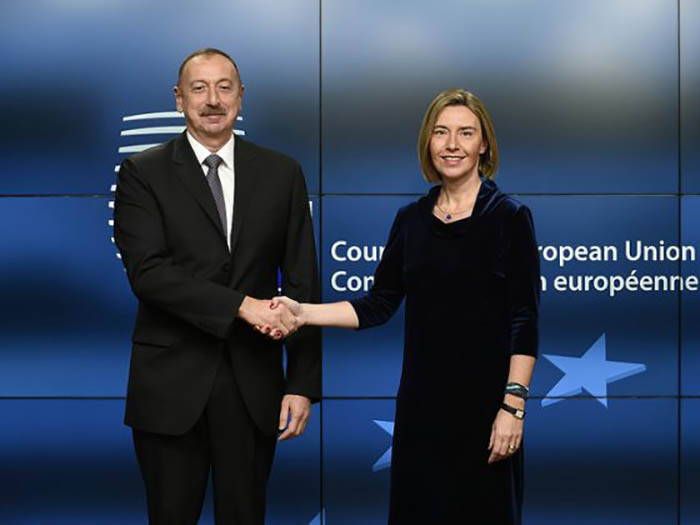
Federica Mogherini and Ilham Aliyev. Credit: EEAS/CC BY
A coalition of 37 human rights NGOs has sent a letter to the EU member state heads and EU leaders ahead of Azerbaijani President Ilham Aliyev’s visit to Brussels to participate in the 5th Eastern Partnership Summit on 24 November 2017. The NGOs urge the EU member state heads and leaders to use the summit to call on president Aliyev to end the current human rights crackdown in Azerbaijan and commit to concrete steps in this regard, including the release of individuals imprisoned on politically motivated charges and reforms of repressive NGO legislation.
The letter was sent on 27 October to the heads and foreign ministers of the 28 EU member states, as well as to EU High Representative for Foreign Affairs and Security Policy Federica Mogherini, EU Commissioner for European Neighbourhood Policy and Enlargement Negotiations Johannes Hahn, EU Commission President Jean-Claude Juncker, European Council President Donald Tusk and European Parliament President Antonio Tajani. The letter (as addressed to Federica Mogherini) can be read below or downloaded here.
Subject: Human Rights in Azerbaijan on the eve of the Eastern Partnership Summit
Brussels, 27 October 2017
Dear Ms Federica Mogherini,
We, the undersigned organisations, are writing ahead of Azerbaijani President Ilham Aliyev’s visit to Brussels to participate in the 5th Eastern Partnership Summit on 24 November. We urge you to use any opportunity you will have during the summit to call on president Aliyev to end the human rights crackdown and commit to concrete and sustainable human rights reforms in Azerbaijan. These include releasing individuals imprisoned on bogus, politically motivated charges; and reforming legislation that effectively prevents independent non-governmental organisations from operating and accessing funding.
Among the 20 Deliverables for the Eastern Partnership by 2020, the European Union has, notably, identified a vibrant civil society as a pre-requisite for “democratic, stable, prosperous and resilient communities and nations.”
Yet in recent years, the Azerbaijani government’s actions sharply contradict the latter and the spirit of this important Eastern Partnership commitment. Azerbaijan has adopted and enforced laws and regulations that severely restrict, rather than foster, a vibrant civil society. It has eliminated independent media, heavily filtered internet, and imprisoned and otherwise sought to silence independent journalists, civic and political activists who are essential to any kind of civil society envisaged by the Eastern Partnership.
The government’s continued crackdown on civil society and independent media has coincided with negotiations on the new, enhanced bilateral agreement between the EU and Azerbaijan. We firmly believe that the pace of those negotiations should largely depend on the progress Azerbaijan is willing to make in respect for fundamental rights.
Although in 2016 the government released 17 unjustly imprisoned human rights defenders and government critics, their convictions stand, and some face travel restrictions and are unable to do their work without undue government interference; those released on suspended sentences could also be sent back to prison. The authorities continue to use bogus, tax-related, and other politically motivated criminal charges to jail critical journalists and bloggers; at least 11 of them are currently in prison.
Azerbaijan is ranked 162nd out of 180 countries in Reporters Without Borders’ 2017 World Freedom Index. In May 2017, unidentified people abducted journalist Afgan Mukhtarli in neighbouring Georgia and illegally brought him to Azerbaijan, where the authorities pressed bogus criminal charges against him. In August, the authorities launched an investigation against Azerbaijan’s last remaining independent news agency, Turan, and a criminal case against its founder and chief editor, Mehman Aliyev, who is now under house arrest on trumped-up tax evasion and other charges. In May 2017, authorities blocked the websites of Azadliq, the newspaper of one of Azerbaijan’s main opposition parties, and of three news outlets that have to operate from abroad: Radio Free Europe/Radio Liberty (RFE/RL) Azerbaijan Service, Meydan TV, and Azerbaycan Saati. In March, a court sentenced Mehman Huseynov, the chairman of the Institute for Reporters’ Freedom and Safety (IRFS), and well-known anti-corruption blogger, to two years in prison for allegedly defaming the staff of a police station. Huseynov had publicized how several police officers arbitrarily detained and beat him, and used electric shock against him in January.
Many government critics or political opposition activists remain behind bars. Among them is Ilgar Mammadov, the leader of a pro-democracy opposition movement who in 2013 tried to run for president and who has been in prison since his arrest in early 2013 on fabricated charges of inciting violent protests. The government has ignored a judgment of the European Court of Human Rights and defied nearly a dozen resolutions by the Committee of Ministers of the Council of Europe calling for Ilgar Mammadov’s release. On 25 October, the Committee took the unprecedented decision and triggered the infringement proceedings against Azerbaijan, provided by Article 46 § 4 of the European Convention, following its failure to implement the Court’s judgment on Mammadov’s case. The proceedings could eventually lead to the Council of Europe sanctioning Azerbaijan, for example by suspending its voting rights in the Parliamentary Assembly.
Non-governmental organisations in Azerbaijan face serious obstacles to operating due to laws and regulations that require both donors and grantees to separately obtain government approval for every grant under consideration. The government has used broad discretion to deny this approval, and the authorities have convicted and imprisoned NGO leaders who failed to obtain it.
In January 2017, the Cabinet of Ministers slightly simplified the procedure by which non-governmental groups must register their funding, but this has not reduced the discretion the authorities have to arbitrarily deny funding approval.
Since 2015, Azerbaijan’s status in two international initiatives has been downgraded due to the government’s failure to meet specific commitments to foster civil society. These include suspension of Azerbaijan’s status by the Extractive Industries Transparency Initiative (EITI), which promotes revenue transparency in the gas, oil, and mining industries, and downgrading to ‘inactive’ status by the Open Government Partnership, a voluntary initiative promoting government transparency and accountability.
In October 2017, the Parliamentary Assembly of the Council of Europe adopted two strongly worded resolutions on Azerbaijan, urging the government to cease its unrelenting crackdown against critics.
At a time when the Azerbaijani government’s defiance of its civil-society commitments has prompted two standards-based organisations to downgrade Azerbaijan’s status, and has driven the Council of Europe member states to take unprecedented collective action on Azerbaijan’s blatant breach of the European Convention, the European Union appears eager to conclude a partnership agreement with the government.
The European Union is a values-based institution. While it has common interests with Azerbaijan, shared interests without shared values will not lead to a strong and reliable partnership. Instead, it is likely to lead to a situation in which Azerbaijan believes European values are negotiable. This risk is illustrated by recent investigations by the Organized Crime and Corruption Reporting Project revealing that members of Azerbaijan’s political elite were engaged in establishing and making use of a money laundering scheme and slush fund amounting to USD 2.9 billion, some of which was used to attempt to influence several European politicians to, among other things, whitewash Azerbaijan’s human rights record.
Under these circumstances, it is of the utmost importance that the EU leaders convey the message to President Aliyev that the conclusion of any new agreement between Azerbaijan and the EU, as well as the quality of the EU-Azerbaijan relationship, depends on the Azerbaijani government’s steps to address the EU’s human rights concerns. The EU would send the wrong political message to the Azerbaijani and other governments if it fails to bring meaningful political consequences for the continued detention of critics, human rights defenders and media professionals.
We urge the heads of the EU member states and the EU to abide by the obligations under article 21 of the Lisbon Treaty, as well as the commitments spelled out in the EU’s Strategic Framework for Human Rights and Democracy to “[…] promote human rights in all areas of its external action without exception”. In the most recent Foreign Affairs Council conclusions, the EU and its member states committed to “promoting stronger positions on civic freedoms and against any reduction in the space for civil society to act.”
During your meeting with President Aliyev, at the Eastern Partnership Summit, we urge you to insist on:
The Immediate and unconditional release of Ilgar Mammadov and the prompt and unconditional release of all other wrongfully imprisoned human rights defenders and civil society and political activists who were prosecuted in retaliation for their legitimate activities.
Absolute respect for free speech and media freedoms, including the prompt and unconditional release of all journalists and social media activists wrongfully put in detention; the dropping of all charges against Mehman Aliyev, and an end to the investigation against Turan.
An immediate end to the use of travel bans to arbitrarily restrict freedom of movement and professional activity, including in respect of investigative journalist Khadija Ismaiylova, human rights lawyer Intigam Aliyev, and others.
Reform of laws and regulations on nongovernmental organisations and their access to foreign funding, in accordance with the Venice Commission recommendations.
We thank you for your attention to this important matter.
Signatory organisations:
1. Amnesty International
2. ARTICLE 19
3. Austrian Helsinki Association – For Human Rights and International Dialogue
4. Barys Zvozskau Belarusian Human Rights House
5. Bir Duino
6. Center for Civil Liberties
7. Center for the Development of Democracy and Human Rights
8. Civil Rights Defenders
9. Crude Accountability
10. FIDH, International Federation for Human Rights
11. Freedom Files
12. Freedom House
13. Front Line Defenders
14. Helsinki Foundation for Human Rights
15. Human Rights Center “Viasna”
16. Human Rights Center of Republic of Azerbaijan (HRCA)
17. Human Rights Club
18. Human Rights Monitoring Institute
19. Human Rights Watch
20. Index on Censorship
21. Institute for Reporters’ Freedom and Safety (IRFS)
22. International Media Support (IMS)
23. International Partnership for Human Rights
24. Kazakhstan International Bureau for Human Rights and the Rule of Law
25. KRF Public Alternative
26. Libereco – Partnership for Human Rights (Germany/Switzerland)
27. Macedonian Helsinki Committee
28. Moscow Helsinki Group
29. Natural Resource Governance Institute (NRGI)
30. Netherlands Helsinki Committee
31. Norwegian Helsinki Committee
32. OMCT – World Organisation Against Torture
33. PEN International
34. Public Association “Dignity”
35. Public Verdict Foundation
36. Regional Center for Strategic Studies
37. Reporters Without Borders
