31 Dec 2018 | Bahrain, Bahrain Statements, Campaigns -- Featured, Statements
[vc_row][vc_column][vc_single_image image=”77714″ img_size=”full” add_caption=”yes”][vc_column_text]
Bahrain’s Court of Cassation has upheld human rights activist Nabeel Rajab’s five-year conviction for critical tweets made from his account condemning Saudi-led airstrikes in Yemen and the use of torture at Bahrain’s notorious Jau Prison.
Rajab, the president of the Bahrain Center for Human Rights and a 2012 Index on Censorship Freedom of Expression Award winner, has been sentenced in all to seven years in prison across two separate trials. In February 2018 he was given five years for the tweets in addition to a two-year conviction in June 2017 for “broadcasting fake news” relating to television interviews he gave in 2015, a conviction that remains upheld.
“Nabeel Rajab has suffered relentless harassment and intimidation for expressing opinions,” Jodie Ginsberg, CEO of Index on Censorship, said. “Index reiterates: opinions are not crimes. Bahrain must immediately release Nabeel and we call on Bahrain’s allies — including the UK — to advocate for this in the strongest possible terms.”
Rajab, known for his peaceful involvement in the Bahrain uprising of 2011, had unsuccessfully appealed the tweet convictions on four previous occasions and this was his fifth and final appeal. He has been in prison on a continual basis since June 2016, during which time his health has deteriorated significantly.[/vc_column_text][vc_basic_grid post_type=”post” max_items=”4″ element_width=”6″ grid_id=”vc_gid:1546244962795-53b7fef4-60df-3″ taxonomies=”3368″][/vc_column][/vc_row]
18 Dec 2018 | Bahrain, Bahrain Statements, Campaigns, Campaigns -- Featured
[vc_row][vc_column][vc_single_image image=”80241″ img_size=”full” add_caption=”yes”][vc_column_text]We the undersigned call on Bahraini authorities to release Nabeel Rajab immediately, to repeal his convictions and sentences, and drop all charges against him. On 31 December 2018 the Court of Cassation in Bahrain may issue its verdict in the appeal of the five-year prison sentence handed to him for peaceful comments posted and retweeted on his Twitter account about the killing of civilians in the Yemen conflict by the Saudi Arabia-led coalition, and allegations of torture in Jau prison.
We are concerned that the authorities intend to increase Rajab’s prison sentence unopposed, by setting 31 December as the date for a hearing and possible issuing of a verdict, while most Bahrainis and people around the globe will be focused on year-end celebrations. This is not an idle concern, as, opposition leader Sheikh Ali Salman was arrested on 28 December 2014 and subsequently convicted and sentenced to four years in jail following an unfair trial. And last month, in yet another case brought against him on spying charges, the Court of Appeal overturned his initial acquittal and sentenced him instead to life in prison.
Rajab has been a tireless champion of human rights for many years, helping to found and run the Bahrain Center for Human Rights and the Gulf Centre for Human Rights, both members of the IFEX network.
He has been detained since his arrest on 13 June 2016. He was held largely in solitary confinement during the first nine months of his detention, violating UN rules on pre-trial imprisonment, and has been subjected to humiliating treatment. His books, toiletries, and clothes have been confiscated and his cell frequently raided at night.
Rajab was sentenced to two years in jail in 2017 on charges of “publishing and broadcasting false news that undermines the prestige of the state” during TV interviews he gave in 2015 and 2016 in which he stated that Bahraini authorities bar reporters and human rights workers from entering the country. He was sentenced in 2018 to five years in prison on charges of “disseminating false rumors in times of war” for tweets about torture in Jau Prison and the war in Yemen.
At its eighty-first session, 17-26 April 2018, the Working Group on Arbitrary Detention concluded that Rajab’s “deprivation of liberty constitutes a violation of articles 2 and 7 of the Universal Declaration of Human Rights and articles 2 (1) and 26 of the Covenant – on the grounds of discrimination based on political or other opinion, as well as on his status as a human rights defender”.
We therefore urge Bahraini authorities to immediately and unconditionally release Nabeel Rajab, quash his convictions and sentences, and drop all charges against him; and undertake a prompt, impartial, independent and effective investigation into his allegations of ill-treatment. The findings of the investigation must be made public and anyone suspected of criminal responsibility must be brought to justice in fair proceedings.
As this case is part of a pattern of abuse and harassment against human rights defenders and journalists in Bahrain, we also urge the authorities to cease all such actions and ensure that the right to freedom of expression and freedom of the press is respected.
Signed,
Bahrain Center for Human Rights
ActiveWatch – Media Monitoring Agency
Adil Soz – International Foundation for Protection of Freedom of Speech
Africa Freedom of Information Centre (AFIC)
Americans for Democracy & Human Rights in Bahrain (ADHRB)
Arabic Network for Human Rights Information (ANHRI)
Association for Freedom of Thought and Expression (AFTE)
Association of Caribbean Media Workers
Bytes for All (B4A)
Cairo Institute for Human Rights Studies (CIHRS)
Cambodian Center for Human Rights (CCHR)
Electronic Frontier Foundation (EFF)
Foro de Periodismo Argentino
Freedom Forum
Free Media Movement
Globe International Center
Gulf Centre for Human Rights (GCHR)
Human Rights Watch (HRW)
I’lam Arab Center for Media Freedom Development and Research
Independent Journalism Center (IJC)
Index on Censorship
Initiative for Freedom of Expression – Turkey
International Press Centre (IPC)
Maharat Foundation
Mediacentar Sarajevo
Media, Entertainment and Arts Alliance
Media Institute of Southern Africa (MISA)
Media Rights Agenda (MRA)
Media Watch
Norwegian PEN
OpenMedia
Pacific Freedom Forum (PFF)
Pacific Islands News Association (PINA)
Palestinian Center for Development and Media Freedoms (MADA)
PEN America
Reporters Without Borders (RSF)
Social Media Exchange (SMEX)
Southeast Asian Press Alliance (SEAPA)
South East European Network for Professionalization of Media (SEENPM)
South East Europe Media Organisation
Syrian Center for Media and Freedom of Expression (SCM)
World Association of Community Radio Broadcasters (AMARC)
World Association of Newspapers and News Publishers
Amnesty International
Bahrain Institute for Human Rights
Bahrain Interfaith
Campaign Against Arms Trade
CIVICUS
FIDH under the Observatory for the Protection of Human Rights Defenders
Frontline Defenders
Gulf Institute for Human Rights
ISHR
Martin Annals
MENA Monitoring Group
OMCT under the Observatory for the Protection of Human Rights Defenders
RAFTO
Salam for Democracy and Human Rights[/vc_column_text][vc_basic_grid post_type=”post” max_items=”4″ element_width=”6″ grid_id=”vc_gid:1545127071633-da20ca65-6e8f-0″ taxonomies=”3368, 716″][/vc_column][/vc_row]
13 Sep 2018 | Bahrain, Bahrain News, Middle East and North Africa, News
[vc_row][vc_column][vc_column_text]
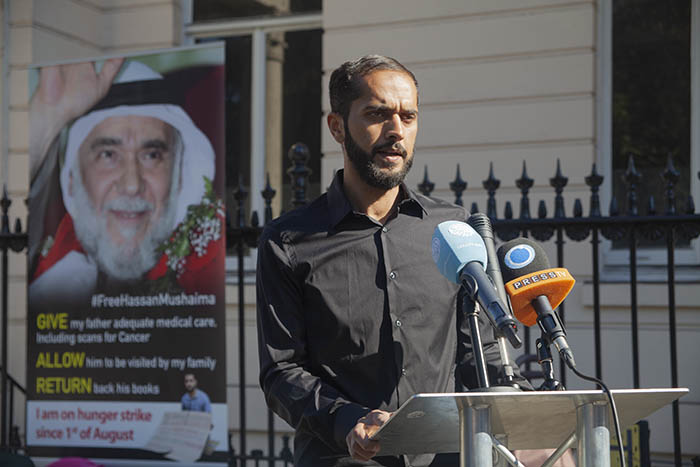
Ali Mushaima gives press conference in front of the Bahrain Embassy in London. (Credit: Gillian Trudeau)
At a press conference outside the Bahraini Embassy in London on 13 September, Bahraini human right activist Ali Mushaima vowed to continue fighting for his 70-year-old father Hassan Mushaima, who was imprisoned in 2011 as part of a crackdown on political activists in the country.
Mushaima said: “After 44 days many friends have argued for me to end my hunger strike. I even received a message from Nabeel Rajab in prison. But what affected me the most was my father telling me how scared he was that there I was hospitalised. I will not end my hunger strike but I will start a liquid diet that will include soups. My body needs to recover but if my father’s basic rights are not met, which is full medical care, family visits and access to books, I’m ready to resume my full hunger strike not because it’s easy and not because it is life-threatening, but because I will never stop fighting for my dad and for our cause.”
Human rights activist Zainab Al Khawaja, who has joined Mushaima’s demonstration after travelling from Denmark, was thanked for her solidarity. Khawaja’s activism has seen her arrested twice in Bahrain, once while pregnant and once with her infant son. Like Hassan Mushaima, Al Khawaja’s father, Abdulhadi Al Khawaja, faces possible life imprisonment.
Outside the Bahraini Embassy, Mushaima also expressed his gratitude towards MPs such as Caroline Lucas and Ian Blackford for raising his father’s case and shedding light on the suffering of political prisoners in Bahrain. His strike has garnered global recognition, going as far as being mentioned by the Human Rights Council in Geneva.
The British Government’s decision to support “false” statements made by the Bahraini Government was highlighted by Mushaima. He believes the UK has been part of the problem rather than the solution, alleging Britain has spent millions of pounds of taxpayers’ money to train Bahrain police violence and to teach them how to whitewash their crimes. Last month Mushaima asked for the Queen’s assistance, citing her friendship with the king of Bahrain as one of the many ways she could help influence the case.
Andrew Smith, who works for Campaign Against Arms Trade, was on hand to show his support. He said: “We want to express our support for Ali’s demands and solidarity with the stands that he has taken. This hunger strike should never have had to happen. The Bahraini regime should never be treating prisoners the way that they have treated Ali’s father. The UK Government should not be arming and supporting such a brutal, oppressive regime which has carried out atrocities against its people for years and has treated Ali’s father, and many other prisoners, absolutely appallingly.”
Background:
In response to Mushaima’s hunger strike, Hassan Mushaima received a cancer scan and has been given access to vital medication that was previously unavailable to him, but several issues remain:
In January 2018, Hassan Mushaima was told by a doctor at the Bahrain Defence Force Hospital that he urgently needs to see a diabetes specialist. He has not been granted access to a consultation yet by the authorities.
In October 2017, Hassan Mushaima’s books, personal notes, and writing materials were confiscated for no reason. They may have been destroyed.
Hassan Mushaima continues to be denied his right to family visitation without being subjected to humiliating measures, including being shackled. He last saw his family 18 months ago, in February 2017.
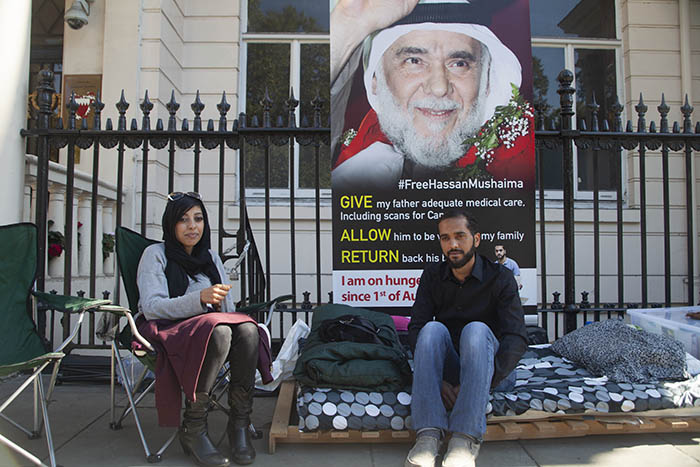
Bahraini human rights activists Zainab al-Khawaja and Ali Mushaima outside of the Bahrain Embassy in London. (Credit: Gillian Trudeau)
[/vc_column_text][/vc_column][/vc_row][vc_row][vc_column][vc_basic_grid post_type=”post” max_items=”4″ element_width=”6″ grid_id=”vc_gid:1537179808073-af3ba6e6-3e04-5″ taxonomies=”716″][/vc_column][/vc_row]
6 Sep 2018 | Index in the Press
Margaret Atwood, Elif Shafak and Ali Smith are just two among a group of leading writers piling pressure on the Bahraini king to intervene in the case of a detained political leader who was stripped of the right to read in jail. Read the full article
