29 Apr 2020 | News
[vc_row][vc_column][vc_column_text]Attacks on press freedom in Europe are at serious risk of becoming a new normal, 14 international press freedom groups and journalists’ organisations including Index on Censorship warn today as they launch the 2020 annual report of the Council of Europe Platform to Promote the Protection of Journalism and the Safety of Journalists. The fresh assault on media freedom amid the Covid-19 pandemic has worsened an already gloomy outlook.
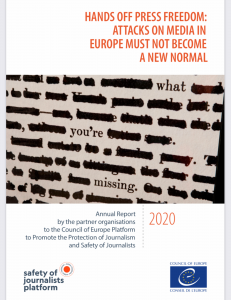 The report analyses alerts submitted to the platform in 2019 and shows a growing pattern of intimidation to silence journalists in Europe. The past weeks have accelerated this trend, with the pandemic producing a new wave of serious threats and attacks on press freedom in several Council of Europe member states. In response to the health crisis, governments have detained journalists for critical reporting, vastly expanded surveillance and passed new laws to punish “fake news” even as they decide themselves what is allowable and what is false without the oversight of appropriate independent bodies.
These threats risk a tipping point in the fight to preserve a free media in Europe. They underscore the report’s urgent wake-up call on Council of Europe member states to act quickly and resolutely to end the assault against press freedom, so that journalists and other media actors can report without fear.
Although the overall response rate by member states to the platform rose slightly to 60 % in 2019, Russia, Turkey, and Azerbaijan – three of the biggest media freedom violators – continue to ignore alerts, together with Bosnia and Herzegovina.
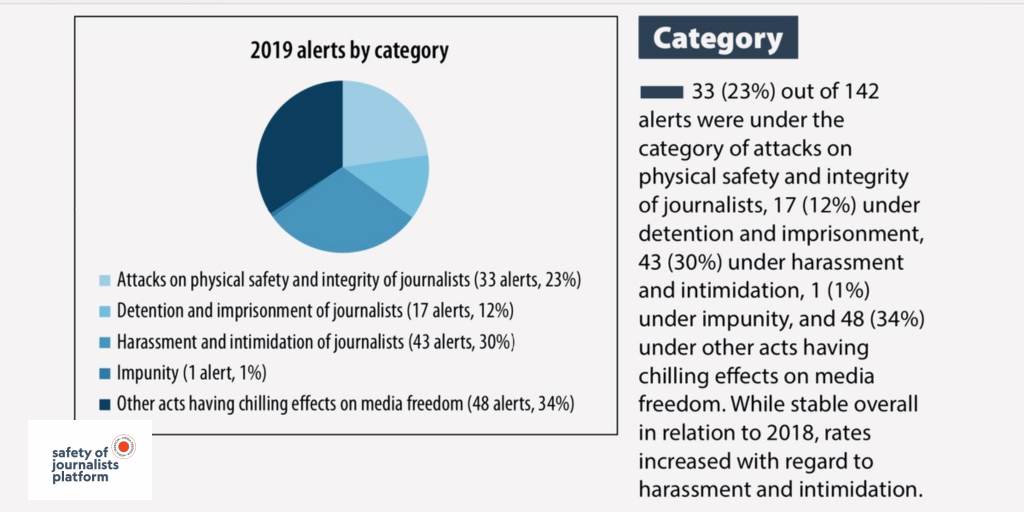
2019 was already an intense and often dangerous battleground for press freedom and freedom of expression in Europe. The platform recorded 142 serious threats to media freedom, including 33 physical attacks against journalists, 17 new cases of detention and imprisonment and 43 cases of harassment and intimidation.
The physical attacks tragically included two killings of journalists: Lyra McKee in Northern Ireland and Vadym Komarov in Ukraine. Meanwhile, the platform officially declared the murders of Daphne Caruana Galizia (2017) in Malta and Martin O’Hagan (2001) in Northern Ireland as impunity cases, highlighting authorities’ failure to bring those responsible to justice. Only Slovakia showed concrete progress in the fight against impunity, indicting the alleged mastermind and four others accused of murdering journalist Ján Kuciak and his fiancée, Martina Kušnírová.
At the end of 2019, the platform recorded 105 cases of journalists behind bars in the Council of Europe region, including 91 in Turkey alone. The situation has not improved in 2020. Despite the acute health threat, Turkey excluded journalists from a mass release of inmates in April 2020, and second-biggest jailer Azerbaijan has made new arrests over critical coverage of the country’s coronavirus response.
2019 saw a clear increase in judicial or administrative harassment against journalists, including meritless SLAPP cases, and spurious and politically motivated legal threats. Prominent examples were the false drug charges filed against Russian investigative journalist Ivan Golunov and the continued imprisonment of journalists in Ukraine’s Russia-controlled Crimea. The Covid-19 crisis has strengthened officials’ tools to harass journalists, with dangerous new “fake news” laws in countries such as Hungary and Russia that threaten journalists with jail for contravening the official line.
Other serious issues identified by 2019 alerts included expanded surveillance measures threatening journalists’ ability to protect their sources, including in France, Poland and Switzerland, as well political attempts to “capture” media through ownership and market manipulation, most conspicuously of all in Hungary. These threats, too, are exacerbated by the actions taken by several governments under the health crisis, which further include arbitrary limitations on independent reporting and on journalists’ access to official information about the pandemic.
Jessica Ní Mhainín, Index’s policy research and advocacy officer, says, “There is a growing pattern of intimidation aimed at silencing journalists in Europe. The situation in Eastern Europe – especially in Hungary, Poland, and Bulgaria – is particularly concerning. But the killing of Lyra McKee shows that we cannot take the safety of journalists for granted anywhere – not even in countries that are seen to be safe for journalists. This report provides an opportunity for us all to come to grips with the serious situation that is facing European media and to remind ourselves of the vital role that the media play in holding power to account.”
Index and the other platform partners call for urgent scrutiny of action taken by governments to claim extraordinary powers related to freedom of expression and media freedom under emergency legislation that are not strictly necessary and proportionate in response to the pandemic. Uncontrolled and unlimited state of emergency laws are open to abuse and have already had a severe chilling effect on the ability of the media to report and scrutinise the actions of state authorities.
While the platform welcomes an increased focus on press freedom by European institutions, including both the Council of Europe and European Union institutions, the ongoing crisis demands more urgent and stringent responses to protect media freedom and freedom of expression and information, and to support the financial sustainability of independent professional journalism. In the age of emergency rule, protecting the press as the watchdog of democracy cannot wait.[/vc_column_text][/vc_column][/vc_row]
30 Mar 2020 | Magazine, Magazine Contents, Volume 49.01 Spring 2020
[vc_row][vc_column][vc_custom_heading text=”With contributions from Ak Welsapar, Julian Baggini, Alison Flood, Jean-Paul Marthoz and Victoria Pavlova”][/vc_column][/vc_row][vc_row][vc_column][vc_column_text]
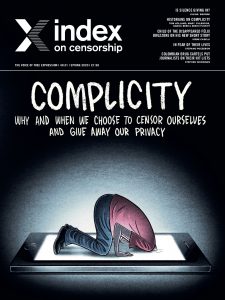 The Spring 2020 issue of Index on Censorship magazine looks at our own role in free speech violations. In this issue we talk to Swedish people who are willingly having microchips inserted under their skin. Noelle Mateer writes about living in China as her neighbours, and her landlord, embraced video surveillance cameras. The historian Tom Holland highlights the best examples from the past of people willing to self-censor. Jemimah Steinfeld discusses holding back from difficult conversations at the dinner table, alongside interviewing Helen Lewis on one of the most heated conversations of today. And Steven Borowiec asks why a North Korean is protesting against the current South Korean government. Plus Mark Frary tests the popular apps to see how much data you are knowingly – or unknowingly – giving away.
In our In Focus section, we sit down with different generations of people from Turkey and China and discuss with them what they can and cannot talk about today compared to the past. We also look at how as world demand for cocaine grows, journalists in Colombia are increasingly under threat. Finally, is internet browsing biased against LBGTQ stories? A special Index investigation.
Our culture section contains an exclusive short story from Libyan writer Najwa Bin Shatwan about an author changing her story to people please, as well as stories from Argentina and Bangladesh.
[/vc_column_text][/vc_column][/vc_row][vc_row][vc_column][vc_custom_heading text=”Special Report”][/vc_column][/vc_row][vc_row][vc_column][vc_column_text]Willingly watched by Noelle Mateer: Chinese people are installing their own video cameras as they believe losing privacy is a price they are willing to pay for enhanced safety
The big deal by Jean-Paul Marthoz: French journalists past and present have felt pressure to conform to the view of the tribe in their reporting
Don’t let them call the tune by Jeffrey Wasserstrom: A professor debates the moral questions about speaking at events sponsored by an organisation with links to the Chinese government
Chipping away at our privacy by Nathalie Rothschild: Swedes are having microchips inserted under their skin. What does that mean for their privacy?
There’s nothing wrong with being scared by Kirsten Han: As a journalist from Singapore grows up, her views on those who have self-censored change
How to ruin a good dinner party by Jemimah Steinfeld: We’re told not to discuss sex, politics and religion at the dinner table, but what happens to our free speech when we give in to that rule?
Sshh… No speaking out by Alison Flood: Historians Tom Holland, Mary Fulbrook, Serhii Plokhy and Daniel Beer discuss the people from the past who were guilty of complicity
Making foes out of friends by Steven Borowiec: North Korea’s grave human rights record is off the negotiation table in talks with South Korea. Why?
Nothing in life is free by Mark Frary: An investigation into how much information and privacy we are giving away on our phones
Not my turf by Jemimah Steinfeld: Helen Lewis argues that vitriol around the trans debate means only extreme voices are being heard
Stripsearch by Martin Rowson: You’ve just signed away your freedom to dream in private
Driven towards the exit by Victoria Pavlova: As Bulgarian media is bought up by those with ties to the government, journalists are being forced out of the industry
Shadowing the golden age of Soviet censorship by Ak Welsapar: The Turkmen author discusses those who got in bed with the old regime, and what’s happening now
Silent majority by Stefano Pozzebon: A culture of fear has taken over Venezuela, where people are facing prison for being critical
Academically challenged by Kaya Genç: A Turkish academic who worried about publicly criticising the government hit a tipping point once her name was faked on a petition
Unhealthy market by Charlotte Middlehurst: As coronavirus affects China’s economy, will a weaker market mean international companies have more power to stand up for freedom of expression?
When silence is not enough by Julian Baggini: The philosopher ponders the dilemma of when you have to speak out and when it is OK not to[/vc_column_text][/vc_column][/vc_row][vc_row][vc_column][vc_custom_heading text=”In Focus”][vc_column_text]Generations apart by Kaya Genç and Karoline Kan: We sat down with Turkish and Chinese families to hear whether things really are that different between the generations when it comes to free speech
Crossing the line by Stephen Woodman: Cartels trading in cocaine are taking violent action to stop journalists reporting on them
A slap in the face by Alessio Perrone: Meet the Italian journalist who has had to fight over 126 lawsuits all aimed at silencing her
Con (census) by Jessica Ní Mhainín: Turns out national censuses are controversial, especially in the countries where information is most tightly controlled
The documentary Bolsonaro doesn’t want made by Rachael Jolley: Brazil’s president has pulled the plug on funding for the TV series Transversais. Why? We speak to the director and publish extracts from its pitch
Queer erasure by Andy Lee Roth and April Anderson: Internet browsing can be biased against LGBTQ people, new exclusive research shows[/vc_column_text][/vc_column][/vc_row][vc_row][vc_column][vc_custom_heading text=”Culture”][vc_column_text]Up in smoke by Félix Bruzzone: A semi-autobiographical story from the son of two of Argentina’s disappeared
Between the gavel and the anvil by Najwa Bin Shatwan: A new short story about a Libyan author who starts changing her story to please neighbours
We could all disappear by Neamat Imam: The Bangladesh novelist on why his next book is about a famous writer who disappeared in the 1970s[/vc_column_text][/vc_column][/vc_row][vc_row][vc_column][vc_custom_heading text=”Index around the world”][vc_column_text]Demand points of view by Orna Herr: A new Index initiative has allowed people to debate about all of the issues we’re otherwise avoiding[/vc_column_text][/vc_column][/vc_row][vc_row][vc_column][vc_custom_heading text=”Endnote”][vc_column_text]Ticking the boxes by Jemimah Steinfeld: Voter turnout has never felt more important and has led to many new organisations setting out to encourage this. But they face many obstacles[/vc_column_text][/vc_column][/vc_row][vc_row][vc_column width=”1/3″][vc_custom_heading text=”Subscribe”][vc_column_text]In print, online, in your mailbox, on your iPad.
Subscription options from £18 or just £1.49 in the App Store for a digital issue.
Every subscriber helps support Index on Censorship’s projects around the world.
 SUBSCRIBE NOW[/vc_column_text][/vc_column][vc_column width=”1/3″][vc_custom_heading text=”Read”][vc_column_text]The playwright Arthur Miller wrote an essay for Index in 1978 entitled The Sin of Power. We reproduce it for the first time on our website and theatre director Nicholas Hytner responds to it in the magazine
READ HERE[/vc_column_text][/vc_column][vc_column width=”1/3″][vc_custom_heading text=”Listen”][vc_column_text]In the Index on Censorship autumn 2019 podcast, we focus on how travel restrictions at borders are limiting the flow of free thought and ideas. Lewis Jennings and Sally Gimson talk to trans woman and activist Peppermint; San Diego photojournalist Ariana Drehsler and Index’s South Korean correspondent Steven Borowiec
LISTEN HERE[/vc_column_text][/vc_column][/vc_row]
1 May 2019
[vc_row full_width=”stretch_row_content_no_spaces” full_height=”yes” css=”.vc_custom_1556706810688{background-image: url(https://www.indexoncensorship.org/wp-content/uploads/2019/01/index-report-online-harassment-cover-banner.png?id=104886) !important;background-position: center !important;background-repeat: no-repeat !important;background-size: contain !important;}”][vc_column][/vc_column][/vc_row][vc_row][vc_column][vc_custom_heading text=”Targeting the messenger: Journalists face an onslaught of online harassment” font_container=”tag:h1|text_align:left” use_theme_fonts=”yes”][vc_custom_heading text=”Mapping Media Freedom correspondents and other journalists discuss their experiences with harassment in the digital realm that has become so commonplace that it is underreported and underestimated.” use_theme_fonts=”yes”][vc_column_text]
“This reporter should be raped.”
This was the response from online trolls to Polish journalist Ada Borowicz after she published the story of an attack on a woman in Italy. Borowicz’s ‘crime’, apparently, was to have published the report without referring to the fact the attackers were alleged to have been migrants. Writing on Facebook Paweł Kukiz, a member of parliament and the leader of the right-wing populist movement Kukiz’15, described Borowicz’s reporting as “scandalous”.
Borowicz, who is also Mapping Media Freedom’s correspondent for Poland, was suspended from duties, and recalled from the assignment. Though her management did not give any explanation, she was told by a colleague that she was being punished on account of Kukiz’s Facebook post. The online threats followed.
When her contract with the government-controlled TVP Info was due to be renewed, an extension was not forthcoming.
Borowicz told Mapping Media Freedom that the story “was supposed to serve as an excuse not to welcome migrants. When my editors realised I wasn’t using harsh words against migrants they weren’t happy. A politician criticised me and then I was surprised to realise how aggressive internet users could be”.
Borowicz’s experience is all too familiar to many journalists, particularly women, throughout the 35 nations that are either European Union members or candidates for entry to the EU. Some 176 cases of online harassment were reported by Mapping Media Freedom correspondents between May 2014 and September 2018 – or one a week. These reports represent just a sliver of the threats against employment, of physical and sexual violence, and of death. Women journalists face malicious threats and are subjected to an extra layer of harassment invoking their gender in a sexually threatening and degrading way. The harassment is often the result of “dog-piling” – as in Borowicz’s case – or the product of an ongoing campaign by a determined troll.[/vc_column_text][vc_single_image image=”106541″ img_size=”full”][vc_row_inner][vc_column_inner width=”1/4″][vc_icon icon_fontawesome=”fa fa-file-pdf-o” color=”black” background_style=”rounded” size=”xl” align=”right”][/vc_column_inner][vc_column_inner width=”3/4″][vc_column_text]
[/vc_column_text][/vc_column_inner][/vc_row_inner][vc_custom_heading text=”Tip of the iceberg” font_container=”tag:h3|text_align:left” use_theme_fonts=”yes”][vc_column_text]The cases in this report represent only the tip of the iceberg. Mapping Media Freedom correspondents – and investigations into online harassment published by Amnesty International, Reporters Without Borders and the International Federation of Journalists – have repeatedly told us that journalists don’t report all the harassment they receive on social media to their unions or the police, which means the number of publicised incidents far from reflects the true magnitude of the problem.
One of the reasons journalists don’t report online harassment is they get used to it and end up seeing it as being part of the job. Ilcho Cvetanoski, an Mapping Media Freedom Balkans correspondent, said: “One continues to report and report incidents to the police. And then at some point one stops reporting them, because it’s easy to end up thinking online harassment is normal.”[/vc_column_text][vc_row_inner][vc_column_inner][vc_custom_heading text=”A wave of abuse” font_container=”tag:h3|text_align:left” use_theme_fonts=”yes”][vc_column_text]Journalists also occasionally feel it’s not safe to speak up about the harassment they have suffered online, fearing it could make things worse and spark a backlash, leading to yet more abuse. Adrien Sénécat, a journalist at Les Décodeurs, Le Monde’s fact-checking section, which engages with readers and verifies stories that have gone viral, says the problem of online harassment is something that concerns him and his team directly. He has thought about reporting incidents – particularly libellous videos – to the police “but feared a Streisand effect so [I] didn’t”.
The online harassment of journalists can take the form of a wave of abuse directed at them. Sénécat likens it to aggressive school bullying. “When you write a story touching certain groups, it prompts very violent reactions which are not limited to the comments of the article but extend to your Twitter mentions, your direct messages, your emails,” he said. “And it can go further – in public forums, for instance. I did a story on bullying in schools, and this [continual] wave of notifications reminded me of how kids would be receiving bullying messages until four in the morning.”
Online harassment can also extend to real life, such as when information about a journalist’s address is published online – “doxing” – and the threats move offline.
Journalists describe feeling surprised at and being unprepared for the violence directed at them, and at the pack mentality of abusive internet users.[/vc_column_text][/vc_column_inner][/vc_row_inner][vc_custom_heading text=”Targeting women” font_container=”tag:h3|text_align:left” use_theme_fonts=”yes”][vc_column_text]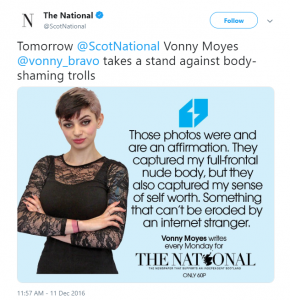 A recent report by Amnesty International confirms women are particularly at risk of being insulted and intimidated on Twitter, and tend to be specifically targeted with an additional layer of violence if they are from a minority group. Women who have a public profile, such as politicians and journalists, suffer insults and threats, with private photos being leaked and published online.
In 2014, the International Women’s Media Foundation (IWMF) reported that two thirds of women polled in an international survey said they had been victims of online harassment.
In 2016, stolen nude photos of Vonny Leclerc (formerly Moyes), a journalist for Scottish newspaper The National, were posted online. She refused to be shamed, and tweeted: “This is the reality of being a female journalist right now. People like you try to use our own bodies against us. All the time.” She then published a nude photo of herself, saying nudity was not an object of shame for her.
Borowicz said: “As a woman, you are always a double target, since you are targeted as a professional and as a woman.”
Meanwhile, Lazara Marinkovic, Mapping Media Freedom’s correspondent in Serbia, said: “For women journalists, people always use the same low blows, based on looks, calling [them whores].”[/vc_column_text][vc_custom_heading text=”Toxic environments” font_container=”tag:h3|text_align:left” use_theme_fonts=”yes”][vc_column_text]When describing the media landscape in countries where there are large numbers of online harassment cases against journalists, our correspondents talk about toxic and polarised environments and of media landscapes largely controlled by governments (such as those in Poland and Serbia).
Marinkovic said: “Calling journalists, NGO workers or whoever is speaking critically about the government, traitors is a very common thing in Serbia. There is a very toxic environment in the media and on social media. There is a mob media mentality. I feel it’s getting much worse.”
She added: “Our ruling party has paid an army of bots to comment. Even the so-called democratic parties hire people to support their agenda online. They usually write positive comments [under pro-government articles] or follow a signal after a politician attacks a member of the opposition.”
Several of the cases on our database started with politicians abusing journalists online before continuing with media outlets running smear campaigns against them, and internet users perpetuating the abuse.[/vc_column_text][vc_custom_heading text=”Impunity” font_container=”tag:h3|text_align:left” use_theme_fonts=”yes”][vc_column_text]Cvetanoski believes a sense of impunity is one of the main reasons online harassment is happening.
“It’s quite easy to harass someone online. People think it’s a safe way to threaten someone,” he said. For example, in August 2018, a satirical comedian on Croatian TV received a death threat on Facebook, and was told “I know where and when you travel” and “You will get one in the back of the head, too, I swear”. When the police discovered that the harasser was a man from Split, the suspect confessed and said sorry, but he also expressed surprised that the police had managed to find him.
Journalists wanting to report online harassment often struggle with a lack of support or preparedness from online platforms, online publications and the police.
Sénécat points at Twitter’s failure to take action. “There’s a problem with Twitter, which doesn’t consider threats are threats unless people are saying ‘I am going to kill you’,” he said.
Meanwhile, referring to Serbia, Marinkovic said: “We have this prosecution office for online harassment. You can report, but they have so many cases and so many other priorities. When people report something they have to bring printed copies of the threats. It’s hard to picture how they operate.”[/vc_column_text][vc_custom_heading text=”Silencing journalists?” font_container=”tag:h3|text_align:left” use_theme_fonts=”yes”][vc_column_text]Online harassment can be effective in silencing journalists. When asked whether online harassment has impacted his work and that of his colleagues, Sénécat said: “We get intimidated by these communities. I notice it among my colleagues and me. Either you start battling with these trolls, antagonising them and answering them, [even though] this is not a rational discussion that can be resolved by a conversation, or you get intimidated, scared of writing about certain topics.
“For instance, if you write about Ulcan [a Franco-Israeli Zionist activist who repeatedly targets journalists whose views he disagrees with], you’ll be scared he’ll end up calling your family, causing your dad to have a heart attack, and you’re aware that writing about certain topics will mean you receive a lot of insults in your inbox.”
Across Europe, journalists are aware that reporting on certain topics is likely to spark online (and possibly offline) harassment against them. These sensitive themes include corruption (such as the mishandling of European funds in Bulgaria, which sparked harassment against investigative website Bivol), organised crime, women’s issues, toxic masculinity and online abuse (journalists reporting on trolling are often targeted), LGBT issues, the migrant crisis (in Greece, journalists reporting on the issue have been repeatedly targeted by supporters of the far-right Golden Dawn party), histories of conflicts (such as the 1990s Balkans war), and the far-right.[/vc_column_text][vc_custom_heading text=”Nadia Daam – a turning point in France” font_container=”tag:h3|text_align:left” use_theme_fonts=”yes”][vc_column_text]
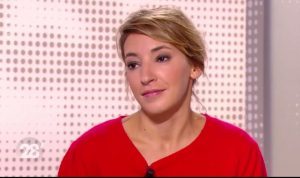
Nadia Daam
The Nadia Daam case in France was seen as a turning point for online harassment cases. It showed that what is illegal offline is also illegal online.
In November 2017 Daam was subjected to an online harassment campaign after a broadcast on Europe 1 radio in which she discussed online forum Blabla 18-25. The users of the forum had flooded a phone number created by two activists keen to fight sexual harassment. Daam called the forum the “internet’s bin of non-recyclable trash”.
Following the broadcast, Daam was targeted on social media – particularly on Twitter. Libération reported that this abuse included pornographic insults, death threats and threats to her child. Her email address was used to subscribe her to pornographic and paedophile websites. There was also an overnight attempt to break into her house.
Daam published the threats she had received on her Twitter account. Two days later, Europe 1 announced she was suing. After a trial in July 2018, two men were given six-month suspended jail sentences and fined €6,000 for threatening Daam online. A third person threatened her and was given a six-month suspended sentence.
“A trial is already a victory,” the journalist said. “Online harassment is not bound to stop tomorrow but the message this trial is sending is we are able to track down the abusers.”[/vc_column_text][vc_custom_heading text=”Adrien Sénécat – establishing boundaries for online presence” font_container=”tag:h3|text_align:left” use_theme_fonts=”yes”][vc_column_text]
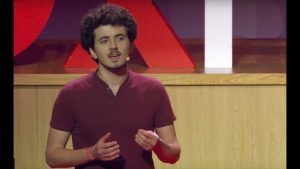
Adrien Sénécat
Adrien Sénécat is adamant that more needs to be done to prepare journalists on how to avoid online harassment.
“This could be talked about in journalism schools. It could be something that outlets tell you when you start a job with them. I always tell students in journalism school to be careful about what can be found about them online,” he said.
After suffering online harassment, he changed his behaviour, reducing his online presence and protecting his private life.
“I’ve deactivated notifications on Twitter,” he said. “Notifications are bad. There’s an accumulation effect. Doing this takes a weight off. You start taking some distance from Twitter and feeling better.”
He also reduced the information on him available online: “I’ve made sure my phone number was unlisted [and] that my address couldn’t be found online. I don’t put photos of my son on Facebook. I’ve changed a lot of things in my behaviour.”
It has also led him to reconsider his priorities as a journalist, which he says are not about building up a public profile on social media and becoming a celebrity but writing stories that start a debate on his publication’s website. He said: “We should start a better conversation about this. Our editors consider we need to write stories but don’t necessarily need to be on Twitter a lot. Twitter is not the space that’s the most important. Spending too much time on it distorts your perspective. Twitter is a space that has been colonised by hordes of malevolent internet users. For me, spending more than one hour on Twitter a day is harmful.”[/vc_column_text][vc_row_inner][vc_column_inner width=”1/2″][vc_column_text]
About this report
This report is part of a series based on data submitted to Mapping Media Freedom. This report reviewed 162 incidents involving investigative journalists from the 35 countries in or affiliated with the European Union between 1 May 2014 and 30 September 2018.
Mapping Media Freedom identifies threats, violations and limitations faced by media workers in 43 countries — throughout European Union member states, candidates for entry and neighbouring countries. The project is co-funded by the European Commission and managed by Index on Censorship as part of the European Centre for Press and Media Freedom (ECPMF).
Index on Censorship is a UK-based nonprofit that campaigns against censorship and promotes freedom of expression worldwide. Founded in 1972, Index has published some of the world’s leading writers and artists in its award-winning quarterly magazine, including Nadine Gordimer, Mario Vargas Llosa, Samuel Beckett and Kurt Vonnegut. Index promotes debate, monitors threats to free speech and supports individuals through its annual awards and fellowship program.
[/vc_column_text][/vc_column_inner][vc_column_inner width=”1/2″][vc_column_text]
Acknowledgements
AUTHOR Valeria Costa-Kostritsky
EDITING Adam Aiken, Sean Gallagher, Ryan McChrystal and Jodie Ginsberg with contributions by Joy Hyvarinen, Paula Kennedy and Mapping Media Freedom correspondents: João de Almeida Dias, Adriana Borowicz, Ilcho Cvetanoski, Jonas Elvander, Amanda Ferguson, Dominic Hinde, Investigative Reporting Project Italy, Linas Jegelevicius, Juris Kaza, David Kraft, Lazara Marinkovic, Fatjona Mejdini, Mitra Nazar, Silvia Nortes, Platform for Independent Journalism (P24), Katariina Salomaki, Zoltan Sipos, Michaela Terenzani, Pavel Theiner, Helle Tiikmaa, Christina Vasilaki, Lisa Weinberger
DESIGN Matthew Hasteley
[/vc_column_text][/vc_column_inner][/vc_row_inner][vc_row_inner][vc_column_inner width=”1/4″][vc_single_image image=”106454″ img_size=”full”][/vc_column_inner][vc_column_inner width=”1/4″][vc_single_image image=”106452″ img_size=”full”][/vc_column_inner][vc_column_inner width=”1/4″][vc_single_image image=”106450″ img_size=”full”][/vc_column_inner][vc_column_inner width=”1/4″][vc_single_image image=”106451″ img_size=”full”][/vc_column_inner][/vc_row_inner][/vc_column][/vc_row]
1 May 2019
[vc_row full_width=”stretch_row_content_no_spaces” full_height=”yes” css=”.vc_custom_1556705695442{background-image: url(https://www.indexoncensorship.org/wp-content/uploads/2019/01/investigative-journalism-cover-2480.png?id=104855) !important;background-position: center !important;background-repeat: no-repeat !important;background-size: contain !important;}”][vc_column][/vc_column][/vc_row][vc_row][vc_column][vc_custom_heading text=”Targeting the messenger: Investigative journalists under extreme pressure” font_container=”tag:h1|text_align:left” use_theme_fonts=”yes”][vc_custom_heading text=”There is a distinct lack of awareness among decision makers about how bad the situation is for journalists reporting on corruption” use_theme_fonts=”yes”][vc_column_text]What do criminals, corrupt corporations and crooked politicians have in common? They all fear investigative journalists, whose job is to expose wrongdoing and hypocrisy by holding the powerful to account.
From the groundbreaking UK-based Bellingcat and the well-regarded multi-national Organised Crime and Corruption Reporting Project, to the uncovering of the Panama and Paradise Papers, the dogged reporting and dedication of investigative journalists is clear. Yet these success stories mask the encroaching pressures that threaten to undermine efforts to expose the corruption eating at the foundations of European democracy.
For their work, investigative reporters have come under threat from multiple sources with the shared aim of stopping information that’s in the public interest from coming to light. Index on Censorship’s Mapping Media Freedom project, which monitors violations against media professionals throughout Europe, recorded 206 cases of investigative journalists in the 35 countries that are in or affiliated with the European Union (EU35) being targeted in their line of work between 1 May 2014 and 31 December 2018. An additional 77 reports from EU35 showed media workers other than investigative journalists being targeted for their role in reporting on corruption.
Under-financing and business models that don’t offer proper support are major problems for investigative journalism in general, but Mapping Media Freedom has also uncovered a litany of methods that have been employed as a direct means to censor journalists, including intimidation (96 instances), defamation (53), laws or court orders curtailing media outlets or workers (48), psychological abuse (35) and blocked access (48). Media workers were also physically attacked on 27 occasions and had their property attacked on 28. Civil lawsuits were taken against journalists on 27 occasions, and criminal charges were brought against journalists on 23.
The country with the largest share of reports was Italy (40), followed by Hungary (25), Serbia (24), France (19) and Turkey (18). “In these five years in Italy, investigative journalism has become increasingly risky, both for journalists themselves and for the media,” Alberto Spampinato, the director of Ossigeno per l’informazione, an Italian press freedom monitor, told Mapping Media Freedom.
Violations of media freedom regarding investigative journalists and those reporting on corruption reported to Mapping Media Freedom per annum went from a low in 2014 of 38, to a high of 75 in 2018 (2015: 51; 2016: 61; 2017: 58).
Mapping Media Freedom’s numbers reflect only what has been reported to the platform. We have found that journalists under-report incidents they consider minor, commonplace or part of the job, or where they fear reprisals. In some cases, Mapping Media Freedom correspondents have identified incidents retrospectively as a result of comments on social media or reports appearing only after similar incidents have come to light.[/vc_column_text][vc_single_image image=”106538″ img_size=”full”][vc_row_inner][vc_column_inner width=”1/4″][vc_icon icon_fontawesome=”fa fa-file-pdf-o” color=”black” background_style=”rounded” size=”xl” align=”right”][/vc_column_inner][vc_column_inner width=”3/4″][vc_column_text]
[/vc_column_text][/vc_column_inner][/vc_row_inner][vc_custom_heading text=”A crisis for journalism” font_container=”tag:h3|text_align:left” use_theme_fonts=”yes”][vc_column_text]Anuška Delić, a Slovenian OCCRP editor who founded Oštro, a centre for investigative journalism in the Adriatic region, told Mapping Media Freedom that there was a distinct lack of awareness among international and national decision makers about how bad the situation was across Europe for journalists reporting on corruption. “It is usually independent media or journalism centres that are investigating corruption,” Delić said.
Delić pointed out that most corruption reporting did not take place in the mainstream media, except in France, Germany and Scandinavia, where journalism had a better standing. Independent and non-profit media outlets were among the most vulnerable to financial pressures and the target of frequent threats, whether in terms of staff safety or lawsuits. She warned that more EU member states – Hungary, Poland, the Czech Republic and, to an extent, Slovakia, Italy and Austria – were failing to live up to democratic standards. Delić said there had been a failure at the European Union level to realise freedom of the press did not actually exist in those nations: “How many journalists have to die before we realise something is wrong?”
After spending 13 years working for Delo, Slovenia’s largest newspaper, Delić said she had to leave her position after a new editor-in-chief, “who wanted only to do PR for the owner”, took charge. This change of editorial direction left Slovenia with a lack of outlets where journalists could report on corruption, and exacerbated the low level of funding for investigative centres such as Oštro, which aims to carry out the investigative role that mainstream media used to fulfil.
Independent media outlets that engage in investigative journalism are also under pressure in Malta, independent political blogger Manuel Delia told Mapping Media Freedom. “A big chunk of the media is owned by political parties. We have a two-party system and a heavily polarised society,” he said.
Delia said that since 1990, Malta’s two big political parties – the Labour Party and the Nationalist Party – have each owned newspapers and television stations, giving “two contradictory visions of reality”. Maltese people, he said, assumed that journalists in the island nation represented and spoke for political interests. “This makes independent journalism really difficult.”
Bulgaria’s media, according to Bivol investigative journalist Atanas Tchobanov, operates in a toxic environment, with most outlets controlled by the Bulgarian government or business interests closely aligned with the country’s politicians. Mediapool journalist Polina Paunova agrees, saying that the Bulgarian media has either been bought by businessman Delyan Peevski, who is also a National Assembly member, or is “under his covert influence”.
Media concentration has become a growing issue for journalists across EU35, notably in Hungary.
Serbia is one of the worst countries in EU35 for freedom for investigative journalists. “Even if there are good media and investigative journalists, for example BIRN, KRIK, CINS, Insajder and others, the situation is very bad,” Chiara Sighele, project director for the Osservatorio Balcani e Caucaso Transeuropa, told Mapping Media Freedom. “You have the big power of the mainstream tabloids and mainstream TV programmes, and it’s hard to challenge this power with investigative stories.”
“We have to consider the cost of investigative journalism, in a country where national television and most of the media are completely controlled through the advertising market by the political party in power,” Sighele added.[/vc_column_text][vc_custom_heading text=”Dark new trend” font_container=”tag:h3|text_align:left” use_theme_fonts=”yes”][vc_row_inner][vc_column_inner width=”1/4″][vc_single_image image=”100187″ img_size=”full”][vc_single_image image=”98320″ img_size=”full”][vc_single_image image=”103114″ img_size=”full”][/vc_column_inner][vc_column_inner width=”3/4″][vc_column_text]The assassination of independent Maltese investigative journalist Daphne Caruana Galizia in a car bomb on 16 October 2017 marked a dark new trend emerging in the EU35: the murder of three investigative journalists in less than 12 months. Caruana Galizia’s death was followed by the murder of Slovakian journalist Ján Kuciak and his partner Martina Kušnírová on 26 February 2018, and the rape and murder of Bulgarian journalist Viktoria Marinova on 6 October 2018. Authorities say Marinova’s death is not connected to her being a journalist, a claim some colleagues have disputed.
There is a marked contrast in the reactions to the deaths of Caruana Galizia and Kuciak in Malta and Slovakia. In Slovakia, Kuciak’s death acted as a tipping point, prompting mass protests and causing politicians to resign. The culture minister stepped down following the murder and later left the ruling party.
“Kuciak’s death changed everything, and it feels that until the next presidential elections, in March 2019, we’re going to be in limbo,” said Slovak journalist Michaela Terenzani, editor-in-chief of The Slovak Spectator. She added that the widespread coverage of the murder, coupled with the public outrage, have created an atmosphere that has encouraged more journalists to dig into allegations of corruption.
“After Kuciak’s killing, the atmosphere was one of co-operation between journalists who published joint investigative reports,” Terenzani added. “They have kept reporting on new scandals linked to the government.”
In Malta, Caruana Galizia’s death was received differently. Delia said: “Our culture minister had been marching in Paris after the Charlie Hebdo murders but after Caruana Galizia was murdered he went to Dubai to sell passports. The government was intent on demonstrating it was business as usual.”
Delia thinks the country is so polarised that only a small part of the Maltese population has been impacted by the journalist’s death.
Impunity is a major problem in the murder of journalists, and not just for those who carry out the crime. Times of Maltajournalist Ivan Camilleri told Mapping Media Freedom: “I think there was a genuine effort to solve [Caruana Galizia’s] murder. I don’t think there was a genuine effort to find who commissioned it.”
Regarding Marinova’s murder, Tchobanov recently told OCCRP that corruption was rife within the police and the judicial system in Bulgaria, pointing at inconsistencies within the current state of the investigation. “If [evidence] disappears, it can also appear to promote a version the authorities like. They have been lying to cover sensitive affairs. Why should we trust their words now?”
The man arrested in relation with Marinova’s murder said he regretted killing her and didn’t remember exactly what had happened. Paunova had a different perspective. “Because of the polarisation of the Bulgarian society at the beginning of Marinova’s case, some of the citizens declared that she was a victim of her work and another part categorically denied that it was possible. That’s why the impression of something hidden was created. Most evidence suggests that the brutal death of Marinova has no connection with her job. But the court will be the judge of this.”[/vc_column_text][/vc_column_inner][/vc_row_inner][vc_custom_heading text=”Physical assaults” font_container=”tag:h3|text_align:left” use_theme_fonts=”yes”][vc_column_text]In the incidents surveyed for this report, Mapping Media Freedom recorded 28 incidents in which investigative journalists or those media workers reporting on corruption were physically assaulted across 12 countries. Italy was the country with the most reports of physical assaults (6), followed by Croatia (5) and Kosovo (4).
“Threats of aggression and violent acts against investigative journalists seem to be more and more common,” Mehmet Koksal, project officer for the European Federation of Journalists, the European regional organisation of the International Federation of Journalists, the global union federation of journalists’ trade unions, told Mapping Media Freedom.
On 23 March 2017 freelance journalist Stefano Andreone was beaten by three men in a bar in Cardito, in the province of Naples, Italy. Federazione Nazionale Stampa Italiana, the unitary trade union of the Italian journalists, linked the violence to a website Andreone created and manages, which published allegations of corruption on exhumations in the local cemetery. Andreone had to receive emergency care in the hospital of Frattamaggiore.
“With its continuous monitoring Ossigeno keeps the focus on threats and reprisals against journalists,” Spampinato said. “This attention is already in itself a system of protection for reporters.”[/vc_column_text][vc_custom_heading text=”Threats and intimidation” font_container=”tag:h3|text_align:left” use_theme_fonts=”yes”][vc_column_text]“The Council of Europe study on self-censorship among journalists has shown that the main form of pressure is ‘psychological violence’, which is mainly visible by intimidation used by public authorities which has a clear chilling effects on media freedom. We are convinced that many investigative journalists are the target of this type of bullying,” Koksal said.
Between 1 May 2014 and 31 December 2018, Mapping Media Freedom recorded 34 instances of psychological abuse, including verbal harassment, offline bullying, and 96 instances of intimidation, where a media worker is menaced as a result of their work.
Such violations are a major problem in Bulgaria. “Pressure we face ranges from calls demanding we change an article to physical threats,” Tchobanov said. He added that staffers had been subjected to death threats, which they reported to authorities, international organisations and local unions, but “nobody is protecting us”.
The threats against Bivol are wide ranging, from when staffers were informed in June 2015 that an attack was being planned against them to December 2016 when journalist Dimitar Stoyanov received threats both in the run-up to and after publishing several major investigative reports about alleged embezzlement of public funds with links between Bulgarian government officials and criminal groups. “The worst is when they threaten to ‘remove you’,” Tchobanov said, referring to implied death threats. Paradoxically, the staff at Bivol have used these incidents to reinvigorate their investigations, engaging in a new strategy that Tchobanov jokingly calls “publish or perish”.
“The future is very uncertain,” Spampinato told Mapping Media Freedom. Although there have been threats to remove protection from Italian investigative journalist Roberto Saviano — who has received death threats for his reporting of the Italian mafia — following an argument with Italy’s interior minister, Matteo Salvini, thankfully no such action has been taken so far, Spampinato added. “The Italian protection system remains the best among all the known systems.”[/vc_column_text][vc_custom_heading text=”Legal measures” font_container=”tag:h3|text_align:left” use_theme_fonts=”yes”][vc_column_text]For journalists reporting on corruption, the threat of legal action is a very serious one, which impacts what one is able to write, particularly for investigative centres with limited resources. Rubino, who recently worked on the CumEx file investigation into a tax fraud scheme discovered in 2017, said: “There are many things we weren’t able to report because there was no ongoing criminal investigation, only an administrative one, and we didn’t want to be sued because that’s automatically thousands of euros spent in legal fees.”
“Reporting on the use of European funds in Bulgaria is important, and it’s important to do it across borders,” said Tchobanov. “We are trying to find patterns and to push the authorities to investigate. The Bulgarian prosecution office is currently investigating only 0.04 per cent of the €5 billion which has been allocated by the European Commission to Bulgaria.”
Delia spoke of a similar pattern in Malta. “Although there are revelations in the press, they have no effect. This increases the vulnerability of journalists who are then portrayed as obsessive crusaders.” In Malta, repeated defamation lawsuits were filed against Caruana Galizia, who had pursued corrupt businesses and politicians as part of her investigative work, prior to her murder. On 21 February 2017 Maltese government minister Chris Cardona and his policy aide Joseph Gerada posted public messages on Twitter taunting reporter Mario Frendo about court action they planned to take against him.
Malta’s investigative journalists have also been ostracised and vilified. Politicians and businesses use lawsuits, public relations and innuendo to ridicule and sow doubt about reportage, as highlighted in the summer 2018 issue of Index on Censorship magazine.
Tchobanov cited audits by tax authorities, something that repeatedly happened to Serbian newspaper Juzne Vesti, as a tactic employed by politicians to retaliate against news outlets. In Bulgaria, authorities froze the assets of Ivo Prokopiev, who publishes the newspapers Capital and Dnevnik. “All the power of the state is used against free media publishers,” Paunova told Mapping Media Freedom.[/vc_column_text][vc_custom_heading text=”Arrest and detention” font_container=”tag:h3|text_align:left” use_theme_fonts=”yes”][vc_column_text]Between May 2014 and December 2018, Mapping Media Freedom recorded 17 instances of arrest or detention against investigative journalists. At 7am on 31 August 2018, armed police in boiler suits arrived at the home of Belfast-based award-winning journalist Barry McCaffrey with a search warrant. McCaffrey is the reporter behind Alex Gibney’s 2017 documentary about the 1994 Loughinisland pub massacre during the Northern Irish Troubles, No Stone Unturned. At the same time, around 30 armed police arrived at the home of Trevor Birney, the producer of No Stone Unturned, and confiscated items, including a broken pink phone.
Both men were arrested. The journalists were told that “on October 4th, 2017, the Police Ombudsman for Northern Ireland reported the theft of two ‘secret’ documents from their offices”. The arrests, they were told, were in connection with suspicion of theft, the handling of stolen goods, the unlawful disclosure of information and the unlawful obtainment of personal data. It later transpired that the Ombudsman for Northern Ireland had made no such complaint about the work of the journalists.
“The Loughinisland massacre was one of the most traumatic events in the history of the Troubles. The investigative work of Birney, McCaffrey and Fine Point Productions was a textbook example of public interest journalism, raising fundamental investigations into the police investigation, proving police collusion and taking risks within a dangerous environment, legally and otherwise, by naming suspects,” Séamus Dooley, assistant general secretary of the National Union of Journalists, a trade union for journalists in the UK and Ireland, told Mapping Media Freedom. “The arrests, the disproportionate use of police power and the flawed legal process serve to undermine the work of the journalists involved and, importantly as a deterrent to other journalists.”
“Given the legacy of the Troubles there are a number of journalists and film production companies who may be deterred by the legal barriers now confronting Barry and Trevor,” Dooley added. “The abuse of process and the use of judicial procedures by the PSNI in these circumstances shows that in Northern Ireland there is a grave lack of respect for journalists or journalism.”[/vc_column_text][vc_custom_heading text=”Access to information” font_container=”tag:h3|text_align:left” use_theme_fonts=”yes”][vc_column_text]Investigative journalists working across EU35 highlight the difficulties in accessing information. Camilleri routinely uses Freedom of Information requests. “There are clearly attempts from the government to make matters take longer,” he said. “The government is not friendly with the independent media at all. The office of the PM employs five to six people, all former Labour employees, who are supposed to answer the media but don’t. They act as gatekeepers. I send questions. They never answer.”
In January 2016 a journalist was prohibited from entering the Maltese Lands Authority offices where he was planning to check records for an investigation into allegations of corruption against the government agency.
Tchobanov told Mapping Media Freedom: “The main difficulty is access to information. Bulgarian and European authorities are very secretive.” Bivol journalists have requested details on Bulgarian officials in receipt of EU funds only to receive incomplete and some incorrect data, which left them unable to properly track the money. Tchobanov added that the publication has to “fight with Bulgarian and Brussels authorities” to get information, often to no avail.
Dragging their feet on FOI requests isn’t the only tactic Bulgarian authorities use to throw up barriers to investigations into corruption. In December 2016 Bivol journalist Dimitar Stoyanov received threats after reporting on alleged corruption, embezzlement of public funds and links between Bulgarian officials and criminals. In September 2018two journalists were arrested after filming people burning documents in a field while conducting an investigation into alleged fraud involving EU funds.
“Investigative journalists [in Serbia] are facing difficulties despite a very good law on access to information: the major institutions do not give them access to the most relevant documents,” Sighele said. “The main problem in Serbia is the current regime leaded by the president Aleksandar Vučić, who is trying to silence the non-aligned media and to minimize the role of the investigative journalism.”[/vc_column_text][vc_custom_heading text=”Denigration of journalists” font_container=”tag:h3|text_align:left” use_theme_fonts=”yes”][vc_column_text]Journalists are at risk of slander from politicians in Malta and Bulgaria especially and, to a lesser extent, in Slovakia. In Malta, Delia said he had been portrayed “as a traitor by the Labour party press”.
Official willingness to discredit and defame journalists is a Europe-wide phenomenon, but one that is especially acute for independent media outlets that specialise in investigative journalism into official corruption. Politicians at all levels of national and local governments have used their platform to smear journalists and their outlets to undermine often embarrassing revelations. In Bulgaria, this trend has seen journalists, journalist groups and unions labeled foreign agents, manipulators and, in the case of the Association of European Journalists — Bulgaria, “scum” and “paid urinals”.
In July 2018 Tchobanov was insulted on Facebook by a Bulgarian MEP Nikolay Barekov, who was under investigation by Bivol. In 2015 Bivol was the target of a smear campaign in mainstream media outlets that appeared to be prompted by investigations into alleged draining of cash from a Bulgarian bank through offshore companies, and abuse of European Union funds, which implicated several bankers and politicians, including the media mogul and lawmaker Peevski.
Terenzani said Slovakia has seen incidents of politicians denigrating journalists. “The leader of the ruling party is saying horrible things about journalists constantly. Everything we know about the murder [of Ján Kuciak] suggests that politicians are responsible at some level, because of the atmosphere they have created.”[/vc_column_text][vc_custom_heading text=”What should be done?” font_container=”tag:h3|text_align:left” use_theme_fonts=”yes”][vc_column_text]Mapping Media Freedom’s report into the targeting of investigative journalism highlights issues affecting the accurate reporting of issues that are in the public interest to know. What should be done to reverse this dangerous trend and to make investigative journalism safer?
Index on Censorship first and foremost recommends that all charges against investigative journalists who have been arrested, imprisoned or who are facing legal action must be dropped. Laws designed to impinge on the work of investigative journalists must be reconsidered, and stronger provisions put in place so the right to access to information is respected.
“It is necessary to change some legislation but the political will to do it is lacking,” Spampinato told Mapping Media Freedom. “It is also necessary that journalists and publishers join forces to tackle problems together and reduce the most frequent risks.”
“States should facilitate the work of investigative journalists by strengthening legal protections: decriminalisation of defamation; legal protection of journalistic sources; laws guaranteeing access to public data; transparency laws; legal protection of whistleblowers,” Koksal told Mapping Media Freedom “It is the responsibility of states to guarantee an environment that favours the work of investigative journalists.”
Koksal added that the public, either through public or financial support, can play a big role in improving conditions for investigative journalists. “Journalism is a public good and should be considered as an act on behalf of the public’s right to access information,” he said.
According to NUJ’s Dooley and Koksal, membership of a trade union or professional association feel better supported when facing pressure. “It is the duty of journalists’ organisations to provide effective support, which starts with the public reporting of threats and the provision of concrete support (legal aid, financial assistance, etc.) to investigative journalists under threat,” Koksal added.
The NUJ has been working alongside investigative journalists who face difficulty in the UK and Ireland, such as Birney and McCaffrey, as well as showing solidarity with journalists facing difficulty elsewhere, including Bulgaria and Turkey, which Dooley said are countries of “profound concern”.
Finally, governments must respect the right of journalists to protect confidential information and sources. This is vital, especially in cases involving whistleblowing in the public interest.[/vc_column_text][vc_row_inner][vc_column_inner width=”1/2″][vc_column_text]
About this report
This report is part of a series based on data submitted to Mapping Media Freedom. This report reviewed 283 incidents involving investigative journalists from the 35 countries in or affiliated with the European Union between 1 May 2014 and 31 December 2018.
Mapping Media Freedom identifies threats, violations and limitations faced by media workers in 43 countries — throughout European Union member states, candidates for entry and neighbouring countries. The project is co-funded by the European Commission and managed by Index on Censorship as part of the European Centre for Press and Media Freedom (ECPMF).
Index on Censorship is a UK-based nonprofit that campaigns against censorship and promotes freedom of expression worldwide. Founded in 1972, Index has published some of the world’s leading writers and artists in its award-winning quarterly magazine, including Nadine Gordimer, Mario Vargas Llosa, Samuel Beckett and Kurt Vonnegut. Index promotes debate, monitors threats to free speech and supports individuals through its annual awards and fellowship program.
[/vc_column_text][/vc_column_inner][vc_column_inner width=”1/2″][vc_column_text]
Acknowledgements
AUTHORS Valeria Costa-Kostritsky and Ryan McChrystal
EDITING Adam Aiken, Sean Gallagher and Jodie Ginsberg with contributions by Joy Hyvarinen, Paula Kennedy and Mapping Media Freedom correspondents: João de Almeida Dias, Adriana Borowicz, Ilcho Cvetanoski, Jonas Elvander, Amanda Ferguson, Dominic Hinde, Investigative Reporting Project Italy, Linas Jegelevicius, Juris Kaza, David Kraft, Lazara Marinkovic, Fatjona Mejdini, Mitra Nazar, Silvia Nortes, Platform for Independent Journalism (P24), Katariina Salomaki, Zoltan Sipos, Michaela Terenzani, Pavel Theiner, Helle Tiikmaa, Christina Vasilaki, Lisa Weinberger
DESIGN Matthew Hasteley
[/vc_column_text][/vc_column_inner][/vc_row_inner][vc_row_inner][vc_column_inner width=”1/4″][vc_single_image image=”106454″ img_size=”full”][/vc_column_inner][vc_column_inner width=”1/4″][vc_single_image image=”106452″ img_size=”full”][/vc_column_inner][vc_column_inner width=”1/4″][vc_single_image image=”106450″ img_size=”full”][/vc_column_inner][vc_column_inner width=”1/4″][vc_single_image image=”106451″ img_size=”full”][/vc_column_inner][/vc_row_inner][/vc_column][/vc_row]
