29 Apr 2022 | China, Media Freedom, News, Russia, Ukraine
Physical attacks on journalists have increased dramatically over the past year, according to the latest annual report from the Council of Europe Platform on media freedom in Europe.
The platform, of which Index on Censorship is a partner, reports on serious threats to the safety of journalists and media freedom in Europe in order to reinforce the Council of Europe’s response to the threats and member states’ accountability.
The new report, Defending Press Freedom in Times of Tension and Conflict, reveals that the number of cases involving the safety and physical integrity of journalists has jumped by 51% year-on-year, with 82 cases reported to the platform.
Many of the attacks on journalists have taken place during public protests.
“Violence against journalists during street protests is fed by a wave of media bashing and an avalanche of hate speech on social networks – very often prompted by political figures – which directly target journalists, questioning their independence and legitimacy and therefore making them more vulnerable to physical aggression,” the report says.
Overall, the number of alerts in all categories published by the CoE platform has sky-rocketed to 280 in 2021, up from around 200 in 2020 and more than double the level reported in 2016. Of the 280 alerts, 110 related to the harassment and intimidation of journalists.
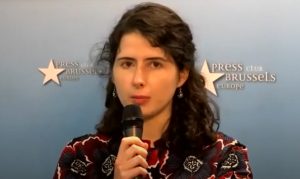
Index’s policy and campaigns manager Jessica Ní Mhainín
Speaking at the launch of the report, Index’s policy and campaigns manager Jessica Ní Mhainín highlighted cases of impunity in CoE’s report.
“Impunity for crimes against journalists refer to failure of states to identify, prosecute and punish anyone including the assailants and masterminds involved in committing a crime against a journalist,” she said. “Cultures of impunity contribute to self-censorship by making journalists more vulnerable to pressures out of fear of reprisals or harm.”
Some 35 cases of impunity have been registered on the platform since 2015 and two new impunity cases – those of Turkish journalist Uğur Mumcu, murdered in 1993, and Turkish-Cypriot journalist Kutlu Adalı, murdered in Cyprus in 1996 – were added to the impunity category during the year.
“In 2021, we welcomed the Slovak Supreme Court’s decision to overturn the not-guilty verdicts of the suspected masterminds of the 2018 murder of journalist Ján Kuciak and his fiancée Martina Kušnírová. The case will be heard in the Specialized Criminal Court later this year,” said Ní Mhainín.
Last year also saw the publication of a 438 page-report from the public inquiry into the assassination of investigative journalist Daphne Caruana Galizia, which concluded that the state of Malta “must bear responsibility for the assassination because it created an atmosphere of impunity”.
“We once again call on the Maltese authorities and the Commission of Experts to implement the recommendations of the Public Inquiry,” said Ní Mhainín.
Russia, Turkey and Ukraine account for 60% of all the cases relating to impunity on the platform. Last October marked the 15th anniversary of Russian journalist Anna Politkovskaya’s murder.
Ní Mhainín said, “The masterminds of her murder are still at large, sending the incredibly dangerous message that killing a journalist is a low-risk crime.”
Yet impunity is not restricted to these countries.
A BBC Spotlight investigation has uncovered serious concerns over the police investigation and the failure to prosecute those behind the murder of Irish journalist Martin O’Hagan, who was killed in September 2001 for his reporting on paramilitary activities in Northern Ireland. The concerns raised in the programme, which aired on 2 March 2022, came in the wake of several Police Ombudsman reports that uncovered collusive behaviour between the police and loyalists in Northern Ireland. According to the BBC’s investigation, police did not act on important information – including individual names – that were handed over to them within 48 hours of the murder. The journalist’s family are now taking legal action against the Police Service of Northern Ireland (PSNI) and the Ministry of Defence.
“Press freedom is the canary in the coal mine – it is a key indicator of the clear and worrying degree of democratic backsliding that is taking place across Europe,” said Ní Mhainín. “That’s why we once again call on Council of Europe member states to ensure that the highest priority is given to conducting thorough and transparent investigations into all crimes against journalists and we remind member states of the 2016 Recommendation of the Committee of Ministers which requires states ‘adopt appropriate criminal law provisions to prevent impunity’”
19 May 2021 | Croatia, Monaco, News
[vc_row][vc_column][vc_column_text]
Mr. Ivan Malenica
Minister of Justice
Ulica grada Vukovara 49
Maksimirska 63
10 000 Zagreb
Republic of Croatia
Tuesday 18 May 2021
Dear Minister,
Jonathan Taylor is a whistleblower; he is a witness to a crime who has cooperated with law enforcement bodies in seven different jurisdictions and should be protected as such. He has been in Croatia for nearly 10 months appealing against a request for extradition from Monaco. Now that the Supreme Court of Croatia has issued its judgment, the final decision on whether or not to extradite Mr. Taylor is up to you, the Minister of Justice.
The Supreme Court of Croatia fully recognises Mr. Taylor’s status as a whistleblower and for the reasons we set out below, we urge you, the Minister of Justice, to refuse Monaco’s abusive request to extradite Mr. Taylor to Monaco and to allow him to return home to the United Kingdom immediately.
Mr. Taylor is a British national who, during the course of his employment as a lawyer for the Dutch-listed oil industry firm SBM Offshore N.V., with its main office in the Principality of Monaco, uncovered one of the largest corruption and bribery scandals in the world that resulted in criminal investigations in the United Kingdom, United States of America, Netherlands, Switzerland and Brazil. His evidence contributed to the company paying fines amounting to over US$800 million and, to date, the imprisonment of three individuals directly involved in the scandal, including the former CEO of SBM Offshore N.V.
Monaco to date has failed to initiate a single criminal investigation into highly credible and well documented allegations of bribery and corruption on the part of SBM Offshore. Instead, it has targeted the one person who blew the whistle and brought public scrutiny to such widespread financial crimes.
On 30 July 2020, over eight years after blowing the whistle on corruption, Jonathan travelled to Dubrovnik, Republic of Croatia for a family holiday. He was arrested at the airport on the basis of a communication issued by Monaco on what was originally stated to be allegations of bribery and corruption. Not only do these allegations have no proper basis in law or fact and constitute an abuse of process but crucially, Mr. Taylor, his lawyers and the Croatian Courts have since been informed in writing that Mr. Taylor is wanted for questioning to determine whether or not to charge him.
At no stage did the law enforcement or judicial authorities in Monaco seek his extradition from the United Kingdom, where Mr. Taylor has lived since 2013, until he was apprehended in Dubrovnik, for the very reason that they knew it would not succeed.
Mr. Taylor has made it clear since 2017, when he first became aware that his former employer, the Dutch listed SBM Offshore N.V. had lodged a criminal complaint in Monaco three years earlier, that he would answer any questions the authorities had of him from the United Kingdom, either remotely or in person. And since his unlawful detention in Croatia, the offer to answer questions there has been repeated on the agreement that he is able to return home to the United Kingdom.
For Jonathan to be returned to Monaco to face questioning in order to determine whether charges should be laid amounts to a clear act of retaliation for his having disclosed the corrupt practices of a major offshore oil firm and one of the largest private sector employers in the small principality.
In March 2021, after the Supreme Court of Croatia partially upheld a second appeal against extradition, the Dubrovnik court was ordered to seek further clarification from the Monegasque authorities regarding the status of the criminal proceedings for which Mr. Taylor was allegedly charged. A letter from the Director of Judicial Services in Monaco sent on 1 March 2021 confirmed there Mr. Taylor is not charged with anything as there are no criminal proceedings, nor is there any execution of a judgement for which he is wanted – which are the only two valid legal bases for seeking extradition. In fact, Interpol confirmed yet again on the 23rd March 2021 that Mr. Taylor is no longer subject to Interpol Red Notice. This after Monaco withdrew the arrest warrant in December 2020.
Further, now that Mr. Taylor’s status as a whistleblower has been confirmed by the Supreme Court of Croatia, even if the Minister accepts that conditions for extradition have been met, in light of Croatia’s duties and obligations under the EU Directive on the protection of whistleblowers and the clearly retaliatory nature of the Monegasque request to extradite Mr. Taylor for questioning, we humbly submit that the decision by the Minister should be to reject it.
Croatia is part of the European Union and one of the 27 Member States which must transpose the EU Directive on the protection of whistleblowers into its national legal system by December 2021. The Directive seeks to harmonise protections for those who report wrongdoing and corruption across Europe. It is crucial that Croatia upholds both the spirit and obligations of the Directive to ensure that whistleblowers are protected by law and this includes ensuring they are immune from civil and criminal liability for having blown the whistle. In a case of such serious corruption like this one, it is essential that vital anti-corruption whistleblower protections do not fall down between borders. To do otherwise, allows those involved in corruption to send a chilling warning to whistleblowers and investigative journalists across the globe that undermines all the efforts of the European Union and the Croatian Government to prevent and root out the corruption that undermines the fabric of its societies and the well-being of its people.
For these very important reasons, and because of his protected status as a whistleblower, we, the undersigned, urge you, the Minister of Justice, to uphold the Rule of Law, reject the extradition order and allow Jonathan Taylor to return home immediately.
Yours sincerely,
Anna Myers, Executive Director, Whistleblowing International Network
on behalf of the Jonathan Taylor Support Committee
With support from:
Access Info Europe (Spain/Europe)
African Centre for Media & Information Literacy (Nigeria)
ARTICLE 19 (United Kingdom)
Blueprint for Free Speech (Australia)
Campax, Switzerland
Center for Whistleblowers Protection (Slovenia)
Centre for Free Expression (Canada)
European Centre for Press and Media Freedom (ECPMF)
European Federation of Journalists (EFJ)
FIND – Financial Investigations (UK)
Free Press Unlimited (Netherlands)
General Workers Union Portugal (UGT-P)
GlobaLeaks (Italy)
Guernica 37 International Justice Chambers (United Kingdom)
Human Rights House Zagreb (Croatia)
Le Réseau Panafricain de Lutte contre la Corruption (UNIS)
Maison des Lanceurs d’Alerte (France)
OBC Transeuropa
Parrhesia Inc (UK)
Pištaljka (Serbia)
Protect (United Kingdom)
South East Europe Media Organisation (SEEMO), (Austria)
SpeakOut SpeakUp Ltd (United Kingdom)
Terra Cypria-the Cyprus Conservation Foundation (Cyprus)
The Daphne Caruana Galizia Foundation (Malta)
The Signals Network (USA/France)
Transparency International (Secretariat, Germany)
Transparency International Bulgaria
Transparency International EU
Transparency International Ireland
Transparency International Italia
Transparency International Slovenia
Vanja Jurić, Attorney at law (Croatia)
WBN – Whistleblower Netzwerk (Germany)
Whistleblowers UK
Baroness Kramer, Co-Chair of the All Party Parliamentary Group on Whistleblowing
Dr John O’Connor Physician and Whistleblower (Canada)
Martin Bright, Editor, Index on Censorship (United Kingdom)
Peter Matjašič, Senior Program Officer, Open Society Initiative for Europe (OSIFE)
Professor David Lewis, Middlesex University. (United Kingdom)
Professor Wim Vandekerckhove, University of Greenwich (United Kingdom)
Susan Hawley, Executive Director, Spotlight on Corruption (UK)
Thomas Devine, Legal Director, Government Accountability Project (USA)
[/vc_column_text][/vc_column][/vc_row][vc_row][vc_column][three_column_post title=”You may also want to read” category_id=”256″][/vc_column][/vc_row]
