28 Jan 2016 | Mapping Media Freedom, News, Russia
(Image: /Demotix)
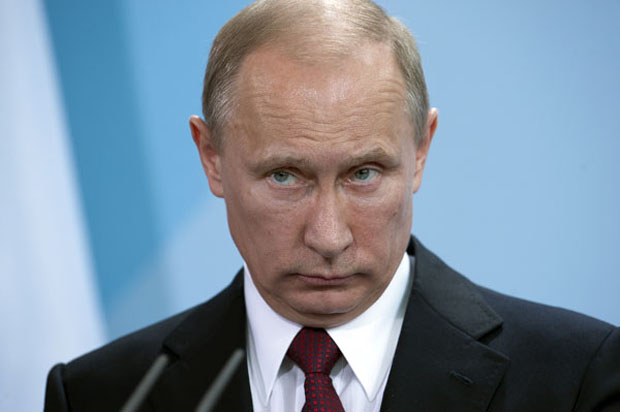
Russia’s media freedom has declined under the government of Vladimir Putin. The president and his allies have used a cloak of legislative legitimacy to target potential opposition to his rule. Mapping Media Freedom correspondents Ekaterina Buchneva and Andrey Kalikh explore what this means for two important sectors of the Russian media.
Print and broadcast media
By Ekaterina Buchneva, Mapping Media Correspondent
Under Russia’s law on mass media amended in autumn 2014, foreign owners are restricted to 20% of shares in media organisations in the country. Its authors said that the legislation would halt the West’s “cold information war”. The law has triggered major changes in the Russian media market and, as critics warned when the law was passed, was used to replace international investors with locals loyal to the Kremlin.
The Russian edition of Forbes magazine, formerly owned by German media conglomerate Axel Springer and known for its independent editorial policy, was sold to businessman Alexey Fedotov, who immediately said that the publication was “too focused on politics” and should cover more business news. In January 2016, the magazine named Nikolay Uskov as its new editor-in-chief. Uslov, a former editor-in-chief of the Russian edition of GQ, has never worked in business journalism.
Finland’s Sonoma Independent Media, America’s Dow Jones and the UK’s Pearson also had to sell their shares in Vedomosti, the main business newspaper known for its critical opinion pieces. Now the paper’s new — and only — owner is Demian Kudryavtsev, a business partner of oligarch Boris Berezovsky, who died in 2013, and a former chief executive of major Russian publishing house Kommersant. Kudryavtsev also purchased The Moscow Times, the country’s only English-language daily. Some journalists were concerned about the origin of the money Kudryavtsev used in the deal and suggested that there was another buyer behind him.
The media ownership law also affected a number of glossy magazines, which, as one of the law’s author said, “squeeze articles favorable to the West and the fifth column in between news about cars and glamorous watches”, and entertainment television channels. CTC Media sold 75% of its shares to loyal to the Kremlin oligarch Alisher Usmanov, who also owns the Kommersant publishing house.
The Russian broadcasters of CNN, Cartoon Network and Boomerang, as well as 11 television channels of Discovery group, came under the control of Media Alliance, 80% of which belongs to National Media Group. The president of NMG, which also owns a number of Russian media organisations, including RenTV, Channel Five, Izvestia newspaper and 25% of Сhannel One, is Kirill Kovalchuk, a nephew of Putin’s old friend Yuri Kovalchuk.
Tightening control over foreign publishers
In addition, in December 2015, another bill with new amendments to the “law about mass media” was introduced into the Russian State Duma. It contains more limitations for media organisations, some of them refer to foreign publishers.
The bill suggests new legal background — violation of anti-extremism legislation — for denying or revoking distribution permit for foreign publishers. Among the ones that now have such permits are Frankfurter Allgemeine Zeitung, China Daily, European Weekly, GQ, Cosmopolitan, Esquire, Tatler, Vogue, and some papers from CIS (Commonwealth of Independent States) countries, including Expert.Ukraine magazine.
“The problem is vagueness and inconsistency of the anti-extremism legislation itself and the practice of its implementation by the Russian authorities,” says Damir Gainutdinov, lawyer of Inter-regional Association of Human Rights Organisations “Agora”.
“It is primarily about Article 1 of the Federal Law on Countering Extremist Activity, which gives a definition of extremism, extremist materials, etc. In practice, this definition is used not only for hate crimes but also, for example, criticism of the Russian authorities. Condemnation of the Crimea annexation is recognised as calls for infringement of the territorial integrity of Russia, as it was in the case of Rafis Kashapov (Tatar activist from Tatarstan, who was convinced in September 2015 to three years in jail for posting informational materials criticising Crimea annexation), and criticism of the United Russia is recognised as the incitement of hatred to a social group, as it was in the case of prohibition of video clips by Navalny (a few activists were found guilty of distribution of extremist materials for posting a video by opposition leader Alexey Navalny titled ‘Let’s recall manifest-2002 to crooks and thieves’, on social media). Therefore, any unenthusiastic article published by foreign media may be recognised as a violation of anti-extremist legislation. Another thing is that this applies only to the print media. Since February 2014, it works much easier with websites; they can be just blocked by orders of the general prosecutor office.”
According to the bill, the foreign publishers also will have to pay a fee for issuing a distribution permit. The authors explained that it would “eliminate the unfair advantage of the founders of foreign publications that provides them with more favorable business conditions”.
Another bill, that was already approved by the State Duma, requires Russian media organisations to inform Roskomnadzor (The Federal Service for Supervision in the Sphere of Telecom, Information Technologies and Mass Communications) about foreign funding, including funding from foreign states, international organisations and Russian NGOs that were considered “foreign agents”. The minimum amount of money that should be declared is 15,000 roubles (less than $200). Penalties for not notifying Roskomnadzor will be fines of 30-50,000 roubles (about $400-600) for officials and the amount of money received for companies. A repeated violation will be punished with a fine of 80,000 roubles (about $1,000) and triples amount of money received.
This bill resembles the one adopted in June 2012 by the Russian State Duma, requiring NGOs to register as “foreign agents”, says Damir Gainutdinov. “First, it is a simple registration and then more and more new burdens will be introduced, for example, state bodies will deny accreditation of such media organisations, officials will be banned from giving them interviews and answering their questions … An additional mandatory audit and special checks of staff could be introduced, who knows what else.”
The bill about foreign funding could affect a number of media platforms – from Colta.ru that cover art and culture to Mediazonа that highlights problems of the Russian justice and the penal system.
Limitations for founders of media organisations
Another block of amendments introduces a new restriction for media founders. It suggests that those, who have unspent or unexpunged convictions for crimes against the constitutional order, public security and public safety, can not found a media organisation.
Those crimes include a number of criminal articles – from hooliganism and repeated violation of rules of organising or holding rallies and demonstrations to espionage and treason. But the most tricky ones are incitement of hatred and abasement of human dignity (Article 282 of the Criminal Code of Russia), public calls for extremism (Article 280) and public calls for infringement of the territorial integrity of Russia (Article 280.1), says Damir Gainutdinov. “These articles are used for persecution of dissenters. In absolute numbers, there are not many cases like this against journalists, but such practice is developing gradually – Stomaknih, Yushkov, Kashapov”.
However, these limitations could not prevent dissenters from taking part in media management at different positions. For example, Pussy Riot members Nadezhda Tolokonnikova and Maria Alekhina, who were convinced for hooliganism, founded Mediazona platform, but as Tolokonnikova told RBC newspaper, they were not officially registered as founders as they had foreseen possible legal problems.
Internet
By Andrey Kalikh, Mapping Media Correspondent
Russia’s environment for freedom of expression on the internet has declined precipitously since 2002 when the law on Counteracting Extremism was adopted. The definition of extremism used in the law is vague and overly broad, according to Aleksandr Verkhovski, an expert on extremism from the SOVA Information and Analytical Centre in Moscow. Verkhovski said that the law was written to keep independent media, oppositional political parties, and “not official” religious confessions under control.
In 2012, the anti-extremism law was amended to empower Roskomnadzor, the state media and communication watchdog, to launch the United Register of Banned Websites. The modifications also enabled the agency to add websites that have “extremist content” without judicial approval. Once a site is added to the list, Russia’s internet services providers are obliged to block it. Within days of the changes, several independent media outlets and political opposition sites websites and blogs — Grani.ru, Ej.ru, Alexei Navalny’s blog — were blacklisted in the country.
On 30 December 2015 a district court in the Siberian city of Tomsk sentenced blogger Vadim Tyumentsev to five years in prison for two videos he posted on his YouTube page.
In the first video, the blogger criticised the local government’s decision to raise the cost of fares on the city’s public transport. In the second video, he said that authorities help refugees from eastern Ukraine more than they help local residents.
The court recognised both of Tyumentcev’s videos as “having extremist character”. Ekaterina Galyautdinova, the presiding judge, gave Tyumentsev a sentence even longer than the prosecutor had pursued. She also banned Tyumentsev from posting online for three years.
The Tyumentcev case is far from the first time that a blogger has been subjected to a prosecution. In 2007, Savva Terentyev, a blogger from the Siberian city of Syktyvkar, was sentenced to a large fine for “offending a social group” – in this case, the local police force – by writing about bad behaviour and human rights abuses committed by officers. In 2012, Maxim Efimov, a blogger from Petrozavodsk, Republic of Karelia, faced prosecution after he posted an article under the headline.
In 2012, Maxim Efimov, a blogger from Petrozavodsk, Republic of Karelia, faced prosecution after he posted an article under the headline “Karelia is tired of priests”, in which he criticised the leadership of the Russian Orthodox Church. Efimov left Russia and was subsequently granted political asylum in Estonia.
That same year the Prosecutor General Office blocked the website and blog of Alexei Navalny, blogger and opposition leader, for allegedly calling “for mass disorders”. Navalny was sentenced to the administrative detention for 15 days and faced other accusations related to his political activities.
“Bloggers law”
In August 2014, the Russian State Duma adopted a number of amendments to communication legislation. The so-called “bloggers law” required sites with more than 3,000 visitors a day to register with Roskomnadzor and observe the same rules as much larger media outlets.
Under the amendments, all site owners and social media users are required to disclose their names and email address on their websites. Owners and users must keep all the information published on the web including personal data for at least six months and immediately submit to the law enforcement bodies on demand.
Moreover, Roskomnadzor received the right to request personal information from all site owners and users.
Most recently, as of 1 January 2016, the “bloggers law” requires all websites and social media platforms to keep all personal data of Russian users on servers within Russian territory. Failing to do this means Roskomnadzor can block the site or service. Companies can either comply or cease doing business in Russia.
According to the Roskomnadzor spokesman Vladimir Ampelonski, some foreign companies submitted to the requirement and brought their servers to Russia. However, some companies — Google, Facebook and Apple — have defied implementing this change. Facebook representatives met with the authority’s deputy chief, Aleksandr Zharov. At the meeting the company said it will not observe the law because it is “economically disadvantageous”, the Vedomosti newspaper reported.
Empowering the FSB
After Putin’s re-election in 2012, Russian security service FSB’s powers were considerably expanded. Articles of the Criminal Code of the Russian Federation on high treason, espionage and disclosure of state secrets were widened and made ever more vague by introducing language on cooperation with any “foreign organisation, or their representatives in hostile activities to the detriment of the external security of the Russian Federation”.
The FSB has further tried to make investigative journalism more by lobbying members of the State Duma to pass a draft law limiting access to information on commercial real estate transactions. If passed, the law would make it impossible to uncover cases of illicit enrichment by government officials.
This article was originally published on Index on Censorship.
25 Sep 2015 | Bahrain Statements, Campaigns, mobile, Statements
The Bahrain Institute for Rights and Democracy, alongside 16 NGOs including Index on Censorship, today voiced support for the UN joint-statement on human rights in Bahrain. The statement, delivered by Switzerland at the 30th session of the UN Human Rights Council, was co-signed by 33 countries, including 19 EU states and the United States of America.
The statement remains open for additional signatories until the end of the Human Rights Council session on 2 October 2015. The NGOs invite states who have not signed to do so and call on those who have to continue exerting collective pressure for human rights progress in Bahrain.
Letter
To the Governments of: Albania, Argentina, Bosnia and Herzegovina, Brazil, Canada, Croatia, Cyprus, Finland, Greece, Hungary, Italy, Malta, Mexico, Republic of Korea, Serbia, Slovak Republic, and Spain
24 September 2015
Excellencies,
We, the undersigned non-governmental organisations, write to voice our support for the joint statement on the human rights situation in Bahrain delivered by Switzerland at the 30th Session of the Human Rights Council (HRC).
Since the last joint statement on Bahrain in June 2014, the government has continued to curtail the rights to freedom of expression, association and peaceful assembly. Human rights defenders, political opposition leaders, members of the media, and youth have faced intimidation, arrest, arbitrary detention, unfair trials and acts of reprisal by the authorities. Furthermore, negotiations of the Office of the High Commissioner for Human Rights’ (OHCHR) for a programme of technical capacity building in Bahrain have stalled in the period since the June 2014 joint statement.
We urge your government, therefore, to sign the joint statement on Bahrain delivered by Switzerland at the HRC’s 30th session in order to refocus international attention on human rights in Bahrain and encourage the government of Bahrain to constructively address its ongoing violations.
International pressure on Bahrain continues to assist in addressing human rights violations in Bahrain, as reflected by the decision of the King of Bahrain to release prominent human rights defender Nabeel Rajab under a royal pardon after he spent over four months in prison for a tweet criticising the government.
It is critical, therefore, to take action now to reaffirm the high level of international concern over human rights conditions in Bahrain. To abandon collective pressure on Bahrain at a time when the situation is continuing to deteriorate would send an entirely wrong message to the Bahraini government, and undermine both internal and external efforts to foster genuine reform.
Switzerland has indicated that this joint statement will be open for additional signatories throughout the session. We therefore call on your government to recommit to supporting human rights in Bahrain, and to add your endorsement to this joint statement.
Sincerely,
Americans for Democracy & Human Rights in Bahrain (ADHRB)
Amnesty International
ARTICLE 19
Bahrain Centre for Human Rights (BCHR)
Bahrain Institute of Rights and Democracy (BIRD)
Cairo Institute for Human Rights Studies (CIHRS)
CIVICUS: World Alliance for Citizen Participation
English Pen
European Center for Constitutional and Human Rights (ECCHR)
European Centre for Democracy and Human Rights (ECDHR)
Human Rights Watch
Index on Censorship
International Service for Human Rights (ISHR)
Pen International
Rafto Foundation
The International Federation for Human Rights (FIDH)
World Organization Against Torture (OMCT)
27 Jul 2015 | Campaigns, mobile, Morocco, Statements
To Your Majesty Mohammed VI,
At a time when Morocco is advocating openness, democratisation and full respect for human rights as instruments for confronting the future, we receive the news of the hunger strike begun by the journalist Ali Lmrabet. For this reason, we wish to pass on to you our deep concern for the situation of this journalist, who has received dozens of international awards and who is deprived of his national identity documents coinciding with the end of a 10-year ban on exercising the profession of journalist in Morocco and also with his announcement that he wishes to return to professional activity.
Freedom of expression and criticism are fundamental elements for the consolidation of a democratic state that is active against regression and intolerance. Any attempt to restrict freedom of expression degrades the image of Morocco and the credibility of its commitment to the rule of law.
Precisely because, from here, we wish to lend our full support to any effort to transform Morocco developed at different levels of the political world and civil society in the country, we are writing to you to express our serious concern at the current situation of Ali Lmrabet, whose life is in danger.
For all these reasons, we would ask you to reflect on this to give instructions to the administration in your country, and its diplomatic staff in Switzerland in particular, to renew all Ali Lmrabet’s Moroccan citizenship documents.
Without a residence certificate, passport and other documents related to journalistic work, Ali Lmrabet would become the first Moroccan deprived of his civil and political rights.
We do not need to give you, Your Majesty, lessons in the fact that the deprivation of these rights is contrary to all liberties, including fundamental freedoms, freedom of expression and, in the case of Ali, the internationally recognised and acclaimed right to freely exercise the profession of journalist. The only thing we would ask you, Your Majesty, in your capacity as Head of State, is to strictly apply the provisions of the Moroccan Constitution, giving the right to all citizens to fully and freely exercise their profession, in this case as journalist and editor of publications in Morocco.
We look forward to your considered response.
Yours sincerely,
Letter signed by the following:
Míriam Acebillo Baqué, President of Lafede.cat, Organisations for Global Justice
Mariano Aguirre, Director of Norwegian Peacebuilding Resource Centre (Norway)
Cinta Arasa, Coordinator of the Persecuted Writers Committee
Carmen Arenas, President of Catalan PEN
Homero Aridjis, Emeritus President of International PEN
Jordi Armadans, Director of FundiPau (Peace Foundation)
Sion Assidon, former Secretary General of Transparency-Morocco
Margaret Atwood, Vice-President of Canada International PEN, Prince of Asturias Award
Danielle Auroi, MP of the National Assembly of France
Juan Tomás Ávila Laurel, Writer, HM Award International Odón Betanzos Palacios of the New York Circle of Ibero-American writers and poets (Equatorial Guinea)
Malén Aznárez, President of Reporters without Borders (RSF- Spanish section)
Elisabeth Badinter, Philosopher
Ekbal Baraka, Chair of PEN International Women Writers Committee, former president of Egyptian PEN
Isaías Barreñada Bajo, University Professor and Human Rights activist
Ana Barrero Tiscar, Peace Culture Foundation
Mark Barwick, Policy Adviser at Human Rights Without Frontiers International (Switzerland)
David Bassa i Cabanas, Journalist, president of the Barnils Group of Journalists
Lluís Bassets, Deputy director of El Pais (Spain)
Anouar Bassi, Transparency 25 President (Tunisia)
Abdejelil Bedoui, Economist and member of the FTDES Steering committee
Sélim Ben Abdesselem, Former member of the Tunisian National Constituent Assembly
Abdelkader Benali, Writer and journalist, Libris Prize (Netherlands)
Thijs Berman, Former Dutch MP of the European Parliament
Mylène Botbol–Baum, Writer, University professor of philosophy and bioethics
Marian Botsford Fraser, Writer and journalist, Chair of Writers in Prison Committee, PEN International Canada
Jean-Marcel Bouguereau, Journalist Le Nouvel Observateur and former chief editor of Libération
Sfia Bouarfa, Belgian honorary MP and former senator
Jim Boumelha, President of the International Federation of Journalists (IFJ)
François Burgat, Political scientist, Research Director of CNRS
Teresa Cadete, Portuguese writer, board member of PEN International
Lindsay Callaghan, President of PEN South Africa
Maria Cañadas, President of Catalonia Amnesty International (AIC)
Gemma Calvet, MP of Parliament of Catalonia (Spain)
Carles Campuzano, MP of Congreso de los Diputados (Spain)
Marius Carol, Editor of La Vanguardia
Ignacio Cembrero, Journalist, former correspondent of El País in Maghreb
Nadia Chaabane, Former deputy of Tunisian National Constituent Assembly
Alain Chabod, International Consultant, former journalist of France Television
Luc Chartrand, Journalist, Radio-Canada
Larbi Chouikha, University professor; Institut de Presse et des Sciences de l’Information (IPSI) (Tunisia)
John Maxwell Coetzee, Writer, Nobel Prize in Literature 2003, Vicepresident of PEN International
Robert Coover, Writer, William Faulkner Foundation Award, American Academy of Arts and Letters, and National Endowment of the Arts (USA)
Olivier Corten, Professor; Centre of international law of ULB; Brussels
Joan Coscubiela, Deputy of Congreso de los Diputados (Spain)
Olivier Da Lage, Journalist, Vice-president of IFJ, RFI and SNJ
Luc Dardenne, Filmmaker
Eric David, Emeritus professor of International Law; Chairman of The International Law Centre of the ULB
Ascensión de las Heras, MP of Congreso de los Diputados (Spain)
Antonio Della Rocca, President of the Trieste PEN Center, Member of the Board of PEN International (Italy)
Christophe Deloire, Secretary General of Reporters Without Borders
Nicolas Dot Pouillard, Resercher of MAEE
Christos Doulkeridis, President of ECOLO group in the Parliament of the Wallonie-Bruxelles Federation (Belgium)
André du Bus, Deputy of Wallonie-Bruxelles Federation
Josy Dubié, Honorary senator (Belgium), former journalist and ONU official
François Dubuisson, Professor, International Law Centre of ULB (Brussels)
Patrick Dupriez, Co-chair of Ecolo party
Isabelle Durant, Brussels MP (Belgium)
Mohamed El Battiui, President of the Amazigh World Assembly
Najat El Hamchi, Writer, Ramon Llull Prize
Ahmed El Khannous, MP, Brussels Parliament
Mahmoud El May, MP and Member of the National Constituent Assembly (Tunisia)
Isabelle Emmery, Brussels Member of Parliament
Mathias Enard, Writer, Gouncourt Prize 2012
Charles Enderlin, Journalist, former France2 correspondent in Israel
Moris Farhi, MBE Vice-President, PEN International
Halim Feddal, Secretary General of the National Association for the Fights against corruption (Algeria)
Soledad Gallego-Díaz, Journalist of El País
Vicent Garcés, Former Member of the European Parliament
María Caridad García Álvarez, MP of Congreso de los Diputados (Spain)
Lise Garon, Professor, Laval University
Zoé Genot, Ecolo MP, Brussels Regional Parliament
François Gèze, President and chief editor of Éditions La Découverte (France)
Jodie Ginsberg, Chief Executive Officer of Index on Censorship
Henri Goldman, Editor of Politique, revue de débats and MICmag (Belgium)
Eric Goldstein, human rights activist (United States)
Elsa González, FAPE President (Spanish Press Associations Federation)
Juan Goytisolo, Writer, National Prize of Spanish Letters and Miguel de Cervantes Prize
Rafael Grasa Hernández, President of Institut Català Internacional per a la Pau
Ricardo Gutiérrez, Secretary general of European Federation of Journalists (EFJ)
Maher Hanin, Member of steering committee of FTDES
Abderrahmane Hedhili, President of Tunisian Forum for Economic and Social Rights (FTDES)
Seymour M. Hersh, American journalist
Francis Hickel, Coordinator Pâquis Solidarity Space, Geneva
Jesús Iglesias Fernández, Senator (Spain)
Jon Iñárritu García, MP of Congreso de los Diputados (Spain)
Véronique Jamoulle, MP, Brussels Parliament
Jean-Jacques Jespers, University Professor, Université libre de Bruxelles
Oriol Junqueres i Vies, Chairman of the party “Esquerra Republicana de Catalunya” (ERC) and opposition leader in Parliament of Catalonia
Lucina Kathmann, Writer, Vice-president of PEN International (United States)
Salam Kawakibi, Arab Reform Initiative, president of the Initiative for a New Syria
Melek Kefif, Doctor and member of the Steering committee of FTDES
Charefeddine Kellil, Lawyer for the families of martyrs and wounded (Tunisia)
Zakia Khattabi, Co-chair of Ecolo Party (Green Belgian)
Kamel Labidi, Tunisian journalist, former director of Amnesty International in Tunisia and former president of the National Authority to Reform Information and Communication (INRIC)
Luis Las Heras, Editor (Spain)
Gilwon Lee, Poète, Poet, Sang-Byeong Cheon Prize and Dong-Ju Yoon Literary Prize, Board Member, PEN International South Korea
Joanne Leedom-Ackerman, vice-president of PEN International (USA)
Jean-Claude Lefort, Former MP at the French Parliament
Emmanuel Lemieux, Essayist, and investigation journalist (France)
Stefano Liberti, journalist and writer, Luchetta Award to the best journalist and Anello Debole Prize
Jonathan Littell, Writer, Goncourt Award and Grand Prix du Roman of the French Academy
Robert Littell, Writer and journalist, Los Angeles Times Book Prize (USA)
Juan López de Uralde, Executive Commission Equo party, former Greenpeace-Spain Director
Bernabé López García, Professor, former member of Averroes Committee Spain-Morocco
Mehdi Mabrouk, Former Culture Minister (Tunisia)
Noël Mamère, MP of the National Assembly and Mayor of Bègles (France)
Sherif Mansour, MENA Program Coordinator, Committee to Protect Journalists (CPJ)
Christophe Marchand, Lawyer, Brussels (Belgium)
Jean-Paul Marthoz, journalist, correspondent of the Committe to Protect Journalists (CPJ) in the European Union
Sandrine Martins Espinoza, Lawyer and international consultant for elections (Argentine)
Daniel Patrick Maunier, University Professor, New York University
Fernando Maura Barandarián, Spanish MP, European Parliament
Federico Mayor Zaragoza, President of Foundation for a culture of peace, former Director of UNESCO
Daniel Menschaert, Diplomatic, Honorary Officer of the Federation Wallonia-Brussels in Morocco
Manuela Mesa Peinado, CEIPAZ Director, Peace Culture Foundation
Rosa Montero, Writer and journalist, Grinzane Cavour award and National Journalism Award (Spain)
Quim Monzó, Writer, National Literature award (Catalonia)
Alexandre Niyungeko, President of the Burundi Journalists Union (UBJ)
Elisabeth Nordgren, Chair of the Search Committee, PEN International (Finland)
Vida Ognjenovic, Vicepresident, PEN International (Serbia)
Margie Orford, Board Member, PEN International (South Africa)
Mario Orrù, Observer Coordinator at Democracy International
Bechir Ouarda, Journalist, Former Coordinator of the civil coalition in defence of freedom of expression in Tunisia
Rémy Pagani, Administrative Councillor for the city of Geneva
Andrés Perelló, Former Member of the European Parliament, Spain
Rosana Pérez Fernández, MP of the Congreso de los Diputados (Spain)
Tone Peršak, Chair of Writers for Peace Committee, Pen International (Slovenia)
Thomas Pierret, University professor, University of Edinburgh
John Ralston Saul, Writer, president of PEN International
Pedro J. Ramírez, Editor of El Español, former editor of El Mundo
Raul Rivero, Cuban writer, UNESCO / Guillermo Cano Press Freedom Prize
Raül Romeva Rueda, Former Spanish MP, European Parliament
Jean Louis Roumegas, MP of the French Parliament
Elena Ruiz Ruiz, University professor (Spain)
Hélène Ryckmans, Member of the Walloon Parliament and the Parliament of the Federation Wallonia-Brussels, Senator
Messaoud Romdhani, Member of the Executive Committee of the Euro-Mediterranean Network of Human Rights (EMHRN), and vice president of the Tunisian League of Human Rights (LTDH)
Amor Safraoui, Chairman of the Independent National Coordination for Transitional Justice (Tunisia)
Mohamed Salah Kherigi, Trade unionist, Vice-president of the Tunisian League of Human Rights (LTDH)
Raffaella Salierno, General Secretary of PEN Català, Director of the GuestWriter programme
Victoria Salvy, Artist and writer (France)
Gervasio Sánchez Fernández, Journalist, National Photography Award, and Ortega y Gasset Journalism Award (Spain)
Mhamed Seghier, Journalist of Liberté (Algeria)
Màrius Serra, Writer, Ramon Llul and Sant Jordi Awards (Catalonia)
Amira Aleya Sghaier, Tunisian historian and university professor
Mohamed Sheriff, President of PEN Sierra Leona
Ricardo Sixto Iglesias, MP at Congreso de los Diputados (Spain)
Simona Skrabec, Chair of Translation and Linguistic Rights Committee, PEN International
Mohamed Smaïn, Activist in charge of human rights, Algerian League for the Defence of Human Rights (LADDH)
Carles Solà, Journalist, TV3 program Director (Catalonia, Spain)
Carlo Sommaruga, Lawyer, MP of the Swiss parliament
Karima Souid, Former MP of the Tunisians from abroad, member of National Constituent Assembly of Tunisis
Simone Susskind, MP of Brussels – Capital Region
Abdellah Taïa, Moroccan Writer, Flore Award
Alaa Talbi, President of Alternatives, Tunisian Section
Joan Tardà, MP of Congreso de los Diputados (Spain)
Sami Tlili, Tunisian Filmmaker, Cinema and Human Rights Award of Amnesty International and Best documentary of the Arab world Award
Jarkko Tontti, Treasurer of PEN International (Finland)
Manuel Tornare, Swiss MP, former Mayor of Geneva
Carles Torner, Executive Director of PEN International
Estefania Torres, Spanish MP of the European Parliament
Mathew Tree, Writer, Octubre – Andròmina Award
Jane Unrue, Director of the Harvard Scholars at Risk (SAR) Program and Freedom to Write Committee board for PEN, New England (United States)
Miguel Urban, Spanish MP of the European Parliament)
Dominique Vidal, Journalist
Santiago Vidal i Marsal, Judge of Provincial Audience Chamber of Barcelona, Judges for Democracy
Per Wästberg, Writer, President of Nobel Committee for Literature, former President of PEN International
Lawrence Weschler, écrivain, George Polk et Lannan Literary Award (United States)
2 Apr 2015 | mobile, News, United Kingdom
QueerSpace Belfast / Facebook
Last Sunday, as Northern Ireland’s footballers prepared to play Finland in a European Championship qualifier, protesters gathered outside Windsor Park, the team’s Belfast home.
The assembled were members of the Free Presbyterian Church. They were angered by the fact that Northern Ireland were playing on a Sunday – the Sabbath – for the first time ever.
Reverend Raymond Robinson told the Press Association: “Our opposition is to the breaking of observance of the Lord’s day.
“We believe in the Sabbath being kept holy. It seems more and more that the football agenda is being driven by the television companies and not what God says, or what public opinion is.”
Commentator Newton Emerson was, like many, blase about the protest, tweeting “I think these people are harmless enough now to just count towards our wonderful diversity.”
Be that as it may, Christian fundamentalism still plays a huge role in public life in Northern Ireland. While the old demands for Biblical propriety may seem archaic, a new struggle has emerged over what many religious people in the country see as threats to their religious freedom and way of life. And a cake has become the latest flashpoint.
Asher’s bakery is a business run by a family known for its Christian beliefs. It is named after one of the Biblical Twelve Tribes of Israel. Last summer, the bakery was asked to provide a cake by Gareth Lee, a volunteer for LGBT group QueerSpace.
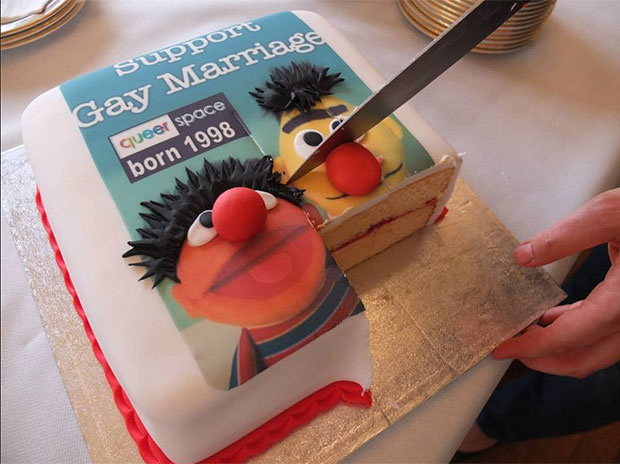
Lee had requested a cake decorated with a picture of Sesame Street’s Bert and Ernie and the slogan “Support Gay Marriage”.
The bakery initially accepted the order, before then informing Lee that it could not fulfil the deal. The case went to Northern Ireland’s Equality Commission, and, between the jigs and reels, is now in the hands of district judge Isobel Brownie, who will rule on Monday whether the Christian bakers engaged in unlawful discrimination by not delivering the pro-same sex marriage cake.
Meanwhile, the “gay cake” case has raised the spectre of a “conscience clause” in equality legislation in Northern Ireland.
The whole situation is, quite frankly, pitiful. One can preach it, validly, both ways: fundamentalist bigots out of touch with the modern world, and inflicting their bigotry on others, or God-fearing, humble folk sticking by their beliefs in the face of an onslaught they didn’t invite.
I can’t help feel sympathetic towards the McArthurs, the family who own the bakery. Karen McArthur told the court that she had initially accepted the order to avoid embarrassment. Colin McArthur said “On that day I didn’t make a clinical decision. I was examining my heart. I was wrestling it over in my heart and in my mind.” He was, apparently, “deeply troubled”. “We discussed how we could stand before God and bake a cake like this promoting a case like this…”
On the other hand, Gareth Lee said he was left feeling like a lesser person after he was told his order would not be fulfilled.
This shouldn’t be down to who was more upset or offended, but then, on what criteria can we judge it? I don’t think it’s necessarily true to say that Lee is entitled to have any message he wants put on any cake by any person. The prosecution, correctly, pointed out that the message was rejected because of the word “gay”. The defence lawyers suggested that a ruling against the McArthurs could lead to a situation where devout Muslims were legally obliged to decorate cakes with images of Muhammad. While “you wouldn’t say that about the Muslims” is a tedious argument, and one deployed increasingly often by Christians, it’s not, in this case, an entirely unreasonable position.
Hardline Christians see homosexuality as a (wrong) choice people make, or a psychological disorder. I recall watching the Reverend Willie McRea, an MP, once, being asked what support he would offer to a constituent who was a victim of homophobia. McRea replied that he would advise the young man not go down that route: basically, the best way to prevent homophobia is to stop being gay.
Meanwhile, Iris Robinson, wife of Democratic Unionist Party leader Peter Robinson, firmly believes that one can be counselled away from homosexuality.
These people are odd, certainly, but they are not fringe characters who can be dismissed as irrelevant to mainstream society in Northern Ireland.
And even if these views were not mainstream, that would not make the fundamentals of the case any different. But it does seem as if the Equality Commission is trying to drag a segment of Northern Irish society kicking and screaming into the secular world.
So who’s right? Who should win? Reader, I am about to break the columnist’s solemn covenant and admit: I don’t fully know. This is not as clear cut a case of discrimination as, say, barring a gay couple from a Bed and Breakfast: if the McArthurs had simply refused to sell a cake to Lee, that would be clear cut. But the cake was loaded, so to speak. Should this tricky case lead to a “conscience clause” in equality legislation, then one can imagine legitimisation of genuinely discriminatory practices.
At the same time, the McArthurs, are wrong, and one’s initial inclination is to side with the gay rights activist against the religious fundamentalists. But that’s the problem with defending freedom of conscience, (and its expression in freedom of speech). Everyone’s conscience is different.
Northern Ireland beat Finland 2-1, by the way. God’s clearly not very troubled by Sunday football.
This column was posted at indexoncensorship.org on April 2, 2015
