31 Jul 2020 | News, Opinion
[vc_row][vc_column][vc_column_text]
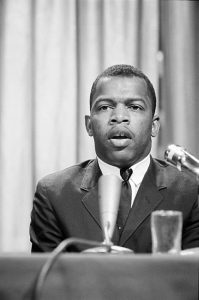
Civil rights activist John Lewis at a meeting of American Society of Newspaper Editors, 16th April 1964. Credit: Marion S Trikosko, US News and World Reports
This week saw the funeral of the civil rights legend, Congressman John Robert Lewis. The word hero can be attributed all too easily but that’s simply not the case when you use it to describe John Lewis. In 1961, he was one of the first freedom riders, refusing to sit at the back of the bus. He one of the “Big Six” organisers and the youngest speaker at the March on Washington in 1963. In 1965 when crossing Edmund Pettus Bridge in Selma, Alabama, he became the face of police brutality as he was beaten until bloody. He led the campaign to register millions of people to vote in the 1970s. And in 1986 he was elected to the US House of Representatives representing Georgia’s 5th Congressional District, a role he held until his death on 17th July 2020. He did all of these things with a level of personal dignity that was inspirational.
John Lewis wasn’t just an American hero – he was a living legend and a global citizen. He inspired all of us who are passionate about human rights and he led the charge for equality – as a peaceful non-violent movement. And on every step of his journey he got into “good trouble”. He was never afraid to use his voice to fight for others, to fight for justice, to fight for fairness, and for that every single one of us owes him an eternal debt of gratitude.
You may be asking why I am using my weekly blog on free speech to celebrate the life of one of my heroes. And of course, I am taking slight liberties. But the civil rights movement used their right to free speech, free association and freedom of the press to make the world stop and listen. They used every right outlined in the First Amendment to make themselves heard. Every possible weapon in their peaceful arsenal to make our global community a better place.
John Lewis worked tirelessly, hand-in-hand, with Dr Martin Luther King Jr, exposing discrimination, shining a light on injustice and using such powerful oratory as part of their protests that the world could not ignore their plight. Our civil rights heroes taught every other equality movement the power of language, of storytelling, of the spoken and written word and the vital importance of the free press. In other words, they didn’t just rely on free speech to achieve their objectives, they celebrated it and that’s why I’m such a passionate defender of it.
I fear that the current climate of increasing polarisation in our public conversation means that we are forgetting the lessons of the heroes and heroines of the civil rights movement. John Lewis wanted to win the argument to make a difference and he did just that. He exposed every injustice and absurdity of the Jim Crow laws; every time he was arrested he made sure that the media knew about it and he told his story – to prove he was right, both morally and legally. We need to relearn his methods and we need to re-embrace storytelling – making sure that we have free speech for a purpose – to make the world a better place.
In his words: “Never, ever be afraid to make some noise and get in good trouble, necessary trouble.”[/vc_column_text][/vc_column][/vc_row][vc_row][vc_column][vc_btn title=”DONATE” color=”danger” link=”url:https%3A%2F%2Fwww.indexoncensorship.org%2Fdonate|||”][/vc_column][/vc_row][vc_row][vc_column][/vc_column][/vc_row]
25 Mar 2020 | News, Press Releases, Statements
[vc_row][vc_column][vc_column_text]Index on Censorship and Justice for Journalists Foundation (JFJ) announce a joint global initiative to monitor attacks and violations against the media, specific to the current coronavirus-related crisis.
According to Rachael Jolley, Editor-in-Chief, Index of Censorship: “In times of extraordinary crisis, governments often take the opportunity to roll back on personal freedoms and media freedom. The public’s right to know can be severely reduced with the little democratic process. Index is already being alerted to attacks and violations against the media in the current coronavirus related crisis, as well as other alarming news pertaining to privacy and freedoms”.
“In our daily work in the post-Soviet region, Justice for Journalists Foundation experts and partners come across grave violations of media freedom and media workers’ human rights. Today, we are witnessing how the corrupt governments and businessmen in many of the regional autocracies are abusing the current limitations of public scrutiny. This major decrease in civil liberties makes pursuing their interests easier and even less transparent, whereas media workers striving to unveil murky practices are facing more risks than ever before”, said Maria Ordzhonikidze, JFJ’s Director.
Index draws on its experience running other mapping projects to enable easy comparisons of media violations in each country, and also so data can be collated and discussed when the global crisis is over.
Justice for Journalists Foundation will contribute to this monitoring effort by expanding cooperation with its existing regional partners who provide data and analysis for the series of Media Threats and Attacks Reports in Azerbaijan, Armenia, Belarus, Georgia, Kazakhstan, Kyrgyzstan, Moldova, Russia, Tajikistan, Turkmenistan, Ukraine and Uzbekistan.
The overall goal of the project is threefold: to increase awareness about the importance of media freedom and the existing state of press freedom at this particular point in history, to support journalists whose work is being impeded, by highlighting the challenges they face to an international audience and to continue to improve media freedom globally in the long run.
Anyone interested to learn more about or contribute to this initiative by providing information on incidents and/or translation, publicity and ideas, please get in touch:
[/vc_column_text][/vc_column][/vc_row]
29 Aug 2019 | Iran, Media Freedom, News
[vc_row][vc_column][vc_single_image image=”108837″ img_size=”full” add_caption=”yes”][vc_column_text]On 24 August 2019 Kioomars Marzban, a 27-year-old satirical writer from Iran, was sentenced to 23 years and 3 months in prison. He was found guilty on five separate charges, given a two-year travel ban, and a two-year ban on publishing or using social media.
Marzban left Iran in 2009 and had been living in Malaysia for nearly a decade, from where he wrote for Iranian diaspora programmes, including Radio Farda and the London-based media network Manoto. He returned to Iran to spend time with his sick grandmother in early 2018. On his return, he began leading creative writing workshops and had referred to some of his work abroad.
In early September 2018, authorities arrested Marzban on charges relating to his satirical writing. They raided his house and confiscated his laptop, mobile phone, and writing materials. He was only permitted to appoint a lawyer several months after being detained.
Following his arrest, a website affiliated with the Iranian Revolutionary Guard Corps (IRGC) falsely claimed that Marzban had travelled to the United States in order to set up an anti-Iranian media outlet. The website said that the outlet would have been “aimed at inflaming the people and creating social divisions”. Marzban is understood to have only ever travelled to Georgia (in the Caucasus) during his time in Malaysia.
The IRGC also accused Marzban of cooperating with the human rights organisation Freedom House, which according to them is “a project of American intelligence to push the issue of human rights internationally through media organisations”.
Marzban was sentenced to 11 years for “communicating with America’s hostile government”, 7 years and 6 months for “insulting the sacred”, 3 years for “insulting the [supreme] leader”, 1 year and 6 months for “propaganda against the state”, and 9 months for “insulting officials”.
Condemning the sentencing of Kioomars Marzban, Jodie Ginsberg, Chief Executive of Index on Censorship, said “Kioomars has been given a sentence that would put him in jail for almost as long as he has been alive, meaning he would not be freed until 50. And all because he poked fun at power through writing. We urge satirists worldwide to condemn his jailing and for states who claim to support freedom of expression to demand his immediate release ”.[/vc_column_text][vc_basic_grid post_type=”post” max_items=”4″ grid_id=”vc_gid:1567097330224-5056a739-f424-9″ taxonomies=”8996″][/vc_column][/vc_row]
9 Aug 2019 | Artistic Freedom, News
[vc_row][vc_column][vc_single_image image=”108512″ img_size=”full”][vc_column_text]”[I] contemplate with dread the erasure of other voices, of unwritten novels, poems whispered or swallowed for fear of being overheard by the wrong people… that thought is a nightmare. As though a whole universe is being described in invisible ink,” Toni Morrison wrote of the prospect of censorship.
Morrison — a revered author, critic, professor, and editor of literature focussed on the African-American experience — died on the evening of 6 August, due to complications from pneumonia. She was 88.
Morrison was no stranger to the insidious effects of censorship. Long a vocal advocate against censorship, she once argued that “The same sensibilities that informed those people to make it a criminal act for black people to read are the ancestors of the same people who are making it a criminal act for their own children to read.” A favorite of many high school teachers and college professors, Morrison’s books are frequently challenged or banned for graphic violence, rape, overt sexuality, and horrific racism. As recently as 2017, Fairfax County in Virginia drafted legislation that would prohibit the teaching of books with sexual themes in public schools, legislation that was spurred by the decision to include Morrison’s Beloved in a high school curriculum (the bill is popularly known as the “Beloved Bill”). Beloved, published in 1987, is Morrison’s best-known work, which earned her the Pulitzer Prize in Fiction.
Morrison often invoked her upbringing in advocating against censorship, speaking about how early exposure to a diversity of literary narratives inspired her to speak out. “If you can read, they can’t cheat you; if you can’t read, they can defeat you,” she said. Morrison was born Chloe Wofford in Lorain, Ohio in 1931. Her father, George Wofford, was born and raised in Georgia, before moving north to the racially integrated suburb of Lorain after witnessing the lynching of two black businessmen in his hometown. She frequently spoke about the love of books that her family instilled in her from an early age, immersing her in traditional African folktales and encouraging her to read Leo Tolstoy and Jane Austen.
After graduating high school, she went on to earn a BA in English from the historically black Howard University, and a master’s of arts from Cornell University. She taught at Texas Southern University for two years, then returned to Howard. She taught at Howard for seven years, where she met Harold Morrison, who she eventually married and with whom she had two children, Ford and Slade. She and Harold divorced in 1964.
While raising two young children, she left Howard for a job as an editor at Random House Publishers. While at Random House, she worked to promote narratives of the black experience in America, a literary genre she saw as woefully underdeveloped in the predominantly white publishing world — she was the first black woman to hold the position of senior editor at Random House. She helped to give a generation of black writers a platform.
While at Howard, she had begun work on The Bluest Eye, which was published in 1970 to critical acclaim despite initially low sales. The Bluest Eye was followed by Sula (1973), Song of Solomon (1977), Tar Baby (1981), and Beloved, all of which brought her national renown, and several nominations for prestigious book awards. She continued publishing novels, eleven in total, for the rest of her life — her last novel, God Help the Child, was published in 2015. In addition to novels, Morrison wrote several short stories, two plays, the libretto to an opera performed by the New York City Opera, and several children’s books (some of which were co-written with her late son, Slade, who died of pancreatic cancer at 45). In addition to Howard University and Texas Southern University, she taught at the State University of New York, Rutgers University, Bard College, Cornell University, and finally Princeton University, to which she donated her papers.
Morrison once spoke about efforts to ban Song of Solomon in prisons, out of fear that her writing might incite the incarcerated to riot. Paraphrasing Morrison in an article for the National Coalition on Censorship, Marilyn Dahl wrote that a problem with a recording device caused some confusion over the word “riot” — the motivation for the ban may have instead been the fear that her work would incite prisoners to “write.” “But ‘riot’ or ‘write,’” Dahl mused, “which would ultimately be the most dangerous?”
To give voice to the powerless was Morrison’s lifelong mission, a mission she fulfilled by telling stories about the experience of the powerless in America. To deny prisoners access to stories that speak to their experiences — America’s prison population is disproportionately men of color — is to achieve the aim of censorship many times over: it not only restricts access to ideas, but also restricts the ability of the powerless to develop their own, and to be heard.[/vc_column_text][/vc_column][/vc_row][vc_row][vc_column][vc_custom_heading text=”Banned Books Week / 22-28 Sept 2019″ use_theme_fonts=”yes” link=”url:https%3A%2F%2Fwww.bannedbooksweek.org.uk%2F|||”][vc_row_inner][vc_column_inner width=”1/4″][vc_single_image image=”103109″ img_size=”full” onclick=”custom_link” link=”https://www.bannedbooksweek.org.uk/”][/vc_column_inner][vc_column_inner width=”3/4″][vc_column_text]
Banned Books Week UK is a nationwide campaign for radical readers and rebellious readers of all ages celebrate the freedom to read. Between 22 – 28 September 2019, bookshops, libraries, schools, literary festivals and publishers will be hosting events and making noise about some of the most sordid, subversive, sensational and taboo-busting books around.
[/vc_column_text][/vc_column_inner][/vc_row_inner][/vc_column][/vc_row]
