24 May 2021 | Belarus, Media Freedom, News
[vc_row][vc_column][vc_column_text]
There has rightly been international condemnation of the arrest of Roman Protasevich after his Ryanair flight from Greece to Lithuania was diverted to Belarusian capital Minsk. It is of particular concern that the state hijacking of Flight FR4978 was carried out on the personal orders of President Alexander Lukashenko. His disgraceful “confession” on state TV comes straight from the authoritarian playbook.
The 26-year-old has been described in a single report on the BBC as a “Belarusian opposition journalist”, a “dissident” and an “activist”. This extraordinary young man is all these things and more. But it is important that the western media does not let the Belarus regime define the narrative.
Protasevich is an independent journalist, but to be so in Belarus is to immediately become an activist. And, meanwhile, the regime is in the process of defining all activists as terrorists. Index has been reporting for months on the systematic crackdown on independent journalism by the Lukashenko regime. Hijacking is just the latest method to control free expression in Belarus.
British MP Tom Tugendhat (chair of the Foreign Affairs Select Committee) has described the arrest as a “warlike act”, and this is no understatement. He has emphasised that a hijacking is an escalation of the situation. But we should not lose sight of why Protasevich represented such a threat. It is because he was a journalist the regime has not been able to control since he fled the country for Poland in 2019.
Protasevich is the former editor of Nexta, a media organisation that works via the social media platfrom Telegram, which circumvents censorship in Belarus. Nexta was instrumental in reporting on the opposition to Lukashenko during the elections of 2020. Until this week Protasevich had been working for another Telegram channel Belamova. Like the underground “samizdat” publications of the Soviet era, these Telegram channels provided much-needed hope to civil society in Belarus.
Parallels have been drawn between Russian dissident Alexei Navalny and Roman Protasevich and it is true that he provides a similar focus for the Belarusian opposition. However, he has been targeted not as a political leader, but as a journalist. It is as a journalist that we should defend him.
[/vc_column_text][/vc_column][/vc_row][vc_row][vc_column][three_column_post title=”You may also want to read” category_id=”172″][/vc_column][/vc_row]
16 Apr 2021 | Fellowship 2021, Opinion, Ruth's blog
[vc_row][vc_column][vc_column_text]
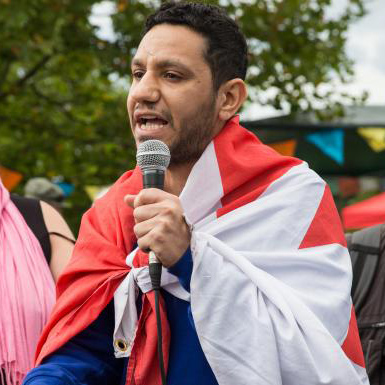
Sayed Ahmed Alwadaei, a 2020 Freedom of Expression Awards winner
This week we were interviewing for a new member of the team to help support our work on the Freedom of Expression awards. The joy of interviewing for a new role is that it makes you reflect on what you do and why, even as you’re speaking to the candidates. As I was outlining the importance of the awards, I was reminded of why they are so incredibly important and not just for the winners, but also for the team. The fact is they give us hope, we get to show real solidarity with people who are on the frontline, people who every day are demanding their rights and protections under Article 19 of the Universal Declaration of Human Rights.
Those people shortlisted for an award are typically unknown outside their countries, their stories untold. They have been jailed for campaigning for free speech. Hounded for using their talents as artists and writers to explore people’s realities under totalitarian regimes. Threatened for being journalists exposing corruption and repression at a national level. They are also just people who have found themselves in horrendous situations which they are determined to help fix.
Our award-winners and all of those nominated are extraordinary. They are inspirational. And they honestly keep the team going when day in and day out we are exposed to some of the horrors of what people are facing in too many places around the world, from Myanmar to Kashmir, from Afghanistan to Hong Kong, from Belarus to Xinjiang, from Komsomolsk-on-Amur to Greece.
It can be emotionally exhausting just trying to keep on top of what is happening in too many countries by too many authoritarian leaders. Soul-destroying to say today we have to focus on Egypt rather than Iran because we don’t have enough resource. The guilt that we aren’t doing enough or that we aren’t providing enough support or that the world has moved on and we can’t get traction for someone’s story. The world can just feel too depressing.
The Index team is extraordinary and resilient – but we all need a little hope.
And that’s what our awards do – they provide hope. The remind us of the struggles that people are prepared to fight and allow us to celebrate those people are fighting the good fight – so they know they are not alone, and that people genuinely care what happens to them.
Our award nominees and the eventual winners are extraordinary individuals but for the team at Index they embody our mission – to ensure that we are a Voice for the Persecuted. They represent the best of us, and we honour and support them not just because of who they are and what they have done – but because of what they represent. Bravery, resilience and determination for a better world.[/vc_column_text][/vc_column][/vc_row][vc_row][vc_column][three_column_post title=”You may also want to read” category_id=”41669″][/vc_column][/vc_row]
23 Jul 2020
In March the first ever issue of the magazine is published under the title Index (“on Censorship” is later added). From the beginning, Index declare its mission to stand up for free expression as a fundamental human right for people everywhere. It is particularly vocal in its coverage of the oppressive military regimes of southern Europe and Latin America, but is clear that censorship is not only a problem in faraway dictatorships. The first issue includes a never-before-published poem, written while serving a sentence in a labour camp, by Soviet dissident Aleksandr Solzhenitsyn, who went on to win a Nobel prize later that year. Articles are published from across the globe, including Bangladesh, Brazil, Greece, Portugal, USA, the Soviet Union, with poems from Natalya Gorbanyevskaya, a poet who had been confined to a mental hospital. It also includes the first publication in any language of a story by Milovan Djilas, who was unable to publish anything in his own country since his trial in 1963.
Also included in the first issue is the Index “Index”, which is round-up of the main and most recent free speech issues around the world. Index Index runs in every issue until 2008.
In the September issue, Nadine Gordimer, a South African writer, political activist and recipient of the 1991 Nobel Prize in Literature, writes her first article for Index. Gordimer stands firmly against apartheid in South Africa. She goes on to write for Index many times.
23 Jul 2020
Author and translator Michael Scammel becomes the first director of Index. Under Scammel’s leadership, it is decided that Writers and Scholars International will form a magazine with Scammel as the editor. He acquires writing from Milovan Djilas from Yugoslavia and Greek law professor George Mangakis’ Letter to Europeans, written from prison.
In the same year Spender announces in the Times Literary Supplement the forthcoming publication of the magazine. He outlines that freedom and tyranny are to be the central theme. He writes: “Obviously there is a risk of a magazine of this kind becoming a bulletin of frustration. However, the material by writers which is censored in Eastern Europe, Greece, South Africa and other countries is among the most exciting that is being written today. Moreover, the question of censorship has become a matter of impassioned debate; and it is one which does not only concern totalitarian societies.”
