29 Aug 2018 | Bahrain, Bahrain Statements, Campaigns -- Featured, Statements
[vc_row][vc_column][vc_single_image image=”95198″ img_size=”full” add_caption=”yes”][vc_column_text]For the second time since 2013, the United Nations (UN) Working Group on Arbitrary Detention (WGAD) has issued an Opinion regarding the legality of the detention of Mr. Nabeel Rajab under international human rights law.
In its second opinion, the WGAD held that the detention was not only arbitrary but also discriminatory. The 127 signatory human rights groups welcome this landmark opinion, made public on 13 August 2018, recognising the role played by human rights defenders in society and the need to protect them. We call upon the Bahraini Government to immediately release Nabeel Rajab in accordance with this latest request.
In its Opinion (A/HRC/WGAD/2018/13), the WGAD considered that the detention of Mr. Nabeel Rajabcontravenes Articles 2, 3, 7, 9, 10, 11, 18 and 19 of the Universal Declaration on Human Rights and Articles 2, 9, 10, 14, 18, 19 and 26 of the International Covenant on Civil and Political Rights, ratified by Bahrain in 2006. The WGAD requested the Government of Bahrain to “release Mr. Rajab immediately and accord him an enforceable right to compensation and other reparations, in accordance with international law.”
This constitutes a landmark opinion as it recognises that the detention of Mr. Nabeel Rajab – President of the Bahrain Center for Human Rights (BCHR), Founding Director of the Gulf Centre for Human Rights (GCHR), Deputy Secretary General of FIDH and a member of the Human Rights Watch Middle East and North Africa Advisory Committee – is arbitrary and in violation of international law, as it results from his exercise of the right to freedom of opinion and expression as well as freedom of thought and conscience, and furthermore constitutes “discrimination based on political or other opinion, as well as on his status as a human rights defender.” Mr. Nabeel Rajab’s detention has therefore been found arbitrary under both categories II and V as defined by the WGAD.
Mr. Nabeel Rajab was arrested on 13 June 2016 and has been detained since then by the Bahraini authorities on several freedom of expression-related charges that inherently violate his basic human rights. On 15 January 2018, the Court of Cassation upheld his two-year prison sentence, convicting him of “spreading false news and rumors about the internal situation in the Kingdom, which undermines state prestige and status” – in reference to television interviews he gave in 2015 and 2016. Most recently on 5 June 2018, the Manama Appeals Court upheld his five years’ imprisonment sentence for “disseminating false rumors in time of war”; “offending a foreign country” – in this case Saudi Arabia; and for “insulting a statutory body”, in reference to comments made on Twitter in March 2015 regarding alleged torture in Jaw prison and criticising the killing of civilians in the Yemen conflict by the Saudi Arabia-led coalition. The Twitter case will next be heard by the Court of Cassation, the final opportunity for the authorities to acquit him.
The WGAD underlined that “the penalisation of a media outlet, publishers or journalists solely for being critical of the government or the political social system espoused by the government can never be considered to be a necessary restriction of freedom of expression,” and emphasised that “no such trial of Mr. Rajab should have taken place or take place in the future.” It added that the WGAD “cannot help but notice that Mr. Rajab’s political views and convictions are clearly at the centre of the present case and that the authorities have displayed an attitude towards him that can only be characterised as discriminatory.” The WGAD added that several cases concerning Bahrain had already been brought before it in the past five years, in which WGAD “has found the Government to be in violation of its human rights obligations.” WGAD added that “under certain circumstances, widespread or systematic imprisonment or other severe deprivation of liberty in violation of the rules of international law may constitute crimes against humanity.”
Indeed, the list of those detained for exercising their right to freedom of expression and opinion in Bahrain is long and includes several prominent human rights defenders, notably Mr. Abdulhadi Al-Khawaja, Dr.Abduljalil Al-Singace and Mr. Naji Fateel – whom the WGAD previously mentioned in communications to the Bahraini authorities.
Our organisations recall that this is the second time the WGAD has issued an Opinion regarding Mr. Nabeel Rajab. In its Opinion A/HRC/WGAD/2013/12adopted in December 2013, the WGAD already classified Mr. Nabeel Rajab’s detention as arbitrary as it resulted from his exercise of his universally recognised human rights and because his right to a fair trial had not been guaranteed (arbitrary detention under categories II and III as defined by the WGAD).The fact that over four years have passed since that opinion was issued, with no remedial action and while Bahrain has continued to open new prosecutions against him and others, punishing expression of critical views, demonstrates the government’s pattern of disdain for international human rights bodies.
To conclude, our organisations urge the Bahrain authorities to follow up on the WGAD’s request to conduct a country visit to Bahrain and to respect the WGAD’s opinion, by immediately and unconditionally releasing Mr. Nabeel Rajab, and dropping all charges against him. In addition, we urge the authorities to release all other human rights defenders arbitrarily detained in Bahrain and to guarantee in all circumstances their physical and psychological health.
This statement is endorsed by the following organisations:
1- ACAT Germany – Action by Christians for the Abolition of Torture
2- ACAT Luxembourg
3- Access Now
4- Acción Ecológica (Ecuador)
5- Americans for Human Rights and Democracy in Bahrain – ADHRB
6- Amman Center for Human Rights Studies – ACHRS (Jordania)
7- Amnesty International
8- Anti-Discrimination Center « Memorial » (Russia)
9- Arabic Network for Human Rights Information – ANHRI (Egypt)
10- Arab Penal Reform Organisation (Egypt)
11- Armanshahr / OPEN Asia (Afghanistan)
12- ARTICLE 19
13- Asociación Pro Derechos Humanos – APRODEH (Peru)
14- Association for Defense of Human Rights – ADHR
15- Association for Freedom of Thought and Expression – AFTE (Egypt)
16- Association marocaine des droits humains – AMDH
17- Bahrain Center for Human Rights
18- Bahrain Forum for Human Rights
19- Bahrain Institute for Rights and Democracy – BIRD
20- Bahrain Interfaith
21- Cairo Institute for Human Rights – CIHRS
22- CARAM Asia (Malaysia)
23- Center for Civil Liberties (Ukraine)
24- Center for Constitutional Rights (USA)
25- Center for Prisoners’ Rights (Japan)
26- Centre libanais pour les droits humains – CLDH
27- Centro de Capacitación Social de Panama
28- Centro de Derechos y Desarrollo – CEDAL (Peru)
29- Centro de Estudios Legales y Sociales – CELS (Argentina)
30- Centro de Políticas Públicas y Derechos Humanos – Perú EQUIDAD
31- Centro Nicaragüense de Derechos Humanos – CENIDH (Nicaragua)
32- Centro para la Acción Legal en Derechos Humanos – CALDH (Guatemala)
33- Citizen Watch (Russia)
34- CIVICUS : World Alliance for Citizen Participation
35- Civil Society Institute – CSI (Armenia)
36- Colectivo de Abogados « José Alvear Restrepo » (Colombia)
37- Collectif des familles de disparu(e)s en Algérie – CFDA
38- Comisión de Derechos Humanos de El Salvador – CDHES
39- Comisión Ecuménica de Derechos Humanos – CEDHU (Ecuador)
40- Comisión Nacional de los Derechos Humanos (Costa Rica)
41- Comité de Acción Jurídica – CAJ (Argentina)
42- Comité Permanente por la Defensa de los Derechos Humanos – CPDH (Colombia)
43- Committee for the Respect of Liberties and Human Rights in Tunisia – CRLDHT
44- Commonwealth Human Rights Initiative – CHRI (India)
45- Corporación de Defensa y Promoción de los Derechos del Pueblo – CODEPU (Chile)
46- Dutch League for Human Rights – LvRM
47- European Center for Democracy and Human Rights – ECDHR (Bahrain)
48- FEMED – Fédération euro-méditerranéenne contre les disparitions forcées
49- FIDH, in the framework of the Observatory for the Protection of Human Rights Defenders
50- Finnish League for Human Rights
51- Foundation for Human Rights Initiative – FHRI (Uganda)
52- Front Line Defenders
53- Fundación Regional de Asesoría en Derechos Humanos – INREDH (Ecuador)
54- Groupe LOTUS (DRC)
55- Gulf Center for Human Rights
56- Human Rights Association – IHD (Turkey)
57- Human Rights Association for the Assistance of Prisoners (Egypt)
58- Human Rights Center – HRIDC (Georgia)
59- Human Rights Center « Memorial » (Russia)
60- Human Rights Center « Viasna » (Belarus)
61- Human Rights Commission of Pakistan
62- Human Rights Foundation of Turkey
63- Human Rights in China
64- Human Rights Mouvement « Bir Duino Kyrgyzstan »
65- Human Rights Sentinel (Ireland)
66- Human Rights Watch
67- I’lam – Arab Center for Media Freedom, Development and Research
68- IFEX
69- IFoX Turkey – Initiative for Freedom of Expression
70- Index on Censorship
71- International Human Rights Organisation « Club des coeurs ardents » (Uzbekistan)
72- International Legal Initiative – ILI (Kazakhstan)
73- Internet Law Reform Dialogue – iLaw (Thaïland)
74- Institut Alternatives et Initiatives Citoyennes pour la Gouvernance Démocratique – I-AICGD (RDC)
75- Instituto Latinoamericano para una Sociedad y Derecho Alternativos – ILSA (Colombia)
76- Internationale Liga für Menschenrechte (Allemagne)
77- International Service for Human Rights – ISHR
78- Iraqi Al-Amal Association
79- Jousor Yemen Foundation for Development and Humanitarian Response
80- Justice for Iran
81- Justiça Global (Brasil)
82- Kazakhstan International Bureau for Human Rights and the Rule of Law
83- Latvian Human Rights Committee
84- Lawyers’ Rights Watch Canada
85- League for the Defense of Human Rights in Iran
86- League for the Defense of Human Rights – LADO Romania
87- Legal Clinic « Adilet » (Kyrgyzstan)
88- Liga lidských práv (Czech Republic)
89- Ligue burundaise des droits de l’Homme – ITEKA (Burundi)
90- Ligue des droits de l’Homme (Belgique)
91- Ligue ivoirienne des droits de l’Homme
92- Ligue sénégalaise des droits humains – LSDH
93- Ligue tchadienne des droits de l’Homme – LTDH
94- Ligue tunisienne des droits de l’Homme – LTDH
95- MADA – Palestinian Center for Development and Media Freedom
96- Maharat Foundation (Lebanon)
97- Maison des droits de l’Homme du Cameroun – MDHC
98- Maldivian Democracy Network
99- MARCH Lebanon
100- Media Association for Peace – MAP (Lebanon)
101- MENA Monitoring Group
102- Metro Center for Defending Journalists’ Rights (Iraqi Kurdistan)
103- Monitoring Committee on Attacks on Lawyers – International Association of People’s Lawyers
104- Movimento Nacional de Direitos Humanos – MNDH (Brasil)
105- Mwatana Organisation for Human Rights (Yemen)
106- Norwegian PEN
107- Odhikar (Bangladesh)
108- Pakistan Press Foundation
109- PEN America
110- PEN Canada
111- PEN International
112- Promo-LEX (Moldova)
113- Public Foundation – Human Rights Center « Kylym Shamy » (Kyrgyzstan)
114- RAFTO Foundation for Human Rights
115- Réseau Doustourna (Tunisia)
116- SALAM for Democracy and Human Rights
117- Scholars at Risk
118- Sisters’ Arab Forum for Human Rights – SAF (Yemen)
119- Suara Rakyat Malaysia – SUARAM
120- Taïwan Association for Human Rights – TAHR
121- Tunisian Forum for Economic and Social Rights – FTDES
122- Vietnam Committee for Human Rights
123- Vigilance for Democracy and the Civic State
124- World Association of Newspapers and News Publishers – WAN-IFRA
125- World Organisation Against Torture – OMCT, in the framework of the Observatory for the Protection of Human Rights Defenders
126- Yemen Organisation for Defending Rights and Democratic Freedoms
127- Zambia Council for Social Development – ZCSD[/vc_column_text][/vc_column][/vc_row][vc_row][vc_column][vc_basic_grid post_type=”post” max_items=”4″ element_width=”6″ grid_id=”vc_gid:1535551119543-359a0849-e6f7-3″ taxonomies=”716″][/vc_column][/vc_row]
19 Jul 2018 | News, Volume 46.01 Spring 2017
[vc_row full_width=”stretch_row_content_no_spaces” full_height=”yes” css_animation=”fadeIn” css=”.vc_custom_1531732086773{background: #ffffff url(https://www.indexoncensorship.org/wp-content/uploads/2018/07/FinalBullshit-withBleed.jpg?id=101381) !important;}”][vc_column width=”1/6″][/vc_column][vc_column width=”2/3″][vc_custom_heading text=”Manipulating news and discrediting the media are techniques that have been used for more than a century. Originally published in the spring 2017 issue The Big Squeeze, Index’s global reporting team brief the public on how to watch out for tricks and spot inaccurate coverage. Below, Index on Censorship editor Rachael Jolley introduces the special feature” font_container=”tag:h2|text_align:left|color:%23000000″][/vc_column][vc_column width=”1/6″][/vc_column][/vc_row][vc_row][vc_column][vc_column_text]
FICTIONAL ANGLES, SPIN, propaganda and attempts to discredit the media, there’s nothing new there. Scroll back to World War I and you’ll find propaganda cartoons satirising both sides who were facing each other in the trenches, and trying to pump up public support for the war effort. If US President Donald Trump is worried about the “unbalanced” satirical approach he is receiving from the comedy show Saturday Night Live, he should know he is following in the footsteps of Napoleon who worried about James Gillray’s caricatures of him as very short, while the vertically challenged French President Nicolas Sarkozy feared the pen of Le Monde’s cartoonist Plantu.
When Trump cries “fake news” at coverage he doesn’t like, he is adopting the tactics of Ecuadorean President Rafael Correa. Cor-rea repeatedly called the media “his greatest enemy” and attacked journalists personally, to secure the media coverage he wanted.
As Piers Robinson, professor of political journalism at Sheffield University, said: “What we have with fake news, distorted information, manipulation communication or propaganda, whatever you want to call it, is nothing new.”
Our approach to it, and the online tools we now have, are newer however, meaning we now have new ways to dig out angles that are spun, include lies or only half the story.
But sadly while the internet has brought us easy access to multitudes of sources, and the ability to watch news globally, it also appears to make us lazier as we glide past hundreds of stories on Twitter, Facebook and the digital world. We rarely stop to analyse why one might be better researched than another, whose journalism might stand up or has the whiff of reality about it.
As hungry consumers of the news we need to dial up our scepticism. Disappointingly, research from Stanford University across 12 US states found millennials were not sceptical about news, and less likely to be able to differentiate between a strong news source and a weak one. The report’s authors were shocked at how unprepared students were in questioning an article’s “facts” or the likely bias of a website.
And, according to Pew Research, 66% of US Facebook users say they use it as a news source, with only around a quarter clicking through on a link to read the whole story. Hardly a basis for making any decision.
At the same time, we are seeing the rise of techniques to target particular demographics with political advertising that looks like journalism. We need to arm ourselves with tools to unpick this new world of information.
Rachael Jolley is the editor of Index on Censorship magazine
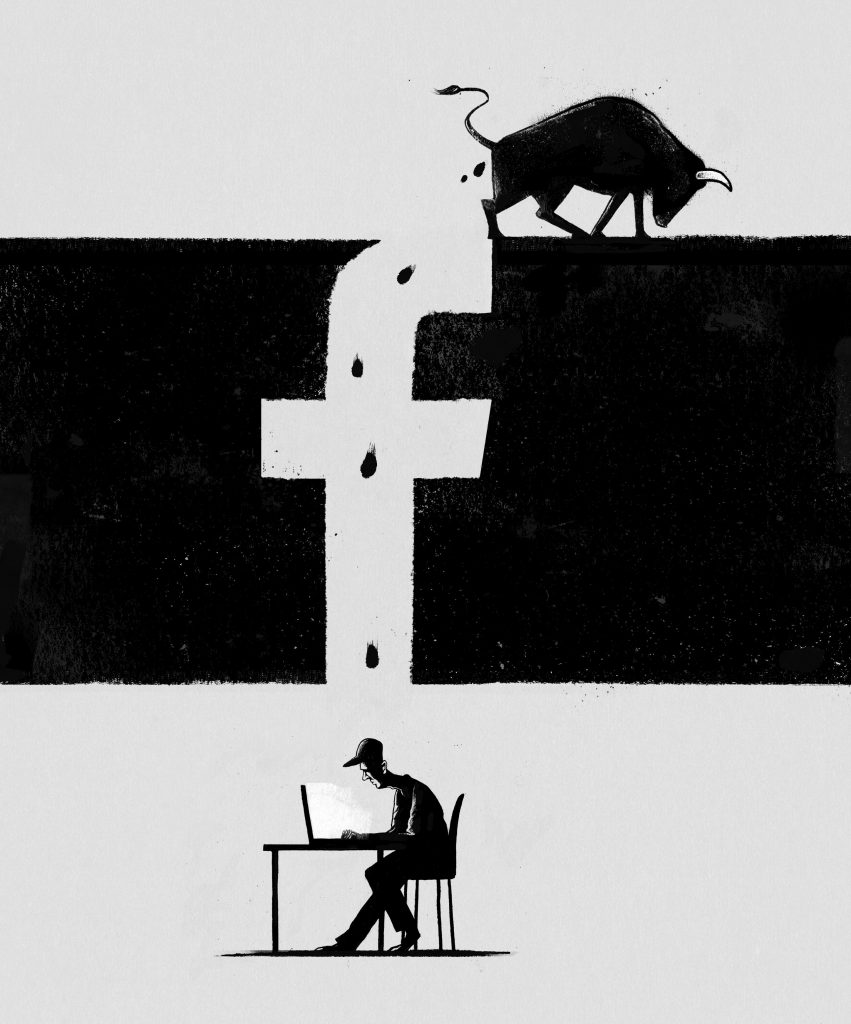
Credit: Ben Jennings
[/vc_column_text][/vc_column][/vc_row][vc_row][vc_column][vc_column_text]
Decoding the News: Turkey
A Picture Sparks a Thousand Stories
KAYA GENÇ dissects the use of shocking images and asks why the Turkish media didn’t check them
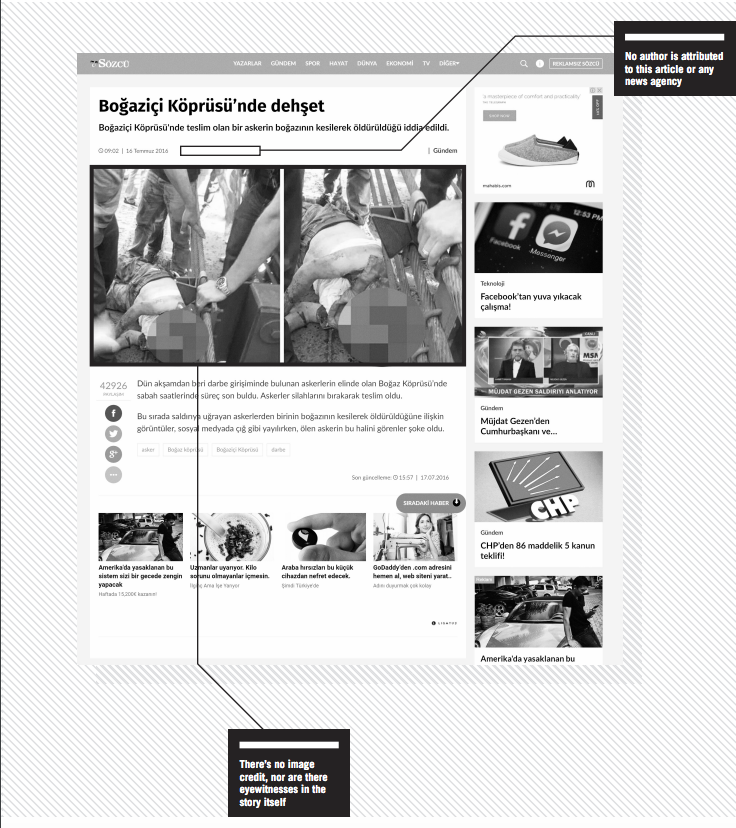
Two days after last year’s failed coup attempt in Turkey, one of the leading newspapers in the country, Sozcu, published an article with two shocking images purportedly showing anti-coup protesters cutting the throat of a soldier involved in the coup. “In the early hours of this morning the situation at the Bosphorus Bridge, which had been at the hands of coup plotters until last night, came to an end,” the piece read. “The soldiers handed over their guns and surrendered. Meanwhile, images of one of the soldiers whose throat was cut spread over social media like an avalanche, and those who saw the image of the dead soldier suffered shock,” it said.
These powerful images of a murdered uniformed youth proved influential for both sides of the political divide in Turkey: the ultra-conservative Akit newspaper was positive in its reporting of the lynching, celebrating the killing. The secularist OdaTV, meanwhile, made it clear that it was an appalling event and it was publishing the pictures as a means of protest.
Neither publication credited the images they had published in their extremely popular articles, which is unusual for a respectable publication. A careful reader could easily spot the lack of sources in the pieces too; there was no eyewitness account of the purported killing, nor was anyone interviewed about the event. In fact, the piece was written anonymously.
These signs suggested to the sceptical reader that the news probably came from someone who did not leave their desk to write the story, choosing instead to disseminate images they came across on social media and to not do their due diligence in terms of verifying the facts.
On 17 July, Istanbul’s medical jurisprudence announced that, among the 99 dead bodies delivered to the morgue in Istanbul, there was no beheaded person. The office of Istanbul’s chief prosecutor also denied the news, and it was declared that the news was fake.
A day later, Sozcu ran a lengthy commentary about how it prepared the article. Editors accepted that their article was based on rumours and images spread on social media. Numerous other websites had run the same news, their defence ran, so the responsibility for the fake news rested with all Turkish media. This made sense. Most of the pictures purportedly showing lynched soldiers were said to come from the Syrian civil war, though this too is unverifiable. Major newspapers used them, for different political purposes, to celebrate or condemn the treatment of putschist soldiers.
More worryingly, the story showed how false images can be used by both sides of Turkey’s political divide to manipulate public opinion: sometimes lies can serve both progressives and conservatives.
 [/vc_column_text][vc_row_inner][vc_column_inner width=”1/4″][/vc_column_inner][vc_column_inner width=”3/4″][/vc_column_inner][/vc_row_inner][vc_column_text]
Decoding the News: China
A Case of Mistaken Philanthropy
JEMIMAH STEINFELD writes on the story of Jack Ma’s doppelganger that went too far
Jack Ma is China’s version of Mark Zuckerberg. The founder and executive chairman of successful e-commerce sites under the Alibaba Group, he’s one of the wealthiest men in China. Articles about him and Alibaba are frequent. It’s within this context that an incorrect story on Ma was taken as verbatim and spread widely.
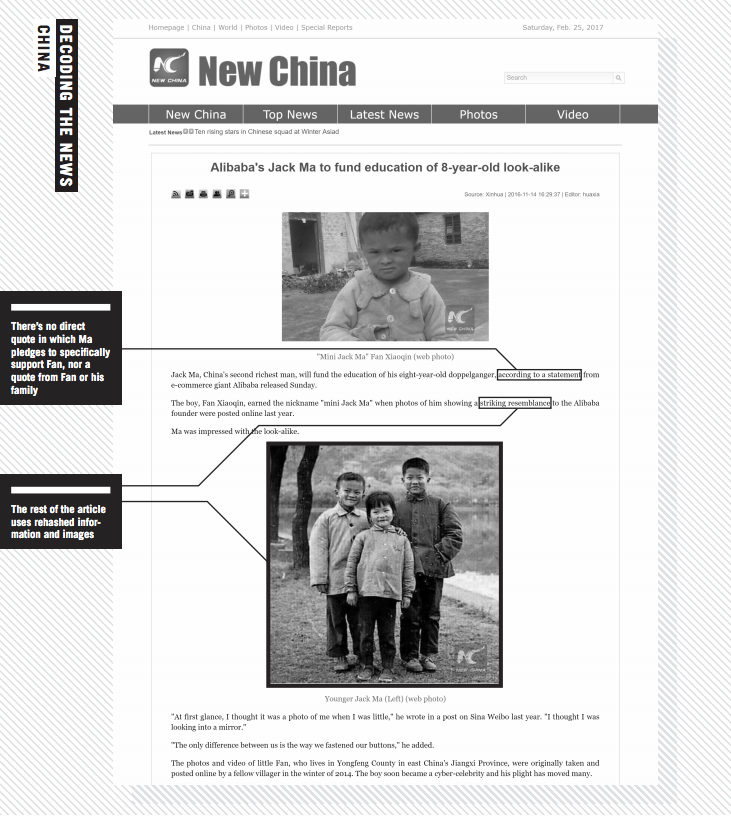
The story, published in November 2016 across multiple sites at the same time, alleged that Ma would fund the education of eight-year-old Fan Xiaoquin, nicknamed “mini Ma” because of an uncanny resemblance to Ma when he was of a similar age. Fan gained notoriety earlier that year because of this. Then, as people remarked on the resemblance, they also remarked on the boy’s unfavourable circumstances – he was incredibly poor and had ill parents. The story took a twist in November, when media, including mainstream media, reported that Ma had pledged to fund Fan’s education.
Hints that the story was untrue were obvious from the outset. While superficially supporting his lookalike sounds like a nice gesture, it’s a small one for such a wealthy man. People asked why he wouldn’t support more children of a similar background (Fan has a brother, in fact). One person wrote on Weibo: “If the child does not look like Ma, then his tragic life will continue.”
Despite the story drawing criticism along these lines, no one actually questioned the authenticity of the story itself. It wouldn’t have taken long to realise it was baseless. The most obvious sign was the omission of any quote from Ma or from Alibaba Group. Most publications that ran the story listed no quotes at all. One of the few that did was news website New China – sponsored by state-run news agency Xinhua. Even then the quotes did not directly pertain to Ma funding Fan. New China also provided no link to where the comments came from.
Copying the comments into a search engine takes you to the source though – an article on major Chinese news site Sina, which contains a statement from Alibaba. In this statement, Alibaba remark on the poor condition of Fan and say they intend to address education amongst China’s poor. But nowhere do they pledge to directly fund Fan. In fact, the very thing Ma was criticised for – only funding one child instead of many – is what this article pledges not to do.
It was not just the absence of any comments from Ma or his team that was suspicious; it was also the absence of any comments from Fan and his family. Media that ran the story had not confirmed its veracity with Ma or with Fan. Given that few linked to the original statement, it appeared that not many had looked at that either.
In fact, once past the initial claims about Ma funding Fan, most articles on it either end there or rehash information that was published from the initial story about Ma’s doppelganger. As for the images, no new ones were used. These final points alone wouldn’t indicate that the story was fabricated, but they do further highlight the dearth of new information, before getting into the inaccuracy of the story’s lead.
Still, the story continued to spread, until someone from Ma’s press team went on the record and denied the news, or lack thereof.
[/vc_column_text][vc_row_inner][vc_column_inner][vc_column_text]
Decoding the News: Mexico
Not a Laughing Matter
DUNCAN TUCKER digs out the clues that a story about clown killings in Mexico didn’t stand up
Disinformation thrives in times of public anxiety. Soon after a series of reports on sinister clowns scaring the public in the USA in 2016, a story appeared in the Mexican press about clowns being beaten to death.
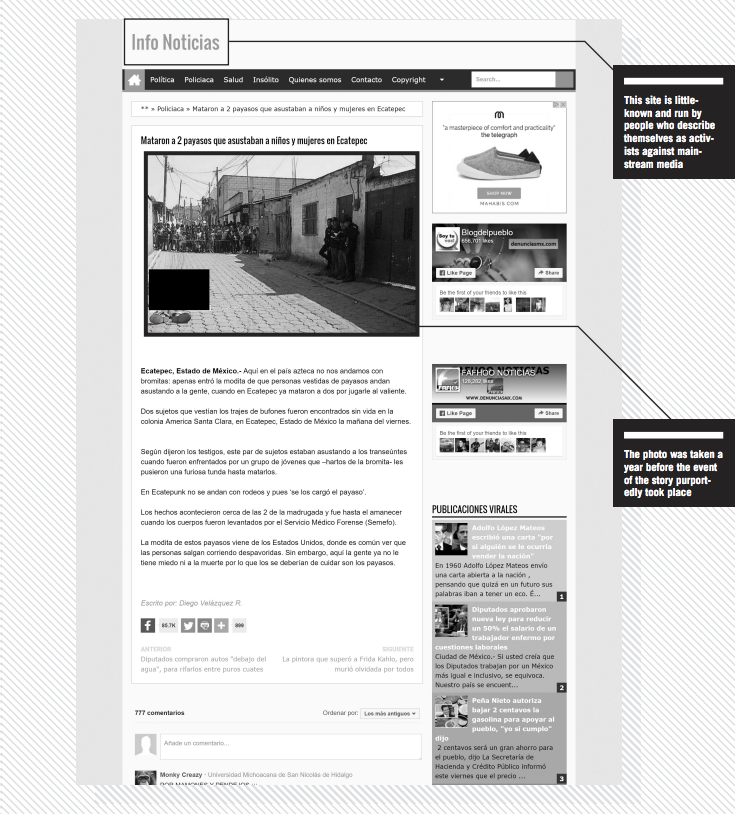
At the height of the clown hysteria, the little-known Mexican news site DenunciasMX reported that a group of youths in Ecatepec, a gritty suburb of Mexico City, had beaten two clowns to death in retaliation for intimidating passers-by. The article featured a low-resolution image of the slain clowns on a run-down street, with a crowd of onlookers gathered behind police tape.
To the trained eye, there were several telltale signs that the news was not genuine.
While many readers do not take the time to investigate the source of stories that appear on their Facebook newsfeeds, a quick glance at DenunciasMX’s “Who are we?” page reveals that the site is co-run by social activists who are tired of being “tricked by the big media mafia”. Serious news sources rarely use such language, and the admission that stories are partially authored by activists rather than by professionally-trained journalists immediately raises questions about their veracity.
The initial report was widely shared on social media and quickly reproduced by other minor news sites but, tellingly, it was not reported in any of Mexico’s major newspapers – publications that are likely to have stricter criteria with regard to fact-checking.
Another sign that something was amiss was that the reports all used the vague phrase “according to witnesses”, yet none had any direct quotes from bystanders or the authorities
Yet another red flag was the fact that every news site used the same photograph, but the initial report did not provide attribution for the image. When in doubt, Google’s reverse image search is a useful tool for checking the veracity of news stories that rely on photographic evidence. Rightclicking on the photograph and selecting “Search Google for Image” enables users to sift through every site where the picture is featured and filter the results by date to find out where and when it first appeared online.
In this case, the results showed that the image of the dead clowns first appeared online in May 2015, more than a year before the story appeared in the Mexican press. It was originally credited to José Rosales, a reporter for the Guatemalan news site Prensa Libre. The accompanying story, also written by Rosales, stated that the two clowns were shot dead in the Guatemalan town of Chimaltenango.
While most of the fake Mexican reports did not have bylines and contained very little detail, Rosales’s report was much more specific, revealing the names, ages and origins of the victims, as well as the number of shell casings found at the crime scene. Instead of rehashing rumours or speculating why the clowns were targeted, the report simply stated that police were searching for the killers and were working to determine the motive.
As this case demonstrates, with a degree of scrutiny and the use of freely available tools, it is often easy to differentiate between genuine news and irresponsible clickbait.
 [/vc_column_text][/vc_column_inner][/vc_row_inner][vc_column_text]
Decoding the News: Eritrea
Not North Korea
ABRAHAM T ZERE dissects the moment that Eritreans mistook saucy satire for real news
In recent years, the international media have dubbed Eritrea the “North Korea of Africa”, due to their striking similarities as closed, repressive states that are blocked to international media. But when a satirical website run by exiled Eritrean journalists cleverly manipulated the simile, the site stoked a social media buzz among the Eritrean diaspora.
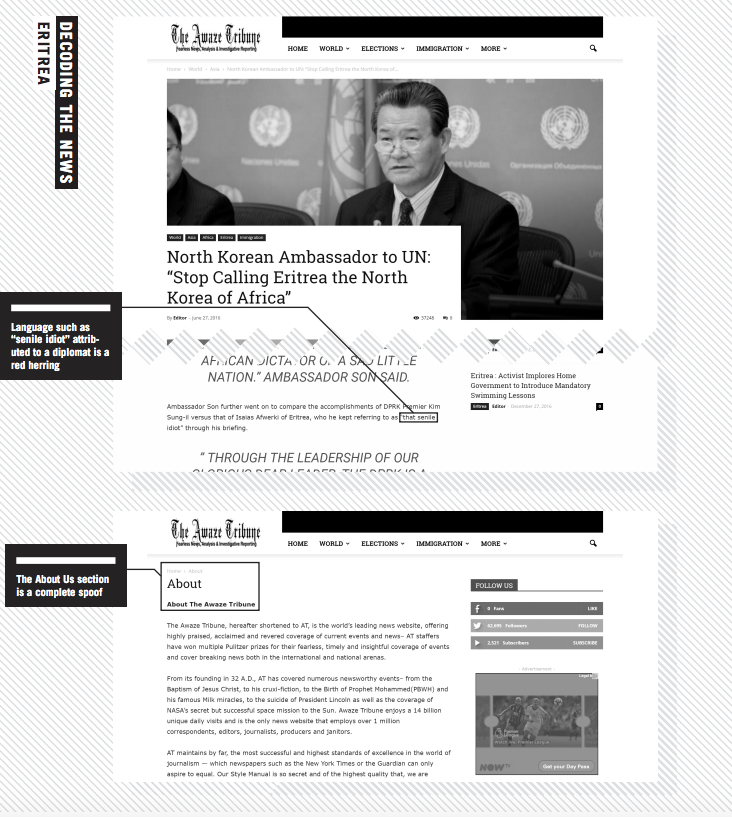
Awaze Tribune launched last June with three news stories, including “North Korean ambassador to UN: ‘Stop calling Eritrea the North Korea of Africa’.”
The story reported that the North Korean ambassador, Sin Son-ho, had complained it was insulting for his advanced, prosperous, nuclear-armed nation to be compared to Eritrea, with its “senile idiot leader” who “hasn’t even been able to complete the Adi Halo dam”.
With apparent little concern over its authenticity, Eritreans in the diaspora began widely sharing the news story, sparking a flurry of discussion on social media and quickly accumulating 36,600 hits.
The opposition camp shared it widely to underline the dismal incompetence of the Eritrean government. The pro-government camp countered by alleging that Ethiopia must have been involved behind the scenes.
The satirical nature of the website should have seemed obvious. The name of the site begins with “Awaze”, a hot sauce common in Eritrean and Ethiopian cuisines. If readers were not alerted by the name, there were plenty of other pointers. For example, on the same day, two other “news” articles were posted: “Eritrea and South Sudan sign agreement to set an imaginary airline” and “Brexit vote signals Eritrea to go ahead with its long-planned referendum”.
Although the website used the correct name and picture of the North Korean ambassador to the UN, his use of “senile idiot” and other equally inappropriate phrases should have betrayed the gag.
Recently, Eritrean President Isaias Afwerki has been spending time at Adi Halo, a dam construction site about an hour’s drive from the capital, and he has opened a temporary office there. While this is widely known among Eritreans, it has not been covered internationally, so the fact that the story mentioned Adi Halo should also have raised questions of its authenticity with Eritreans. Instead, some readers were impressed by how closely the North Korean ambassador appeared to be following the development.
The website launched with no news items attributed to anyone other than “Editor”, and even a cursory inspection should have revealed it was bogus. The About Us section is a clear joke, saying lines such as the site being founded in 32AD.
Satire is uncommon in Eritrea and most reports are taken seriously. So when a satirical story from Kenya claimed that Eritrea had declared polygamy mandatory, demanding that men have two wives, Eritrea’s minister of information felt compelled to reply.
In recent years, Eritrea’s tightly closed system has, not surprisingly, led people to be far less critical of news than they should be. This and the widely felt abhorrence of the regime makes Eritrean online platforms ready consumers of such satirical news.
 [/vc_column_text][/vc_column][/vc_row][vc_row][vc_column][vc_column_text]
Decoding the News: South Africa
And That’s a Cut
Journalist NATASHA JOSEPH spots the signs of fiction in a story about circumcision
The smartest tall tales contain at least a grain of truth. If they’re too outlandish, all but the most gullible reader will see through the deceit. Celebrity death stories are a good example. In South Africa, dodgy “news” sites routinely kill off local luminaries like Desmond Tutu. The cleric is 85 years old and has battled ill health for years, so fake reports about his death are widely circulated.
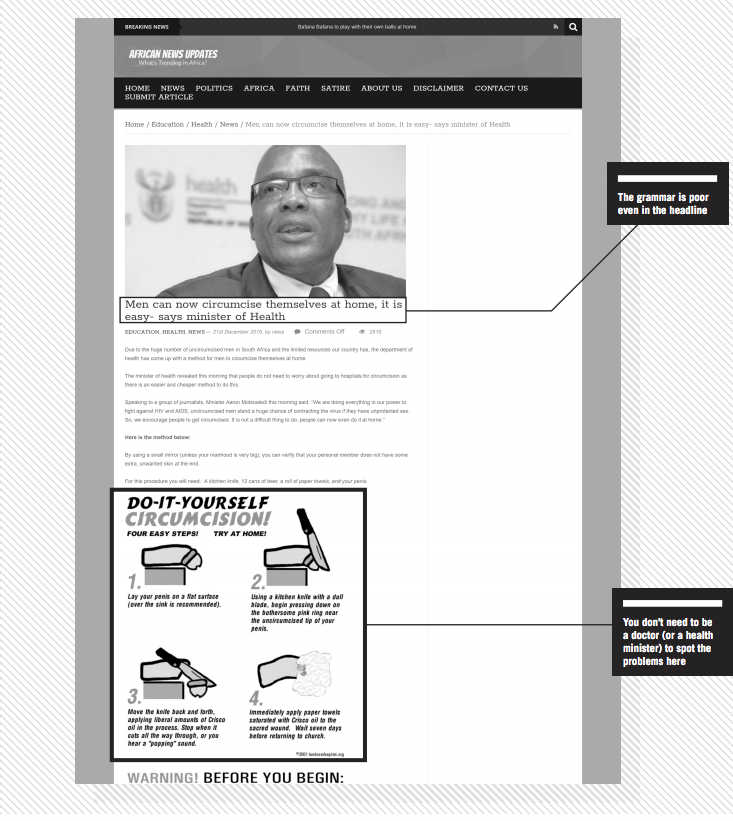
This “grain of truth” rule lies at the heart of why the following headline was perhaps believed. The headline was “Men can now circumcise themselves at home, it is easy – says minister of health”. Circumcision is a common practice among a number of African cultural groups. Medical circumcision is also on the rise. So it makes sense that South Africa’s minister of health would be publicly discussing the issue of circumcision.
The country has also recently unveiled “DIY HIV testing kits” that allow people to check for HIV in their own homes. This is common knowledge, so casual or less canny readers might conflate the two procedures.
The reality is that most of us are casual readers, snacking quickly on short pieces and not having the time to engage fully with stories. New levels of engagement are required in a world heaving with information.
The most important step you can take in navigating this terrible new world is to adopt a healthy scepticism towards everything. Yes, it sounds exhausting, but the best journalists will tell you that it saves a lot of time to approach information with caution. My scepticism manifests as what I call my “bullshit detector”. So how did my detector react to the “DIY circumcision” story?
It started ringing instantly thanks to the poor grammar evident in the headline and the body of the text. Most proper news websites still employ sub editors, so lousy spelling and grammar are early warning signals that you’re dealing with a suspicious site.
The next thing to check is the sourcing: where did the minister make these comments? To whom? All this article tells us is that he was speaking “in Johannesburg”. The dearth of detail should signal to tread with caution. If you’ve got the time, you might also Google some key search terms and see if anyone else reported on these alleged statements. Also, is there a journalist’s name on the article? This one was credited to “author”, which suggests that no real journalist was involved in production.
The article is accompanied by some graphic illustrations of a “DIY circumcision”. If you can stomach it, study the pictures. They’ll confirm what I immediately suspected upon reading the headline: this is a rather grisly example of false “news”.
Finally, make sure you take a good look at the website that runs such an article. This one appeared on African News Updates.
That’s a solid name for a news website, but two warning bells rang for me: the first bell was clanged by other articles, which ranged from the truth (with a sensational bent) to the utterly ridiculous. The second bell rang out of control when I spotted a tab marked “satire” along the top. Click on it and there’s a rant ridiculing anyone who takes the site seriously. Like I needed any excuse to exit the site and go in search of real news.
[/vc_column_text][/vc_column][/vc_row][vc_row][vc_column][vc_column_text]
Decoding the News: How To
Get the Tricks of the Trade
Veteran journalist RAYMOND JOSEPH explains how a handy new tool from South Africa can teach you core journalism skills to help you get to the truth
It’s been more than 20 years since leading US journalist and journalism school teacher Melvin Mencher released his Reporter’s Checklist and Notebook, a brilliant and simple tool that for years helped journalists in training.
Taking cues from Mencher’s, there’s now a new kid on the block designed for the digital age. Pocket Reporter is a free app that leads people through the newsgathering process – and it’s making waves in South Africa, where it was launched in late 2016.
Mencher’s consisted of a standard spiral-bound reporter’s notebook, but also included tips and hints for young reporters and templates for a variety of stories, including a crime, a fire and a car crash. These listed the questions a journalist needed to ask.
Cape Town journalist Kanthan Pillay was introduced to Mencher’s notebook when he spent a few months at the Harvard Business School and the Nieman Foundation in the USA. Pillay, who was involved in training young reporters at his newspaper, was inspired by it. Back in South Africa, he developed a website called Virtual Reporter.
“Mencher’s notebook got me thinking about what we could do with it in South Africa,” said Pillay. “I believed then that the next generation of reporters would not carry notebooks but would work online.”
Picking up where Pillay left off, Pocket Reporter places the tips of Virtual Reporter into your mobile phone to help you uncover the information that the best journalists would dig out. Cape Town-based Code for South Africa re-engineered it in partnership with the Association of Independent Publishers, which represents independent community media.
It quickly gained traction among AIP’s members. Their editors don’t always have the time to brief reporters – who might be inexperienced journalists or untrained volunteers – before they go out on stories.
This latest iteration of the tool, in an age when any smartphone user can be a reporter, is aimed at more than just journalists. Ordinary people without journalism training often find themselves on the frontline of breaking news, not knowing what questions to ask or what to look out for.
Code4SA recently wrote code that makes it possible to translate the content into other languages besides English. Versions in Xhosa, one of South Africa’s 11 national languages, and Portuguese are about to go live. They are also currently working on Afrikaans and Zulu translations, while people elsewhere are working on French and Spanish translations.
“We made the initial investment in developing Pocket Reporter and it has shown real world value. It is really gratifying to see how the project is now becoming community-driven,” said Code4SA head Adi Eyal.
Editor Wara Fana, who publishes his Xhosa community paper Skawara News in South Africa’s Eastern Cape province, said: “I am helping a collective in a remote area to launch their own publication, and Pocket Reporter has been invaluable in training them to report news accurately.” His own journalists were using the tool and he said it had helped improve the quality of their reporting.
Cape Peninsula University of Technology journalism department lecturer Charles King is planning to incorporate Pocket Reporter into his curriculum for the news writing and online-media courses he teaches.
“What’s also of interest to me is that there will soon be Afrikaans and Xhosa versions of the app, the first languages of many of our students,” he said.
Once it has been downloaded from the Google Play store, the app offers a variety of story templates, covering accidents, fires, crimes, disasters, obituaries and protests.
The tool takes you through a series of questions to ensure you gather the correct information you need in an interview.
The information is typed into a box below each question. Once you have everything you need, you have the option of emailing the information to yourself or sending it directly to your editor or anyone else who might want it.
Your stories remain private, unless you choose to share them. Once you have emailed the story, you can delete it from your phone, leaving no trace of it.
[/vc_column_text][vc_column_text]
This article originally appeared in the spring 2017 issue of Index on Censorship magazine.
Kaya Genç is a contributing editor for Index on Censorship magazine based in Istanbul, Turkey
Jemimah Steinfeld is deputy editor of Index on Censorship magazine
Duncan Tucker is a regular correspondent for Index on Censorship magazine from Mexico
Journalist Abraham T Zere is originally from Eritrea and now lives in the USA. He is executive director of PEN Eritrea
Natasha Joseph is a contributing editor for Index on Censorship magazine and is based in Johannesburg, South Africa. She is also Africa education, science and technology editor at The Conversation
Raymond Joseph is former editor of Big Issue South Africa and regional editor of South Africa’s Sunday Times. He is based in Cape Town and tweets @rayjoe
[/vc_column_text][/vc_column][/vc_row][vc_row][vc_column][vc_custom_heading text=”From the Archives”][vc_row_inner][vc_column_inner width=”1/3″][vc_single_image image=”91220″ img_size=”full” alignment=”center” onclick=”custom_link” link=”http://journals.sagepub.com/doi/pdf/10.1080/03064228408533808″][vc_custom_heading text=”There’s nothing new about fake news” font_container=”tag:p|font_size:24|text_align:left” link=”url:http%3A%2F%2Fjournals.sagepub.com%2Fdoi%2Fpdf%2F10.1080%2F03064228408533808|||”][vc_column_text]June 2017
Andrei Aliaksandrau takes a look at fake news in Belarus[/vc_column_text][/vc_column_inner][vc_column_inner width=”1/3″][vc_single_image image=”99282″ img_size=”213×289″ alignment=”center” onclick=”custom_link” link=”http://journals.sagepub.com/doi/pdf/10.1080/03064227508532452″][vc_custom_heading text=”Fake news: The global silencer” font_container=”tag:p|font_size:24|text_align:left” link=”url:http%3A%2F%2Fjournals.sagepub.com%2Fdoi%2Fpdf%2F10.1080%2F03064227508532452|||”][vc_column_text]April 2018
Caroline Lees examines fake news being used to imprison journalists [/vc_column_text][/vc_column_inner][vc_column_inner width=”1/3″][vc_single_image image=”88803″ img_size=”213×289″ alignment=”center” onclick=”custom_link” link=”http://journals.sagepub.com/doi/pdf/10.1080/03064229808536482″][vc_custom_heading text=”Taking the bait” font_container=”tag:p|font_size:24|text_align:left” link=”url:http%3A%2F%2Fjournals.sagepub.com%2Fdoi%2Fpdf%2F10.1080%2F03064229808536482|||”][vc_column_text]April 2017
Richard Sambrook discusses the pressures click-bait is putting on journalism[/vc_column_text][/vc_column_inner][/vc_row_inner][vc_separator][/vc_column][/vc_row][vc_row content_placement=”top”][vc_column width=”1/3″][vc_custom_heading text=”The Big Squeeze” font_container=”tag:p|font_size:24|text_align:left” link=”url:https%3A%2F%2Fwww.indexoncensorship.org%2F2017%2F12%2Fwhat-price-protest%2F|||”][vc_column_text]The spring 2017 issue of Index on Censorship magazine looks at multi-directional squeezes on freedom of speech around the world.
Also in the issue: newly translated fiction from Karim Miské, columns from Spitting Image creator Roger Law and former UK attorney general Dominic Grieve, and a special focus on Poland.[/vc_column_text][/vc_column][vc_column width=”1/3″][vc_single_image image=”88802″ img_size=”medium” alignment=”center” onclick=”custom_link” link=”https://www.indexoncensorship.org/2017/12/what-price-protest/”][/vc_column][vc_column width=”1/3″ css=”.vc_custom_1481888488328{padding-bottom: 50px !important;}”][vc_custom_heading text=”Subscribe” font_container=”tag:p|font_size:24|text_align:left” link=”url:https%3A%2F%2Fwww.indexoncensorship.org%2Fsubscribe%2F|||”][vc_column_text]In print, online. In your mailbox, on your iPad.
Subscription options from £18 or just £1.49 in the App Store for a digital issue.
Every subscriber helps support Index on Censorship’s projects around the world.
 SUBSCRIBE NOW[/vc_column_text][/vc_column][/vc_row]
10 Apr 2018 | Awards, Fellowship 2018, News
[vc_row][vc_column][vc_video link=”https://youtu.be/jPOdNm8Sxos”][vc_column_text]Avispa Midia is an independent online magazine that prides itself on its daring use of multimedia techniques to bring alive the political, economic and social world that is Mexico and Latin America.
“As with avispas (wasps), insects that exist across the world that are equipped with various eyes or ocelli capable of distinguishing between light and dark, Avispa Media seeks to participate in and witness the variety of shades that colour reality,” said Avispa Midia. “We believe that modern-day communication should be nourished by the varied formats and technology that characterise new virtual journalism, such as integrating multimedia tools that make information more dynamic. What sets us apart is our critical, far-reaching eye, primarily through reportage and investigative journalism.”
In the Spanish version, the site’s use of pictures, videos, music and maps to illustrate its stories is particularly striking.
But the beauty of the design masks the serious intent of this collective of journalists and researchers who are seeking to challenge violence and corruption in the region and reflect the lives of marginalised and indigenous people.
They specialise in investigations into organised criminal gangs and the paramilitaries behind mining mega-projects, hydroelectric dams, and the wind and oil industry.
The Latin American world they report on is extremely violent. Between 2000 and 2016, at least 105 journalists were murdered in Mexico for carrying out their work. According to Reporters Without Borders, in 2016 Mexico became third highest country in the world for journalist killings — the most deadly outside war zones.
Avispa Midia says its work has meant that human rights organisations and NGOs have taken action on slave labour and undocumented migrants as a result of their reports.
The site however suffers from scant resources and their main challenge is to be able to establish some form of continuous financing, since they do not have a fixed budget to do their work and no one receives a salary.
Topics that Avispa Midia has addressed in the last year include: US interference in Mexico and Central America; the persecution of peasants in Honduras; land restitution demands by displaced people in Guatemala and the first visit of Mexican president Enrique Peña Nieto to the city of Oaxaca.
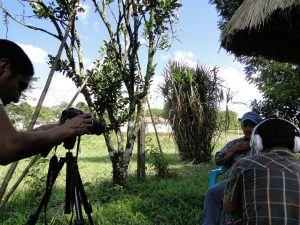
Many of the reports in the last 12 months have been focused on Mexico and Central America, where the media group has helped indigenous and marginalised communities report on their own stories by helping them learn to do audio and video editing.
In the future the journalists want to create a multimedia journalism school for indigenous people and young people from marginalised neighbourhoods, so that ordinary citizens can inform the world what is happening in their region, and break the stranglehold of the state and large corporations on the media.
“In a field where war has contaminated even communication, where truths but also actions are disputed, having been nominated for the Index of Censorship award lifts our courage up,” said Avispa Midia. “And it enables us to reaffirm our investment in the truth and the tenacity of the voices and experiences we carry through each word and each image documented by Avispa Midia. For us, this represents respect and appreciation for the work we have done. This means expanding the support of communities, civil organisations and academic groups that supported us against the violence exerted against journalists in Mexico.”
See the full shortlist for Index on Censorship’s Freedom of Expression Awards 2018 here.[/vc_column_text][/vc_column][/vc_row][vc_row full_width=”stretch_row_content” equal_height=”yes” el_class=”text_white” css=”.vc_custom_1490258749071{background-color: #cb3000 !important;}”][vc_column width=”1/2″][vc_custom_heading text=”Support the Index Fellowship.” font_container=”tag:p|font_size:28|text_align:center” use_theme_fonts=”yes” link=”url:https%3A%2F%2Fwww.indexoncensorship.org%2Fsupport-the-freedom-of-expression-awards%2F|||”][vc_column_text]
By donating to the Freedom of Expression Awards you help us support
individuals and groups at the forefront of tackling censorship.
Find out more
[/vc_column_text][/vc_column][vc_column width=”1/2″ css=”.vc_custom_1521479845471{background-image: url(https://www.indexoncensorship.org/wp-content/uploads/2017/05/2017-awards-fellows-1460×490-2_revised.jpg?id=90090) !important;background-position: center !important;background-repeat: no-repeat !important;background-size: cover !important;}”][/vc_column][/vc_row][vc_row][vc_column][vc_basic_grid post_type=”post” max_items=”4″ element_width=”6″ grid_id=”vc_gid:1523523668709-d546d4ac-7872-3″ taxonomies=”10735″][/vc_column][/vc_row]
12 Jan 2018 | Journalism Toolbox Spanish
[vc_row][vc_column][vc_custom_heading text=”Con ocasión de las elecciones mexicanas del año que viene, Duncan Tucker repasa en este reportaje de investigación para Index las amenazas que han sufrido los periodistas de este país durante la última década.”][vc_row_inner][vc_column_inner][vc_column_text]
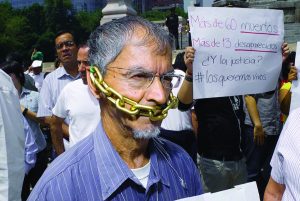
Un periodista mexicano sujeta una cadena alrededor de su boca durante una marcha silenciosa de 2010 en protesta contra los secuestros, asesinatos y violencia que sufren los periodistas del país, John S. and James L. Knight/Flickr
[/vc_column_text][/vc_column_inner][/vc_row_inner][/vc_column][/vc_row][vc_row][vc_column][vc_column_text]
Pablo Pérez, periodista independiente de Ciudad de México, atravesaba en coche el estado sin ley de Guerrero con dos colegas de la capital y cuatro reporteros locales cuando los detuvo una horda de hombres armados. Pérez estaba trabajando en un reportaje sobre los lugareños a los que la violencia del narcotráfico había desplazado de la región.
«Acabábamos de dejar la zona más peligrosa y pasamos por un puesto de control del ejército, lo cual nos hizo creer que estábamos en una zona segura», narra Pérez, poco después del incidente del 13 de mayo. «Pero no: a kilómetro y medio de allí nos detuvo un grupo de 80 a 100 hombres jóvenes; muchos de ellos, armados. Registraron nuestros vehículos y nos robaron todo el equipo, el dinero y los documentos de identificación. Se llevaron uno de nuestros autos y nos dejaron con el otro. Nos dijeron que tenían informadores en el puesto de control y que nos quemarían vivos si se lo contábamos a los soldados», relata.
Pérez y sus compañeros sobrevivieron, conmocionados, pero ilesos. Otros no han tenido tanta suerte. 2016 batió el récord con 11 periodistas asesinados, y 2017 va camino de superar ese cómputo nefasto.
Los medios impresos han comenzado a introducir modestos protocolos de seguridad en una apuesta por proteger a sus empleados, mientras que el gobierno ha anunciado recompensas para quienes faciliten información sobre los responsables de asesinar a periodistas. Pese a todo, lo más probable es que estas medidas no tengan un gran impacto frente a la violencia desenfrenada, la corrupción y la ausencia de justicia imperante en el país. La narcoguerra de México ha dado cifras récord de muertes en 2017 y, con la posibilidad de que las elecciones del año que viene provoquen aún más inestabilidad, no parece que los ataques a periodistas vayan a desaparecer próximamente.
El nivel de peligrosidad varía considerablemente según la región de México a la que nos refiramos. Los ataques a corresponsales extranjeros son raros, probablemente porque acarrearían una presión internacional indeseada. Los mexicanos que trabajan en publicaciones nacionales o metropolitanas también están protegidos de la violencia, hasta cierto punto. Son los reporteros locales los que se enfrentan a los mayores peligros. Según el Comité para la Protección de los Periodistas, el 95% de las víctimas de asesinato como respuesta directa a su trabajo son normalmente reporteros de publicaciones de regiones remotas, donde el crimen y la corrupción rampantes minan el peso de la ley. Los estados sureños de Guerrero, Veracruz y Oaxaca comprenden actualmente los lugares más mortíferos, sumando al menos 31 periodistas asesinados desde 2010 en el territorio.
Pese a los riesgos a los que se expone la profesión, el periodista mexicano medio gana menos de 650 dólares al mes y recibe pocas ventajas.
«No tenemos seguro médico ni de vida. Somos vulnerables a esta violencia», dice Pérez. «Aunque los que vivimos en grandes ciudades estamos mucho más seguros que los que están en lugares como Guerrero».
Cuando visitan zonas en conflicto, reconoce Pérez, no hay mucho que puedan hacer salvo adoptar algún que otro protocolo básico de seguridad. «Todos tratábamos de mantener contacto constante con colegas en la ciudad, cosa que no era nada fácil, ya que a menudo perdíamos la cobertura del teléfono. El protocolo era no separarnos, seguir en contacto con periodistas locales y mantenernos alerta a cualquier señal de peligro».
[/vc_column_text][/vc_column][/vc_row][vc_row][vc_column width=”1/4″][/vc_column][vc_column width=”3/4″][/vc_column][/vc_row][vc_row][vc_column][vc_column_text]
Mientras que los periodistas de la capital pueden refugiarse en lugares relativamente seguros después de trabajar en zonas peligrosas, los reporteros locales están permanentemente expuestos a las consecuencias de su trabajo. Una brutal ilustración de ello fue el asesinato el 15 de mayo de Javier Valdez, uno de los periodistas más afamados y respetados de México, en su Sinaloa natal. Valdez acababa de salir de su oficina de Ríodoce, un semanal de noticias fundado por él mismo, cuando unos hombres armados lo bajaron a la fuerza de su coche y lo obligaron a arrodillarse. Le dispararon 12 veces a quemarropa y acto seguido huyeron con su teléfono y portátil, abandonándolo boca abajo en la carretera. Su característico sombrero panamá estaba manchado de sangre.
Valdez era una autoridad en el campo de los bajos fondos de Sinaloa, la cuna del narcotráfico mexicano. También era el periodista más prominente asesinado en años. En una entrevista con Index unos meses antes de su asesinato, habló de amenazas contra su periódico y lamentaba la falta de protección por parte del gobierno. Afirmaba: «Lo mejor sería llevarme a mi familia y abandonar el país».
En las semanas anteriores a su muerte, Valdez había estado involucrado en las consecuencias de un sangriento forcejeo por el poder dentro del poderoso cártel mexicano de Sinaloa. La violencia en la región se ha disparado desde que el líder Joaquín «El Chapo» Guzmán, de terrible fama, fuera extraditado a EE.UU. el pasado año, dejando a sus hijos Iván y Alfredo luchando por el control del cártel contra Dámaso López, su ex-mano derecha.
Cuando Valdez entrevistó a un intermediario enviado por López en febrero de 2017, los hijos de Guzmán llamaron a la sala de redacción de Ríodoce y les advirtieron acerca de publicar el artículo. Ofrecieron comprar toda la tirada, pero Valdez se mantuvo en sus trece. Cuando el periódico salió en distribución, miembros armados del cártel siguieron a los camiones de reparto por Culiacán y compraron todos los ejemplares. Los colegas de Valdez sospechan que fue su decisión de publicar la entrevista lo que le costó la vida.
Adrián López, editor de Noroeste, otro periódico de Sinaloa, contó a Index que la muerte de Valdez causó «mucha indignación, rabia y miedo» en la comunidad local. Según él, el haber puesto en el blanco a una figura tan conocida envía un mensaje contundente a los periodistas y activistas de México, así como a la sociedad al completo: «Si somos capaces de matar a Javier, somos capaces de matar a cualquiera».
López también ha vivido la interferencia editorial de los cárteles. En 2010, varios hombres armados dispararon 64 veces contra las oficinas de Noroeste, en la ciudad costera de Mazatlán. Los asaltantes habían amenazado a los empleados por teléfono horas antes, instándolos a atribuir los casos recientes de violencia a un cártel rival. «Decidimos no publicar lo que ellos querían porque nuestra postura es que no se puede decir que sí a semejantes exigendias», dijo López. «Si dices que sí una vez, después nunca podrás decir que no».
López sufrió unas circunstancias similares a las de Valdez en 2014, cuando unos hombres armados bloquearon su coche en la capital estatal de Culiacán. Los asaltantes le robaron el coche, la cartera, el teléfono y el portátil y le dispararon en la pierna. Semanas antes, varios reporteros de Noroeste habían recibido amenazas y palizas mientras cubrían el caso de Guzmán y el cártel de Sinaloa.
Según López, su periódico trabaja continuamente para mejorar sus protocolos de seguridad. Noroeste emplea a abogados para denunciar todas las amenazas contra ellos a las autoridades pertinentes, y han contratado a terapeutas que faciliten ayuda psicológica a los trabajadores. «La violencia con la que tratamos día tras día no es normal», explica López. «Necesitamos ayuda profesional para entender y hablar más sobre estas cosas, sobre el trauma que la violencia nos podría ocasionar».
Más de 100 periodistas mexicanos han sido asesinados desde 2000, y hay al menos otros 23 desaparecidos. En estos últimos tres años, cada año ha superado al anterior en cuestión de asesinatos, y este podría ser el más mortífero hasta la fecha, tras los 10 periodistas asesinados en los primeros ocho meses de 2017 (hasta agosto de 23). Las autoridades mexicanas a menudo están implicadas en los ataques. Artículo 19, organismo de control de la libertad de prensa, documentó 426 ataques contra medios de comunicación el pasado año; un incremento del 7% desde 2015. El 53% de esos ataques se atribuyen a ocupantes de cargos públicos o a las fuerzas de seguridad.
Alejandro Hope, analista de seguridad, contó a Index: «Las autoridades federales no han investigado ni procesado estos casos en condiciones. Han creado un entorno de impunidad que ha permitido que prosperen los ataques a la prensa».
En julio de 2010, el gobierno fundó la Fiscalía Especializada para la Atención de Delitos contra la Libertad de Expresión (Feadle) con la intención de investigar los delitos cometidos contra los medios de comunicación. La agencia, que no respondió a la petición de Index de una entrevista, ha facilitado botones de alarma a los periodistas en peligro, les ha instalado cámaras de seguridad en casa y, en casos extremos, les ha asignado guardaespaldas. Pero hacia finales de 2016, de un total de 798 investigaciones, tan solo había logrado condenar tres autores de agresiones a periodistas.
En vista del empeoramiento de la violencia contra la prensa, el presidente Enrique Peña Nieto nombró en mayo de 2017 a un nuevo director que pudiese revigorizar Feadle. Al mes siguiente, su gobierno anunció recompensas de hasta un millón y medio de pesos (83.000 dólares) a cambio de información sobre los responsables de matar a periodistas.
Hope añadió que México ha progresado en cierta medida en lo que respecta a la libertad de prensa en décadas recientes, gracias a la proliferación de webs informativas críticas e independientes y la mejora del acceso público a información sobre el gobierno. Sin embargo, añadió, estas mejorías se han dado sobre todo en lo nacional, mientras que los periodistas de ciertas regiones operan «en un entorno mucho más difícil» a día de hoy.
Las mayores dificultades las entraña el tener que lidiar con las relaciones fluctuantes entre las autoridades locales y las bandas de narcos, dijo Hope. Citó el caso de Miroslava Breach, una respetada reportera asesinada en Chihuahua en abril de 2017 después de que investigara el vínculo entre políticos locales y el crimen organizado.
Hay poco motivo para el optimismo. México se prepara para las elecciones generales del año que viene, pero algunas campañas recientes ya se han visto perjudicadas por acusaciones de fraude electoral e intimidación. Hope advirtió de que las elecciones podrían perturbar la estabilidad de pactos existentes entre criminales y políticos, dificultando aún más el trabajo de los periodistas locales y haciéndolo más peligroso. Vaticina que la actual ola de violencia continuará durante las elecciones «porque va a haber más gente en el terreno informando sobre regiones conflictivas».
Pérez cree que la situación no va a mejorar mientras el país no aborde su cultura de corrupción e impunidad. Puso como ejemplo el caso de Javier Duarte, exgobernador de Veracruz y amigo del presidente, arrestado en Guatemala en abril de 2017 tras seis meses a la fuga. Al menos 17 periodistas locales fueron asesinados y tres más desaparecieron durante los seis años de su mandato; sin embargo, no fue sujeto a escrutinio alguno hasta que se reveló su malversación de aproximadamente tres mil millones de dólares de fondos públicos.
«¿A cuántos de nuestros colegas han asesinado sin que la fiscalía haga nada?» pregunta Pérez. «Lo más importante es apresar a todos nuestros políticos corruptos. Si el robo de fondos públicos no tiene repercusiones, ¿cómo vamos a esperar que aquellos que minan la libertad de expresión se preocupen por las consecuencias?».
[/vc_column_text][/vc_column][/vc_row][vc_row][vc_column][vc_column_text]
UN «WATERGATE» MEXICANO
Una investigación de Citizen Lab y The New York Times este verano ha revelado la presencia del spyware Pegasus, desarrollado por una compañía de ciberarmas israelí llamada NSO Group, en mensajes enviados a periodistas y otros objetivos. Algunos periódicos lo han bautizado como «el Watergate mexicano».
Uno de los objetivos del spyware era Rafael Cabrera, miembro de un equipo de periodistas de investigación dirigidos por Carmen Aristegui. Estos perdieron su empleo en una emisora nacional de radio tras destapar un escándalo de corrupción en el que estaban envueltos el presidente Enrique Peña Nieto y su mujer, Angélica Rivera.
Index habló con él dos años antes acerca de su cobertura del escándalo. En aquel entonces, Cabrera había comenzado a recibir unos misteriosos mensajes de texto en los que lo advertían de que tanto a él como a sus colegas podían demandarlos o encarcelarlos a causa de su investigación.
Los mensajes venían con enlaces que prometían más información, pero Cabrera, sospechando que podían contener algún virus, no los abrió.
Y estaba en lo cierto. Como se descubrió más adelante, abrir el enlace habría permitido a sus remitentes acceder a los datos de Cabrera, ver todo lo que tecleaba en su teléfono y utilizar su cámara y micrófono sin ser detectados.
NSO Group afirma que vende spyware a gobiernos exclusivamente, con la condición de que se use solamente para investigar a criminales y terroristas. Pero la investigación descubrió que Aristegui y su hijo adolescente también habían sido objetivos del spyware, además de otros periodistas, líderes de la oposición, activistas anticorrupción y por la salud pública.
Peña Nieto respondió diciendo que la ley se aplicaría contra aquellos que estaban «haciendo acusaciones falsas contra el gobierno». Más adelante, en una entrevista con The New York Times, un portavoz afirmaba: «El presidente no trató en ningún momento de amenazar ni a The New York Times ni a ninguno de estos grupos. El presidente cometió se explicó mal».
El gobierno, sin embargo, ha admitido el uso de spyware contra bandas criminales, si bien niega haber espiado a civiles. Las autoridades han prometido investigarlo.
Cabrera le contó a Index que tenía poca fe en la credibilidad de una investigación del gobierno de sus propios programas de vigilancia. También expresó su alarma ante la reacción inicial de Peña Nieto. «No está nada bien que el presidente diga que va a tomar acción penal contra ti», afirmaba Cabrera. «Se salió del guion y por un momento nos mostró al dictador que lleva dentro». DT
[/vc_column_text][/vc_column][/vc_row][vc_row][vc_column][vc_column_text]
PLATA O PLOMO
Los periodistas mexicanos se las ven con todo tipo de amenazas y presiones económicas, desde los cárteles del narcotráfico hasta agentes del estado. Article 19 documentó 426 ataques contra la prensa mexicana en 2016, incluyendo 11 asesinatos, 81 agresiones, 79 actos de intimidación, 76 amenazas directas, 58 secuestros y 43 casos de acoso.
Los cárteles se han infiltrado en las salas de prensa de áreas asoladas por el crimen, y normalmente ofrecen a los reporteros a elegir entre «plata o plomo»; es decir, entre un soborno o una bala. Como el aclamado periodista Javier Valdez declaraba para Index meses antes de su asesinato, esto genera miedo y desconfianza dentro de los equipos informativos y fomenta la autocensura.
Muchas publicaciones también temen criticar al estado porque dependen en gran medida de la publicidad contratada por el gobierno. Tanto el gobierno federal como los gobiernos estatales mexicanos se gastaron aproximadamente 1.240 millones de dólares en publicidad en 2015. Las voces críticas afirman que se trata de una forma de «censura blanda», ya que las publicaciones deben vivir con la amenaza implícita de que el gobierno castigará todo tipo de cobertura desfavorable retirando su financiación. DT
[/vc_column_text][/vc_column][/vc_row][vc_row][vc_column][vc_column_text]
CIFRAS CRIMINALES
-
Al menos 107 periodistas han sido asesinados en México desde 2000. Del total, 99 son hombres y 8, mujeres.
-
Han desaparecido 23 periodistas en México desde mayo de 2003 hasta mayo de 2017.
-
En 2016, el 53% de los ataques contra la prensa tuvo a cargos públicos involucrados. Entre 2010 y 2016, las autoridades investigaron 798 ataques a periodistas. Solo los autores de tres de esos ataques han recibido condena.
-
Son más de 200.000 las personas asesinadas o desaparecidas desde que comenzó la guerra antinarco en diciembre de 2006. DT
[/vc_column_text][/vc_column][/vc_row][vc_row][vc_column][vc_column_text]
Investigación realizada para Index por Duncan Tucker, periodista afincado en Guadalajara, México.
Este artículo fue publicado en la revista Index on Censorship en otoño de 2017.
Traducción de Arrate Hidalgo.
[/vc_column_text][/vc_column][/vc_row][vc_row content_placement=”top”][vc_column width=”1/3″][vc_custom_heading text=”Free to air” font_container=”tag:p|font_size:24|text_align:left” link=”url:https%3A%2F%2Fwww.indexoncensorship.org%2F2017%2F12%2Fwhat-price-protest%2F|||”][vc_column_text]Through a range of in-depth reporting, interviews and illustrations, the autumn 2017 issue of Index on Censorship magazine explores how radio has been reborn and is innovating ways to deliver news in war zones, developing countries and online
With: Ismail Einashe, Peter Bazalgette, Wana Udobang[/vc_column_text][/vc_column][vc_column width=”1/3″][vc_single_image image=”95458″ img_size=”medium” alignment=”center” onclick=”custom_link” link=”https://www.indexoncensorship.org/2017/12/what-price-protest/”][/vc_column][vc_column width=”1/3″ css=”.vc_custom_1481888488328{padding-bottom: 50px !important;}”][vc_custom_heading text=”Subscribe” font_container=”tag:p|font_size:24|text_align:left” link=”url:https%3A%2F%2Fwww.indexoncensorship.org%2Fsubscribe%2F|||”][vc_column_text]In print, online. In your mailbox, on your iPad.
Subscription options from £18 or just £1.49 in the App Store for a digital issue.
Every subscriber helps support Index on Censorship’s projects around the world.
SUBSCRIBE NOW[/vc_column_text][/vc_column][/vc_row]
