7 Nov 2013 | Africa, News
1) Angola
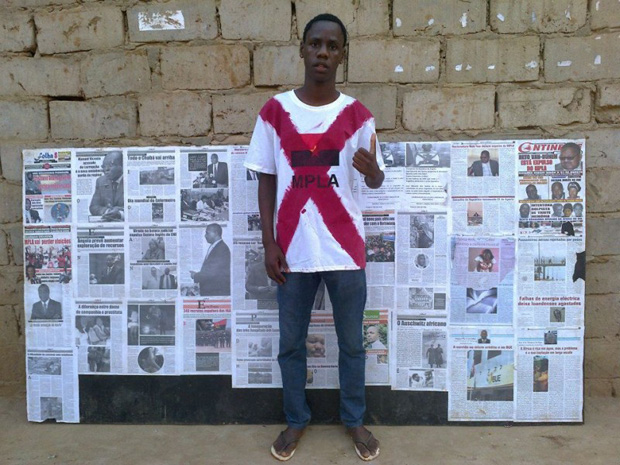
Manuel Chivonde Nito Alves was held in solitary confinement for printing t-shirts. Image from his Facebook page.
Angolan 17-year-old Manuel Chivonde Nito Alves went on hunger strike on Tuesday, following his arrest on 12 September for printing t-shirts with the slogan “Out Disgusting Dictator”. The message was aimed at the country’s President Jose Eduardo dos Santos, who has held power in since 1979. The shirts were to be worn at a demonstration in the capital Luanda, highlighting corruption, forced evictions, police violence and lack of social justice under dos Santos’ regime. Nito Alves has been charged with “insulting the president”, and has now spent almost two months in detention – parts of it in solitary confinement. His family were barred from seeing him, and three weeks went by before he was allowed to speak to a lawyer. The hunger strike is in protest at his “unjust and inhumane treatment”.
2) Belarus
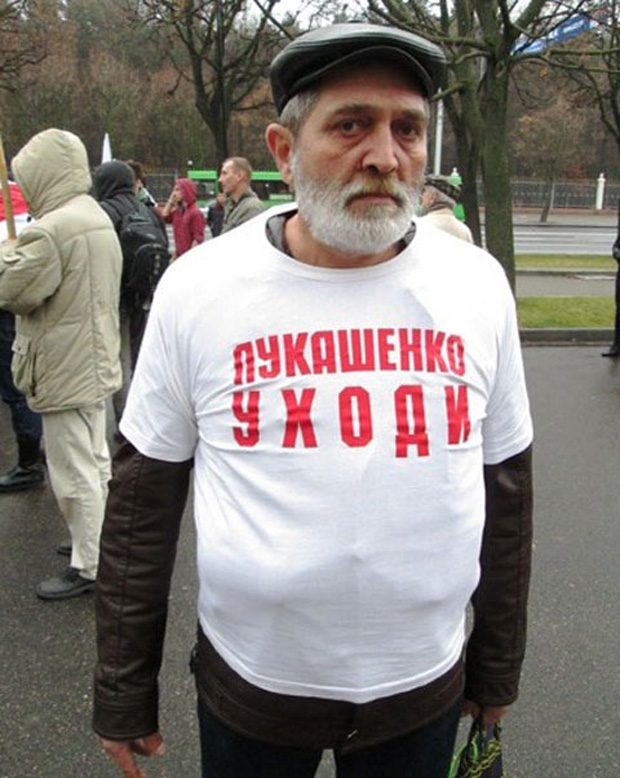
Yury Rubstow wearing the t-shirt that landed him in prison. (Image Viasna Human
Rights Centre)
On Monday, Belarusian opposition activist Yury Rubstow was sentenced to three days in jail for wearing a t-shirt with the slogan “Lukashenko, go away” on the front, and “A four-time president? No. This is not a president but an impostor tsar” on the back.” The message was aimed at the country’s dictator Alexander Lukashenko, during an opposition protest march. He was found guilty of disobedience to police officers under Article 23.4 of the Civil Offenses Code.
3) Swaziland
In 2010, Sipho Jele, a member of Swaziland’s People’s United Democratic Movement, was arrested for wearing a t-shirt supporting the party during a May Day parade. He was arrested under the country’s Suppression of Terrorism Act, and died in custody. The police said he had hanged himself, while the party say the police of killed him.
4) Egypt
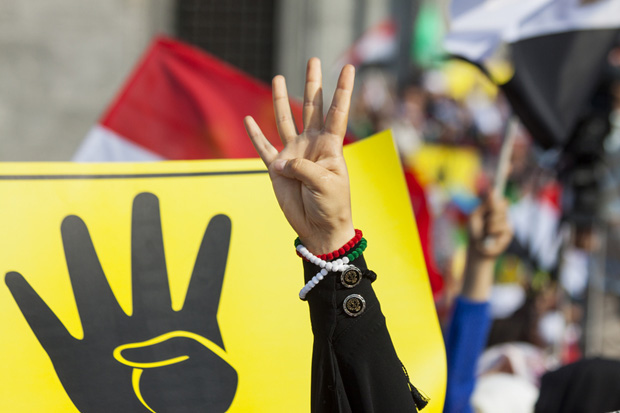
The Rabaa symbol displayed at a protest in Turkey (Image Bünyamin Salman/Demotix)
In September, three Egyptian men were arrested for wearing t-shirts emblazoned with the Rabaa symbol. A hand holding up four fingers, it is widely used by those opposing Egypt’s interim military-backed government, and the coup that ushered in in. Mohamed Youssef, the country’s kung fu champion, was also suspended by the national federation for wearing a similar t-shirt during a medal ceremony.
5) Hong Kong
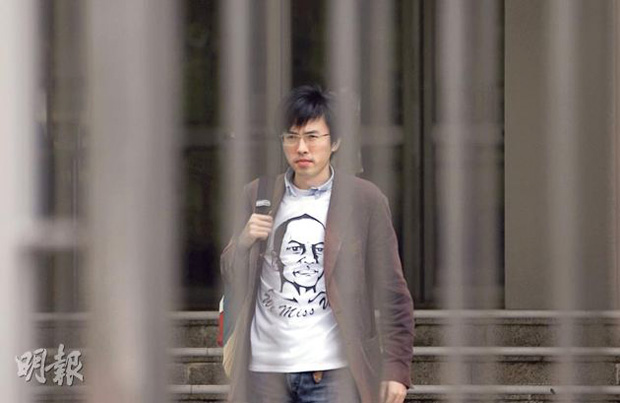
Avery Ng wearing the t-shirt he threw at Hu Jintao. Image from his Facebook page.
An activist from Hong Kong was arrested last December for throwing a t-shirt at former Chinese president Hu Jintao during an official visit almost six month earlier, on 1 July. League of Social Democrats Vice Chairman Avery Ng threw a t-shirt with a drawing of the late Chinese dissident Li Wangyang, a Tiananmen Square activist who died under suspicious circumstances only weeks before the visit. Ng was charged “with nuisance crimes committed in a public place”.
6) Malaysia
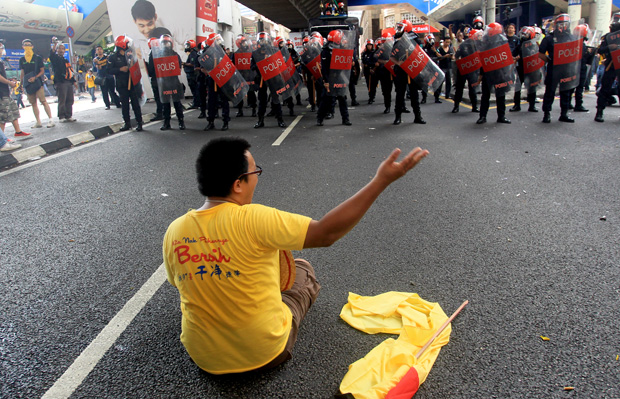
Malaysian protester wearing a Bersih shirt. (Image Syahrin Abdul Aziz/Demotix)
In June 2011, Malaysian police arrested 14 opposition activists for wearing t-shirts promoting a rally in Kuala Lumpur calling for election reform. The shirts carried the slogan “bersih” which means “clean”, and is the name of one of the groups behind the protest. Authorities claimed the demonstration was an “attempt to create chaos on the streets and undermine the government”, and they were therefore within their rights to arrest the protesters. They also confiscated t-shirts from the group’s headquarters.
7 & 8) The US
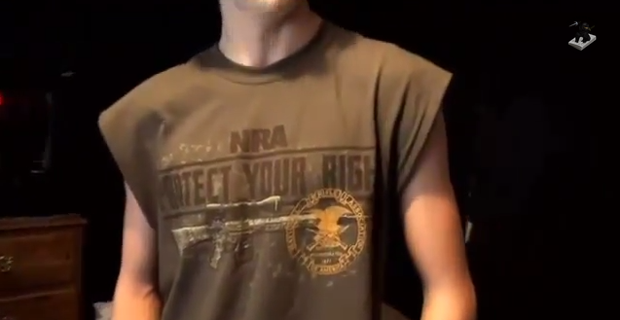
Jared Marcum wearing his NRA t-shirt in a TV report. (Image Youtube)
A 14-year-old student from West Virginia was in April suspended from school and subsequently arrested for refusing to remove a t-shirt supporting the pro-gun National Rifle Association. Jared Marcum was charged with “obstructing an officer” and faced a $500 fine and up to one year in prison.
On the flip side, a Tennessee man was arrested for wearing a t-shirt in support of stricter gun control laws. Stanley Bryce Myszka was wearing a shirt that read “Has your gun killed a kindergartener today?” at a shopping centre, following the shooting at Sandy Hook Elementary School. He was approached by security guards, who called the police when he when he refused to remove the shirt. He was also banned from the shopping centre for life.
9) United Kingdom
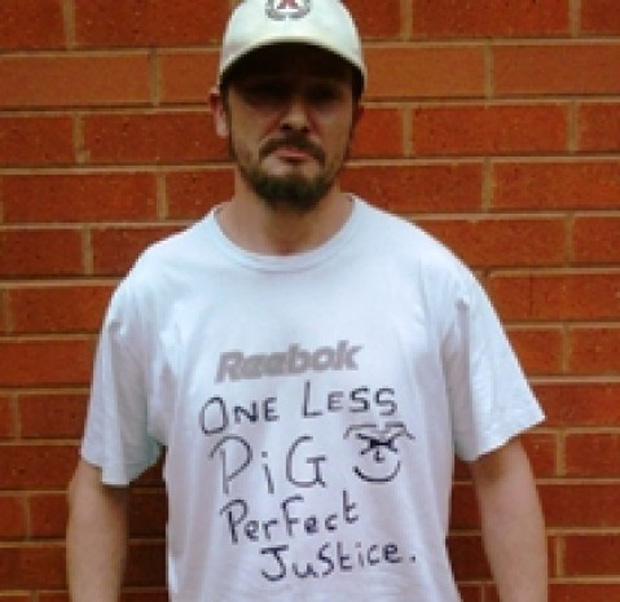
The front of Barry Thew’s t-shirt. (Image Greater Manchester Police)
A Manchester man was in October 2012 sentenced to eight months in prison in part for wearing a t-shirt emblazoned with offensive comments referencing the murders of two policewomen. Barry Thew had written “One less pig; perfect justice” on the front of his t-shirt and “killacopforfun.com haha” on the back. While four months of the sentence was handed down for breach of a previous suspended sentence, he was charged on a Section 4A Public Order Offence for the t-shirt incident.
15 Aug 2013 | Bulgaria, Digital Freedom, News
(Photo illustration: Shutterstock)
While the revelations around mass surveillance by the US and some European governments were reported by Bulgaria’s media, the country’s focus in recent months has been the fallout from the country’s elections.
After a polarising election in May, tens of thousands went out to protest against the new Bulgarian government and staged daily rallies for over nearly two months. As a result, the significance of the NSA revelations was not enough to elevate it above domestic political skirmishes.
The Snowden affair had all the ingredients for the media sensation other European countries experienced: a huge cover-up affirming most citizens’ suspicions about governments spying on them, a global chase through Hong Kong and Moscow (with possible sequels in Vienna, Havana and Caracas) and – most importantly – a local context.
Bulgarians, long sensitive about government surveillance after nearly five decades of totalitarianism, had an eavesdropping scandal of their own as recently as in April when a former interior minister was accused of wiretapping a host of political figures, businessmen and journalists. According to one opinion poll conducted in April, 73% of Bulgarians believed that their government had been practicing illegal wiretapping.
Thus, the interest for the Snowden affair among the Bulgarian public was a given. And the media promptly reacted, assigning it the expected prominence among their foreign affairs coverage, if not the front pages which the scandal got in Germany, the UK or France.
“Revelations about the NSA activities were covered in Bulgaria, but did not become a central topic for the media as they of coincided with the anti-government protests,” said Nelly Ognyanova, a leading Bulgarian media law expert and media analyst. ‘However, Bulgarian media paid special attention to the aspect of the EU – US relations in the light of the scandal,” she said.
Media in Bulgaria, which joined the European Union in 2007, covered the reaction in Brussels and in major European capitals and especially in Berlin where the topic was becoming a battleground in light of the German general elections in the fall. Bulgarian media also focused on the fact that the NSA scandal was threatening to derail the negotiations for a major free trade agreement between the EU and the US.
End mass surveillance! Sign the petition
EU leaders: Stop mass surveillance | Лидеры Евросоюза: прекратите массовую слежку! | Líderes europeos: Paren la vigilancia masiva | Dirigeants européens: Arrêtez la surveillance de masse! | Europas Staats-und Regierungschefs: Stoppen Sie die Massenüberwachung! | Liderzy Unii Europejskiej: zaprzestańcie masowej inwigilacji! | Лидери на ЕС: Cпрете масовото наблюдение
Since there are only a handful of Bulgarian foreign correspondents, local media mostly quoted international titles like The New York Times, the BBC, The Guardian and Der Spiegel. The Snowden revelations also did not have (obvious) Bulgarian links – when information emerged that the US was secretly wiretapping foreign embassies on American soil, the weekly “Capital” tried to contact the Bulgarian mission in Washington but was referred to the foreign ministry in Sofia which, in turn, had no comment on the case.
As for Snowden himself, Bulgarian media painted a mostly neutral portrait of the whistleblower.
“Bulgarian media were rather sticking to the facts without taking a judgmental position on Snowden, but without making him look like a hero as well,” said Ognyanova. “In Bulgaria there was no discussion like the one that took place in other countries about whether Snowden is a hero. Against the backdrop of the very important information that he revealed, however, the media treated him with a degree of sympathy for his civil courage.”
Given the anti-government protests and the heightened domestic political situation, the political and social media reaction to the Snowden affair appeared mostly muted. The Bulgarian social networks – an otherwise vibrant community of some 2.5 million people – was mostly preoccupied with the anti-government protests which, in fact, originated mostly on Facebook walls and Twitter profiles and later transferred to the streets of Sofia and other major cities.
One small political party, the Greens, issued a statement in July calling the revelations “a serious attack on civil rights and the foundations of democracy” and asking the Bulgarian government to offer asylum to Snowden.
“The Greens party expresses our gratitude to Edward Snowden for his courage and for his service to EU citizens,” the statement said.
According to Ognyanova, the media law expert, it is important to draw conclusions from the NSA affair.
“Either in the free trade pact or in another agreement, there must be a provision to protect the personal data and privacy of European citizens,” she said. “It is high time for the EU to have their own clouds and to not provide our information to companies under the jurisdiction of countries outside the European Union,” she said. “I expect this from my government and from the EU, being its citizen.”
This article was originally published on 15 Aug, 2013 at indexoncensorship.org. Index on Censorship: The voice of free expression.
12 Aug 2013 | Asia and Pacific, China, News, Politics and Society, Taiwan
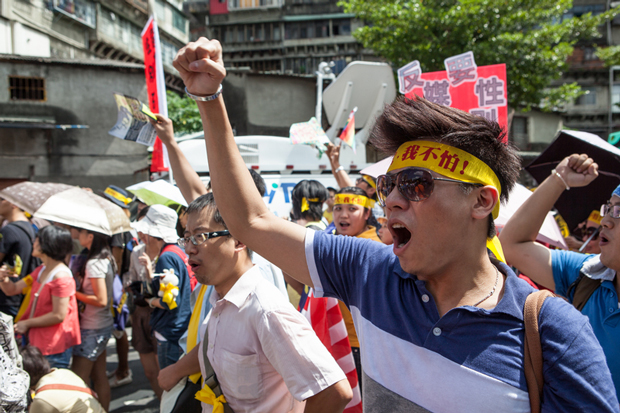
Activists and civic groups march in Taipei in protest against the Want Want China Times Group’s planned acquisition of China Network Systems’s cable TV services in Sept 2012.
(Photo: Craig Ferguson / Demotix)
The connections between China and Taiwanese media owners has given rise to concerns, along with some evidence, that the industry is under growing pressure to curb reporting on topics detrimental to Chinese interests and cross-strait ties.
The capital, Taipei, erupted in protests when it became known that Tsai Eng-ming, a pro-Beijing businessman, attempted to wrest control of Taiwan’s largest newspaper, the Apple Daily, earlier this year. The attempt failed amid popular outrage. But conversations with several journalists suggest that Beijing continues to exert a quieter influence – involving self-censorship and lucrative business interests – in attempt to avoid further scrutiny.
This is perhaps most prominent at the China Times Group, a Taiwanese media conglomerate that Tsai purchased in 2008. Estimated to be worth up to US$10.6 billion, the snack manufacturer has since led its subsidiaries to become more China-friendly, accepting payment from Beijing in return for camouflaged advertising and one-sided reporting. His flagship daily, the China Times, has been fined multiple times by Taiwan’s media regulators for masquerading advertising as reporting.
“It happens far more frequently than most people realize,” said Lin Chao-yi, the former head of the Association of Taiwan Journalists, that uncovered one such example last year. After receiving a copy of a schedule detailing how a visit from a ranking Chinese official was to be covered, including pre-defined topics and article lengths, Lin then impersonated a China Times employee to ask the delegation how the paper was going to be compensated.
Caught on tape, the Chinese press officer replied that the payment would be wired to a China Times Group subsidiary in Beijing. But far from discouraging such deals from taking place again, Lin said that his report “just made them more careful.” Indeed, accepting Chinese money is not only lucrative business, but also allows the paper to stay on Beijing’s good graces – guaranteeing access from behind China’s Great Firewall – according to sources familiar with the relationship.
The China Times Group’s cosy relationship with Beijing has led some journalists working under its banner to become more aware of what might, and might not, be publishable. Speaking on the condition of anonymity, one China Times reporter said that, there is an “unspoken understanding” of what articles or reports might contradict the paper’s political viewpoint, including, for example, pieces critical of either Beijing or Taiwan’s China-friendly president, Ma Ying-jeou.
“In these cases, we might choose to just drop the subject, instead of choosing to pursue it further,” the reporter said, in words reminiscent of the self-censorship taking place elsewhere in the Chinese-speaking region.
But far from taking place only at the China Times Group, self-censorship is also seen as a necessity by other media groups keen on maintaining access to the Chinese market. Much of this has to do with Taiwan’s highly profitable entertainment industry that feeds thousands of hours of programming each year into local Chinese television channels. Produced by the same media groups that also run cable news stations, coverage of some politically sensitive topics, such as the Dalai Lama or the Falungong movement, are toned down to avoid antagonizing Beijing.
“China uses its vast market as a bargaining chip,” said Cheryl Lai, the former editor-in-chief of the state run Central News Agency, adding that most of this takes place secretly and away from public scrutiny. “They know that most of these media companies are in it for the money. All they have to do is threaten to cut it off.”
The trend towards greater Chinese influence in the media is reflective of the realization that its political objectives of unifying Taiwan, which it claims to be a breakaway province, can be achieved cheaper and more effectively through propaganda, rather than force. Instead of “spilling blood on Taiwan,” an old rallying call for conquering the island by force if necessary, Beijing has deemed it easier to “spill money on Taiwan,” said Lai, who has been writing on China’s growing political sway on the island.
The same trend can be seen elsewhere where China holds political interests, such as Hong Kong, where a large number of publications are ostensibly under its influence. The South China Morning Post, for example, has reportedly been hit by allegations of self-censorship after the appointment of new Editor-in-Chief Wang Xiangwei, a member of the Chinese People’s Political Consultative Congress, a Chinese government body.
In Taiwan, even as most media interests are controlled by large corporations, some with extensive business ties to China, there is, however also a realization that hard-fought press freedoms must be protected. More than 100,000 protestors, including students and reporters, rallied in defence of the Apple Daily during the failed purchase in January this year, with some groups vowing to raise the equivalent funds if it meant protecting the paper’s journalistic integrity.
All this is reason why Beijing is likely to continue and incubate its media influence behind the scenes, at least for now.
9 Aug 2013 | In the News
#DONTSPYONME
Tell Europe’s leaders to stop mass surveillance #dontspyonme
Index on Censorship launches a petition calling on European Union Heads of Government to stop the US, UK and other governments from carrying out mass surveillance. We want to use public pressure to ensure Europe’s leaders put on the record their opposition to mass surveillance. They must place this issue firmly on the agenda for the next European Council Summit in October so action can be taken to stop this attack on the basic human right of free speech and privacy.
(Index on Censorship)
CHINA
Fault Lines Laid Bare in Hong Kong
To her supporters, Alpais Lam Wai-sze, an award-winning primary schoolteacher who shouted obscenities at the Hong Kong police last month over their handling of a street dispute between a pro-Chinese Communist Party group and an anti-Communist group, is a free-speech heroine.
(The New York Times)
GAZA
Gazans Use Satire to Bypass
Political Censorship
Cynical television presenters such as Egyptian Bassem Youssef may soon no longer appear on Palestinian television outlets as a result of the increased censorship imposed on local media. Yet, this same censorship has stood helpless with the spread of sarcastic literature and media published on social networking sites.
(Al Monitor)
MEXICO
Mexico: self-censorship for survival
Journalists in Mexico are increasingly publishing their articles anonymously. Attaching your name to a report, an article or a picture is an obligation and a right. But doing so in Mexico can cost journalists their jobs or their lives. The biggest danger facing reporters there is not being hit by a stray bullet. No, the main peril is being murdered in order to silence and censor the media.
(Radio Netherlands)
PAKISTAN
Pakistani artists challenging YouTube ban
YouTube is a source of entertainment and news for billions around the world, but Pakistanis have lost access to the video site for almost a year after clips of the controversial film “Innocence of Muslims” prompted a government ban.
(CNN)
SINGAPORE
Singapore: End ‘Scandalizing the Judiciary’ Prosecutions
Singapore’s Attorney General’s Chambers should cease using contempt of court charges to muzzle critics of the judiciary.
(HRW)
TURKEY
Singapore: End ‘Scandalizing the Judiciary’ Prosecutions
Singapore’s Attorney General’s Chambers should cease using contempt of court charges to muzzle critics of the judiciary.
(HRW)
UNITED STATES
The more nefarious US foreign policy, the more it relies on media complicity
Americans are shielded from the ugly consequences of US military power by our journalists’ self-censorship
(The Guardian)
National Park Service’s First Amendment Violations Covered Up by Hometown Paper
During the Saint Augustine Tea Party’s month-long saga of standing up for Free Speech, the Right of Assembly and the American way, the local print newspaper, The St Augustine Record, remained elusive and nowhere to be found.
(Examiner.com)
States take aim at sex-ad websites, but run into resistance
A two-word change proposed to one of the nation’s first online laws has triggered a battle between law enforcement and Internet libertarians.
(The Free Press)
Previous Free Expression in the News posts
Aug 7 | Aug 6 | Aug 5 | Aug 2 | Aug 1 | July 31 | July 30 | July 29 | July 26 | July 25 | July 24 | July 23 | July 22 | July 19 | July 18 | July 17
