18 Sep 2019 | Campaigns -- Featured, Media Freedom, Statements
[vc_row][vc_column][vc_column_text]To: Marija Pejčinović Burić
Secretary-General
Council of Europe
Dear Secretary-General,
On behalf of the undersigned organisations, we warmly congratulate you on your appointment as the new Secretary-General of the Council of Europe. We are motivated by our experience and understanding of the worsening of the environment for journalists and free expression across Europe to ask you to make sure that your commitment to democracy, the rule of law and human rights will be reflected in enhanced efforts for the effective protection of freedom of expression, press freedom and the safety of journalists, backed up by robust measures and strong and consistent statements and actions by yourself as Secretary-General.
Media freedom and media pluralism must be given a clear and consistent priority across the Council of Europe area, as they enable the public to make informed choices about their government and society, and are thus prerequisites for the full enjoyment of all other rights.
Renewed and determined efforts to achieve Member States’ compliance with the Council of Europe’s conventions, recommendations and other texts, as well as the case-law of the European Court of Human Rights (ECtHR) are vital in these times of rising threats against journalists and press freedom throughout Europe. The environment for media freedom has worsened significantly, as was documented in the Annual Report published by the partner organisations of the Council of Europe Platform for the Protection of Journalism and Safety of Journalists. We see extremely worrying developments in Azerbaijan, Poland, Hungary, Italy, Turkey, Russia and elsewhere.
Regarding the Platform for the Protection of Journalism and Safety of Journalists, we urge you to provide all necessary means and support available to ensure that Member States respond concretely to alerts, intensify the dialogue and follow-up moves to provide redress, and to do everything possible to gain the active cooperation of those Member States which have failed to reply to alerts that highlight shortcomings or abuses on the part of state authorities. We ask you to establish a monthly exchange at the level of the Committee of Ministers to allow for a meaningful discussion on the progress of Member States in dealing with the alerts and persistent and serious threats to media freedom and the safety of journalists and other media actors.
In view of the well-documented increase in attacks on the media and backsliding in some states’ fulfilment of their commitments, we request you to prioritise actions and policies to implement Recommendation CM/Rec(2016)4 of the Committee of Ministers on the protection of journalism and safety of journalists and other media actors – including specific measures to comply with Council of Europe standards on Protection; Prevention of attacks; and Prosecution of crimes against journalists.
We hope that the concerns and recommendations outlined in the Platform partners’ latest report will be given priority by the Secretariat under your leadership, and through the projects and activities foreseen in the bi-annual Council of Europe programme and budget. To address these concerns, we request you to make available the resources and support needed to give it greater visibility, recognition and impact – both internally and externally to the Council of Europe.
We are convinced that strong and concerted political action from Member States and the Council of Europe is now essential. We request your energetic support against the ongoing impunity for attacks including murders of journalists within Europe, and against widespread attempts to adopt severely restrictive legislation on media regulation, defamation, anti-terrorism that are increasingly used to criminalise journalists.
Anti-media rhetoric is creating a toxic atmosphere for journalists amongst the general public and must be countered. The spread of online disinformation intensifies this effect. We welcome the recent PACE resolution on the rule of law in Malta, which points to the urgent need for effective actions against the politicisation of state institutions, media capture by political forces, and a climate of impunity related to attacks against members of the media.
We call on you to provide your full political support, and necessary resources, to ensure the successful implementation of Recommendation CM/Rec(2016)4, as is specified in the 2018 Steering Committee on Media and Information Society (CDMSI) strategy 2018. It is especially important to us that robust and frank debate on the subject of implementation (including securing firm commitments to national action plans) takes place at the Conference of Ministers responsible for media and information society in Cyprus in May 2020, with the full participation of civil society to pave the way for meaningful actions to reverse the recent negative trends.
We call on you to use your influence on Member States to reform their domestic laws and practices so that they comply with their obligations under the European Convention on Human Rights and CM Recommendation (2016)4, and do everything in your power to improve the safety of journalists through the establishment of effective safeguards.
We thank Thorbjørn Jagland for his efforts in the past years and we are happy to continue to support the Council of Europe with our research and our international networks.
We request a meeting with you soon to discuss these matters in person and to share our knowledge and experience with you as you begin your term of office.
We look forward to your positive response.
Yours sincerely,
Lutz Kinkel, Managing Director, European Centre for Press and Media Freedom (ECPMF)
Sarah Clarke, Head of Europe and Central Asia, ARTICLE 19
William Horsley, Special Representative for Media Freedom, Association of European Journalists (AEJ)
Gulnoza Said, Europe and Central Asia program coordinator, Committee to Protect Journalists (CPJ)
Daniel Gorman, Director, English PEN
Ricardo Gutiérrez, General Secretary, European Federation of Journalists (EFJ)
Leon Willems, Director of Policy and Programmes, Free Press Unlimited (FPU)
Ralf Nestmeyer, Vice-President, German PEN
Bertrand Pecquerie, CEO, Global Editors Network (GEN)
Annie Game, Executive Director, IFEX
Joy Hyvarinen, Head of Advocacy, Index on Censorship
Anthony Bellanger, General Secretary, International Federation of Journalists (IFJ)
Ravi R. Prasad, Director of Advocacy, International Press Institute (IPI)
Ides Debruyne, Managing Director, Journalismfund.eu vzw
Hege Newth, Secretary General, Norwegian PEN
Chiara Sighele, Programme Director, Osservatorio Balcani Caucaso Transeuropa (OBCT/CCI)
Alberto Spampinato, Director, Ossigeno per l’informazione
Aaliya Ahmed, International Programmes Director, PEN International
Christophe Deloire, Secretary General, Reporters without Borders (RSF)
Oliver Vujovic, Secretary General, South East Europe Media Organisation (SEEMO)
Clothilde Redfern, Director, The Rory Peck Trust
Andrew Heslop, Director, World Association of News Publishers (WAN-IFRA)[/vc_column_text][vc_basic_grid post_type=”post” max_items=”4″ element_width=”6″ grid_id=”vc_gid:1568796322393-650d0cd0-526d-5″ taxonomies=”6534″][/vc_column][/vc_row]
15 Jul 2019 | Magazine, News, Volume 48.02 Summer 2019
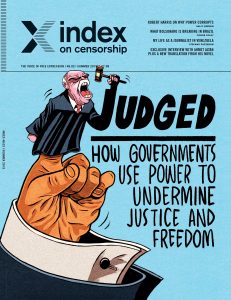
[vc_row][vc_column][vc_custom_heading text=”Index editor Rachael Jolley argues in the summer 2019 issue of Index on Censorship magazine that it is vital to defend the distance between a nation’s leaders and its judges and lawyers, but this gap being narrowed around the world” google_fonts=”font_family:Libre%20Baskerville%3Aregular%2Citalic%2C700|font_style:400%20italic%3A400%3Aitalic”][vc_column_text]
 It all started with a conversation I had with a couple of journalists working in tough countries. We were talking about what kind of protection they still had, despite laws that could be used to crack down on their kind of journalism – journalism that is critical of governments.
They said: “When the independence of the justice system is gone then that is it. It’s all over.”
And they felt that while there were still lawyers prepared to stand with them to defend cases, and judges who were not in the pay of – or bowed by – government pressure, there was still hope. Belief in the rule of law, and its wire-like strength, really mattered.
These are people who keep on writing tough stories that could get them in trouble with the people in power when all around them are telling them it might be safer if they were to shut up.
This sliver of optimism means a great deal to journalists, activists, opposition politicians and artists who work in countries where the climate is very strongly in favour of silence. It means they feel like someone else is still there for them.
I started talking to journalists, writers and activists in other places around the world, and I realised that although many of them hadn’t articulated this thought, when I mentioned it they said: “Yes, yes, that’s right. That makes a real difference to us.”
So why – and how – do we defend the system of legal independence and make more people aware of its value? It’s not something you hear being discussed in the local bar or café, after all.
Right now, we need to make a wider public argument about why we all need to stand up for the right to an independent justice system.
[/vc_column_text][vc_row_inner][vc_column_inner width=”1/4″][vc_icon icon_fontawesome=”fa fa-quote-left” color=”custom” size=”xl” align=”right” custom_color=”#dd3333″][/vc_column_inner][vc_column_inner width=”3/4″][vc_custom_heading text=”On an ordinary day, most of us are not in court or fighting a legal action, so it is only when we do, or we know someone who is, that we might realise that something important has been eroded” font_container=”tag:h3|text_align:left” google_fonts=”font_family:Libre%20Baskerville%3Aregular%2Citalic%2C700|font_style:400%20italic%3A400%3Aitalic”][/vc_column_inner][/vc_row_inner][vc_column_text]
We need to do it because it is at the heart of any free country, protecting our freedom to speak, think, debate, paint, draw and put on plays that produce unexpected and challenging thoughts. The wider public is not thinking “hey, yes, I worry that the courts are run down, and that criminal lawyers are in short supply”, or “If I took a case to trial and won my case I can no longer claim my lawyer’s fees back from the court”. On an ordinary day, most of us are not in court or fighting a legal action, so it is only when we are, or when we know someone who is, that we might realise that something important has been eroded.
Our rights are slowly, piece by piece, being undermined when our ability to access courts is severely limited, when judges feel too close to presidents or prime ministers, and when lawyers get locked up for taking a case that a national government would rather was not heard.
All those things are happening in parts of the world right now.
In China, hundreds of lawyers are in prison; in England and Wales since 2014 it has become more risky financially for most ordinary people to take a case to court as those who win a case no longer have their court fees paid automatically; and in Brazil the new president, Jair Bolsonaro, has just appointed a judge who was very much part of his election campaign to a newly invented super-ministerial role.
Helpfully, there are some factors that are deeply embedded in many countries’ legal histories and cultures that make it more difficult for authoritarian leaders to close the necessary space between the government and the justice system.
Many people who go into law, particularly human-rights law, do so with a vision of helping those who are fighting the system and have few powerful friends. Others hate being pressurised. And in many countries there are elements of the legal system that give sustenance to those who defend the independence of the judiciary as a vital principle.
Nelson Mandela’s lawyer, Sir Sydney Kentridge QC, has made the point that judges recruited from an independent bar would never entirely lose their independence, even when the system pressurised them to do so.
He pointed out that South African lawyers who had defended black men accused of murder in front of all-white juries during the apartheid period were not easily going to lose their commitment to stand up against the powerful.
Sir Sydney did, however, also argue that “in the absence of an entrenched bill of rights, the judiciary is a poor bulwark against a determined and immoderate government” in a lecture printed in Free Country, a book of his speeches.
So it turned out that this was the right time to think about a special report on this theme of the value of independent justice, because in lots of countries this independence is under bombardment.
It’s not that judges and lawyers haven’t always come under pressure. In his book The Rule of Law, Lord Bingham, a former lord chief justice of England and Wales, mentions a relevant historical example. When Earl Warren, the US chief justice, was sitting on the now famous Brown v Board of Education case in 1954, he was invited to dinner with President Dwight Eisenhower. Eisenhower sat next to him at dinner and the lawyer for the segregationists sat on his other side. According to Warren, the president went to great lengths to promote the case for the segregationists, and to say what a great man their lawyer was. Despite this, Warren went on to give the important judgement in favour of Brown that meant that racial segregation in public schools became illegal.
Those in power have always tried to influence judges to lean the way they would prefer, but they should not have weapons to punish those who don’t do so.
In China, hundreds of lawyers who stood up to defend human-rights cases have been charged with the crime of “subverting state power” and imprisoned. When the wife of one of the lawyers calls on others to support her husband, her cries go largely unheard because people are worried about the consequences.
This, as Karoline Kan writes on p23, is a country where the Chinese Communist Party has control of the executive, judicial and legislative branches of government, and where calls for political reform, or separation of powers, can be seen as threats to stability.
As we go to press we are close to the 30th anniversary of the Tiananmen Square killings, when thousands of protesters all over China, from all kinds of backgrounds, had felt passionately that their country was ready for change – for democracy, transparency and separation of powers.
Unfortunately, that tide was turned back by China’s government in 1989, and today we are, once more, seeing China’s government tightening restrictions even further against those who dare to criticise them.
Last year, the Hungarian parliament passed a law allowing the creation of administrative courts to take cases involving taxation and election out of the main legal system (see p34). Critics saw this as eroding the gap between the executive and the justice system. But then, at the end of May 2019, there was a U-turn, and it was announced that the courts were no longer going ahead. It is believed that Fidesz, the governing party in Hungary, was under pressure from its grouping in the European Parliament, the European People’s Party.
If it were kicked out of the EPP, Hungary would have in all likelihood lost significant funding, and it is believed there was also pressure from the European Parliament to protect the rule of law in its member states.
But while this was seen as a victory by some, others warned things could always reverse quickly.
Overall the world is fortunate to have many lawyers who feel strongly about freedom of expression, and the independence of any justice system.
Barrister Jonathan Price, of Doughty Street Chambers, in London, is part of the team advising the family of murdered journalist Daphne Caruana Galizia over a case against the Maltese government for its failure to hold an independent inquiry into her death.
He explained why the work of his colleagues was particularly important, saying: “The law can be complex and expensive, and unfortunately the laws of defamation, privacy and data protection have become so complex that they are more or less inoperable in the hands of the untrained.”
Specialist lawyers who were willing to take on cases had become a necessary part of the rule of law, he said – a view shared by human-rights barrister David Mitchell, of Ely Place Chambers, in London.
“The rule of law levels the playing field between the powerful and [the] powerless,” he said. “It’s important that lawyers work to preserve this level.”
Finally, another thought from Sir Sydney that is pertinent to how the journalists I mentioned at the beginning of this article keep going against the odds: “It is not necessary to hope in order to work, and it is not necessary to succeed in order to hope in order to work, and it is not necessary to succeed in order to persevere.”
But, of course, it helps if you can do all three.
[/vc_column_text][/vc_column][/vc_row][vc_row][vc_column][vc_column_text]
Rachael Jolley is editor of Index on Censorship. She tweets @londoninsider. This article is part of the latest edition of Index on Censorship magazine, with its special report on local news
Index on Censorship’s spring 2019 issue is entitled Is this all the local news? What happens if local journalism no longer holds power to account?
Look out for the new edition in bookshops, and don’t miss our Index on Censorship podcast, with special guests, on Soundcloud.
[/vc_column_text][/vc_column][/vc_row][vc_row][vc_column width=”1/3″][vc_custom_heading text=”How governments use power to undermine justice and freedom” font_container=”tag:h3|text_align:left” link=”url:https%3A%2F%2Fwww.indexoncensorship.org%2F2019%2F06%2Fmagazine-judged-how-governments-use-power-to-undermine-justice-and-freedom%2F|||”][vc_column_text]The summer 2019 Index on Censorship magazine looks at the narrowing gap between a nation’s leader and its judges and lawyers.[/vc_column_text][/vc_column][vc_column width=”1/3″][vc_row_inner][vc_column_inner][vc_single_image image=”107686″ img_size=”full” onclick=”custom_link” link=”https://www.indexoncensorship.org/2019/06/magazine-judged-how-governments-use-power-to-undermine-justice-and-freedom/”][/vc_column_inner][/vc_row_inner][/vc_column][vc_column width=”1/3″][vc_custom_heading text=”Subscribe” font_container=”tag:h3|text_align:left”][vc_row_inner][vc_column_inner][vc_column_text]In print, online. In your mailbox, on your iPad.
Subscription options from £18 or just £1.49 in the App Store for a digital issue.
Every subscriber helps support Index on Censorship’s projects around the world.
 SUBSCRIBE NOW[/vc_column_text][/vc_column_inner][/vc_row_inner][/vc_column][/vc_row]
5 Jul 2019 | News, Volume 48.02 Summer 2019 Extras
[vc_row][vc_column][vc_column_text]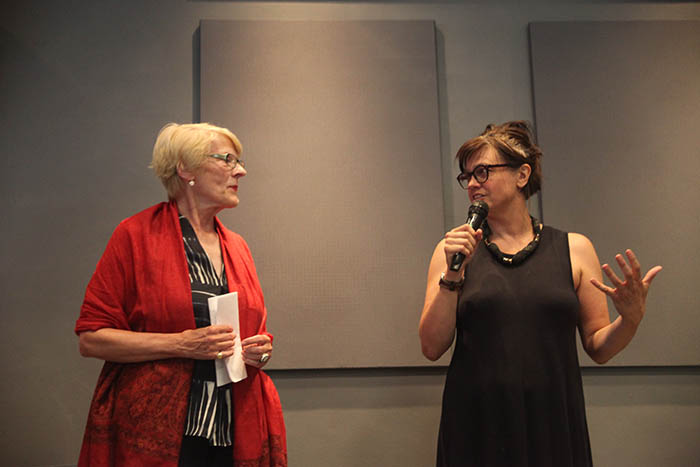
“What is said and what is written is unbelievably important,” said Trevor Phillips, chairman of the board of Index on Censorship, at the close of the recent launch party for the Summer 2019 edition of Index Magazine.
The summer 2019 edition, Judged: How Governments Use Power to Undermine Justice and Freedom, looks at attempts to undermine freedom of expression through attacks on the judiciary. The magazine covers issues ranging from new laws in Venezuela intended to limit freedom of the press to instances of self-censorship due to government control of content-sharing platforms in China to new technology created by journalists to check back against threats from politicians regarding the coverage of recent elections in South Africa.
Rachael Jolley, editor of Index magazine, explained that the idea behind the theme came from conversations she had with journalists in Italy covering areas with limited press freedom and hostile environments for journalists. She said, “one of the things that [the journalists] said kept them going was that there were still lawyers who were willing to stand up with them and defend them when they were attacked, when they had libel suits against them, when all the things that happen to them mean that they end up having to stand before a judge.”
This inspired Jolley to curate the latest edition of the magazine around legal issues, to address the legal fight for free speech behind the work of journalists to liberate the media under repressive regimes.
The keynote speaker of the evening was German writer Regula Venske, whose article What Does Weimar Mean to us 100 Years On? was published in the issue. Venske spoke about the history and ultimate downfall of the Weimar Republic, which is now known for fraught democracy and the promotion of freedom of expression, though Venske spoke about how attempts to preserve free speech in the republic were often complicated or insufficient. She walked the audience through some of the influential writing and art produced before the republic’s fall to Nazism.
To conclude, Venske quoted Weimar-era author and poet Erich Kästner: “You cannot fight the avalanche once it has developed into an avalanche, you have to crush the snowball.”
Venske added: “I think that is quite a good saying for the times we are now living in, though unfortunately, he did not leave a recipe for how one could prevent this. I think we need to keep on working for it.”
Phillips, the last speaker of the evening, lamented the state of media freedom in the multiple countries where right-wing leaders have recently come to power. He mentioned specifically the rise of Viktor Orbán in Hungary and Jair Bolsonaro in Brazil, two countries covered in the summer issue. “My time at Index has been marked not by the incredible march of progress but actually a reminder, pretty much every week, why what this organisation does is so important,” he said.
He applied Kästner’s quote to the work Index on Censorship continues to do around the globe. Like Kästner, he explained, Index works to warn the people before the snowballs represented by the arrest of a journalist or the censorship of an artwork become an avalanche of fascism.
“The avalanche starts long before you hear it,” Phillips concluded. “A large part of what we do is give the avalanche warning.”
[/vc_column_text][/vc_column][/vc_row][vc_row][vc_column width=”1/3″][vc_custom_heading text=”Subscribe”][vc_column_text]In print, online, in your mailbox, on your iPad.
Subscription options from £18 or just £1.49 in the App Store for a digital issue.
Every subscriber helps support Index on Censorship’s projects around the world.
SUBSCRIBE NOW[/vc_column_text][/vc_column][vc_column width=”1/3″][vc_single_image image=”107175″ img_size=”medium”][/vc_column][vc_column width=”1/3″][vc_custom_heading text=”Listen”][vc_column_text]The summer 2019 magazine podcast, featuring interviews with best-selling author Xinran; Italian journalist and contributor to the latest issue, Stefano Pozzebon; and Steve Levitsky, the author of the New York Times best-seller How Democracies Die.
LISTEN HERE[/vc_column_text][/vc_column][/vc_row]