18 Apr 2019 | Magazine, News, Volume 48.01 Spring 2019
[vc_row][vc_column][vc_custom_heading text=”Responding to violations of media freedom in Hungary has become a conundrum for the EU. With populist parties poised for large gains in the next European election, Sally Gimson explores in the spring 2019 issue of Index on Censorship magazine what the EU could do to uphold free speech in member countries” google_fonts=”font_family:Libre%20Baskerville%3Aregular%2Citalic%2C700|font_style:400%20italic%3A400%3Aitalic”][vc_column_text]
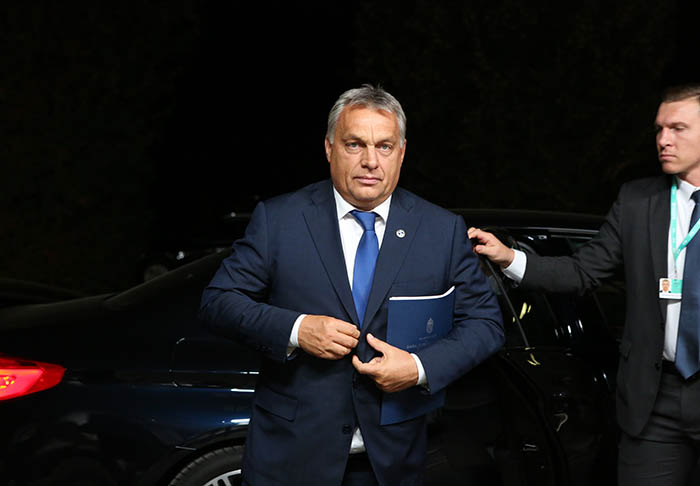
Hungarian prime minister Viktor Orbán. Credit: EU2017EE Estonian Presidency / Flickr
Dutch MEP Judith Sargentini is enemy number one in the eyes of the Hungarian government. The Green politician incurred that government’s anger when she persuaded the European Parliament to the country losing voting rights.
She accused Hungary, among other democratic failings, of not ensuring a free and uncensored press. But since the vote last September, nothing has happened, except that the Hungarian government launched a campaign against her on state television – and she no longer feels safe to travel there.
“[The government] has been spreading so much hate against me, and if the government is spreading hate, what if there is a lunatic around? I’m not taking the risk,” she said.
“The Hungarian government spent 18 million euros on a publicity campaign against me, after I won the vote – with TV commercials and a full-page advertisement with my face on it.” The other vocal critic of Hungary, Belgian Liberal MEP and former Belgian prime minister Guy Verhofstadt, as well as the philanthropist George Soros were targeted in the same campaign.
With the European elections coming up in May 2019, and the possibility of large gains by nationalist, populist parties, the question is what the EU can do to curb freedom of expression violations on its territory.
The problem according to Lutz Kinkel, managing director of the European Centre for Press and Media Freedom, is the EU has no specific competences over media freedom. No country can join the EU without guaranteeing freedom of expression as a basic human right under Article 49 of the Lisbon Treaty. Article 7 is triggered when there is “a clear risk” of a member state breaching EU values. Although this can lead to a country’s voting rights being taken away, to get to that point, all the other EU countries have to agree.
As Camino Mortera-Martinez, a senior research fellow at the think-tank Centre for European Reform in Brussels, said: “Article 7 is never going to work because it is so vague. [All the other] member states are never going to argue to punish another one by suspending voting rights.”
Historian Tim Snyder, author of The Road to Unfreedom, a book about how Russia works to spread disinformation within the West, told Index he thought Hungary should have been thrown out of the EU a long time ago. But, with Britain’s exit from the EU, it is difficult to start expelling countries now.
“The tricky thing about the European Union, and this goes not just for eastern Europe but everyone, is that there might be rules for how you get in, but once you are in the rules are a lot less clear,” he said.
[/vc_column_text][vc_row_inner][vc_column_inner width=”1/4″][vc_icon icon_fontawesome=”fa fa-quote-left” color=”custom” size=”xl” align=”right” custom_color=”#dd3333″][/vc_column_inner][vc_column_inner width=”3/4″][vc_custom_heading text=”It’s like joining a sorority with very strict rules for entering, but when you are there you can misbehave and it is covered up by the group” font_container=”tag:h3|text_align:left” google_fonts=”font_family:Libre%20Baskerville%3Aregular%2Citalic%2C700|font_style:400%20italic%3A400%3Aitalic”][/vc_column_inner][/vc_row_inner][vc_column_text]
[/vc_column_text][vc_column_text]
Hungary is the most prominent country in Europe to put restrictions on media freedom. Not only is public service media directly under government control, and critical journalists have been fired, but the government has also made sure that private media has either been driven out of business or taken over by a few oligarchs close to Prime Minister Viktor Orbán. The only independent media are very small operations, publishing almost exclusively on the internet.
Snyder told Index: “I think Europeans generally made the mistake of thinking that it doesn’t matter if we have one small country which is going the wrong way [and that] Hungary can’t possibly affect others. But the truth is – because it is easier to build authoritarianism than democracy – one bad example does ripple outwards and Hungary isn’t just Hungary and Orbán isn’t just Orbán; they represent a kind of mode of doing things which other people can look to, and individual leaders can say: ‘That’s possible’.”
This is borne out by Index on Censorship’s Mapping Media Freedom project which tracked media freedom in 43 European countries and found patterns that showed countries following Hungary’s example including Poland.
Anita Kőműves is an investigative journalist in Hungary who works for non-profit investigative outlet Átlátszó.hu which won an Index award for digital activism in 2015. She says not only does Brussels do nothing to challenge Hungary’s undermining of the free press but people in the commission are persuaded it is not all that bad.
She said: “Orbán is walking a fine line with Brussels. He knows that he cannot go too far. Whatever happens here, it must be deniable and explainable. Orbán goes to Brussels, or sends one of his henchmen, and he explains everything away. He has bad things written about him every single day in Hungary and nobody is in jail, so everything is fine… everything is not fine. Freedom of speech, the fact that I can write anything I like on the internet and nobody puts me in jail, is not the same as freedom of media when you have a strong media sector which is independent of the government.”
[/vc_column_text][/vc_column][/vc_row][vc_row][vc_column width=”1/4″][vc_icon icon_fontawesome=”fa fa-quote-left” color=”custom” size=”xl” align=”right” custom_color=”#dd3333″][/vc_column][vc_column width=”3/4″][vc_custom_heading text=”I think Europeans generally made the mistake of thinking that it doesn’t matter if we have one small country which is going the wrong way” font_container=”tag:h3|text_align:left” google_fonts=”font_family:Libre%20Baskerville%3Aregular%2Citalic%2C700|font_style:400%20italic%3A400%3Aitalic”][/vc_column][/vc_row][vc_row][vc_column][vc_column_text]
The solution for Brussels, she argues, is not Article 7 but for the EU to use European competition law to challenge the monopoly on media ownership the government and government-backed companies have in Hungary.
Kinkel says that this would be a warning to other countries, such as Bulgaria and Romania, which are trying to control the media in similar ways and in the case of Bulgaria giving EU funds only to government-friendly media.
“Governments try to get hold of public service media: this is one step,” he said. “And the other step is to throw out investors and media they don’t like and to give media outlets to oligarchs who are government-friendly and so on and so on, and to start new campaigns against independent investigative journalists.”
In Poland, the European Commission invoked Article 7 because of the government’s threats to the independence of the judiciary. The government so far controls only the state media but, as journalist Bartosz Wieliński , head of foreign news at the Gazeta Wyborcza newspaper, points out, the government used that state media to hound the mayor of Gdańsk, Paweł Adamowicz, for months before he was assassinated in January this year.
Wieliński believes it was only after Britain voted to leave the EU that countries realised they would face little sanction if they chipped away at freedom of expression. Although the EU did not collapse as they expected, the initial disarray gave them an opportunity to test European mechanisms and find them wanting.
Maria Dahle is chief executive of the international Human Rights House Foundation. She believes financial sanctions could be the way to stop countries from crossing the line, as Poland and Hungary have.
“When allocating funding, it should be conditional,” she said. “If [member states] do violate the rule of law, it has to have consequences … and the consequences should be around financial support.”
But Mortera-Martinez warns if the EU starts punishing countries too much financially, it will encourage anti-EU feeling which could be counter-productive, leading to election wins for populist, nationalist parties. The effect of any populist gains in the May elections concerns Kinkel, also: “What is clear is that when the populist faction grows, they have the right to have their people on certain positions on committees and so on. And this will be a problem… especially for press and media freedom,” he said.
Back at the European Parliament, Sargentini is impatient. “It’s about political will, and the EU doesn’t have it at the moment,” she said. “It’s like joining a sorority [with] very strict rules for entering, but when you are there you can misbehave and it’s covered up by the group.”
[/vc_column_text][/vc_column][/vc_row][vc_row][vc_column][vc_column_text]
Sally Gimson is the deputy editor of Index on Censorship magazine.
Index on Censorship’s spring 2019 issue is entitled Is this all the local news? What happens if local journalism no longer holds power to account?
Look out for the new edition in bookshops, and don’t miss our Index on Censorship podcast, with special guests, on Soundcloud.
[/vc_column_text][/vc_column][/vc_row][vc_row][vc_column width=”1/3″][vc_custom_heading text=”Is this all the local news?” font_container=”tag:h3|text_align:left” link=”url:https%3A%2F%2Fwww.indexoncensorship.org%2F2018%2F12%2Fbirth-marriage-death%2F|||”][vc_column_text]The spring 2019 issue of Index on Censorship magazine asks Is this all the local news? What happens if local journalism no longer holds power to account?
With: Libby Purves, Julie Posetti and Mark Frary[/vc_column_text][/vc_column][vc_column width=”1/3″][vc_row_inner][vc_column_inner][vc_single_image image=”105481″ img_size=”full” onclick=”custom_link” link=”https://www.indexoncensorship.org/2018/12/birth-marriage-death/”][/vc_column_inner][/vc_row_inner][/vc_column][vc_column width=”1/3″][vc_custom_heading text=”Subscribe” font_container=”tag:h3|text_align:left”][vc_row_inner][vc_column_inner][vc_column_text]In print, online. In your mailbox, on your iPad.
Subscription options from £18 or just £1.49 in the App Store for a digital issue.
Every subscriber helps support Index on Censorship’s projects around the world.
 SUBSCRIBE NOW[/vc_column_text][/vc_column_inner][/vc_row_inner][/vc_column][/vc_row][vc_row][vc_column][vc_column_text]This article has been updated on 18 April 2019 to reflect that the name of organisation Lutz Kinkel works for had been written incorrectly. The article read “European Centre for Press and Media Reform”, when it should have read “European Centre for Press and Media Freedom”.[/vc_column_text][/vc_column][/vc_row]
26 Mar 2019 | Magazine, Magazine Editions, Volume 48.01 Spring 2019
[vc_row][vc_column][vc_custom_heading text=”With contributions from Richard Littlejohn, Libby Purves, Michal Hvorecký, Karoline Kan, Andrew Morton, Jeffrey Wasserstrom, Rituparna Chatterjee and Julie Posetti”][/vc_column][/vc_row][vc_row][vc_column][vc_column_text]
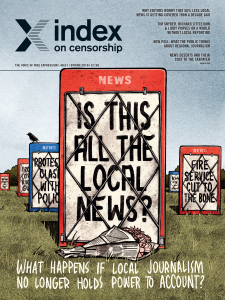
Is this all the local news? The spring 2019 issue of Index on Censorship magazine.
The spring 2019 edition of Index on Censorship looks at local news in the UK and around the world and what happens when local journalism no longer holds power to account.
Our exclusive survey of editors and journalists in the UK shows that 97% are worried that local newspapers don’t have the resources any more to hold power to account. Meanwhile the older population tell us they are worried that the public is less well informed than it used to be. Local news reporting is in trouble all over the world. In the USA Jan Fox looks at the news deserts phenomenon and what it means for a local area to lose its newspaper. Karoline Kan writes from China about how local newspapers, which used to have the freedom to cover crises and hold the government to account, are closing as they come increasingly under Communist Party scrutiny. Veteran English radio journalist Libby Purves tells editor Rachael Jolley that local newspapers in the UK used to give a voice to working-class people and that their demise may have contributed to Brexit. In India Rituparna Chatterjee finds a huge appetite for local news, but discovers, with some notable exceptions, that there is not enough investment to satisfy demand. “Fake news” is on the rise, and journalists are vulnerable to bribery. Meanwhile Mark Frary examines how artificial intelligence is being used to write news stories and asks whether this is helping or hindering journalism. Finally an extract from the dystopian Slovak novel Troll, Michal Hvorecký published in English for the first time imagines an outpouring of state-sponsored hate
[/vc_column_text][/vc_column][/vc_row][vc_row][vc_column][vc_custom_heading text=”Special Report: Is this all the local news?”][/vc_column][/vc_row][vc_row][vc_column][vc_column_text]
The future is robotic by Mark Frary Would journalists have more time to investigate news stories if robots did the easy bits?
Terrorising the truth by Stephen Woodman Journalists on the US border are too intimidated by drug cartels to report what is happening
Switched off by Irene Caselli After years as a political football, Argentinian papers are closing as people turn to the internet for news
News loses by Jan Fox Thousands of US communities have lost their daily papers. What is the cost to their area?
Stripsearch by Martin Rowson On the death of local news
What happens when our local news disappears by Tracey Bagshaw How UK local newspapers are closing and coverage of court proceedings is not happening
Who will do the difficult stories now? by Rachael Jolley British local newspaper editors fear a future where powerful figures are not held to account, plus a poll of public opinion on journalism
“People feel too small to be heard” by Rachael Jolley Columnist Libby Purves tells Index fewer working-class voices are being heard and wonders whether this contributed to Brexit
Fighting for funding by Peter Sands UK newspaper editors talk about the pressures on local newspapers in Britain today
Staying alive by Laura Silvia Battaglia Reporter Sandro Ruotolo reveals how local news reporters in southern Italy are threatened by the Mafia
Dearth of news by Karoline Kan Some local newspapers in China no longer dig into corruption or give a voice to local people as Communist Party scrutiny increases
Remote controller by Dan Nolan What happens when all major media, state and private, is controlled by Hungary’s government and all the front pages start looking the same
Rocky times by Monica O’Shea Local Australian newspapers are merging, closing and losing circulation which leaves scandals unreported
[/vc_column_text][/vc_column][/vc_row][vc_row][vc_column][vc_custom_heading text=”Global View”][vc_column_text]
[/vc_column_text][/vc_column][/vc_row][vc_row][vc_column][vc_custom_heading text=”In Focus”][vc_column_text]
Turning off the searchlights by Alessio Perrone The Italian government attempts to restrict coverage of the plight of refugees crossing the Mediterranean
Standing up for freedom Adam Reichardt A look at Gdańsk’s history of protest and liberalism, as the city fights back after the murder of mayor Paweł Adamowicz
After the purge by Samuel Abrahám and Miriam Sherwood This feature asks two writers about lessons for today from their Slovak families’ experiences 50 years ago
Fakebusters strike back by Raymond Joseph How to spot deep fakes, the manipulated videos that are the newest form of “fake news” to hit the internet
Cover up by Charlotte Bailey Kuwaiti writer Layla AlAmmar discusses why 4,000 books were banned in her home country and the possible fate of her first #MeToo novel
Silence speaks volumes by Neema Komba Tanzanian artists and musicians are facing government censorship in a country where 64 new restrictions have just been introduced
[/vc_column_text][/vc_column][/vc_row][vc_row][vc_column][vc_custom_heading text=”Culture”][vc_column_text]
The year of the troll by Michal Hvorecký This extract from the novel Troll describes a world where the government controls the people by spewing out hate 24 hours a day
Ghost writers by Jeffrey Wasserstrom The author and China expert imagines a fictional futuristic lecture he’s going to give in 2049, the centenary of Orwell’s Nineteen Eighty-Four
Protesting through poetry by Radu Vancu Verses by one of Romania’s most renowned poets draw on his experience of anti-corruption protests in Sibiu
[/vc_column_text][/vc_column][/vc_row][vc_row][vc_column][vc_custom_heading text=”Column”][vc_column_text]
[/vc_column_text][/vc_column][/vc_row][vc_row][vc_column][vc_custom_heading text=”Endnote”][vc_column_text]
Press freedom: EU blind spot? By Sally Gimson Many European countries are violating freedom of the press; why is the EU not taking it more seriously?
[/vc_column_text][/vc_column][/vc_row][vc_row][vc_column width=”1/3″][vc_custom_heading text=”Subscribe”][vc_column_text]In print, online, in your mailbox, on your iPad.
Subscription options from £18 or just £1.49 in the App Store for a digital issue.
Every subscriber helps support Index on Censorship’s projects around the world.
SUBSCRIBE NOW[/vc_column_text][/vc_column][vc_column width=”1/3″][vc_single_image image=”105481″ img_size=”medium”][/vc_column][vc_column width=”1/3″][vc_custom_heading text=”Listen”][vc_column_text]The spring 2019 magazine podcast, featuring interviews with editor of chinadialogue, Karoline Kan; director of the Society of Editors in the UK Ian Murray and co-founder of the Bishop’s Stortford Independent, Sinead Corr. Index youth board members Arpitha Desai and Melissa Zisingwe also talk about local journalism in India and Zimbabwe
LISTEN HERE[/vc_column_text][/vc_column][/vc_row]
21 Dec 2018 | Croatia, Hungary, Macedonia, Media Freedom, media freedom featured, Montenegro, News, Poland, Serbia
[vc_row][vc_column][vc_single_image image=”104453″ img_size=”full” add_caption=”yes”][vc_column_text]Additional reporting by Ada Borowicz, Ilcho Cvetanoski, Lazara Marinković and Zoltán Sipos
Unpatriotic behaviour. Sedition. Being in the pay of shadowy external forces. Faking a neo-Nazi event. These are just a few of the charges that have recently been levelled against independent journalists by pro-government media outlets in several central and eastern European countries.
The opening volley in a sustained campaign of vilification directed at Serbia‘s independent media was fired by the state-owned weekly Ilustrovana Politika at the end of October, with an article that accused journalists who are critical of the government of being “traitors and collaborators with the enemies of Serbia”.
Two weeks later, Ilustrovana Politika followed up with another piece that accused the veteran journalist Ljiljana Smajlović – who has long been critical of the nationalistic legacy bequeathed on the country by its former leader Slobodan Milosević and co-founded the Commission Investigating the Murders of Journalists in Serbia – of complicity in the 1999 NATO bombing of Belgrade.
In mid-December, Ilustrovana Politika’s campaign of character assassination against Smajlović ratcheted up another level with a garish front page depicting her as a Madonna figure with two naked infants bearing the features of Veran Matić, the chairman of the commission, and US Ambassador to Serbia Kyle Scott.
Smajlović has no doubt over what lies behind this tidal wave of denigration, of which she has become the prime target.
History repeating itself?
Editor Slavko Ćuruvija was murdered in 1999.
The long-running trial of four ex-members of the Serbian intelligence service accused of the murder of Dnevni Telegraf editor Slavko Ćuruvija – shot dead in April 1999 a few days after the pro-government Politika Ekspres accused him of welcoming the NATO bombardment – is now in its final stages, and Smajlović is convinced that the current campaign against her is designed to influence the judges in the case.
“The attacks come from the same Milosevic-era editors who also targeted my colleague Ćuruvija as a traitor prior to his assassination,” she told Mapping Media Freedom. “What is also sinister is that they are published and printed by the same state-owned media company that targeted Slavko nearly twenty years ago.”
“The clear implication is that I am the same kind of traitor as he was. How will that affect the judges? Will they fear this is not a good time to hold state security chiefs to account?” she added.
While Smajlović admits that Ilustrovana Politika’s denunciation has made her feel insecure, she insists she is less concerned for her own safety than worried about the consequences for the outcome of the Ćuruvija trial. Quoting Marx’s dictum that “History repeats itself, first as tragedy and then as farce”, Smajlović said. “I hope this is the farce part.”
Laying the blame
In Serbia and other central and eastern European countries, the assignment of responsibility for historic causes of resentment and the potential of these to further divide a polarised public often form the background to attacks on independent journalists by their state-approved colleagues.
The thorny topic of Poland’s relations with Germany during the last century recently gave pro-government media in Poland a chance to accuse independent media of being insufficiently patriotic and even of falsifying facts.
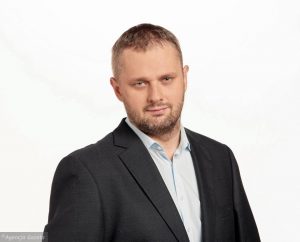
Journalist Bartosz Wieliński was targeted by the head of TVP Info’s news site.
In November, after Bartosz Wieliński, a journalist with the independent daily Gazeta Wyborcza, gave a critical account of a speech made by the Polish ambassador to Berlin at a conference devoted to the centenary of Poland’s independence, the head of the state broadcaster’s news website, TVP Info, accused him of lying and of putting the interests of Germany before those of his own country.
Only a few days before this attack, two media outlets that support Poland’s ruling national-conservative Law and Justice (PiS) party accused the independent US-owned channel TVN of fabricating the evidence on which a report about the resurgence of neo-Nazism in Poland was based.
Since it came to power in 2015, PiS – which has been accused by its critics of tolerating organisations that espouse far-right ideologies – has put pressure on independent media outlets, many of which are foreign-owned, as part of its campaign to “re-polonise” the media, and now appears to be using the public broadcaster and other tame outlets as accessories in this drive.
Willing accomplices
In Hungary, where the government led by Viktor Orbán has succeeded in imposing tight control on all but a few determinedly independent media outlets, a number of loyal publications are available for the purposes of vilification.
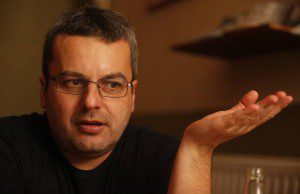
2015 Freedom of Expression Journalism Award winner Tamás Bodoky, founder of Atlatszo.hu
In September, a whole raft of pro-government media outlets vied with each other to depict Tamás Bodoky, the editor-in-chief of the investigative journalism platform Átlátszó and winner of the 2015 Index on Censorship Freedom of Expression Award for Journalism, as a “Soros hireling”. Bodoky became the target of a co-ordinated smear campaign after he posted on Facebook a picture of himself taken in Brussels with Dutch Green MEP Judith Sargentini, whose report on the Fidesz government’s infringement of core EU values had formed the basis for the European parliament’s censure motion against Hungary a few weeks earlier.
Another Hungarian journalist, András Dezső, who works for the independent news website Index.hu, also recently came under attack from pro-government media outlets after a Budapest court let him off with a reprimand over a case in which he was alleged to have made unauthorised use of personal information. In an article published before April’s general election, Dezső had cast doubt on the account of a woman who declared on Hungarian TV that she felt safer in Budapest than in Stockholm because of the lower level of immigration in Hungary. The airing of the interview by the public broadcaster was seen as providing support for Fidesz’s anti-immigration stance and aiding its election victory.
A criminal charge was issued against Dezső for “misuse of personal data”, and after he received what was described in the Hungarian media as “the mildest possible punishment”, two pro-government news websites, 888.hu and Origo.hu, accused him of deliberately propagating fake news and seeking to mislead his readers.
Why do they do it?
What motivates those journalists who smear their colleagues who seek to hold power to account?
There does not appear to be a simple answer to this question. While some may vilify fellow journalists to order purely for financial gain (or because of a desire for job security, government-sponsored media outlets generally being on a more secure financial footing than their independent counterparts), some appear to approach the task with at least a measure of conviction.
Ilcho Cvetanoski, who reports on Bosnia, Croatia, Macedonia and Montenegro for Mapping Media Freedom and has observed many smear campaigns over the years, believes that financial and ideological motivating factors are often inextricably intertwined. He points out that two decades on from the armed conflicts in the region, Balkans societies are still deeply divided along ideological and ethnic lines, and many people still find it extremely difficult to accept the right of others to see things differently. Cvetanoski notes that there are many “true believers” who are genuinely convinced that they have a duty to defend their country from the “other” – a group in which they tend to lump critical journalists along with mercenaries, spies and traitors.
Lazara Marinković, who covers Serbia for Mapping Media Freedom, believes that the main motivation there is a need to be on the winning side and to please those in power. “Often they actually enjoy doing it, either for ideological reasons or because they feel more powerful when they are on the side of the ruling party,” she told Mapping Media Freedom. Marinković noted that the majority of Serbian tabloids and TV stations that conduct smear campaigns against independent journalists are owned by businessmen who have close links to President Aleksandar Vučić’s national conservative Serbian Progressive Party (SNS). Vučić began his political career during the Milosević era, when he served as Minister of Information.
In Poland, the divisions in society and the consequent lack of tolerance in political culture have been blamed for the increasing polarisation of the media. Michal Głowacki, a professor of media studies at Warsaw University, told Mapping Media Freedom that journalists take their cue from politicians in failing to show respect for fellow journalists associated with the “other side”. “They even use the same language as politicians,” Głowacki notes.
This is a view echoed by Hungarian journalist Anita Kőműves, a colleague of Bodoky’s at Átlátszó. Kőműves, however, insists that while journalists who work for independent media outlets strive to uphold the principles of journalistic ethics, the same cannot be said of those employed by pro-government outlets. “Some of those serving the government at propaganda outlets think that the two ‘sides’ of the Hungarian media are equally biased and that they are not acting any differently from their counterparts in the independent media sphere. However, this is not true: pro-government propaganda outlets do not adhere to even the basic rules of journalism,” she told Mapping Media Freedom.[/vc_column_text][vc_raw_html]JTNDaWZyYW1lJTIwd2lkdGglM0QlMjI3MDAlMjIlMjBoZWlnaHQlM0QlMjI0MDAlMjIlMjBzcmMlM0QlMjJodHRwcyUzQSUyRiUyRm1hcHBpbmdtZWRpYWZyZWVkb20udXNoYWhpZGkuaW8lMkZ2aWV3cyUyRm1hcCUyMiUyMGZyYW1lYm9yZGVyJTNEJTIyMCUyMiUyMGFsbG93ZnVsbHNjcmVlbiUzRSUzQyUyRmlmcmFtZSUzRQ==[/vc_raw_html][vc_basic_grid post_type=”post” max_items=”4″ element_width=”6″ grid_id=”vc_gid:1545385969139-cb42990e-b3e2-3″ taxonomies=”9044″][/vc_column][/vc_row]
9 Nov 2018 | News, Press Releases
[vc_row][vc_column][vc_single_image image=”103665″ img_size=”full”][vc_column_text]— New report surveys over 3,000 verified media freedom incidents in EU member states, candidates and potential candidates for entry.
— Journalists facing an array of threats: Burned in effigy. Insulted. Menaced. Spat at. Discredited by their nation’s leaders. Assaulted. Sued. Homes strafed with automatic weapons. Rape threats. Death threats. Assassinations.
— Key themes: National Security, Political Interference, Social Media/Online Harassment, Protests, Public Television
— Report covers May 2014 to 31 July 2018
Index on Censorship has released a new report detailing the state of media freedom in 35 European countries in the past four years. Threats include being burned in effigy, insulted, menaced, spat at, threatened with death and rape. There have been assassinations, lawsuits, and assaults.
The report Demonising the Media: Threats to Journalists in Europe, published today (November 9th) covers 3,000 incidents reported to and verified by the Mapping Media Freedom team, which includes a set of correspondents across the region.
“The huge number of reports outlines that threats to media freedom are occurring across the EU, not just in countries perceived to be on the fringes of the community. Demonising the Media details the key issues that we’ve identified: From national security legislation being used to silence investigative journalists to the undermining of the editorial independence of public broadcasters across the continent. All of this has taken place amid the toxic atmosphere journalists are confronting on a global scale,” said Index CEO Jodie Ginsberg.
KEY THREATS
The report flags 445 verified physical assaults across the region, with Italy as the EU member state with the most reports of physical assaults (83), followed by Spain (38), France (36) and Germany (25).
There were 437 verified incidents flagged as having included an arrest or detention as part of the narrative in the EU member states, candidate and potential candidate countries. Greece had 15 reports. It was followed by France (9), Germany (8), the Netherlands (7) and Latvia (6). In the candidate and potential candidate countries: FYROM (9), Serbia (8), Bosnia and Herzegovina (4) and Kosovo (4).
There were 697 verified incidents categorised as having intimidation as part of the narrative in the EU member states, candidate and potential candidate countries. Among the member states, Italy’s journalists were intimidated most often, with 133 reports. It was followed by Romania (47), Croatia (41), France (39) and Hungary (36). In candidate and potential candidate countries, Bosnia and Herzegovina had 47 reported incidents. It was followed by Serbia (40), FYROM (31), Turkey (31) and Montenegro (19).
The report includes analysis of specific threats in Austria, Hungary, The Netherlands, Spain, Sweden and Montenegro.
KEY THEMES:
National Security and Counter-terrorism Legislation
Well-intentioned legislation that aims to protect the citizens and institutions of a country is, in the best-case scenario, often blind to journalism in the public interest. In the worst-case scenario, such laws are used deliberately to prevent the dissemination of information that is in the public interest. In 39 cases, reporters have been targeted for prosecution for publishing embarrassing leaked information that governments have asserted was not meant for public discussion. This is an acute issue that often involves the judicial and extrajudicial surveillance of journalists in an effort to ferret out the identities of whistleblowers.
Political Interference
This report identifies two key trends within this category. The first is direct interference in the operations of media outlets, either by politicians requesting editors or others involved in the production of news to alter or halt a story, or by replacing journalists critical of a particular political party or policy with ones more favourable to those in power.
Political interference has come from across the spectrum – from Podemos in Spain to the Front National in France, from Fidesz in Hungary to Labour and the Scottish National Party in the United Kingdom. The methods can take many forms, sometimes subtle (behind-the-scenes phone calls to an editor), sometimes overt (preventing a journalist affiliated with particular outlets from attending a press conference) – but the goal of controlling information flow remains the same.
The second form of interference is potentially more insidious: attempts to discredit media outlets by smearing journalists, news outlets, and in some cases an entire industry in order to sow doubt about the veracity of their reporting. This is having a damaging effect, particularly on the safety of journalists, who increasingly are seen as “fair game” by the broader public and subjected to both verbal and physical threats.
Social Media/Online Harassment
Social media has provided journalists with a wide avenue to share their information and interact with readers in a public yet intimate way. This has helped media professionals in reporting and allowed for constructive debates around current events, and can help improve the quality of information available to citizens overall. However, the other side of that bargain is the growing hostility toward journalists online. This takes many forms, from tweets of sexual harassment to death threats made via Facebook. This is a widespread and pernicious issue that journalists across the continent confront on a daily basis, and is fomented by the widely reported remarks of some politicians from member states. Women are most frequently the target of such attacks.
Protests
Journalists also face a number of risks offline. When protesters pour into the streets, journalists are necessarily among the first responders – an essential part of their professional duties. Traditionally present at demonstrations to document and interpret events, media workers – whether freelance or staff – are also among the first to be corralled, targeted and injured. A number of incidents documented at protests – as recorded by the Mapping Media Freedom project – provide insight into the multidimensional threats that journalists confront when called upon to report from the scene of demonstrations, whether small or large. These include a lack of understanding among some police forces about the role of media at such events.
Public Television
A significant but underreported trend during the period was the threat to public broadcasters. A number of national broadcasters were brought under closer government control. Taken together, these reports outline the importance of maintaining the editorial independence of these vital public services.
About Mapping Media Freedom
Mapping Media Freedom is an Index on Censorship project, partly funded by the European Commission, to investigate the full spectrum of threats to media freedom in the region – from the seemingly innocuous to the most serious infractions – in a near-real-time system that launched to the public on 24 May 2014.
Driven by Index on Censorship’s decades-long experience in monitoring censorship across the globe, Mapping Media Freedom set out to record the widest possible array of press freedom violations in an effort to understand the precursors to the retreat of media freedom in a country. The ambitious scope of the project called for a flexible methodology that draws on a network of regional correspondents, partner organisations and media sources. The project is fed by 25 correspondents who provide narrative-driven articles about the press freedom violations.
To date, the project has recorded more than 4,700 incidents covering 43 countries.The report is available online and in PDF format. More information is available here.
[/vc_column_text][/vc_column][/vc_row]
