27 Aug 2019 | Statements
[vc_row][vc_column][vc_column_text]Monday 26th August 2019
Rt. Hon. Nicky Morgan MP Secretary of State for Digital, Culture, Media and Sport 100 Parliament Street London SW1A 2BQ
Dear Rt. Hon. Nicky Morgan MP,
The undersigned organisations, including Scottish PEN, ARTICLE 19, English PEN, European Centre for Press and Media Freedom (ECPMF), Index on Censorship, National Union of Journalists Scotland and Reporters Without Borders, are concerned by the recent attack on journalist Owen Jones and the worsening state of press freedom both in the UK and across the globe. We call on the UK authorities to take all necessary actions to investigate this attack, prosecute those responsible and commit to ensuring press freedom is protected.
The Guardian columnist Owen Jones was celebrating his birthday with friends when he was violently assaulted outside a London pub in the early morning of 17 August 2019. While the motivation behind this attack is unclear at this stage, it should be viewed in the context of a wider set of threats made against Jones, based on his writing and political positions. This includes a photo taken of him without his knowledge in a pub, with the caption “I can get close to your like minded people it’s scary. Do not underestimate my talents of my past and present I even know your address of all you radicals.” The day after the attack, The Guardian reported that “there had been ‘chatter online’ about the incident at the Lexington pub on Pentonville Road hours before [Jones] went public about it on Saturday afternoon”. Jones himself reported that “football hooligans were boasting in closed groups along the lines of ‘Owen Jones has been done in, in Islington’”.
While journalism comes with risks, no journalist should ever be attacked in connection with their work or in their personal life. Disagreement, however hyperbolic or antagonistic, should never lead to violence. Every attack on a writer shuts down debate and sends a dangerous signal to others, encouraging them to avoid sensitive topics, however important, that may invite threats of violence.
Unfortunately, in the UK – which is currently ranked 33rd out of 180 countries in Reporters Without Borders’ World Press Freedom Index – this is one of many attacks on journalists in recent times. Over the past year alone, journalist Lyra McKee was killed while reporting events in Derry, photographer Joel Goodman was assaulted while covering a demonstration
in Manchester, a BBC camera crew was attacked by supporters of Stephen Yaxley-Lennon (aka Tommy Robinson) outside the Old Bailey in London, and in Northern Ireland, journalists Trevor Birney and Barry McCaffrey faced early morning raids at their homes, were detained and questioned, and had charges brought against them and equipment confiscated in connection to their reporting on leaked documents related to the 1994 Loughinisland massacre. Such actions constitute a significant threat to press freedom, the right to free expression and to society at large as the public will be less able to access independent and impartial information.
Around the world, journalism is becoming a more hazardous profession. Mexico remains one of the most dangerous places in the world to be a journalist, with over 150 journalists being murdered since 2000; hundreds of journalists have been arrested and convicted in politically motivated criminal cases in Turkey; journalists across Europe have been assassinated for their work uncovering networks of corruption and abuses of power including state entities, senior politicians and organised crime networks; and The Intercept Brazil is under increasing threats for its coverage of state corruption in Brazil. This is a small snapshot of the threats that journalists endure around the world. At a time when journalists are being decried as traitors, saboteurs, ‘enemies of the people’, or accused of participating in ‘Project Fear’, and journalism itself is being devalued, the space for a free press is severely shrinking.
At the Global Conference for Media Freedom in London in July 2019, the Foreign and Commonwealth Office brought together leading experts to explore ways the UK and other like-minded states can meaningfully protect journalists across the globe. This was an important step, but concrete action needs to follow to ensure the issues raised are not ignored. The commitments undertaken will ring hollow if we are silent on the threats to press freedom within the UK.
Every journalist, whether a reporter, investigative journalist, columnist, editor or cartoonist deserves all necessary protections to ensure they can continue their work free from threats of violence. If journalists are threatened into silence, we suffer, and our democracy suffers. The undersigned organisations call on all relevant UK authorities to live up to their commitments to the right to freedom of expression and to ensure that all journalists are safe to continue their work across the United Kingdom.
We look forward to hearing from you and would be interested to schedule a meeting to talk about these issues in more detail.
Yours sincerely,
Carl MacDougall, President, Scottish PEN
Sarah Clarke, Head of Europe and Central Asia, ARTICLE 19
Maureen Freely, Chair of Trustees, English PEN
Nora Wehofsits, Advocacy Officer, European Centre for Press and Media Freedom (ECPMF)
Joy Hyvarinen, Head of Advocacy, Index on Censorship
John Toner, National Organiser for Scotland, National Union of Journalists Scotland
Rebecca Vincent, UK Bureau Director, Reporters Without Borders [/vc_column_text][vc_basic_grid post_type=”post” max_items=”4″ element_width=”6″ grid_id=”vc_gid:1566893600598-fdac8bc8-eaed-3″ taxonomies=”6534″][/vc_column][/vc_row]
6 Aug 2019 | Events
[vc_row][vc_column][vc_column_text]Inspired by our friends Book-ish in Crickhowell, Index on Censorship and VINTAGE are coordinating a nationwide series of publication-day celebrations and midnight openings at independent bookshops across the UK as part of Banned Books Week UK to celebrate the publication of Margaret Atwood’s highly anticipated The Testaments (sequel to The Handmaid’s Tale) on 10 September.[/vc_column_text][vc_row_inner][vc_column_inner width=”1/2″][vc_single_image image=”108451″ img_size=”full” onclick=”custom_link” link=”https://www.bannedbooksweek.org.uk/events/9-sept-the-testaments-launch-party-at-book-ish-crickhowell/”][/vc_column_inner][vc_column_inner width=”1/2″][vc_column_text]Book-ish will be celebrating the much anticipated publication of The Testaments by Margaret Atwood with an evening event and Old Skool midnight opening.
When: 9 September 20:00 – 23:00
Where: Book-ish 18 High Street Crickhowell NP8 1BD
Tickets: Full details here.
[/vc_column_text][/vc_column_inner][/vc_row_inner][vc_row_inner][vc_column_inner width=”1/2″][vc_single_image image=”108420″ img_size=”full” onclick=”custom_link” link=”https://www.bannedbooksweek.org.uk/events/9-september-launch-party-for-atwoods-the-testaments/”][/vc_column_inner][vc_column_inner width=”1/2″][vc_column_text]Join us for the midnight launch party of The Testaments, Margaret Atwood’s long-anticipated sequel to The Handmaid’s Tale, at Roe River Books in Dundalk.
When: 9 September 21:00 – 23:00
Where: Roe River Books 66/67 Park St Dundalk Co. Louth, A91 C6VK Ireland
Tickets: Full details here. [/vc_column_text][/vc_column_inner][/vc_row_inner][vc_row_inner][vc_column_inner width=”1/2″][vc_single_image image=”108636″ img_size=”full” onclick=”custom_link” link=”http://www.redlionbooks.co.uk/stop-press-margaret-atwood-the-testaments-release/”][/vc_column_inner][vc_column_inner width=”1/2″][vc_column_text]Red Lion Books in Colchester will host a midnight launch for The Testaments on 9th September. They are inviting customers to submit personal and anonymous testaments of when they have experienced forms of prejudice. These testaments will be read by an actor. They will use the prize fund to create props, make bonnets and provide refreshments, as well as advertising the event on social media.
When: 10 September, 7pm
Where: Red Lion Books, 125 High Street, Colchester, Essex, CO1 1SZ
Tickets: Full details here.[/vc_column_text][/vc_column_inner][/vc_row_inner][vc_row_inner][vc_column_inner width=”1/2″][vc_single_image image=”108701″ img_size=”full” onclick=”custom_link” link=”http://rogansbooks.co.uk/”][/vc_column_inner][vc_column_inner width=”1/2″][vc_column_text]Rogan’s Books, a specialist independent feminist and children’s bookshop in Bedford, also plan a midnight launch for The Testaments on 9th September. They are arranging a lantern-lit parade of handmaids through Bedford, passing landmarks such as the Embankment, the river, the wall and the eerie Castle ruins. Just before midnight, the procession will arrive at Rogan’s Books to striking window displays, a reading from the first chapter and Handmaid’s Tale themed refreshments.
When: 9 September, 11:30pm
Where: Rogan’s Books, 26 Castle Ln, Bedford MK40 3US
Tickets: Full details here.[/vc_column_text][/vc_column_inner][/vc_row_inner][vc_row_inner][vc_column_inner width=”1/2″][vc_single_image image=”108593″ img_size=”full” onclick=”custom_link” link=”https://storysmithbooks.com/events/handmaids-tale-book-club/”][/vc_column_inner][vc_column_inner width=”1/2″][vc_column_text]Join Storysmith in Bristol for an informal discussion of the original novel, and enjoy 20% off your copy of The Testaments when purchased from them on the night (they’ll have plenty in stock). Entry is free and includes a glass of wine, but spaces are limited: This event is now fully booked.
When: 10 September 6:30pm
Where: Storysmith, 49 North Street, Bristol, BS3 1EN
Tickets: Full details here.[/vc_column_text][/vc_column_inner][/vc_row_inner][vc_row_inner][vc_column_inner width=”1/2″][vc_single_image image=”108924″ img_size=”full” onclick=”custom_link” link=”https://www.bannedbooksweek.org.uk/events/11-september-banned-book-club-at-belsize-community-library/”][/vc_column_inner][vc_column_inner width=”1/2″][vc_column_text]Belsize Community Library’s book club looks at literature through the lens of censorship. This month, as preparation for UK Banned Books Week, they’ve invited Index on Censorship to come and talk about literary censorship and their work defending free speech worldwide. They’ll also be discussing Margaret Atwood’s The Handmaid’s Tale, which has been both challenged and celebrated. It has been banned and restricted by some schools in the US, but used as a A-level set text in the UK – and now is the basis for a very successful TV series.
When: 11 September, 7-8pm
Where: Belsize Community Library, Antrim Grove, Belsize Park, NW3 4XP
Tickets: Free, no registration necessary. Full details here.[/vc_column_text][/vc_column_inner][/vc_row_inner][/vc_column][/vc_row][vc_row][vc_column][vc_custom_heading text=”Banned Books Week / 22-28 Sept 2019″ use_theme_fonts=”yes” link=”url:https%3A%2F%2Fwww.bannedbooksweek.org.uk%2F|||”][vc_row_inner][vc_column_inner width=”1/4″][vc_single_image image=”103109″ img_size=”full” onclick=”custom_link” link=”https://www.bannedbooksweek.org.uk/”][/vc_column_inner][vc_column_inner width=”3/4″][vc_column_text]
Banned Books Week UK is a nationwide campaign for radical readers and rebellious readers of all ages celebrate the freedom to read. Between 22 – 28 September 2019, bookshops, libraries, schools, literary festivals and publishers will be hosting events and making noise about some of the most sordid, subversive, sensational and taboo-busting books around.
[/vc_column_text][/vc_column_inner][/vc_row_inner][/vc_column][/vc_row]
28 Jun 2019 | Academic Freedom, Campaigns, News
[vc_row][vc_column][vc_column_text]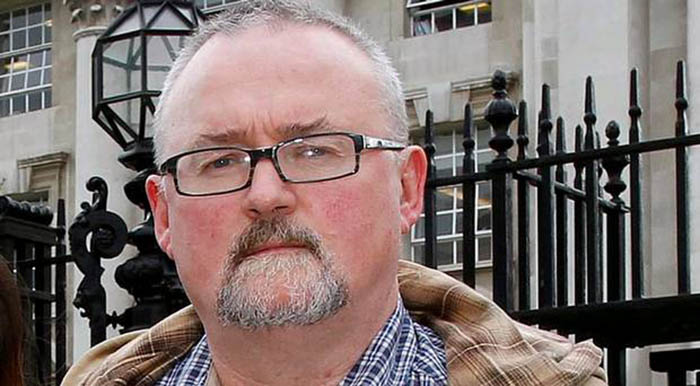
Former IRA member Anthony McIntyre has been granted a UK Supreme Court hearing in an attempt to stop the Police Service of Northern Ireland getting hold recordings of interviews he gave about his role during the so-called “Troubles” in Northern Ireland.
The recordings are part of the Belfast Project, an oral history of Irish republican and loyalist paramilitaries at Boston College, that was directed by journalist Ed Moloney with McIntyre as a researcher. The recordings, gathered between 2001 and 2006, were made on the condition that their content would not be made public until after the death of interviewees except where they had given written permission for their use otherwise.
“These tapes were made solely for academic purposes. They were never intended to be used for criminal investigations,” McIntyre said. “I welcome the fact that the Supreme Court will now hear this case given the important issues at hand.”
Through a mutual legal assistance treaty between the USA and the UK for co-operation in the investigation and prosecution of crime, the PSNI issued subpoenas in 2011 to gain access to recordings made of IRA volunteer Dolores Price as part of their investigation into the disappearance and murder of Belfast mother of ten Jean McConville in 1972. Moloney and McIntyre were unsuccessful in their legal challenges against this subpoena. As Boston College’s legal protections were insufficient to secure the confidentiality of the tapes in the face of British inquiry, the PSNI were granted access to eleven tapes after a legal battle in US courts.
In 2016 the British government subpoenaed Boston College to obtain interviews with McIntyre. Moloney said at the time that the British government was acting on behalf of the PSNI.
In October 2018, McIntyre attempted to stop the investigation via judicial review, pointing out numerous errors in the International Letter of Request sent to Boston College by the PSNI to obtain copies of the tapes. He lost his legal battle to stop the authorities accessing the recordings.
In the latest issue of Index on Censorship magazine, McIntyre said the attempts by police to obtain the tapes have “limited understanding of the conflict” and have impacted on the ability of future historians and researchers. “It also puts police in charge of what society will know about major areas of activity that is deemed illegal,” he added.
The Supreme Court is expected to sit in early October 2019. In the meantime, the tapes remain unopened at the Royal Courts of Justice until a final verdict is reached. [/vc_column_text][/vc_column][/vc_row][vc_row][vc_column][vc_basic_grid post_type=”post” max_items=”4″ element_width=”6″ grid_id=”vc_gid:1561712121963-f6ad8d7e-7a39-5″ taxonomies=”8843″][/vc_column][/vc_row]
27 Jun 2019 | Magazine, News, Volume 48.02 Summer 2019 Extras
[vc_row][vc_column][vc_video link=”https://youtu.be/cA4H7_d9q20″][vc_column_text]
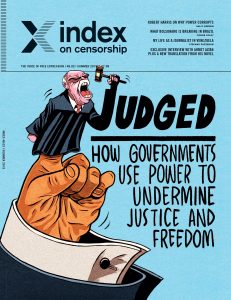
The summer 2019 Index on Censorship magazine looks at the narrowing gap between a nation’s leader and its judges and lawyers. What happens when the independence of the justice system is gone and lawyers are no longer willing to stand up with journalists and activists to fight for freedom of expression? Free expression is vital to inform — and criticise — the actions of the authorities who have the power to take it away. Music has long been a form of popular rebellion, especially in the 21st century where it is easier than ever for artists to distribute and share their songs. This playlist compiles a selection of songs written about, and around, the threats to free expression touched on in this issue. The songs give insight into everything from the nationalism in Viktor Orban’s Hungary to the role of government-controlled social media in China to poverty in Venezuela.
[/vc_column_text][/vc_column][/vc_row][vc_row][vc_column][vc_column_text]
The Punch Brothers is a folk-bluegrass band headed by virtuoso mandolinist Chris Thile. Jumbo is a song from their most recent, Grammy-winning album All Ashore. It is a satirical song mocking an ineffectual American leader that comes from immense privilege, meant to criticize the presidency of Donald Trump. Throughout the song, the titular character is portrayed living a lavish life while the institutions around him flounder. Jan Fox’s article in the most recent magazine covers Trump’s effect on American institutions, much of what the Punch Brothers song aims to mock.
Liszt spent a large portion of his career in the Weimar region of Germany — the subject of Regula Venske’s recent piece on the intellectual history of the area. Liszt capitalized on the rich musical history of the region in composing Ad nos, ad salutarem undam, which was based on Act I of Giacomo Meyerbeer’s opera Le prophète. Weimar, in addition to being known for the classical writers Venske discusses, was also famous for long, dramatic organ pieces, going back to J. S. Bach. Liszt employed that history when writing Ad nos, ad salutarem undam.
Bobi Wine, a Ugandan songwriter and politician, was interviewed by Lewis Jennings for Index Magazine. Incorporating elements of reggae, dancehall, and afrobeat, his music often communicates political statements about freedom in Uganda. Wine wrote Afande in April 2019 while under house arrest for two days. He has served in the Ugandan parliament since April 2017, and was arrested by political rivals. The word “afande” means military policeman, and the song protests the police violence that Wine has experienced in Uganda.
Gilberto Gil began his career as a bossa nova musician, a genre that fuses traditional Brazilian music with samba, jazz, and French classical melodies. Gil was instrumental in the Tropicalia movement, which took inspiration from bossa nova and American rock, though it was far more political. Domingo no parque was the song that propelled him to solo fame, from his second self-titled album. Gil later went on to have phenomenal musical success and a political career: he served as minister of culture in the early 2000s under the popular Lula de Silva, who was eliminated from the most recent Brazilian election following corruption charges. Jair Bolsonaro, the subject of Conor Foley’s article on 26, ended up winning the election.
FFC Acrush, now known as FanxyRed after the departure of three out of its original seven members, is one of many Chinese Pop (or c-pop) bands that has built its following on the government-controlled Chinese social media site Weibo. Weibo is monitored by the government as referenced in Karoline Kan’s and Xinran’s pieces on pages 23 and 74. FFC Acrush has received increased attention due to the androgynous style of its members — homosexuality, though decriminalized, is still taboo in Chinese society, and the band in many ways represents recent generations’ evolving attitudes in the face of strict cultural norms.
The Police’s frontman, Sting, wrote Invisible Sun while living in Ireland during the Belfast hunger strikes during the troubles. Sting’s first wife was Irish which led him to move to Galway in the 1980s. Ten Irish nationalist inmates in Northern Irish prisons died as a result of the hunger strikes, which the song commemorates. As Ryan McChrystal writes, Northern Irish institutions still lack public trust, because of the lack of transparency in their dealings. The aftereffects of the Troubles are still felt in Ireland and Northern Ireland today.
Ali Primera was a Venezuelan activist and musician in the 1960s and 1970s. His music came to define a generation of Venezuelans, particularly the working classes. Techos de Carton, or cardboard roofs, tells the story of the poverty faced by many Venezuelans, a story that is all too familiar today. Melanio Escobar and Stefano Pozzebon discuss how conditions have worsened in Venezuela following a long period of economic and political unrest, conditions that may be again reflected in the music of Ali Primera.
Hazám, hazám (My homeland, my homeland) is an aria from the opera Bánk Bán, by Erkel Ferenc. Viktoria Serdult discusses the changes in Hungary’s institutions following the rise of Viktor Orban. In addition to the increased pressure on the judiciary, press, parliament, and electoral system, Orban (in typical nationalist fashion) has increased funding to the arts to glorify Hungary’s history. Bánk Bán is considered the national opera of Hungary, one of several put on in the most recent season of the Hungarian State Opera House following an increase in funding.
Radiohead’s Electioneering, from their seminal album OK Computer, was written in the wake of UK Prime Minister Tony Blair’s election in 1997. Radiohead members, who were sceptical at the time of the new direction in which Blair pledged to take the Labour Party, wrote the song Electioneering about corrupt politics and the tactics employed by the power hungry to remain in power. Many of the pieces in the Index magazine talk about the corruption of politics, including several that touch on the ways in which corrupt officials manipulate elections to remain in power.
La Voz del Desierto is a band from Madrid, Spain. Three of its members are ordained Catholic priests, and their music brings Spanish Catholicism into the 21st century. In her piece Silvia Nortes examines why the Catholic church has maintained prominence and power in Spain, even while its influence is diminishing elsewhere in Europe. Modern rock bands like La Voz del Desierto, which go on US tours and are popular within Spain and Portugal, connect the public with the church through music.
[/vc_column_text][/vc_column][/vc_row][vc_row][vc_column][vc_basic_grid post_type=”post” max_items=”4″ element_width=”6″ grid_id=”vc_gid:1561647837045-68e87787-0278-4″ taxonomies=”7819″][/vc_column][/vc_row]