The stream may be small right now, a trickle, but it is unmistakable. Turkey’s academics and secular elite are quietly and slowly making their way for the exits.
Some months ago, in the age before Turkey’s post-coup crushing of academia, a respected university lecturer told me she was seeking happiness outside Turkey. She was teaching economics at one of Istanbul’s major universities, but neither her nor her husband, who is also in the financial sector, had a desire to remain in the country any longer. They simply packed up and left for Canada.
The growing unease about the future is now accelerating among the academics and mainly secular elite in the country. This well-educated section of society is feeling the pressure more than any other, and as the instability mounts the urge to join the “brain drain” will only increase.
Some of them, particularly those academics who have been fired and those who now face judicial charges for signing a petition calling for a return to peace negotiations with the Kurdish PKK, no longer see a future for their careers. With the government further empowered by emergency rule decrees, the space for debate and unfettered learning is shrinking.
One of the petition’s signatories, the outspoken sociologist Dr Nil Mutluer, has already moved to a role at the well-respected Humboldt University in Berlin to teach in a programme devoted to scholars at risk.
You only have to look at the numbers to realise why more are likely to follow in the footsteps of those who have already left Turkey. In the days after the failed coup that struck at the country’s imperfect democracy, the government of president Recep Tayyip Erdogan swept 1,577 university deans from their posts. Academics who were travelling abroad were ordered to return to the country, while others were told they could not travel to conferences for the foreseeable future. Some foreign students have even been sent home. The pre-university educational system has been hit particularly hard: the education ministry axed 20,000 employees and 21,000 teachers working at private schools had their teaching licenses revoked.
Anyone with even the whiff of a connection to FETO — the Erdogan administration’s stalking horse for the parallel government supposedly backed by the Gulenist movement — is in the crosshairs. Journalists, professors, poets and independent thinkers who dare question the prevailing narrative dictated by the Justice and Development Party will hear a knock at the door.
It appears that the casualty of the coup will be the ability to debate, interrogate and speak about competing ideas. That’s the heart of academic freedom. The coup and the president’s reaction to it have ripped it from Turkey’s chest.
But it’s not just the academics who are starting to go. The secular elite and people of Kurdish descent that are also likely to vote with their feet.
Signs are, that those who are exposed to, or perceive, pressure, are already doing this. Scandinavian countries have noted an increase in the exodus of the Turkish citizens. Deutsche Welle’s Turkish news site reported that 1719 people sought asylum in Germany in the first half of this year. This number already equals the total of Turkish asylum seekers who registered during the whole of 2015. Not surprisingly, 1510 of applications in 2016 came from Kurds, who are under acute pressure from the government.
The secular (upper) middle class is also showing signs of moving out. The economic daily Dünya reported on Monday that the number of inquiries into purchasing homes abroad grew four-to-five times the pre-coup level. Many real estate agencies, the paper reported, are expanding their staff to meet the demand. Murat Uzun, representing Proje Beyaz firm, told Dünya:
“The demand is growing since July 15 by every day. Emergency rule has also pushed up the trend. These people are trying to buy a life abroad. Ten to twelve people visit our office every day….Many ask about the citizenship issues.”
Adnan Bozbey, of Coldwell Banker, told the paper that people were asking him: “Is Turkey becoming a Middle Eastern country?”
According to Dünya, the USA, Ireland, Portugal, Greece, Malta and Baltic countries are popular among those who want to seek life prospects elsewhere.
In short, the unrest is spreading. Unless the dust settles and the immense political maneuvering about the course Turkey is on reverses, it would be realistic to presume that a significant demographic shift will take place in the near future.
Do taboos play an essential role in culture and society or must we simply get rid of them? Index on Censorship magazine editor Rachael Jolley spoke on the topic at Fritt Ord headquarters in Oslo, Norway, on 21 June at a discussion co-organised by Index, Fritt Ord the Free Word Centre.
Other speakers included Maria Stepanova, poet and editor of the webzine Colta.ru, Moscow, and Pål Johan Karlsen, author and editor-in-chief of the website Psykologisk.no.
Index magazine’s winter 2015/16 issue was on the theme of taboos and why breaking down social barriers matters. In her talk, Jolley presented a global survey of taboos, discussed their history in certain countries and explored why certain taboos lead to censorship.
“Who decided these are the rules and how do they change?” she asked. “Sometimes it takes a generational shift such as we’ve seen in Ireland with the vote to change the law on gay marriage.”
“There’s a tipping point theory where a body of resistance builds up to such a point that the dam breaks and the public suddenly demands another way is found and an older way is discarded,” Jolley added.
Stepanova focused on taboos in Russia, paying special attention to “government-inspired” taboos that were virtually non-existent until a few years ago, but which are now shaped and encouraged by propaganda. Johan Karlsen spoke in defence of the elephant in the room: Why are taboos useful? If we are to co-exist and find inner peace in a dangerous world, we must make space for taboos in our lives, he argued.
Knut Olav Åmås, executive director of the Fritt Ord Foundation, moderated the discussion.
[vc_row][vc_column][vc_custom_heading text=”This year brings the 400th anniversary of William Shakespeare’s death and Index on Censorship is marking it with a special issue of our award-winning magazine, looking at how his plays have been used around the world to sneak past censors or take on the authorities – often without them realising.”][vc_row_inner][vc_column_inner width=”1/2″][vc_column_text]
Our special report explores how different countries use different plays to tackle difficult themes. Hungarian author György Spiró writes about how Richard III was used to taunt eastern European dictators during the 1980s. Dame Janet Suzman remembers how staging Othello with a black lead during apartheid in South Africa caused people to walk out of the theatre.
Kaya Genç tells of a 1981 production of A Midsummer’s Night Dream in Turkey that landed most of the cast in jail. And Brazilian director Roberto Alvim recountshis recent staging of Julius Caesar, which was inspired by the country’s current political tumult. The issue also includes contributions from Simon Callow, Tom Holland, Preti Taneja and Kathleen E McLuskie. Plus we explore Shakespeare’s ability to provoke and protest in India, Zimbabwe and the USA. Currently Shakespeare is very much in favour in China and our contributing editor Jemimah Steinfeld explores why.
Shakespeare aside, we have Hollywood screenwriter John McNamara on why his film on blacklisted screenwriter Dalton Trumbo nearly didn’t make it to the big screen. There are interviews with US academic Steven Salaita and Syrian playwright Liwaa Yazji. We look at how one man from New Zealand has been hacking North Korea for years. And we explore Index’s archives on Argentina’s dictatorship, 40 years after the coup, with interviews from former prisoners and descendants of the disappeared.
The issue also includes new fiction from Akram Aylisli, one of Azerbaijan’s leading, and persecuted, writers. Plus lyrics from Egyptian musician Ramy Essam, famed for his performances in the Tahrir Square revolution, and Basque protest singer Fermin Muguruza. And there are illustrations and cartoons by Martin Rowson, Ben Jennings,Eva Bee and Brian John Spencer.
Order your copy here, or take out a digital subscription via Exact Editions (just £18 for the year, with a free trial). Copies are also available in excellent bookshops including at the BFI and Serpentine Gallery (London), News from Nowhere (Liverpool), Home (Manchester) and on Amazon. Each magazine sale helps Index on Censorship fight for free expression worldwide.
Rising star – Jemimah Steinfeld on how China has embraced Shakespeare, with performances spanning from brash pro-government productions to a Tibetan Hamlet
When the show doesn’t go on – Jan Fox reports on why school and community theatre productions in the US are under increasing pressure to curb “controversial” themes
The Bard meets Bollywood – Suhrith Pathasarathy looks at how India’s films use Shakespeare to tackle controversy
Lifting the curtain on Zimbabwe – While Shakespeare’s tales of power play and ageing rulers get the go-ahead, local playwrights struggle to be heard, says playwright Elizabeth Zaza Muchemwa
Lend me your ears – Claire Rigby interviews leading Brazilian director Roberto Alvim about tackling his country’s current political turmoil through Julius Caesar
Theatre of war – Charlotte Bailey interviews Syrian playwright Liwaa Yazji
Beyond belief – Ryan McChrystal looks at whether Ireland’s new government will finally phase out the country’s blasphemy law
Exposing history’s faultlines – Vicky Baker explores the Index archives for stories of Argentina’s dictatorship 40 years on, and talks to those who were affected
Rainbow warriors – Duncan Tucker reports on the attacks and killings of LGBT activists in Honduras
Hack job – Sybil Jones interviews Frank Feinstein, who monitors the North Korean propaganda machine
“They worried I’m dangerous. I’m absolutely harmless” – Nan Levinson speaks to US academic Steven Salaita who lost his job after posting controversial tweets
Tools and tricks for truthseekers – Alastair Reid and Peter Sands on why people need to learn verification techniques to combat hoaxes and misinformation on social media
Your television is watching you – Jason DaPonte explains how information stored by internet-connected home devices could be used against us
Tackling Trumbo – Hollywood screenwriter John McNamara on how his story about blacklisted writer Dalton Trumbo almost didn’t make it to screens
[/vc_column_text][/vc_column][/vc_row][vc_row][vc_column][vc_custom_heading text=”SUBSCRIBE” css=”.vc_custom_1481736449684{margin-right: 0px !important;margin-left: 0px !important;border-bottom-width: 1px !important;padding-bottom: 15px !important;border-bottom-color: #455560 !important;border-bottom-style: solid !important;}”][vc_column_text]Index on Censorship magazine was started in 1972 and remains the only global magazine dedicated to free expression. Past contributors include Samuel Beckett, Gabriel García Marquéz, Nadine Gordimer, Arthur Miller, Salman Rushdie, Margaret Atwood, and many more.[/vc_column_text][vc_row_inner][vc_column_inner width=”1/2″][vc_single_image image=”76572″ img_size=”full”][/vc_column_inner][vc_column_inner width=”1/2″][vc_column_text]In print or online. Order a print edition here or take out a digital subscription via Exact Editions.
Copies are also available at the BFI, the Serpentine Gallery, MagCulture, (London), News from Nowhere (Liverpool), Home (Manchester), Calton Books (Glasgow) and on Amazon. Each magazine sale helps Index on Censorship continue its fight for free expression worldwide.
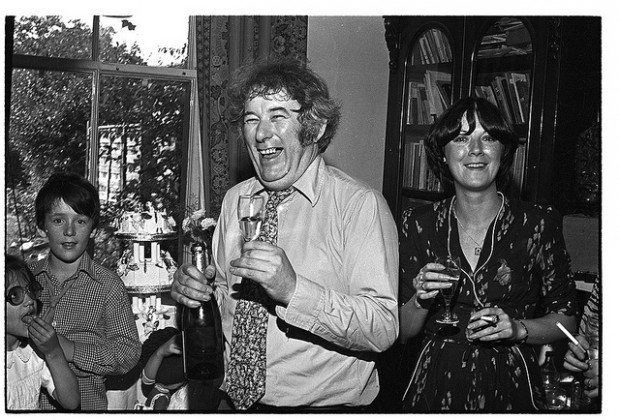
Seamus Heaney with his family and at a party at home in Dublin, 1979. Photographer: Bobbie Hanvey
It’s the 17th annual World Poetry Day, which was first declared by Unesco in 1999 to help meet the world’s aesthetic needs by promoting the reading, writing and teaching of poetry. This year, Unesco director-general Irina Bokova said: “By paying tribute to the men and women whose only instrument is free speech, who imagine and act, Unesco recognises in poetry its value as a symbol of the human spirit’s creativity. […] The voices that carry poetry help to promote linguistic diversity and freedom of expression.”
One poet of this calibre was Seamus Heaney.
The Irish poet, playwright and lecturer was as prolific a translator of poetry as he was a writer. In September 1998, his translation of Gile na Gile, a poem written by Irish language poet Aodhagán Ó Rathaille (1670–1726) was published exclusively in Index on Censorship under the title The Glamoured.
“It is a classic example of a genre known as the aisling (pronounced ashling) which was as characteristic of Irish language poetry in the late seventeenth and eighteenth centuries as rhymed satire was in England at the same time,” Heaney wrote in Index. “The aisling was in effect a mixture of samizdat and allegory, a form which mixed political message with passionate vision.”
This month, Heaney, who died in August 2013, offers us a gift from the afterlife: the publication of his translation of Aeneid’s Book VI, the Roman poet Virgil’s epic on mythic Trojan Aeneas’s journey to Hades. In the poem, Sibyl of Cumae, a guide to the underworld, “chanted menacing riddles” in an attempt to confuse our hero:
Then as her fit passed away and her raving went quiet,
Heroic Aeneas began: ‘No ordeal, O Sibyl, no new
Test can dismay me, for I have foreseen
And foresuffered all. But one thing I pray for
Especially: since here the gate opens, they say,
To the King of the Underworld’s realms, and here
In these shadowy marshes the Acheron floods
To the surface, vouchsafe me one look,
One face-to-face meeting with my dear father.
In the introduction to Aeneid’s Book VI, published posthumously, Heaney describes the poem – which he began working on in 1986 after the death of his father – as “like classics homework, the result of a lifelong desire to honour the memory of my Latin teacher at St Columb’s College, Father Michael McGlinchey”.
St Columb’s is a Roman Catholic grammar school for boys in Derry. Heaney formed part of the school’s “golden generation” in the 1940s and 1950s, which included the dramatist Brian Friel and politician John Hume.
When I attended St Columb’s between 1999 and 2006, pupils were reminded of the school’s alumni illustrissimi — especially Nobel laureates Heaney and Hume — at many a class, assembly and function. One of the highlights of my time as a pupil was attending an after-school discussion with Heaney and the classicist Peter Jones. They spoke of the positive effect reading poetry has on thought processes and the irrelevancy of the poet’s intention when a reader encounters the poem. It is, he said, our own unique experience with a work that truly matters.
Afterward, Heaney signed my copy of Redress of Poetry, a collection 10 lectures he gave between 1989 and 1994 while a professor of poetry at Oxford.
“Poetry cannot afford to lose its fundamentally self-delighting inventiveness, its joy at being a process of language as well as a representation of things in the world,” Heaney writes in the opening chapter. “[P]oetry is understandably pressed to give voice to much that has hitherto been denied expression in the ethnic, social, sexual and political life.”
Redress of Poetry’s predecessor, the collection of literary criticism essays from 1978-1987 titled Government of the Tongue, discusses in much more depth those who have been denied such expression in their political and social lives. The book is perhaps best known for its celebration of poets of the Eastern Bloc, the former communist states of central and eastern Europe. The discovery of poets such as Czesław Miłosz, Osip Mandelstam, Joseph Brodsky and Zbigniew Herbert had an impact on Heaney’s own work. As a Northern Irish Catholic, Heaney could easily identify with the religion, culture and history of Polish poets Miłosz, whose work was banned by Poland’s communist government, and Herbert, who organised protests against censorship in the Eastern Bloc.
One poem Heaney references is Miłosz’s Child of Europe, which reads:
We, from the fiery furnaces, from behind barbed wires
On which the winds of endless autumns howled,
We, who remember battles where the wounded air roared in
paroxysms of pain.
We, saved by our own cunning and knowledge.
It brings to mind the experiences of many in Northern Ireland. Throughout the Troubles, Heaney was known for expressing both clarity and humanity amid chaos. He tells a story in Government of the Tongue, however, of his personal difficulties in creating art amid violence. He was on his way to a recording session at the BBC studios in Belfast sometime in 1972 with folksinger David Hammond when the pair heard bombs go off.
“[T]he very notion of beginning to sing at the moment when others were beginning to suffer seemed like an offence against their suffering,” he wrote.
This tension in the poet’s mind seemingly had no bearing on his ability to capture the mood of an entire nation through his work. In The Cure at Troy, Heaney’s telling of Sophocles’ Philoctetes, the story of how Odysseus tricked Achilles’ son into joining the Greek forces at Troy, expressed the hope felt by many in his country in 1991, a year of ceasefires and all-party talks.
The poem contains the often-quoted and poignant words:
History says, don’t hope
On this side of the grave.
But then, once in a lifetime
The longed-for tidal wave
Of justice can rise up,
And hope and history rhyme