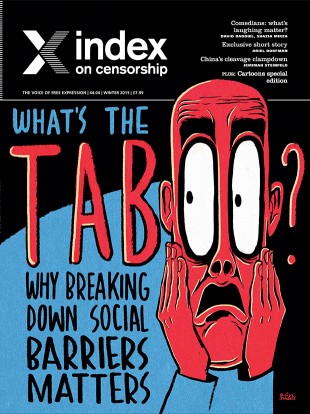
The winter 2015 issue of Index on Censorship magazine, focusing on taboos. Cover image by Ben Jennings
Join Index on Censorship for a taboo-busting evening at London’s best alternative venue – the Royal Vauxhall Tavern – to celebrate the launch of What’s the Taboo? – Index’s latest magazine featuring stories of the most controversial subjects from around the world.
With a panel that includes comedians Shazia Mirza and Grainne Maguire – we’ll be tackling tricky subjects – nudity, atheism, porn in China, mental health and racism could all be on the cards. If you want to explore and question who makes the rules when it comes to taboos – join us for what will be a dynamic evening exploring the unthinkable, the unmentionable and the unacceptable.
Following the panel event stick around for a special DJ set – Taboo Disco!
When: Wednesday 27 January 6:00pm – 11:00pm (6:00pm: Doors open & drinks; 6:30-8:00pm: What’s the Taboo?; 8:00-11pm: Taboo Disco DJ set) Where: The Royal Vauxhall Tavern, 372 Kennington Lane, London SE11 5HY (map) Tickets: Free but limited. Tickets must be booked in advance by emailing: [email protected]
More on the speakers:
Shazia Mirza is an award-winning comedian and columnist. TV Appearances include: Have I Got News For You, F*** Off, I’m a Hairy Woman, NBC’s Last Comic Standing and Richard and Judy. In 2008, she was listed in The Observer as one of the 50 funniest acts in British comedy and won the GG2 Young Achiever of the Year Award. Her current show The Kardashians Made Me Do It is on tour at the moment.
Grainne Maguire is a stand up comedian and comedy writer. She has appeared on Stewart Lee’s Alternative Comedy Experience, Radio 4’s Now Show, Stephen K Amos’ An Idiots Guide, Front Row and Women’s Hour. Last year her campaign to tweet Taoiseach Enda Kenny her menstrual cycle to protest against Ireland’s abortion laws went viral.
Kunle Olulode is director of black campaigning infrastructure charity Voice4Change England. He is also a film historian and exhibitor and part of the BFI’s African Odyssey programming team.
Max Wind-Cowie is a writer and political consultant. He previously ran the Progressive Conservatism project at the thinktank Demos and has written for newspapers including The Guardian, and the London Evening Standard.
Music has long been used as a form of resistance, from civil rights movements to the fall of the Berlin Wall. The latest issue of Index on Censorship magazine, focusing on taboos and the breaking down of social barriers, features an exclusive new short story by Ariel Dorfman about a military trumpeter who plays a defiant, rebellious song on his instrument.
In honour of the story, we have compiled a playlist of music that has been used as protest and resistance from all over the world. The influence of these songs show just how powerful music can be as a form of rebellion.
Many artists on the list have been forced into exile or censored. Index on Censorship has teamed up with the award-winning makers of the documentary They Will Have To Kill Us First to launch the Music in Exile Fund, which will help support musicians in similar situations.
Beethoven’s Ninth Symphony – Ode to Joy
Ode to Joy has been adopted by many protest movements around the world. Most notably the song was played on the streets of Chile in resistance to the Pinochet dictatorship. Demonstrators gathered outside prisons singing Ode to Joy, giving strength to the prisoners who suffered torture there at the hands of the regime.
Joan Baez – We Shall Overcome
We Shall Overcome is a key protest song of the civil rights movement. The song, which has been covered by various artists, was first used in 1945 by tobacco workers fighting for better pay in Charleston, South Carolina. The song, with its message of solidarity and hope, has been used in many protests around the world, not least in the 1950s and 1960s by activists in the American civil rights movement.
Vuyisile Mini – Ndodemnyama we Verwoerd
Ndodemnyama we Verwoerd (Watch Out, Verwoerd) is one of the most well-known songs in South Africa due to its association with the campaign against apartheid. Hendrik Verwoerd, who served as prime minister of South Africa until his assassination in 1966, became known as the “architect of apartheid” for his role in implementing the system of racial segregation. Unsurprisingly, he became the subject of many protest songs, including Ndodemnyama we Verwoerd by Vuyisile Mini. Mini became one of the most powerful organisers of the resistance, earning himself the moniker the “organiser of unorganised”. He was sentenced to death in 1964 on charges of sabotage and political crimes and is said to have sung the song while being led to the gallows.
November 2015 marked the 25th anniversary of the fall of the Berlin wall. Many songs have been associated with the demise of the wall, which divided Berlin for nearly three decades, particularly Wind of Change by German heavy metal band The Scorpions. The song, one of peace and hope, was released a few months after the wall was torn down and became one of the top-selling singles of 1991. The music video to Wind of Change shows footage of the wall being removed.
Songhoy Blues – Al Hassidi Terei
The four members of Songhoy Blues met as refugees after being forced into exile by Muslim extremists who banned all music in Mali in 2012. In defiance of the extremists, they formed the desert blues band, refusing to have music taken away from them. They have since gone on to work with Damon Albarn of Blur and Nick Zimmer of the Yeah Yeah Yeahs, been on an international tour and were nominees for the arts category of the Index on Censorship Freedom of Expression Awards 2014.
Ramy Essam – Irhal
Irhal became known as the anthem of Egypt’s uprising against President Mubarak’s after singer Ramy Essam performed the song during the 2011 protests in Tahrir Square. Irhal, which urges the president to resign, became internationally known after Essam’s performance was posted on YouTube during the protests. After the revolution, Essam returned to Tahrir Square where he was arrested and tortured by the military council. He was offered safe city residence in Sweden following his arrest and has been living there since 2014.
Tropicália/Gilberto Gil – Miserere Nóbis
The Tropicália movement is a brief artistic movement that took place in Brazil in the 1960s. During the movement, which was co-founded by Gilberto Gil and Caetano Veloso, musicians expressed their resistance to the country’s military dictatorship through their music and their socially and politically charged lyrics. The movement only lasted around a year before being suppressed by the military regime. Gil and Veloso were arrested in 1969 and forced to live in exile in London for the political content of their work but returned to Brazil in 1972.
Billie Holiday – Strange Fruit
Strange Fruit, most famously performed by Billie Holiday, protests American racism and the lynching of African Americans. The song began as a poem written by teacher Abel Meeropol published in 1937; Who then set it to music and performed it as a protest song at various venues in New York in the late 1930s along with his wife and the singer Laura Duncan.
Chieftains and Sinead O’Connor – Foggy Dew
Foggy Dew is the name of several old Irish ballad. This version of the song chronicles the Easter Rising of 1916 in Dublin when Irishmen fought for the cause of Irish independence. During World War I, thousands of Irishmen served in the British forces. Many Irish nationalists felt they should have stayed in Ireland and fought for Irish independence, which is reflected in the song.
Killing in the Name – Rage Against The Machine
American rap-metal band Rage Against the Machine released Killing in the Name in 1992, six months after the Los Angeles riots, which were triggered after four white police officers were acquitted of beating black motorist Rodney King. The song is institutional racism and police brutality. Known for its excessive use of expletives, Killing in the Name originally received little air time.
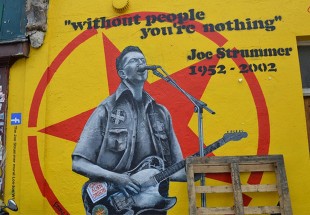
Joe Strummer (The Clash) mural, London. Credit: Flickr / Matt Brown
The Clash – White Riot
When The Clash released White Riot, many people thought it was a song advocating some kind of race war. This couldn’t be further from the truth. With the lyrics, Joe Strummer was appealing to white youths to find a worthy cause to fight (or riot) for, just as many black youths had in the UK at the time. At its heart, it is a song about class and race.
Bob Marley – Get Up, Stand Up
Bob Marley is renowned for his songs about peace, love and resistance. With Get Up, Stand Up being one of his most well-known protest songs. Marley wrote the song with fellow Jamaican musician Peter Tosh as a challenge to oppression. The song is famed for the lyrics: “You can fool some people sometimes but you can’t fool all the people all the time.”
Pete Seeger – Joe Hill
Joe Hill was a miner, songwriter and union organiser for the Industrial Workers of the World (IWW). Hill was executed in America in 1915 following a controversial trial in which he was found guilty of the murders of John G Morrison and his son Arling. Hill refused to testify at his trial believing he would be worth more to the labour movement as a dead martyr than alive. After his death, Hill was the subject of songs by various artists, including Paul Robeson, Joan Baez and Pete Seeger.
Sam Cooke – A Change Is Gonna Come
A Change Is Gonna Come has been covered by various artist but was originally written by Sam Cooke. The song is another civil rights anthem concerning the struggles of African Americans during the 1960s. Cooke was said to have been inspired to write to song by various events in his life, predominantly being turned away from a “whites only” hotel. The singer was shot and killed just before the song was due to be released as a single in 1964.
Tinariwen – Lulla
Tinariwen are made up of musicians from the Tuareg community, whose music reflects the issues faced by the Tuareg people. The musicians received military training when they were living in exile in Libya in the 1980s, and many of the members of Tinariwen were rebel fighters in the 1990 revolt against the Malian government. In 1991, the collective, who’s name translates to “the people of the desert”, left the military to focus on music on a full-time basis.
Eagles of Death Metal – People Have the Power
On 8 December, Eagles of Death Metal joined U2 on stage in Paris, just three weeks after Muslim extremists launched an attack at their concert at the Bataclan Theatre, killing 89 people, plus 41 in two other attacks. Together the bands performed a cover of Patti Smith’s People Have the Power, showing bravery and resistance against the terrorists who left the city in fear.
You can read the Ariel Dorfman’s new short story, All I Ever Have, about music as a form of resistance in the latest Index on Censorship magazine. Each magazine sale helps Index on Censorship fight for free expression worldwide. Order your copy here, or take out a digital subscription via Exact Editions (just £18 for the year).
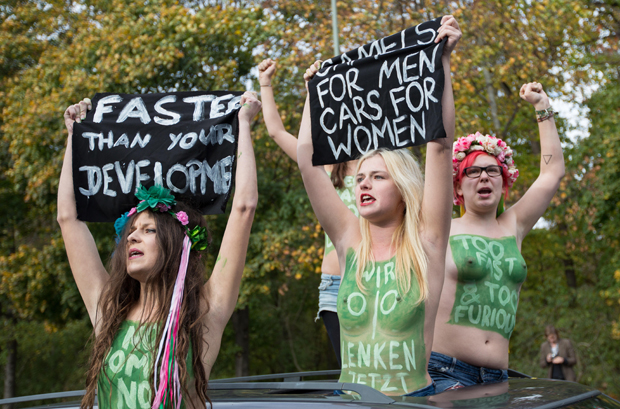
Femen activists demonstrate in front of the Saudi Arabian embassy in Berlin. Photo: Florian Schuh/dpa/Alamy Live News
Societies often endanger lives by creating taboos, rather than letting citizens openly discuss stigmas and beliefs. Index on Censorship magazine editor Rachael Jolley introduces our taboo-themed issue, which looks at no-go subjects worldwide, from abortion and mental health to the Holocaust and homosexuality
Teenager Rahenaz Sayed was told by her family not to sit on a bed, not to touch her hair oil and not to pray during her period.
Sayed, now 20, has started to go into schools in Mumbra, near Mumbai, along with two other young women, to discuss the taboos around menstruation, according to India’s Hindustan Times.
Traditionally, girls here didn’t talk to their mothers about getting their periods, or pain that they might be experiencing. This was something you were not expected to discuss, better, in fact, to pretend that it just wasn’t happening.
These restrictions were not open to challenge, until now. “We thought, ‘Why not talk of an issue which women don’t speak about and suffer silently?’ We suffered due to silences surrounding menstruation and didn’t want others to go through the same,” Mubhashirin Naik, one of the women starting to go into schools to talk about these long-held practices, told the newspaper.
They had been told that these “rules” came from the scriptures, but when they read those same passages themselves they found that while they spoke about women resting during menstruation nothing was written about banning them from prayer.
Taboos, subjects that are off limits to argument, are different in every country around the world. But this story shows why the act of not allowing a group of people to discuss a tradition or convention can injure society. Why should girls be treated like outcasts once a month and banned from doing the most normal things in life? The answer is because somehow this has become accepted and challenges frowned upon.
Once these three young women began to see that the structures they were being told to follow were nonsensical (they were not able to ask for painkillers, for instance), they had the strength to stand up against them. And by doing so, they will have begun to change the dynamic. No doubt, other women will also be encouraged to question the “rules”. And that’s how societies adapt over time, by questioning power.
In El Salvador, where abortion is illegal under any circumstance, even where the pregnant woman could die, the way that the law is enforced means that women who suffer a miscarriage can wake up with a police officer standing next to them.
The abortion law is so draconian that women who lose their baby through illness can find themselves charged with man- slaughter. Under the ferocity of this law, many women are too frightened to talk to anyone about any concerns they might have about pregnancy, let alone discuss abortion (more on this in the latest issue). In 2008 a 25-year-old woman, Guadalope Vásquez, was sentenced under the abortion law to a 30-year sentence after suffering a miscarriage. Under these conditions, women are often too frightened to discuss anything about health complications during their pregnancy with a doctor, or anyone else. Lives will be put at risk.
Throughout history, taboos have been established to limit and control society, and help to retain a status quo. “Best not mention it” is the nodded instruction to put something off limits in the family living room. In the 20th century, in the UK, societal disapproval would be rained down on those who ate something other than fish on Fridays, or children who played outside on a Sunday, or an adult who didn’t wear a hat to church. And in the US today the Westboro Baptist Church tells its female followers that it is forbidden for them to cut their hair. But why? Who decided these were the rules, and how do they change?
Sometimes it takes a generational shift, such as we have seen in Ireland, with the 62% vote to change the law to allow same-sex marriage. There’s a tipping point when a body of resistance builds up to such a point that the dam breaks and the public suddenly demands another way is found, and an older way is discarded.
But societal disapproval can be fierce and individuals who deviate from “the normal” can also find themselves isolated and alone, as Palestinian academic Mohammed Dajani Daoudi discovered when he took a group of his students to Auschwitz to learn about the Holocaust (read his story in the magazine). Dajani felt it was important for his university students to learn about this period of history. He saw his duty as one of teaching about,
not ignoring, a particular piece of history. Others saw it as the action of a traitor, accusing him of ignoring the suffering of Palestinians. He knew he was tackling a taboo subject, but hadn’t expected the reaction to the visit to be so violent. Afterwards he received death threats, and has now moved his family to Washington DC, partly for safety reasons.
Societies often endanger lives by creating taboos, rather than letting citizens openly discuss stigmas and beliefs. Remember the days when people would fear being judged for admitting they had cancer and would not mention it in public? Alastair Campbell does, and draws parallels to attitudes to mental illness today. Such beliefs can lead to people failing to talk to doctors about symptoms because of embarrassment, and potentially leaving diagnosis too late. These societal barriers are often out-of-date, sometimes stemming from archaic religious beliefs, or from traditions that have been left unchallenged. But still today an action that conflicts with expected behaviour can result in damage to an individual. The Encyclopedia Britannica states: “Generally, the prohibition that is inherent in a taboo includes the idea that its breach or defiance will be followed by some kind of trouble to the offender, such as lack of success in hunting or fishing, sickness, miscarriage, or death.” Living in fear of breaching such a “rule” can leave people afraid to dispute or argue for a sensible alternative.
To challenge a famous phrase from a WWI poster, talk doesn’t cost lives, but not talking certainly can.
Each magazine sale helps Index on Censorship fight for free expression worldwide. Order your copy here, or take out a digital subscription via Exact Editions (just £18 for the year).
[vc_row][vc_column][vc_custom_heading text=”What can’t people talk about? The latest magazine looks at taboos around the world”][vc_row_inner][vc_column_inner width=”1/2″][vc_column_text]
What’s taboo today? It might depend where you live, your culture, your religion, or who you’re talking to. The latest issue of Index on Censorship magazine explores worldwide taboos in all their guises, and why they matter. Comedians Shazia Mirza and David Baddiel look at tackling tricky subjects for laughs; Alastair Campbell explains why we can’t be silent on mental health; and Saudi Arabia’s first female feature-film director Haifaa Al Mansour speaks out on breaking boundaries with conservative audiences.
Plus a crackdown on porn and showing your cleavage in China; growing up in Germany with the ghosts of WW2; what you can and can’t say in Israel and Palestine; and the argument for not editing racism out of old films. As the anniversary of Charlie Hebdo murders approaches, we also have a special section of cartoonists from around the world who have drawn taboos from their homelands – from nudity, atheism and death to domestic violence and necrophilia.
Also in this issue, Mark Frary explores the secret algorithms controlling the news we see, Natasha Joseph interviews the Swaziland editor who took on the king and ended up in prison, and Duncan Tucker speaks to radio journalists who lost their jobs after investigating presidential property deals in Mexico.
And in our culture section, Chilean author Ariel Dorfman looks at the power of music as resistance in an exclusive short story, which is finally seeing the light after 50 years in the pipeline. We have fiction from young writers in Burma tackling changing rules in times of transition, and there’s newly translated poetry written from behind bars in Egypt, amid the continuing crackdown on peaceful protest.
Each magazine sale helps Index on Censorship fight for free expression worldwide. Order your copy here, or take out a digital subscription via Exact Editions (just £18 for the year).
The history man – Professor Mohammed Dajani Daoudi explains how he has no regrets, despite causing outrage after taking Palestinian students to Auschwitz
Provoking Putin – Oleg Kashin on how new laws are silencing Russians
Quiet zone: a global cartoon special – Featuring taboo-busting illustrations from Bonil, Dave Brown, Osama Eid Hajjaj, Fiestoforo, Ben Jennings, Khalil Rhaman, Martin Rowson, Brian John Spencer, Padrag Srbljanin, Toad and Vilma Vargas
[/vc_column_text][/vc_column][/vc_row][vc_row][vc_column][vc_custom_heading text=”SUBSCRIBE” css=”.vc_custom_1481736449684{margin-right: 0px !important;margin-left: 0px !important;border-bottom-width: 1px !important;padding-bottom: 15px !important;border-bottom-color: #455560 !important;border-bottom-style: solid !important;}”][vc_column_text]Index on Censorship magazine was started in 1972 and remains the only global magazine dedicated to free expression. Past contributors include Samuel Beckett, Gabriel García Marquéz, Nadine Gordimer, Arthur Miller, Salman Rushdie, Margaret Atwood, and many more.[/vc_column_text][vc_row_inner][vc_column_inner width=”1/2″][vc_single_image image=”76572″ img_size=”full”][/vc_column_inner][vc_column_inner width=”1/2″][vc_column_text]In print or online. Order a print edition here or take out a digital subscription via Exact Editions.
Copies are also available at the BFI, the Serpentine Gallery, MagCulture, (London), News from Nowhere (Liverpool), Home (Manchester), Calton Books (Glasgow) and on Amazon. Each magazine sale helps Index on Censorship continue its fight for free expression worldwide.

 Shazia Mirza is an award-winning comedian and columnist. TV Appearances include: Have I Got News For You, F*** Off, I’m a Hairy Woman, NBC’s Last Comic Standing and Richard and Judy. In 2008, she was listed in The Observer as one of the 50 funniest acts in British comedy and won the GG2 Young Achiever of the Year Award. Her current show The Kardashians Made Me Do It is on tour at the moment.
 Grainne Maguire is a stand up comedian and comedy writer. She has appeared on Stewart Lee’s Alternative Comedy Experience, Radio 4’s Now Show, Stephen K Amos’ An Idiots Guide, Front Row and Women’s Hour. Last year her campaign to tweet Taoiseach Enda Kenny her menstrual cycle to protest against Ireland’s abortion laws went viral.