Index on Censorship has had a longstanding interest in the issue of freedom of expression relating to satire. Drawing on Index on Censorship magazine’s more than 40-year-archive, this reading list compiles articles looking at the relationship between comedy and censorship, including a recent piece by Samm Farai Monro aka Comrade Fatso, founder of Zambezi News, Zimbabwe’s leading satirical news programme.
Students and academics can browse the Index magazine archive in thousands of university libraries via Sage Journals.
Comedy of Terrors: Zimbabwean satirists challenge power by Samm Farai Monro
Samm Farai Monro, June 2015; vol. 44, 2: pp. 78-82.
Samm Farai Monro, aka Comrade Fatso, talks about founding Zimbabwe’s leading satirical show, and how the nation’s comedians challenge politicians and take on longstanding taboos
Out in Africa by Scott Capurro
Scott Capurro, March 2001; vol. 30, 2: pp. 190-194.
Stand up comedian Scott Capurro explores the limits of stand-up comedy in South Africa
Laughter Lines by Arthur Matthews
Arthur Matthews, March 2015; vol. 44, 1: pp. 86-88.
Co-writer of comedy sitcom, Arthur Matthews discusses censorship in comedy and satire in Ireland
Opiate of the Masses by Saeed Okasha
Saeed Okasha, November 2000; vol. 29, 6: pp. 106-111.
“No matter what form it takes, comedy is a political act in the first degree. It serves as an outlet for frustrations and is a way of putting impossible and incomprehensible situations into perspective. Egyptian society today is urgently in need of such therapy”
Comfort Zones by Scott Capurro
Scott Capurro, November 2000; vol. 29, 6: pp. 134-138.
Stand-up Comedian Capurro provides commentary on how political correctness stifles comedy
South Korea: A Serious Business by Andrew H. Malcolm
Andrew H. Malcolm, July 1978; vol. 7, 4: pp. 62.
A brief look at how comedy was strictly censored in South Korea, as the “serious government has cracked down on humour.”
Side road, dark corner by Edgar Langeveldt
Edgar Langeveldt, November 2000; vol. 29, 6: pp. 86-89.
A stand-up comedian in Zimbabwe describes the dangers comedians face for covering controversial topics, including an account of his own violent attack in 1999.
They shoot comedians by Jamie Garzon
Jamie Garzon, January 2000; vol. 29, 1: pp. 132-133.
Transcripts of television satires by journalist and humourist Jaime Garzon. In August of 1999, Garzon was executed on his way to the Radionet studio.
How to Win Friends and Influence an Election by Rowan Atkinson
Rowan Atkinson, May 2005; vol. 34, 2: pp. 117-120.
Atkinson, a foremost British comedian, opposes the government’s proposed law of Incitement of Religious Hatred in a speech given at the House of Lords, as he considers its dire effects on his profession.
Dark Magic by Martin Rowson
Martin Rowson, February 2009; vol. 38, 1: pp. 140-164
Author and cartoonist Martin Rowson expounds on satire, discussing how breaking cultural taboos often stimulates the best political satire
Confronting fear with laughter by Martin Smith
Martin Smith, January 1992; vol. 21, 1: pp. 8-10.
Smith writes about the terror that Burma’s army has inflicted, specifically mentioning the comedian Zargana, who was punished for his bold, pointed jokes.
Comedy is everywhere by Milan Kundera
Milan Kundera , November 1977; vol. 6, 6: pp. 3-7
Banned novelist, playwright, and short story writer Kundera writes on committed literature, the death of the novel, the nature of comedy, and more topics.
“Comedy isn’t here simply to stay docilely in the drawer allotted to comedies, farces and entertainments, where ‘ serious spirits’ would confine it.”
Egypt: Shame on the censor by Karim Alrawi
Karim Alrawi, December 1983; vol. 12, 6: pp. 40..
Discusses the charges filed against the comic actor Said Saleh
“We can only assume that Said Saleh has been made an example of for the shameful act of making people laugh.”
The reading list for comedy and censorship can also be found at the Sage website.
Index on Censorship has been publishing articles on satire by writers across the globe throughout its 43-year history. Prior to our event, Stand Up for Satire, we published a series of archival posts from the magazine on satire and its connection with freedom of expression.
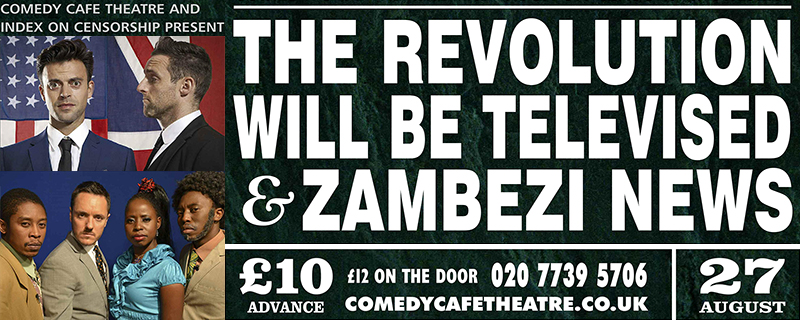
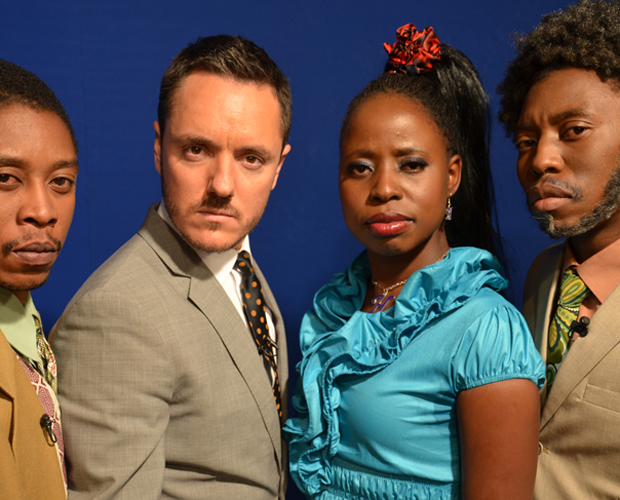
Zambezi News cast, pictured left to right – Michael Kudakwashe, Samm Farai Monro, Chipo Chikara and Tongai Makawa
The Zimbabwean Minister of Impending Projects proudly stands in front of a mine that he has christened Mine Mine. “Because,” he says, “it’s mine. And because a diamond mine is a minister’s best friend.” This corrupt politician who has never completed a single programme in his department, is a fictional character on Zambezi News, a satirical show I helped create, with fellow activist Outspoken.
Zambezi News has become Zimbabwe’s leading satirical programme, reaching millions of viewers across the country and the whole continent. The show is a parody of the state-controlled propaganda machine, the Zimbabwe Broadcasting Corporation, and mimics the station’s sycophancy to the ruling party, the Zimbabwe African National Union Patriotic Front (Zanu PF). Quite frankly, our show started off by fluke. Outspoken and I have a background as spoken word and hip-hop artists and were approached by a friend involved in a local film festival to do a live news skit. When it aired at the festival and was really well received, we knew we were on to something.
We shot the first season in 2011 as a faux news show with three comic newscasters. The show cut between the newsroom and satirical reports from the field and featured a string of outrageous characters. We even did a special episode for the 2013 elections where our newscaster, Mandape Mandape, showed how easy it is to vote – unless you are young, urban and likely to vote for the opposition. We publicised the show around the country using partners ranging from community radio stations to activist groups. We also pushed it heavily on social media and shared the videos on YouTube. Interest was so great we then produced 10,000 DVDs, which were requested in more than 100 different towns and villages in Zimbabwe. Since then we have shot two more seasons. The show has been viewed by six million Zimbabweans, and we have been invited to do live shows in Sweden, South Africa, Swaziland and the USA.
The fact that there is thriving satire in Zimbabwe and that we, as the cheeky cast of Zambezi News, are still alive confuses a lot of people. Most TV and radio in Zimbabwe is controlled by the state or cronies of the ruling party, so the public has a growing appetite for comedy and satire that present an alternative voice. People like to laugh and think about our crazy situation at the same time.
“Political satire has provided comic relief to many Zimbabweans, but, above all, it has been an innovative way of speaking truth to power,” said political commentator Takura Zhangazha. “Zambezi News is key in carrying on this tradition especially across various media spectrums and between generations.” The fact that we’re still alive? Well, I guess that’s down to luck and the fact that we hide in plain sight.
Index on Censorship has been publishing articles on satire by writers across the globe throughout its 43-year history. Ahead of our event, Stand Up for Satire, we published a series of archival posts from the magazine on satire and its connection with freedom of expression.
However, being a leading satire show and poking fun at the powerful, comes with risks: one of our main actors in Zambezi News has been threatened by people we suspect are state security agents. The actor was approached after we launched our first season in 2012. He was threatened for working on an “anti-government, regime-change agenda” and told that he would be “dealt with”. Our content is blacklisted on state-controlled radio and TV, while we often get attacked by Zanu PF-aligned bloggers who write that we produce “anti-government propaganda”. Earlier this year, as we prepared to launch our third season, the police called up to ask if we had “police clearance” to do so. We also get harassed by the officials from the censorship board and the Central Intelligence Organisation who ask us: “Do you have accreditation and clearance to do this?” I guess this means that they are watching our show, so half our job is done.
We are not alone. Other online satirical shows are emerging, including PO Box, The Comic King Show and LYLO, to name but a few. PO Box has been a viral success in Zimbabwe with its weekly five-minute skits posted on Facebook with the skits getting 20,000 views in two days. The show deals with the country’s social and economic issues and has the cast playing everything from corrupt politicians to victims of xenophobic violence in South Africa. “Comedy and satire depict society’s stance and are the voice of the ordinary people to the elite,” said PO Box creator Luckie Aaroni.
Many outsiders wouldn’t expect to discover Zimbabweans poking fun at the powerful, or mocking the president and his wife, an act that was taboo until recently. “It’s a reflection of the times,” said leading comedian and comedy promoter, Simba The Comic King. “Things are hard, so people might as well laugh about them. That’s their form of protest.” There are also standup shows in the main cities of Harare and Bulawayo. Bulawayo’s gritty Umakhelisa Comedy Club regularly features the city’s top comedians, who joke about the tough social and economic realities that are modern Zimbabwe. Harare’s two leading monthly comedy events, the Bang Bang Comedy Club and Simuka Comedy, often attract capacity crowds to their hard-hitting shows.
Stand-up comedy emerged in Zimbabwe in the 1990s but today has grown into something more daring, where comedians are continually pushing boundaries. However, the authorities don’t always think the jokes should be shared with the public. “A couple of times I have been approached by presumed state security agents who have told me that certain jokes are funny, but get them out of your set if you want to live till the next show,” said Simba. Such threats are real and common in the country. It’s a recurring joke in Zimbabwe among artists: you have freedom of expression, but not freedom after expression.
Despite these trends, Zimbabwe is not an easy place to perform. The state has basically used a carrot-and-stick approach with artists. The carrot is the 75 per cent local-content policy on all state-controlled radio and TV, introduced in April 2000 by the Zanu PF government. For musicians, this means your songs will get played if you aren’t dissing the government and they will get played even more so if you are praising it. And if you’re known to be obedient, Zanu PF might also book you to play at one of its many galas, where taxpayers’ money is used to enchance the party’s image. The stick approach is more straightforward: critical artists get no state support, won’t have their songs played on radio and TV, and are likely to be harassed and threatened.
Artists such as comic character Dr Zobha get airplay on state-controlled radio as they are seen as obedient and toeing the party line. Whereas Zimbabwean music legend Thomas Mapfumo, a national hero for his role in the liberation struggle, was hounded out of the country in 2001 after releasing music critical of Zanu PF. Mapfumo now lives in self-imposed exile in the USA.
With more and more young people online in Zimbabwe sharing videos and content on Facebook and WhatsApp, we now have more and more alternative means of disseminating our content. And considering our politicians aren’t going to stop being clowns anytime soon, we definitely won’t be running out of things to say. So we’ll keep striving to build a new country. One joke at a time.
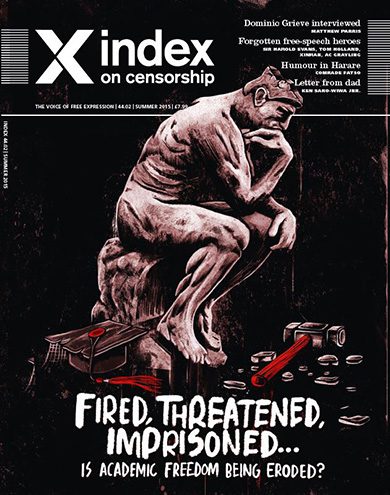
The summer 2015 issue of Index on Censorship magazine focusing on academic freedom will be available from 12 June.
With threats ranging from “no-platforming” controversial speakers, to governments trying to suppress critical voices, and corporate controls on research funding, academics and writers from across the world have signed Index on Censorship’s open letter on why academic freedom needs urgent protection.
Academic freedom is the theme of a special report in the summer issue of Index on Censorship magazine, featuring a series of case studies and research, including stories of how setting an exam question in Turkey led to death threats for one professor, to lecturers in Ukraine having to prove their patriotism to a committee, and state forces storming universities in Mexico. It also looks at how fears of offence and extremism are being used to shut down debate in the UK and United States, with conferences being cancelled and “trigger warnings” proposed to flag potentially offensive content.
Signatories on the open letter include authors AC Grayling, Monica Ali, Kamila Shamsie and Julian Baggini; Jim Al-Khalili (University of Surrey), Sarah Churchwell (University of East Anglia), Thomas Docherty (University of Warwick), Michael Foley (Dublin Institute of Technology), Richard Sambrook (Cardiff University), Alan M. Dershowitz (Harvard Law School), Donald Downs (University of Wisconsin-Madison), Professor Glenn Reynolds (University of Tennessee), Adam Habib (vice chancellor, University of the Witwatersrand), Max Price (vice chancellor of University of Cape Town), Jean-Paul Marthoz (Université Catholique de Louvain), Esra Arsan (Istanbul Bilgi University) and Rossana Reguillo (ITESO University, Mexico).
The letter states:
We the undersigned believe that academic freedom is under threat across the world from Turkey to China to the USA. In Mexico academics face death threats, in Turkey they are being threatened for teaching areas of research that the government doesn’t agree with. We feel strongly that the freedom to study, research and debate issues from different perspectives is vital to growing the world’s knowledge and to our better understanding. Throughout history, the world’s universities have been places where people push the boundaries of knowledge, find out more, and make new discoveries. Without the freedom to study, research and teach, the world would be a poorer place. Not only would fewer discoveries be made, but we will lose understanding of our history, and our modern world. Academic freedom needs to be defended from government, commercial and religious pressure.
Index will also be hosting a debate in London, Silenced on Campus, on 1 July, with panellists including journalist Julie Bindel, Nicola Dandridge of Universities UK, and Greg Lukianoff, president and CEO of Foundation for Individual Rights in Education, US.
Personally, I don’t believe Satan, or God, exist, so it’s not a question I give a great deal of time to.
Salman Rushdie gave it some thought. The title of The Satanic Verses comes from an old idea that there may have been parts of the Sura that were false. Specifically, a concession to the polytheism of the pre-Islamic Meccans to whom Muhammad preached: “And see ye not Lat and Ozza, And Manat the third besides? These are exalted Females, And verily their intercession is to be hoped for.”
Muhammad was, the story goes, tricked into saying these lines by Satan. The Angel Gabriel later told Muhammad he had been deceived, and he recanted.
For Thought-For-The-Day types, it’s a nice little “don’t believe everything you read” lesson. For literary types, it may even be seen as an interesting early example of an unreliable narrator. Muhammad trusted the angel to tell him the truth: but at that moment, the angel was not who he seemed.
I sincerely doubt Northern Ireland’s Pastor James McConnell has much truck with the idea of unreliable narration. Or even fiction, for that matter. McConnell is the type of person who believes that if someone is going to go to the trouble of writing a thing down in a book, then that thing should be true.
A book? No. The Book. There is one book for the pastor. It’s called the Bible, and it’s got everything you need. You might read other books, but they’ll be books about the Book. Books explaining in great detail just how great the Book is. What there are not, cannot be, are other the Books.
So the Bible can be true, or the Quran can be true: but they can’t both be true. And if the Quran is false, but Islam claims it is true, then Islam must be wicked. Satanic, even.
In May last year, Pastor McConnell, like many of his ilk, was very exercised by the story of Meriam Yehya Ibrahim, who had reputedly been sentenced to death in Sudan after converting from Islam to Christianity. Here was further proof, septuagenarian McConnell preached to the congregation at Whitewell Metropolitan Tabernacle, that “Islam is heathen, Islam is satanic, Islam is a doctrine spawned in hell.” There may be good Muslims in the UK, he said, but he didn’t trust them. Enoch Powell was right, McConnell said, to predict “rivers of blood”.
McConnell seemed to know this was going to get him in trouble. “The time will come in this land and in this nation,” he preambled, “to say such things will be an offence to the law.”
Turns out, the pastor was half-right at least in this much. Last week, Northern Irish prosecutors announced that McConnell would face prosecution for his sermon. For inciting religious hatred? No, too obvious. McConnell, now retired and said to be in declining health, will be prosecuted under Section 127 of the Communications Act.
Section 127 is, free-speech nerds may recall, the piece of legislation that pertains to the sending “by means of a public electronic communications network a message or other matter that is grossly offensive or of an indecent, obscene or menacing character”.
It’s the one that led to the Paul Chambers “Twitter Joke Trial” case, one of the great rallying points of online free speech in recent years. In January 2010 Chambers joked online that he would blow up Doncaster Robin Hood airport if his flight to Belfast (always Belfast!) to meet his girlfriend was cancelled. He was convicted, even though every single person involved in the case acknowledged that he had been joking, including the airport security, who did not for one second treat the tweet seriously, even as a hoax.
Chambers was convicted. Eventually, in June 2012, the conviction was quashed. Questions were raised about why then-Director of Public Prosecutions Keir Starmer had persisted in pursuing the case. For his part, Starmer launched a consultation to draft guidelines on when the Communications Act provisions should and should not be used (this writer took part in the meetings and submitted written evidence).
During that process, Starmer was fond of pointing out (correctly) that the Communications Act had been designed to protect telephone operators from heavy breathers. It had nothing to do with stupid jokes on the internet.
And it certainly had nothing at all to do with the online streaming of sermons by fundamentalist preachers.
Let there be no doubt: the prosecution of James McConnell under the Communications Act is a disgrace and a travesty. It is the action of a prosecution service more interested in appearing to be liberal than upholding justice and rights. If McConnell is suspected of being guilty of incitement, then prosecute him under that law. But the deployment of the catch-all Communications Act, in a situation it was very obviously not designed for, suggests prosecutors were not confident of that case and have instead reached for the vaguest charge possible.
When one combines this latest prosecution with the recent “gay cake” case, in which a Christian bakery in County Antrim was fined for refusing to decorate a cake with a pro-equal marriage message, it’s hard not to think the people of Protestant Ulster may, on this occasion, have some real fuel for the siege mentality that’s kept them going for so very long. It feels as if an attempt is being made to force liberalisation on Christians through the courts. It’s hard to imagine any outcome besides resentment, and Lord knows the “wee province” has enough of that already.

 Index on Censorship has been publishing articles on satire by writers across the globe throughout its 43-year history. Prior to our event, Stand Up for Satire, we published a series of archival posts from the magazine on satire and its connection with freedom of expression.