Index: Leveson goes too far


This article was originally published in The New Statesman
Between the Leveson Inquiry and the crisis at the BBC, it seems journalism is all we ever read or hear about these days.
These crises are heightened because journalists are, essentially, gossips who like talking about journalists. In this, we’re no different from people in any other line of work: programmers talk about other people’s code, plumbers slag rivals’ work – it’s human.
Note I wrote “line of work” rather than profession. That’s because it is very, very important to remember that journalism is not and cannot ever be a profession.
This is at the very heart of the debate over what Lord Justice Leveson should conclude from his findings when he reports in the coming weeks. Can you legally force journalists to behave in a certain way without damaging free expression?
Some point to regulatory bodies such as the Law Society or the General Medical Council, and say that regulation does not affect those professions. But think. One can strike off a doctor or a lawyer – how does one strike off a journalist? Sure, you can sack her, but what if she starts a blog? Starts making phone calls? Starts covering stories?
How do you stop people doing journalism? The old distinction will become ever more blurred as we all now carry publishing apparatus in our pocket. Journalists in the traditional sense had desks, telephones, expense accounts and bad habits. But most importantly, access to a printing press and means of distribution. A decent smartphone carries all this in one (apart from the expenses and habits).
Journalism is one way in which people can exercise their right to free expression, and the danger with statutory regulation is that one can actually create separate levels of access to a right – giving the journalist less of a right to free expression than anyone else. That’s not how rights work.
Some will point out that there are many “statutes” that apply to journalists, and this is true, but these statutes – contempt, libel etc, do not apply just to journalists – they are universal.
Creating a new law governing the press compromises that universality.
Many point to the “Irish model” as an example of statutory underpinning. But this is not entirely correct. The Press Council of Ireland was already established before it was recognised in statute, and then only with membership as a mitigating factor in a libel defence. It was not established by statute. (Bear in mind, by the way, Leveson watchers, that it took five years of negotiation to set up the Irish Press Council. This may go on for some time.)
Meanwhile, Germany (in terms of market size, possibly a better example for the UK) does not even permit specific laws on the press.
A press regulator cannot carry legal compulsion. Politicians already try their hardest to influence newspapers, and allowing them to create statute that will rule over the press will almost inevitably prove too tempting for a parliamentarians fed up of their eternal role as lamposts to the press’s dogs (as HL Mencken had it). Statute specifically dealing with the press will hurt free speech, no matter how much its advocates say it won’t.
Padraig Reidy is news editor at Index on Censorship
The world’s two biggest superpowers are about to choose their next leaders. While the American battle is laid bare for all to see, in China, Beijing’s new emperor and his closest advisers are something of a mystery.
Chinese flags (Shutterstock)
That hasn’t stopped the rest of the world debating what Xi Jinping (China’s most likely candidate for the new Communist Party chief) and his top officials will mean for the country. So far it’s all guesswork, and there are some widely differing opinions from Xi the reformer, to Xi the hardliner. Here’s a round-up of the predictions from Tokyo to Washington.
Hong Kong
While there is virtually no discussion in mainland media about the new incoming Politburo, Hong Kong-based pundits are free to publish their views. According to AFP, Hong Kong-based website Mirror Books is pessimistically predicting that the new line-up will be dominated by conservatives and not reformers. It predicted the line-up “would include Zhang Dejiang, Yu Zhengsheng, Liu Yunshan, Zhang Gaoli and Wang Qishan, citing sources close to the party.”
Hong Kong political commentator Willy Lam was positive: “This looks like the line-up. It is not one that will be good for reform hopes”.
Australia
The Australian Strategic Policy Institute argues that it will be business as usual under Xi. He won’t be “making any drastic domestic changes”, argues Hayley Channer, because of his “allegiance to the Communist Party.” But compared to current premier Hu Jintao, Xi is “more approachable as well as more confident.” Channer suggests that domestic problems will keep Xi busy and away from acting too feisty in regional politics.
Kevin Rudd, the Chinese-speaking former Australian prime minister, pointed out last month that the new government — likely to be announced on 8 November, two days after the US elections — will have the same key goal as all other Chinese governments since 1949: that is “the new leadership will seek to sustain the political pre-eminence of the Chinese Communist Party within the country.” This will be tough, Rudd says, because of corruption, economic issues, and the need to boost the country’s international standing.
In terms of issues of free speech, Xi will be walking into a much freer China: “Democratic forces within China also now have greater space to operate than used to be the case,” Rudd writes. “There is now a much more open debate about Chinese policy questions in the Chinese media.”
And while the Party itself is off limits and will continue to be so as a topic of public discussion, Rudd suggests that “the public debate, both in the mainstream media, the social media and on the ground through popular protest activity over local decisions, is now a firm and probably fixed feature of Chinese national political life.”
We can only bide our time, he says, to see how much Xi is prepared to allow this develop.
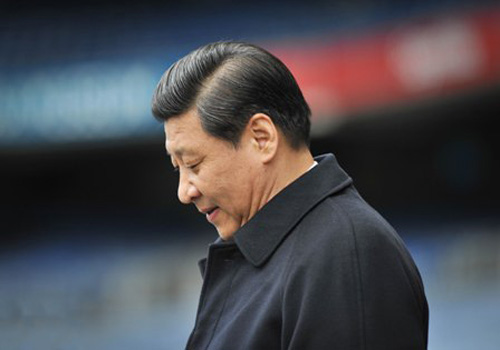
Xi Jinping during a trip to Dublin, Ireland, February 2012. Art Widak | Demotix
Japan
Dr. Satoshi Amako at The Association of Japanese Institutes of Strategic Studies bleakly pedicts that Xi will be more hardline than Hu.
“Some analysts contend that [Xi] will adopt more conservative policies and try to strengthen one-party rule domestically,” Amako says. “ His statements are conservative but reformist, China-centric but internationalist.”
Xi will have to grapple with a number of crucial issues, one of which is the struggle between a growing need among the people for more freedoms and the supremacy of the Party. He says:
China’s open reform policies not only realized economic growth but also generated a sense of rights, and the Communist Party has applied a strong brake to social and political liberation. On the other hand, various steps have been taken to introduce a degree of flexibility. Nevertheless, resistance from minorities, farmer movements, frequent civil and mass protests, civil rights movements aimed at raising public awareness of rights, and expansions of “free spaces” by informal media are now all evident.
Amako, sadly, offers no prediction over how Xi will attempt to juggle this one.
United States
Xi’s strong ties to the military could mean that he will be a “formidable leader for Washington to contend with”, writes Jane Perlez in the New York Times. With an increasingly stronger People’s Liberation Army (PLA), Xi is likely to focus on making China more assertive on the world stage, particularly in Asia, Perlez cites analysts as saying.
Not so, says infamous former US Secretary of State, Henry Kissinger. After he held talks with Xi this year he said he was convinced China’s new leader would bring sweeping reforms to the country.
“It’s unlikely that in 10 years the next generation will come into office with exactly the same institutions that exist today,” Kissinger said.
Like Rudd, Kissinger believes internal issues will dominate Xi’s agenda so that he will not be looking for confrontation with the West:
What we must not demand or expect is that they will follow the mechanisms with which we are more familiar. It will be a Chinese version (…) and it will not be achieved without some domestic difficulties.
According to The Diplomat, Xi’s “confidence” — which Channer in the Australian Strategic Policy Institute also referred to — may be good or bad. A. Greer Meisels writes:
It could mean that President Xi may be more difficult to work with, at least from an American perspective, because he may feel as if the U.S. should be more deferential to China and its core interests. On the other hand, he could be easier to deal with because he may have the confidence to make bolder moves on the foreign policy, political, and economic reform fronts.
So again we’re advised to “wait and see”. And we may have to wait some time: The Diplomat warns that it will be at least one to two years before Xi will have amassed enough “political capital” to make his mark.
United Kingdom
The Economist asks if Xi has “the courage and vision to see that assuring his country’s prosperity and stability in the future requires him to break with the past?” In other words, Xi must start to relax the party’s grip on power to deal with the problems facing China today: a slowing economy, corruption and growing social discontent.
Social media and growing incomes have meant people are more willing and able to voice their complaints, and news of protests can now be debated nationwide.
Xi could, the Economist says, privatise rural land and give it to peasants. The judicial system needs to properly address grievances, and “a free press would be a vital ally in the battle against corruption.”
While the magazine concedes this scenario is highly unlikely, it argues that Xi has no choice if he wants a strong a stable China in the years to come.
In the age of social media, the European Union needs to defend free expression. But it often falls far short, says Padraig Reidy