17 Nov 2007 | Comment, News
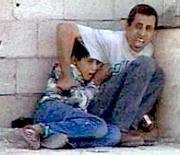
It was the most iconic image of the second intifada: the killing, on camera, of a Palestinian child caught up in the violence of September 2000. But a French libel case has raised questions about what happened that day in Gaza.
Natasha Lehrer reports
In a packed courtroom in Paris’s Palais de Justice last Wednesday, Charles Enderlin, veteran Jerusalem correspondent for the state-owned television channel France 2, presented 18 minutes of raw footage filmed at the Netzarim Junction in Gaza on 30 September 2000. The footage included 68 seconds of the final moments of Mohammed al Dura, the 12-year-old boy whose death in a barrage of Israeli gunfire was caught on film that day and broadcast around the world. The image became an iconic image of Israeli brutality and was the trigger for some of the worst violence ever seen in the Israeli-Palestinian conflict. These 68 seconds of footage form the pivotal evidence in the latest stage in a libel case brought by Enderlin and his employer against Philippe Karsenty, head of a small Internet current affairs watchdog called Media Ratings, who accuses Enderlin of having perpetrated a hoax and demands that he and Arlette Chabot, head of news at France 2, resign.
Karsenty bases his allegations on the work of a small, dedicated—some would say obsessive—group of Israeli, French and American bloggers and journalists who have been voicing serious doubts about the footage filmed that day by Talal Abu Rahma, a freelance Palestinian cameraman who has often worked for France 2. Enderlin himself was not in Gaza that day.
The principal objections to the footage focus on the fact that although Abu Rahma claimed under oath that the boy and his father were subjected to a 45-minute sustained attack from the Israeli position, there are only seven bullet holes in the wall. These bullet holes are perfectly round. According to ballistics experts, this is consistent with having been fired from straight ahead, whereas the Israeli position is to the extreme right of the father and son. Even if the Israelis had managed to hit them directly with bullets fired at an angle from a position over 100 metres away, the holes they would have made in the wall would have been noticeably distended.
The difficulty with unravelling this story is that it has, in the main, preoccupied people whose obsessions are at least in part political, leading to extravagant claims that serve only to undermine their arguments. Much of the evidence on both sides is little more than conjecture. But if one thing can be said about what was viewed in court last week, it is that it is impossible to verify the claim that al Dura was killed by an Israeli bullet from watching the footage alone. The only corroboration of the attack was made by the cameraman himself, whose sworn affidavit at the Palestinian Centre for Human Rights furnishes further essential details of what took place that day.
Enderlin and Abu Rahma have always claimed that what was broadcast on the evening of 30 September 2000 was significantly shorter than what was filmed earlier in the day. In his sworn affidavit, Abu Rahma said that he filmed 27 minutes of footage that day. He told Esther Schapira, the German filmmaker who made the 2002 documentary Three Bullets and a Dead Child: Who Shot Muhammad al Dura, that he filmed six consecutive minutes of the attack. In an interview in the French magazine Telerama in October 2000 Enderlin explained his decision not to include the footage of the actual death throes—“agonies”—of the child because they were so unbearable.
Why then, when the court ordered France 2 to release the raw footage to be shown in court (on a DVD made in the presence of a bailiff in the offices of France 2 from the original tape) did we see footage that was only 18 minutes long? Why, in the course of that 18 minutes did we see only 68 seconds of non-consecutive footage rather than six consecutive minutes of Jamal and Mohammed al Dura? Where are the death throes that Enderlin described so eloquently? In fact, there is nothing in the tape that definitively shows that the child is dead. The first 17 minutes of the video are taken up with scenes of young Palestinian children and youths apparently staging riots, playing at being shot, getting up again and smoking cigarettes nonchalantly. For 16 minutes (Enderlin told the courtroom) only rubber bullets were fired; the real bullets that are fired in the 16th minute were, according to Enderlin’s commentary in court, from the Palestinian position. At no point in the footage do we see gunfire coming from the Israeli position.
Enderlin’s commentary in court contradicted earlier claims he has made about the raw footage. Last Tuesday, he told the BBC that “nothing is staged. Footage of the same events filmed by other news organisations confirms this”. In court he explained why there is in fact no other footage of Mohammed’s death: “All the other cameramen ran away in fear”. In a galvanising moment in court, Guillaume Weill-Raynal, a lawyer (though not working on the case) and friend of Enderlin, gestured to the judge to pause the playing of the footage to show how Mohammed’s foot in one of the penultimate frames is positioned in such a way that shows that he must be dead. Experts, explained Weill-Raynal, have verified that it is impossible for a living person to lie with his foot in such a position; the child is clearly dead at that point in the footage. The judge gestured for the showing of the footage to continue. Within a couple of frames everyone in the courtroom saw the “dead” child raise his arm and leg to peer out in the direction of the gunfire. The irony of his resurrection at that point was lost on nobody.
Does it matter if the child did or did not die that day from an Israeli bullet? For Enderlin, in the end, it clearly doesn’t; in a January 2005 article in the Figaro written by two veteran French journalists who expressed severe reservations about the veracity of the footage, Enderlin responded that “the image corresponded to the reality of the situation, not only in Gaza but also in the West Bank”. In other words, its symbolic importance is much more important than its factual truth. This is undeniably true, given the uses to which the image of al Dura has been put over the last seven years. With his death Mohammed became “the first child martyr of the Intifada”. He was eulogised by the Palestinian poet Mahmoud Darwish. All over the Arab world streets were renamed in Mohammed’s honour and stamps with his picture were issued. Appalling acts of violence were perpetrated in his name. Less than a fortnight after his murder two Israeli soldiers were lynched in Ramallah. Osama bin Laden name-checked the child after 9/11. His picture can be seen in the videotape of Daniel Pearl’s beheading. Both in the west and in the Arab world there are many who even go so far as to claim that Mohammed’s death changed the course of 21st century history.
Given the significance of the footage it is striking that the case hasn’t exactly galvanised the French media. Though it has been reported in the American and Israeli press, and last week appeared on the websites of both the BBC and al Jazeera, the French media have all but ignored it, with the exception of the 2005 article in the Figaro, a brief mention on France 24’s website and some coverage in the Jewish press. Enderlin’s close relationship to former President Chirac was underlined when during the first round of the libel case last year—which he won—the journalist’s lawyer produced a letter from the then president attesting to Enderlin’s integrity. It is perhaps no coincidence that it is only now with Sarkozy in power that the appeal court finally ordered France 2 to release the footage for it to be shown in open court.
It is undoubtedly true that l’affaire Enderlin raises uncomfortable questions regarding the independence of the French media from its government. Questions must inevitably be asked about the ethical standards, transparency and self-regulation of France 2 in particular and the French media in general, which has shown next to no interest in an affair that not only exposes a rotten core at the heart of the country’s public information network but is a salutary reminder that we ignore the importance of maintaining the highest level of journalistic integrity at our peril. Lives depend on it.
12 Nov 2007 | Magazine, Middle East and North Africa

Iranian intelligence is using new interrogation tactics on journalists reports Maziar Bahari who received an invitation to tea at an upmarket hotel
I’m not supposed to tell you this but I met Mr Mohammadi. In fact I met three Mr Mohammadis in four days.
Mohammadi is the nickname of choice for the agents of Iran’s Ministry of Intelligence — Iran’s equivalent of the CIA. They have other nicknames as well, most of which are variations of the names of Shia imams such as Alavi, Hassani and Hosseini. I guess the names don’t indicate a rank or anything (I have to guess because Mr Mohammadi doesn’t tell you much. He asks the questions).
Mr Mohammadi is responsible for the security of Iran. That includes protecting the values of its government. It’s a tough job. It’s like being in charge of Britney Spears’s public image. Well, not exactly, but you get my point. The values change so often that the officials who put former colleagues on trial today are careful not to be incarcerated by the same people tomorrow (who may very well have jailed them in the past). Mr Mohammadi’s job description is to keep the integrity of the regime intact and to stop those who plan to undermine the holy system of the Islamic Republic. But what does undermining mean? And what if it is actually the government of Iran that is doing the under- mining (as it does constantly)? These questions seem to puzzle Mr Mohammadi. So he is more than a little bit paranoid and edgy these days. When he calls you for questioning, you don’t know if he’s going to charge you with something or if he’s seeking advice.
These days, Mr Mohammadi’s main concern is that the American fifth column, disguised as civil rights activists, as well as scholars and journalists, is destabilising the Islamic Republic. The American government has, after all, allocated US$75m to promote ‘democracy’ in Iran. To put it in layman’s terms, it means undermining the Islamic government through the media and civil society groups. The American government is also giving US$63 billion in military aid to Saudi Arabia, Egypt and Israel to ‘counter Iran’. The US would love to have agents in the country to take the money and spend it wisely. There are so many social and economic problems in Iran, that if someone wanted to exploit them to create dissent it wouldn’t be difficult to do so. But most activists I know inside Iran wouldn’t touch the money with a bargepole and resent the American government much more than their own. In the meantime, the Iranian government tries to find foreign perpetrators and domestic accomplices instead of solving the root causes of dissent, such as mismanagement of the country’s economy, poverty, internal migration and drug addiction.
In the 1980s and 1990s, intelligence agents were rough and scary. You were guilty until proven otherwise. But nowadays, they politely call you for tea at some fancy hotel or other to question you. I never understood their fascination with hotels. Why can’t you just meet them in their offices? Or why don’t they come to your office? Why not a restaurant, a park or a cinema? Anyway, when you enter the hotel room you are offered a range of non-alcoholic drinks. Mr Mohammadi is very generous with his beverages. As soon as you finish your tea you are offered Nescafe , then some kind of juice, then Fanta, Pepsi etc. But he never offers anything solid. Why can you drink tea while being asked about plots against the government but not have a biscuit? Does an interrogation over a kebab lunch make it less trustworthy?
These questions of course pop into your head while you’re enjoying the comfort of not being in Mr Mohammadi’s presence. He has killed many people in the past. And you know that he is well capable of violence again if he thinks it necessary Mr Mohammadi’s counterparts in numerous parallel security apparatuses (intelligence units of the judiciary, Revolutionary Guards and the police) still have not caught up with his methods. Recently a number of students and labour activists were arrested and instead of being offered tea or Nescafe in an upscale hotel they spent days in solitary confinement and were beaten up with electric cables and batons. I met the three different Mr Mohammadis while on assignment for Newsweek magazine. I was writing an article about the suppression of civil society and civil rights activists in Iran.
Day one: I’ve set up an appointment with a teachers’ union leader at a cafe . I am supposed to meet him after an exam at the high school where he teaches. The teacher doesn’t show up on time. I wait for an hour. Even by Iranian standards he is late. I call him on his mobile but it is off. Strange. He was so keen to talk the day before, so what has happened? I then get a call from his mobile.
‘Who is that?’ the caller asks. It is not the teacher. ‘I’m Bahari from Newsweek.’ ‘News what?’ ‘Week.’
‘So you’re a journalist. Will call later.’ I learn that the teacher was arrested during the exam and sent to prison. An hour later I get a call from a ‘private number’. It is a new voice. He is much more pleasant. There are several intelligence apparatuses in Iran. The judiciary, Revolutionary Guards and the police – each has its own intelligence arm. But Mr Mohammadi’s Ministry of Intelligence is supposed to be the main one.
It certainly is the most professional, and polite, one. ‘Could you come to … Hotel at three this afternoon’ asks Mr Mohammadi. It’s been a while since I’ve been summoned. Naturally I oblige.
Mr Mohammadi has become more polite, cordial and strangely reassuring. He sneaks a smile when I ask him, ‘Why am I summoned here?’ He used to give me an angry look that would mean he is the one in charge, not me. He begins by asking really simple questions about me and my work: who am I? How long have I worked for Newsweek? Why did I want to meet the teacher? Have I ever met him before? What is the angle of my story? Easy questions to answer. Mr Mohammadi is quite relaxed. He scribbles in his notebook while I talk and every now and then exchanges a smile with me. There’s nothing remotely amusing about what I’m saying, but Mr Mohammadi keeps on smiling. That makes me think: what is so interesting about the banality I’m spewing here? Is he really taking notes or is he doodling a fish? Is it a dead fish? Maybe it’s a fish in the belly of another one. When is he going to let me out of here? Is he going to let me out of here?
I get tired of talking after a while. Then, like Mohammad Ali in the seventh round of his fight with George Foreman, Mr Mohammadi snaps and starts to challenge me. He keeps on smiling. I wish he wouldn’t. Why do I think an American publication is interested in talking to Iranian dissidents? Was I given a list of questions by American paymasters to ask the dissidents? Have I ever been to any conferences in the US or in Europe? Have I ever met any dissidents in Europe or the US? How did I come to be chosen as Newsweek’s correspondent in Iran and not someone else? Mr Mohammadi is now targeting my integrity as a journalist, explicitly trying to make a connection between me and a dissident, suggesting that we both work as agents of the Great Satan and that we are part of a bigger plot to topple the Islamic government.
If this session had been with previous Mr Mohammadis a few years ago, I would be scared of a pending trial and imprisonment for something I had never done – a destiny that befell many of my friends and colleagues. But what makes this Mr Mohammadi tolerable, is his half-hearted approach to the whole thing. His expression is not a grin or a smirk. You can see that he’s been down this road before and really doesn’t think that it works. He almost feels sorry for himself and asks for your sympathy. He looks genuinely confused and somehow out of his depth. His bosses have come up with a conspiracy theory and asked Mr Mohammadi to validate it. He is a smart man and has been down this road many times since the 1979 Islamic revolution. It’s never worked in the past and it doesn’t work now. Mr Mohammadi knows that he’s wasting his time and mine. He knows that his government should reform itself if it wants to survive. As former Minister of Intelligence Ali Yunessi (who was removed from office
Mr Mohammadi says that he is sorry for the trouble. He then gives me a modified farewell spiel in the style of the other Mr Mohammadi and the others before him. The conclusion remains the same: we know where you live.
Day four: I’ve been meeting feminist activists to find out why 15 of them were sent to jail and how they were treated in Tehran’s Evin prison. Apparently, their Mr Mohammadi was not that different from mine. He smiled and tried to find a connection between them and the government of the United States. Less than an hour after I leave the house of my last interviewee, I’m invited to have tea at a hotel. This time it’s a different, more upscale one.
I decide that if Mr Mohammadi’s job is to scare people like me into censoring ourselves or leaving Iran then my job is to tell him and his bosses to wake up and change. You can’t lead a country by scaring people all the time. The Islamic Republic of Iran is at the height of its power. The US has gotten rid of your two great enemies, Saddam in Iraq and the Taliban in Afghanistan. For you, there is no viable opposition to your government and you’re selling oil at 70 dollars a barrel. But with power comes responsibility. Isn’t it time to grow up and feel confident? Why does the government spend its time and money on people like me while the country is being gnawed at from the inside by pollution, unemployment, drug addiction and prostitution? Doesn’t Mr Mohammadi see all the drug addicts in the parks and on the street corners all over Iran? Doesn’t he find it strange that in a country that calls itself the motherland of all Muslims of the world, the average age of the prostitutes is 16?
Finally, Mr Mohammadi’s smile is gone. ‘There is one thing that you forget in your mature government theory.’ I feel that he is finally coming out of his bureaucratic intelligence shell. ‘I’ve heard that you’ve studied in Canada.’
‘Yes.’
‘Good. Now imagine if Iran has 250,000 soldiers in Canada and Mexico [about the same number of American soldiers in Iran’s neighbours Iraq and Afghanistan] and then allocates a budget to help civil rights movements in the United States, let’s say to the Black Panthers or a native Indian movement, wouldn’t Americans be paranoid? We know our internal problems much better than anyone and we definitely do our best to tell those who are responsible about the social maladies you just talked about. But this is Iran. It takes ages for anything to happen. In the meantime we have a vicious enemy to deal with: the United States. It’s determined to topple our government by any means necessary. As Tom Clancy says, the United States is [Mr Mohammadi’s exact words]: A Clear and Present Danger.’
I don’t know how Mr Mohammadi will react to my writing about these encounters. Not too happily, I guess. He strongly advised me not to talk about these meetings with anyone. But it’s important to know that Mr Mohammadi has changed. And if he can change, the Islamic regime can change. I’m still not too convinced about his point about the American threat. Throughout its history, the Islamic Republic has looked for foreign enemies and has usually found them around the world in abundance. Yet on many occasions it has undermined its own legitimacy by linking the genuine domestic opposition to its foreign ene- mies. It’s time for the international community, especially the United States, to accept that the Islamic Republic is a force to be reckoned with and deserves respect as much any other sovereign nation. But it is equally important for the Islamic Republic to realise its own maturity and act responsibly. Maybe instead of a conference on the myth of the Holocaust, our president could organise a conference entitled ‘Islamic Republic of Iran: 28 Years of Trials and Tribulations’.
On a more personal note, the change can start with the government treating its citizens with respect. I know Mr Mohammadi knows where I live. He doesn’t have to brag about it.

Maziar Bahari is a journalist and documentary filmmaker, he was imprisoned in Tehran from June to October 2009.
This article first appeared in Index on Censorship magazine, Volume 36 Number 3. Click here to subscribe.
26 Jul 2007 | Statements
Jailed Tunisian dissident, writer and lawyer Mohamed Abbou was released from prison in Le Kef, where he had been held since his arrest in March 2005. He was sentenced to prison for three-and-a-half years for exposing torture in Tunisian prisons on the Internet. His release and that of more than 20 other political prisoners came on the eve of the 50th anniversary of the Proclamation of the Republic of Tunisia, marked on 25 July.
It led to speculation that the release of the country’s highest profile domestic critic was timed simply to prevent the case from spoiling the international response to the independence celebrations.
Index on Censorship and other members of the International Freedom of Expression eXchange (IFEX) Tunisian Monitoring Group (TMG) have long campaigned for his release – including trying to visit him in prison in March.
Index chief executive Henderson Mullin urged the Tunisian authorities to cease the kind of aggressive and intimidating surveillance that Abbou’s wife Samia has endured since he was jailed in 2005.
‘Policemen have been climbing over the Abbou family balconies in the middle of the night, repeatedly, purely to terrorise them,’ said Mullin. ‘Police officers often harassed Mrs Abbou and the friends who accompany her for weekly visits with her husband at Kef prison, and they only let up when representatives of Index and other TMG members were watching in person.
‘It would be a disgrace if this kind of aggressive harassment is allowed to continue now Mr Abbou is free. He must be allowed to express his opinions freely.’
TMG Chair Carl Morten Iversen of Norwegian PEN assured Abbou that the TMG and other human rights groups will keep a close eye on the way Tunisian authorities will treat him and his family in the future. Tunisia’s repression of free expression is seen by many as the sole stain on the country’s otherwise tolerant and peaceful system. Increasingly its poor free speech record has become an issue that obstructs Tunisia’s routine relations with the EU and France.
Significantly, new French president Nicolas Sarkozy had raised Abbou’s case in meetings with Tunisian head of state Zine el-Abidine Ben Ali the week before.
Abbou told al Jazeera TV on the day of his release: ‘As a former prisoner of conscience, I would like to thank all those in Tunisia and the rest of the world who stood by my side during the ordeal I have been through. My release is the result of actions of resistance to oppression undertaken by Tunisians capable of saying no to a regime in violation of basic human rights. The Tunisian Constitution and international human rights law guarantee the right to criticise the government, as long as there are human rights abuses and corruption.’
But he added: ‘The lack of freedom led some young people to use violence which I strongly denounce.’
Abbou was jailed for three-and-a-half-years for posting an article on the Tunisnews website in August 2004 comparing the torture of political prisoners in Tunisia to that perpetrated by US soldiers at Abu Ghraib prison in Iraq. But observers at his trial suspected the sentence was imposed in response to a different article he had posted online a few days before his arrest, in which he criticised an invitation to Israeli leader Ariel Sharon to attend a UN summit in Tunis.
The IFEX-TMG continues to call on the Tunisian authorities to allow writers, journalists, web loggers and publishers to express themselves freely without fear of persecution or imprisonment in accordance with Article 19 of the Universal Declaration of Human Rights and the UN International Covenant on Civil and Political Rights (ICCPR), to which Tunisia is a signatory.
(more…)
18 Jul 2007 | Comment, News
Yemen and Kuwait have both bound themselves to a number of international human rights treaties guaranteeing freedom of expression, particularly the International Covenant on Civil and Political Rights, which guarantees the right to ‘seek, receive, and impart information and ideas of all kinds’. But journalists and activists in both these countries have been arrested many times for exercising this right.
Just last month in Yemen, a prominent editor of an opposition newspaper was jailed for allegedly having ties to a terrorist group. In Kuwait, an outspoken human rights advocate was confined for two weeks in a mental hospital for burning a flag in a public protest.
On 20 June, Yemeni security services raided the home of Abdel Abdul Karim al Khaiwani, the editor of Al Shora, a leading Yemeni opposition newspaper.
According to the International Herald Tribune, Yemeni officers pulled al Khaiwani from his home in his night clothes and beat him. Local journalists, including Mohammed al Asaadi, former editor of the Yemen Observer, and Ebtihal Mubarak of the Arab News, suggested several possible motivations for the arrest. These range from al Khaiwani’s vocal opposition to government tactics during the recently quelled rebellion around the northern city of Sa’dah, to his plan to publish an article decrying perceived manoeuvring to ensure that Yemeni President Ali Abdullah Saleh’s son succeeds him in office.
The government justified the arrest by claiming that al Khaiwani had ties to 18 people recently arrested for belonging to a terrorist cell. This claim was based largely on his possession of documents related to the recent rebellion. Despite protests by journalists, the penal court ruled that al-Khaiwani will be held for a month without bail while authorities investigate his alleged ties to terrorism.
This is not al Khaiwani’s first trip to prison in Yemen. In 2005, he was sentenced to one year’s imprisonment, after being found guilty on charges of incitement, insulting the president, publishing false news, and causing tribal and sectarian discrimination. President Saleh pardoned al Khaiwani two days after sentencing, but the incident caused severe damage to al Khaiwani’s reputation and his other interests; according to reports by Reporters sans Frontières, his newspaper was shut down for six months, and thereafter it was forced to retreat to online-only form. Prior to al Khaiwani’s tenure as editor, Human Rights Watch reported that Al Shora had been shut down for six months for allegedly defaming the leader of a mainstream political party, and one of its journalists received 80 lashes and a year-long ban from writing.
Al Khaiwani’s arrests are part of a pattern of intimidation in Yemen, Michael Kozak, Acting US Assistant Secretary for Democracy, Human Rights and Labour, noted in testimony before the US Congress. And Yemen’s press law affords little if any refuge for those seeking to express their views. For example, it only allows licensed individuals to work as journalists and prohibits criticism of the head of state, albeit with the proviso that the prohibition does not ‘necessarily apply to constructive criticism’.
While Yemen has the essential structures of democracy in place, including contested elections and an independent legislature, the lack of a truly free press leaves the country without a marketplace of ideas to compete with the incumbent government’s preferred policy views. In the words of one activist quoted on local website NewsYemen, civil society in Yemen is governed by a ‘totalitarian mentality’.
In what appears to be another blatant infringement on freedom of expression, on 21 June an activist and journalist was arrested and sent to a mental institution in Kuwait after burning a flag in a non-violent public protest.
According to the Kuwait Times, Dr Omran al Qarashi burned the British and American flags in front of a mosque as part of his protest at Britain’s decision to award a knighthood to novelist Salman Rushdie. Although flag burning is illegal in Kuwait, the arrest also provided an opportunity to quell al Qarashi’s vocal opposition to human rights violations in the country.
Described by many as a passionate and outspoken political critic, the Kuwait Times reports that al Qarashi has been imprisoned and sent to psychiatric hospitals multiple times over the years for other non-violent protests including carrying signs reading ‘Down with Israel’ and ‘Down with the USA’. According to the Kuwait Times, officials have repeatedly confined al Qarashi in a mental hospital despite medical reports stressing that he was not suffering from any psychological disorder. The Kuwait Times also reports that the Ministry of Interior confiscated al Qarashi’s passport more than five years ago, and that he was forced to retire from teaching at Kuwait University. Al Qarashi has a PhD in chemical engineering.
According to a member of the Kuwait Journalists Association, al Qarashi was released at 3:00 am on 4 July after a member of the Kuwait parliament personally requested that he be freed.
The Kuwaiti Constitution asserts that ‘the right to express opinions freely is guaranteed’, yet according to the US Department of State, the Kuwaiti government has significantly restricted these rights in practice. The Printing and Publications Law prohibits, among many other things, criticising the emir and ‘attacking friendly countries’.
And recently, in a broader step at limiting freedom of speech, the Kuwait Times reported that the Interior Ministry compiled a detailed list of articles, advertisements and banners that could no longer be printed without official approval, including displaying ‘slogans that glorify some countries against others’.
These actions by the Kuwaiti government would be considered violations of fundamental liberties in many countries, even by some of the most conservative viewpoints. For instance, in the landmark case of Texas vs Johnson, the US Supreme Court held that political speech should receive the highest level of protection from interference by the government. The court overturned the conviction of a man who was prosecuted for burning an American flag in violation of a state law that criminalised ‘the desecration of a venerated object’.
The court held that the government cannot criminally punish flag burning because it is a legitimate form of political expression. Even though some might have considered the flag burner’s acts offensive, the constitution’s ban on laws ‘abridging the freedom of speech’ protects expressing dissatisfaction with government in this non-violent way.
The arrests of al Khaiwani and al Qarashi follow in the wake of an alarming trend of governments restricting the non-violent expression of ideas through censorship. Both Yemen and Kuwait have publicly acknowledged the illegitimacy of such censorship, however, by binding themselves to the International Covenant on Civil and Political Rights, which forbids it. It is time for these countries to acknowledge their international and moral obligations – and to nurture their own fledgling democracies along the way – by freeing al Khaiwani and acknowledging the wrong done to al Qarashi.
(more…)
