31 Oct 2018 | Artistic Freedom, Artists in Exile, News
[vc_row][vc_column][vc_single_image image=”103533″ img_size=”full” add_caption=”yes”][vc_column_text]
“Music gives me a voice and the power to survive physically and mentally,” rapper Khaled Harara tells Index on Censorship.
In 2003, 16-year-old Harara was a refugee living in Gaza. The Israeli occupation of the territory was in full force. Food was in short supply due to a lack of aid shipments. Then US president George W. Bush pledged a “personal commitment” to peace between Israel and Palestine. A new Palestinian prime minister was appointed. There were peace talks and a 7-week ceasefire, but they were disrupted by the killing of a senior Hamas leader. Throughout everything, there were reports of more suicide bombings and Israeli invasions.
Driven by the chaos around him, Harara began rapping to reflect his feelings and thoughts.
As one of the first rappers in Gaza city, he says the music gave him a unique place in society.
Rap “gave me a character, not just only a number like many people living inside the community suffering from occupation and unlivable circumstances,” he said.
Harara’s music revolves around the political situation in Palestine. He often criticises the lack of freedom of expression and the suffering of Palestinians under Hamas rule.
His activism didn’t go unnoticed. Harara’s group, Palestinian Unit, was banned by the Hamas government, along with hip hop workshops that he organised for Palestinian youth.
Because of his involvement with the Palestine Liberation Organsation before Hamas came to power in 2006, and his outspoken music, Harara was detained and jailed by the government on multiple occasions.
In 2013, Harara was able to relocate to Denmark and later Sweden, where he has been based ever since.
Despite being away, he’s still been involved in efforts back home. Using his experiences living in Gaza, Harara helped design and manage the Zouqaq project, which supports musicians in Gaza city so they can continue to make music. The project, begun in 2016 by a friend of Harara, also focused on training them to become music teachers and coaches. Harara developed the strategy for going into Gaza and implementing the initiative, and the team also built small studios inside schools using equipment from outside of Gaza.
The project, funded by the Swedish Postcode Lottery, was designed for conflict areas. He studied the risks in the area and focused on how to support artists and musicians directly without an on-the-ground organisation.
As part of the analysis Harara conducted, a Swedish journalist and colleague of his spoke with the cultural ministry and the education ministry in Gaza to ask them if they could begin sound engineering workshops in schools to teach music to hundreds of Palestinian children. Hamas more or less accepted, but UNWRA, which also operates schools in Gaza, did not.
Harara is also working on developing a cultural toolkit for other conflict areas to help organisations and individuals in those countries start effective and sustainable cultural initiatives like the Zouqaq project.
Leah Asmelash from Index on Censorship spoke with Harara about his music and the current situation in Gaza.
Index: Hamas considers you an enemy of the state and banned both your hip hop workshops and your music. What was your reaction to that?
Harara: I think Hamas considers anyone who doesn’t agree with their ideology an enemy of the state, and, to be honest, when Hamas banned the workshops that didn’t surprise us. They banned all the cultural activities that didn’t serve their cause. Hamas’ actions taught us how to work with different strategies to keep our music alive, and that gave me the experience I needed to now work in cultural project management in conflict areas.
In 2016 I launched the Zouqaq project to support music and culture in conflict areas, specifically in Gaza. It was a big success.
Working with culture in conflict areas gave me the experience I needed to understand and work with refugees that come to Europe. I am able to use culture and music as an integration tool and give them a way to communicate with the new community.
Index: Before Hamas took over, you were a soldier with the PLO forces. What was your experience like and how did that influence your music?
Harara: It’s a difficult question, and I do not know how to answer it in just a few short lines.
The most important lessons l learned at that time were that your true friend is the weapon you hold in your hands and that you should only trust your fellow soldier who is standing next to you at the checkpoint. I learned to never trust high-ranking officers, who sit in the office and give us orders to die defending our positions, while they get higher military ranks after our deaths.
I also learned not to trust politicians, no matter how much they pretend to love the country.
All these lessons opened my eyes to the bitter reality we live in Gaza, and that’s what I talk about in many of my songs.[/vc_column_text][/vc_column][/vc_row][vc_row][vc_column][vc_video link=”https://youtu.be/arSHRKBXOxU”][/vc_column][/vc_row][vc_row][vc_column][vc_column_text]Index: What was the tipping point when you knew you had to leave Gaza?
Harara: The tipping point happened when I lost hope of change in the situation of Gaza. I felt very frustrated in my country, like all the young people who suffer there.
The music was my hope, but it was the cause of my suffering as well. The community was against me because of the Western music that I make and the government was against me because of my political lyrics. My parents were against my music because they thought it was a waste of time and money, and that I should get a real job.
I felt that Gaza was too small for me and for my dreams. I felt helpless there. I had no choice but to leave.
Index: How has your move to Denmark impacted your work? How do you keep up to date with news in Gaza?
Harara: Moving to Denmark impacted my work because of the level of freedom of speech there. Also I improved my musical skills by working with several Danish and European musicians. In general my life turned upside down when I decided to live in Europe.
I have learned a lot about life differently. I have worked in many European countries in the field of music, and I have the chance to speak out loud about the suffering of artists in conflict areas.
I have been living in Sweden for the last five years, after I got accepted by the ICORN organisation for a 2-year scholarship. This scholarship has grown my abilities and put me on the right path to continue my work. I formed a big network of friends and people who work in the cultural and musical field.
I get updated about Gaza by following the daily news and being in contact with friends and relatives there.
Index: How popular is hip hop in Gaza? Why do you think Hamas saw your rapping as dangerous?
Harara: Hip hop is still not very popular in Gaza, but I hope by my work and the others’ work we will change that. We hope to open a university in Gaza for this music and all types of modern art and music.
Hamas sees any cultural activity not compatible with their political views as a danger, threatening their control or breaking the fear walls that they built around the community. My lyrics criticised their behaviour, and therefore my music was seen as a threat.
Index: How does the situation in Gaza shape the art people are making, and how have you seen it change?
Harara: Living under occupation gives artists solid material to shape their art. Artists get inspired by the daily problems and obstacles they face, and art gives them an area where they can discharge all their feelings and get strength to keep going.
Art is a mirror reflecting reality and everything happening in reality reflects in art. Every fluctuation in the Gaza situation is thus reflected in the art people produce.
[/vc_column_text][/vc_column][/vc_row][vc_row][vc_column][vc_video link=”https://youtu.be/Iqt4A6veiHw”][vc_row_inner][vc_column_inner width=”1/4″][vc_column_text]
[/vc_column_text][/vc_column_inner][vc_column_inner width=”3/4″][vc_column_text]
Index encourages an environment in which artists and arts organisations can challenge the status quo, speak out on sensitive issues and tackle taboos.
Index currently runs workshops in the UK, publishes case studies about artistic censorship, and has produced guidance for artists on laws related to artistic freedom in England and Wales.
Learn more about our work defending artistic freedom.[/vc_column_text][/vc_column_inner][/vc_row_inner][/vc_column][/vc_row][vc_row][vc_column][vc_basic_grid post_type=”post” max_items=”4″ element_width=”6″ grid_id=”vc_gid:1540979137842-f7d520ea-14c7-9″ taxonomies=”15469″][/vc_column][/vc_row]
11 Oct 2018 | Artistic Freedom, News, Risks, Rights and Reputations
[vc_row][vc_column][vc_single_image image=”97076″ img_size=”full” add_caption=”yes”][vc_column_text]Agnieszka Kolek is curator and co-founder of Passion for Freedom, an annual competition exhibition of by artists facing censorship worldwide. In February 2015, Kolek survived the terrorist attack in Copenhagen, targeting the panel discussion she appeared in alongside Swedish artist Lars Vilks. Later that year in London, the Passion for Freedom 2015 exhibition at Mall Galleries, London, hit the headlines when a work Isis Threaten Sylvania by Mimsy was removed by the curators on the advice of the police. They had no choice because they couldn’t pay the £36,000 demanded by the police to guarantee security of the exhibition.
JF: How does your experience of the Danish police compare to the British police?
AK: The panel discussion — Art, Blasphemy and Freedom of Speech — was organised by the Lars Vilks Committee with the full support of the police. This was only a month after the Charlie Hebdo attack, but there was no question that the discussion should go ahead. There were two plain-clothed police officers, two uniformed police and then two special service officers responsible for Lars, who has 24-hour police protection. Police checked bags as the audience came in. When the attack happened — the Danish filmmaker Finn Nørgaard, one of the guests, was shot outside the venue and died on the pavement — the two special service officers took Lars to safety. We know that after an attack on freedom of speech the next target is Jews – it happened with Charlie Hebdo and it happened in Copenhagen when the same gunman attacked a bat mitzvah party in the evening, killing the security guard. Danes feel very bad that they didn’t anticipate this pattern and there was a lot of blaming of the police for this, but they did their best considering the circumstances. I think there has to be more legal power give to the police to extinguish the sources of the extremism, and its results. When you already have flames it is harder to put it, instead you have to prevent the fire from starting.
In London in 2015 it was very different. The police wanted to determine what artworks could go on show, and even the artistic value of exhibited works, showing an indirect form of censorship claiming it was “for your own good – security”. Police intelligence identified “serious concerns” regarding the “potentially inflammatory content” of Mimsy’s work and for this reason “advised” us to remove the work or pay protection money at £6,000 a day. We were completely shocked. Out of all the works in the exhibition, we would never have thought that they would pick this one out. We asked for more information about the “serious concerns”, especially because we wanted to know if there was a threat to Mimsy herself. They didn’t give us any more information. They wanted to place blame on the festival or its artists for causing problems, rather than protecting the space for art to show the suffering of people around the world and the lack of freedom to openly discuss it. While we tried to fundraise for our own protection, we were threatened with more works being withdrawn. Art cannot be controlled by the police – not in London, which for hundreds of years is a symbol of democracy and freedom. Not in the creative capital of Europe where artists flock from all over the world.
JF: But in Copenhagen two people lost their lives – you could have lost yours. How do you reconcile the loss of life with the pursuit of freedom?
AK: It is not easy to answer as I am not treating others’ and my own life lightly. Behind each individual there is a unique person, unique life story and to cut it short for the supposedly abstract ideal of free speech and expression might seem reckless. It is not. Again and again we learn how giving concessions to those who want to restrict freedoms of speech allows the darkness not only to enter our home but also our hearts. Not resisting it at early stages causes our societies to change beyond recognition.
I was invited to the Copenhagen event way ahead, so after the Charlie Hebdo attack, the chair got in touch with me to say she would understand in view of the heightened security risk, if I chose not to come. So I thought long and hard about it and said I will have to die someday, and I know I will look back at that this moment and I will remember the choice I made and it will be important.
Passion for Freedom is a very effective tool for assessing how much freedom there is in society. Artists cannot be easily controlled. In their inner core they are idealists. We stand with them giving them space and time to express themselves. Freedom will prevail despite political and corporate pressure to censor and restrict open debate. We are its guardians.
JF: How have the experiences of 2015 impacted on how you approach this year’s exhibition?
AK: The commitment and the conviction are still there. But we are not clear where we stand, because there is no clear definition of what is appropriate or what is inflammatory. It is a shifting ground. In the past, we created the space to fully exhibit work that had been censored elsewhere by a curator or a gallery owner. Now we are in the situation where the state, through the arm of the police, imposes this pre-emptive self-censorship on you. Since the censorship incident, we cannot guarantee artists that they will be able to exhibit/perform during a festival talking about freedom. Over the years there has been a number of artists who requested to be exhibited under pseudonyms (as often their lives are threatened in the UK or back in their home countries). Can we guarantee that the police will not arrest them? Until now, we could guarantee it to them. Since 2015 we are not sure that is the case. My approach is not to have any preconceived idea of how it will go with the police this time. We will still try to be open and have a dialogue in the belief that the police are still there to protect us and it is still a democratic country. I will be honest – we are also treating it as a kind of testing ground. Let’s see if this is still a democratic country or is it just on paper?
The artistic community in the United States and Australia is shocked by the police’s censorious attitude to arts in London. There are groups of people who decided to open Passion for Freedom branch offices in New York and Sydney to ensure that British censorship is being exposed. And in case freedom is completely extinguished in the UK they can continue the important work to give artists the platform to exhibit their works and debate important issues in our societies. And if we discover that there is even less freedom than in 2015, we are considering moving this exhibition to Poland because there is more freedom there. This is on the cards, we are already discussing it.
JF: Do you think Passion for Freedom exhibition represents a security risk?
AK: The way it is being framed in the media it looks like we are troublemakers and we are asking for it. I see it another way – we are representing the majority of society that wants to ask questions, to solve problems and to move forward together. Instead of giving in to a minority that wants to use violence and threats as a way to push forward their own agenda. I think it is in the interests of any society to make sure there is the space for difficult conversations because it moves away from creating the situation where the only way to solve problems is violence. You need to allow people to have this space and art is a wonderful tool to do that, without falling for propaganda, or just favouring one way of looking at things over another. Here you can have different voices, at different volumes, and different issues at play.
JF: The 2015 terror attack in Copenhagen targeted Swedish artist Lars Vilks and those who support him. Why do you think it is important for an artist to be free to deliberately insult and offend people’s religious beliefs?
AK: The world is a much more complex place than the newspaper headlines would like us to believe. Lars Vilks was invited to participate in an art exhibition on the theme “The Dog in Art” that was to be held in the small town of Tällerud in Värmland. Vilks submitted three pen and ink drawings on A4 paper depicting Muhammad as a roundabout dog. At this time, Vilks was already participating with drawings of Muhammad in another exhibition in Vestfossen, Norway, on the theme “Oh, My God”. Vilks has stated that his original intention with the drawings was to “examine the political correctness within the boundaries of the art community”. It is not a secret that Sweden is known for vehemently criticising the United States and Israel, whereas political Islam and its influence on non-Muslim communities are rarely questioned.
Artists practising various forms of art, whether poetry, drama, drawing or film, have been challenging those who hold power for millennia.
Few kings, warlords or dictators allowed criticism or satire of themselves. The blasphemy laws were in place not to protect God but those who claimed to be his only representatives on earth. Nowadays, the same seems to be disguised in the cloak of hurt feelings and delicate egos. Artists are idealistic visionaries. They cannot hold themselves back pretending that they are blind to what is in front of their eyes. Lack of open discussion stifles our development as societies. Fear of reprisal and death cripples the human spirit. Those who cower under the whip hoping to appease and remove the threat are actually risking the fate of a slave and subordinating to dehumanised serfdom their true nature – that of a free man.
JF: Why do you have this passion for freedom?
AK: Behind the Iron Curtain we naively believed that not only was the West this Land of Milk and Honey of material goods, we were also certain that there was freedom here, that people would value and protect it. So moving here, first you discover that everything is not so perfect materially, but then the bigger eye-opener is that there is always someone who wants to take freedom away and if you don’t stand up tall in society this threat is always present. I don’t think you can continue just exercising freedom of speech without appreciating what it has brought to us over the long years when previous generations were fighting for it, and though it is not ideal, the state we are in is much better than it used to be.[/vc_column_text][vc_row_inner][vc_column_inner width=”1/4″][vc_single_image image=”103159″ img_size=”full”][/vc_column_inner][vc_column_inner width=”3/4″][vc_column_text]
Passion for Freedom Art Festival
10th-anniversary edition, 1 – 12 October 2018, London
The Royal Opera Arcade Gallery & La Galleria Pall Mall
Royal Opera Arcade, 5b Pall Mall, London SW1Y 4UY
The 10th-anniversary edition of internationally renowned Passion for Freedom Art Festival will open in London on 1 – 12 October 2018 at its new location – the Royal Opera Arcade Gallery & La Galleria Pall Mall. The exhibition showcases uncensored art from around the world, promoting human rights, highlighting injustice and celebrating artistic freedom.
Passion for Freedom was founded in 2008 and over the past ten years grew into an international network of artists, journalists, filmmakers and activists striving to celebrate and protect freedom of expression. We have displayed more than 600 artworks from 55 countries, including China, Iran and Venezuela.
The competition attracts much worldwide attention. This year, we received more than 200 submissions out of which we will exhibit over 50 shortlisted artists. From Venezuela to Turkey to the United Kingdom, those artists ceaselessly expose the restraints on freedom of speech, expression, and information in their countries. Altogether, we will display 100 such artworks during the festival. Passion for Freedom covers painting, photography, sculpture, performance, video, as well as authors, filmmakers and journalists.
Competitors will be judged by a prestigious selection panel. Winners will be announced on the 6th of October at the Gala Award Night.
This year’s judges are:
Andrew Stahl (United Kingdom)
Francisco Laranjo (Portugal)
Gary Hill (USA)
Lee Weinberg, PhD (Israel)
Mehdi-Georges Lahlou (Belgium)
Miriam Elia (United Kingdom)
Mychael Barratt PRE (Canada/United Kingdom)
This year we are thrilled to announce a Special Theo Van Gogh Award awarded in honour of his courage and contributions to freedom of expression.
Furthermore, we have invited a select group of special guest artists to display their latest works.
Passion for Freedom 2018 Guest Artists are:
Agata Strzalka (Poland)
Andreea Medar (Romania)
Emma Elliott (United Kingdom)
Jana Zimova (Czech Republic/Germany)
Mimsy (United Kingdom)
Öncü Hrant Gültekin (Turkey/Germany)
Oscar Olivares (Venezuela)
[/vc_column_text][/vc_column_inner][/vc_row_inner][/vc_column][/vc_row][vc_row][vc_column][vc_basic_grid post_type=”post” max_items=”12″ style=”load-more” items_per_page=”4″ element_width=”6″ grid_id=”vc_gid:1539249597657-189331c4-e1af-0″ taxonomies=”15471, 8884″][/vc_column][/vc_row]
5 Jun 2018 | Artistic Freedom, News, Turkey
[vc_row][vc_column][vc_column_text]
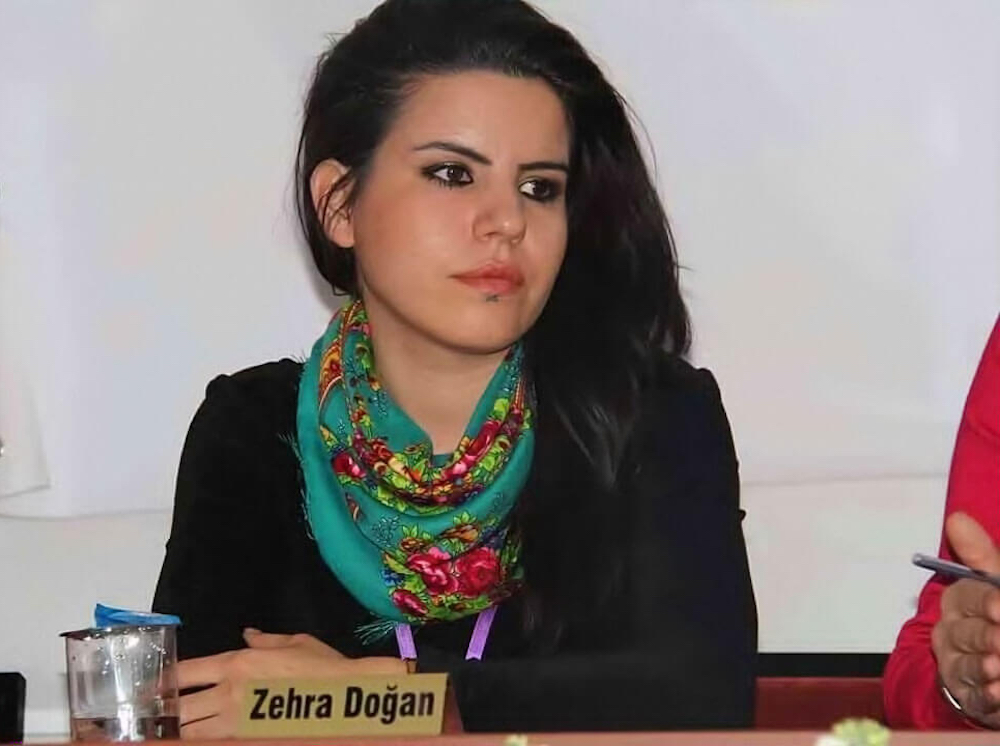
Kurdish artist and journalist Zehra Doğan
The last time Onur Erem and his girlfriend Zehra Doğan, a Turkish artist and journalist, met face-to-face, she was chirpy and seemed happy, he recalls. They sat at a picnic table and talked about her art being concurrently exhibited in various places around the world, from New York to Europe. They were surrounded by other families, busily conversing amongst each other at the picnic tables to their left and right.
But this was no picnic. Two prison guards walking up and down the aisle in between two rows of tables screwed to the concrete floor, eyeing the prisoners and their families with forced indifference masking wariness, made sure no one lost sight of the fact.
“She was in good spirits,” Erem says, attributing it to her continuing to create art while in prison, just like she did on the outside, before her sudden arrest as she was awaiting the outcome of the court case against her on charges of spreading propaganda in favour of a terrorist organisation.
“She writes down the stories of the people she met there. Since there’s not much in terms of the supplies on the inside, she uses the dyes that she makes from food. They don’t give her canvass, so she draws either on clothing or envelopes from the letters she receives. She collects the bird feathers that fall in the prison yard and makes improvised brushes out of them,” he explains.
The reason for Doğan’s incarceration was the drawing she made while covering the Turkish military operation in the town of Nusaybin on the border with Syria, populated mainly by Kurds. The drawing was made based on the photograph that had previously been circulated widely by the Turkish military on social media, according to press reports and Erem. The point of contention is whether the original photograph did or did not include the flags of the Turkish Republic hanging from buildings half-destroyed during the operation.
“She drew a military vehicle in the form of a scorpion. I’d say, this was her only addition to the photograph itself,” he says explaining that the military vehicle his girlfriend depicted in such a manner is referred to as “Akrep”, the Turkish word for a scorpion. “However the judge, in spite of all the evidence presented, sided with the opinion that the photo was taken by Zehra herself, that the original photo didn’t contain the Turkish flags hanging from the destroyed buildings and that [she] added them on for propaganda purposes, and thus, by way of this picture she was engaged in a propaganda on behalf of a terrorist organisation.”
Boxing the art
The widely-shared narrative is that Erdogan lashed out against artists after the July 2016 coup attempt. However, his government had gone after scores of artists and their freedom of artistic expression much earlier, of which Doğan is but one example. Two years after the coup, the crackdown doesn’t seem to dissipate, and the arrest of Turkish rapper Ezhel on inciting drug use in his songs on 24 May 2018 being the latest occurrence.
Attacks on artists across Turkey range from firing of one of the country’s most prominent orchestra conductors İbrahim Yazıcı for his criticism of the Erdogan government, to decapitating Ankara University’s theater department by dismissing Tülin Sağlam, its head and five other senior professors critical of the authoritarianism; from arrests of popular cartoonists, such as Cumhuriyet newspaper’s Musa Kart, to handing down a 10-months sentence against Zuhal Olcay, one of the country’s most popular singers and actresses.
The limitation of artistic freedoms is clearly a trend in Turkey, says Julie Trebault, Director of Artists at Risk Connection, an artistic freedom non-profit based in New York, adding that while in the past two years the attacks have escalated, they’d started before the coup attempt.
Years in the making
“We have several cases, for example, the case of the two filmmakers who have released their film, Bakur in 2015. Bakur was screened at many festivals in Europe for a couple of months without being censored or attacked. And then, in 2015, at the 34th Istanbul film festival, just hours before the premiere, the film got censored,” she recalls, explaining that the film was a documentary about the PKK, a Kurdistan Workers’ Party that is considered a terrorist organisation by the government of Turkey.
As to the persecution of artists even before the coup, Trebault adds “When Erdogan became president, things went down and down and down in Turkey. It took years to arrive where we are in Turkey [now]”.
Turkish filmmaker Elif Refiğ sees the roots and the reasons for the persecution of artists in the Gezi Park protests of 2013. “There had been a very serious oppositional sentiment that had collected in the society until then, that failed to organise until that moment. A very important feature, it included artistic institutions, and its nature was very creative to the extent that it changed the very definition of ‘disobedience’,” she says. According to her, it was a completely peaceful campaign spearheaded by arts institutions that didn’t tolerate violence, and it spread all over the country.
Refiğ points out that in addition to arrests, torture and jailings as ways for the state to punish the disobedient artists that often meet the eye, there are other ways of applying pressure: “The economic obstacles make the lives of the artists miserable. Blacklisting. It makes it difficult for the people to find work, impedes their freedom of movement.” As the case in point, she cites Füsun Demirel, popular television and cinema actress who has been struggling to find work for the past three years because “she is a Kurd, and because she openly voiced her opinions.”
As harmful as it is for the arts in Turkey, the crackdown on the freedom of artistic expression has also affected the general public, Trebault says.
“There’s definitely more self-censorship. People tend to get less out about those issues. People tend to be extremely careful on what they are saying,” she adds.
Responding to a question about the public’s reaction, Refiğ says that, although, the general public is critical, “Where would the criticism from the society be coming from? At this point, all television channels, all newspapers have been silenced by the forces in power.” She explains that multiple ongoing court cases against the media outlets are having a chilling effect on the public.
While the Turkish society is succumbing to self-censorship and its artists are fighting to get out their artistic word amid incarceration and repressions, the international community is struggling with possible solutions.
International support coming too late
“In my personal opinion, the international support is coming to Turkey too late,” says Refiğ. She explains that some international institutions like Pen America or Amnesty International are doing their best to call the international attention to the ongoing crisis with the freedom of expression in Turkey, while others, “institutionalised international organisations,” as she terms them, such as the E.U. and the Council of Europe, for instance, have their own pressing concerns-not letting the mass influx of refugees from the conflicts in the MENA region to cross into their borders, and, therefore, desperately needing the co-operation of the Turkish government.
“At very critical points, when they shouldn’t have restrained their words, they stood by our government, as they were afraid of the opening of the borders [by Turkey] and a free movement of Iraqi and Syrian refugees to Europe” she says of the international institutions. “Hypocrisy is the word that even might come to one’s mind. Words-wise, there’s a lip service to improving the human rights situation in Turkey, but action-wise, there’s very little acting upon it, unfortunately.”
Trebault, on the other hand, says Turkey, as a member of various international bodies is a signatory to important international human rights treaties, and Western governments should call on its government to abide by them.
Grim prospects, great expectations
Looking into the future, Trebault says she doubts things will get better in the next few years in Turkey.
“In 2017 the referendum gave even more power to the president,” she says of the plebiscite that effectively abolished the parliamentary system existing at the time and replaced it with the presidential system with a much stronger executive. “So, to be honest with you, I don’t think there will be changes for the better with this government,” she says.
Back in Diyarbakır’s E-type maximum security prison, while counting days until her release, Doğan is also pondering her future.
Making plans for after her release upon completing her two-and-a-half-year sentence next February, Erem says Doğan plans to continue working on her art, as well as her work as a journalist. “Currently, there’s an exhibit of her artwork In France that includes paintings and drawings smuggled out of the prison, as well as her previous work. This draws the attention of the artistic community, as well as the society at large, that’s why she wants to continue.”
He says that his girlfriend is also taking notes while in prison that she’s planning to use for writing a book when she is out.
“Of course, the solidarity that she sees on the outside also helps a lot. [It] helps her and her jailed friends to keep their spirits high, as they see that their voices are heard on the outside and there are quite a few people who don’t want to leave their side.”[/vc_column_text][/vc_column][/vc_row][vc_row][vc_column][vc_basic_grid post_type=”post” max_items=”4″ element_width=”6″ grid_id=”vc_gid:1528275200044-7774f8c3-7f31-3″ taxonomies=”8607″][/vc_column][/vc_row]
14 May 2018 | Czech Republic, Europe and Central Asia, News, United Kingdom
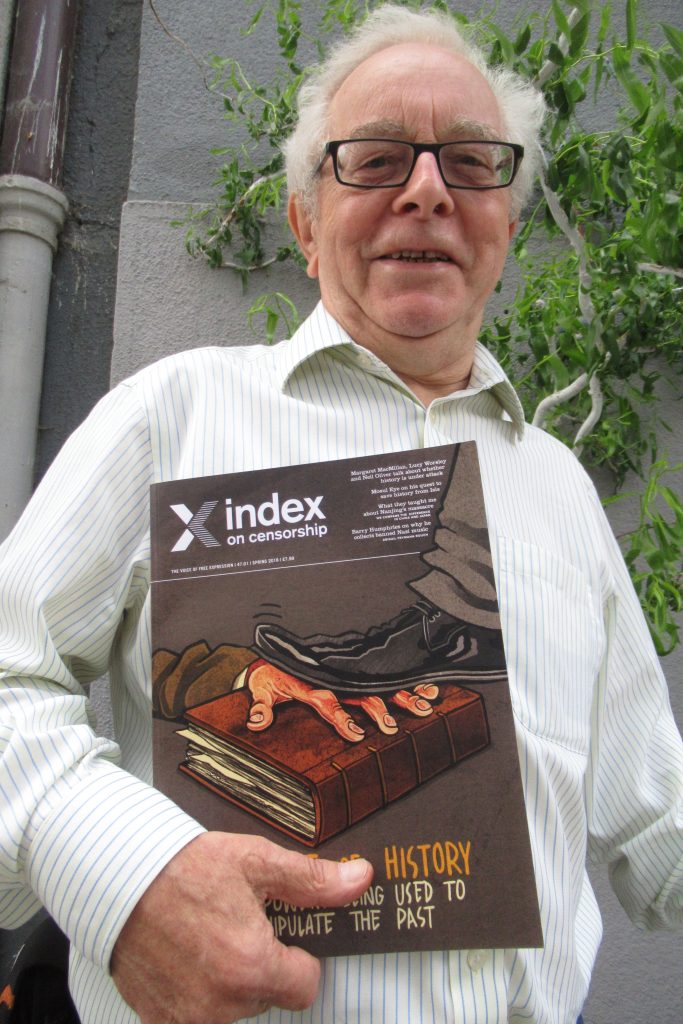
2018 winner of the George Theiner Award David Short with a copy of Index on Censorship magazine
British academic David Short has been announced as the recipient of the George Theiner Award 2018.
Named in honour of George, also known as Jiri, Theiner, the former editor-in-chief of Index on Censorship magazine, the literary award is given to people and organisations outside the Czech Republic, who have made long-term contributions to the promotion of Czech literature and free expression across the globe.
George Theiner was widely respected by writers and poets in Czechoslovakia and across the globe for his work translating Czech works into English, including Vaclav Havel, Ivan Klima,
and Ludvik Vaculik. Theiner was the deputy editor of Index on Censorship magazine throughout the 1970s, and, following Michael Scammell’s departure, as the editor in the 1980s.
First awarded in 2011 and created by World of Books, the award is presented at the Prague book fair in May each year. The winner is decided by a five-person jury, and also receives a prize of £1000.
This year’s winner Short is a British academic who taught Czech and Slovak at the School of Slavonic and East European Studies, University College London, from 1973 to 2011. Over the years he has translated various Czech works into English, including a number of Slovak authors and also created a well-respected Czech-English/English-Czech dictionary, all of which contributed to the profile of Czech authors and literature abroad.
Pavel Theiner, son of George, said: “As always, the recipient has in a major way, and over a long period, contributed to the promotion of Czech literature abroad. David Short is remarkably modest, multilingual, an expert in terms of the grammar and his Czech-English/English-Czech dictionary is extremely well respected.”
Previous winners include Ruth Bondy, who won the award in 2012. Bondy was an Auschwitz and Theresienstadt survivor who moved to Israel after the war to work as a journalist for Hebrew daily newspaper Davar. She taught journalism at the Tel Aviv University in the 1980s and 1990s, as well as translating a number of Czech authors into Hebrew, including the first translation into Hebrew of Hasek´s Good Soldier Schweik. Bondy sadly passed away in November 2017 aged 94.
